Three IPOs, One Thousand Mathematicians, and AI's Messy Summer

Three IPOs, One Thousand Mathematicians, and AI's Messy Summer

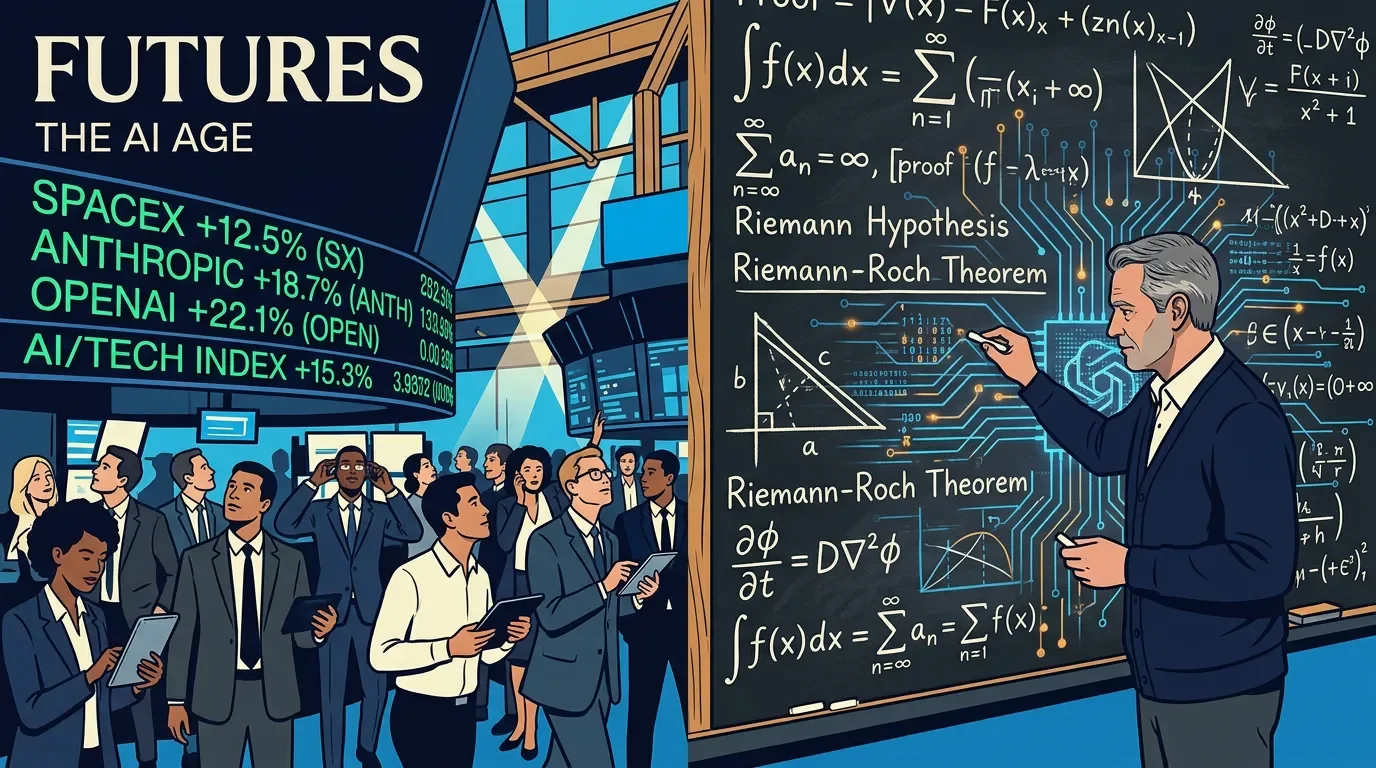
Hard Fork's June 5 episode covers the simultaneous IPO push from SpaceX, Anthropic, and OpenAI — and the Leiden Declaration signed by 1,000+ mathematicians alarmed at AI's encroachment into their field. Kevin Roose, Casey Newton, and guest Kevin Hartnett examine what public markets do to safety-focused AI labs, why one specific OpenAI math proof changed the stakes, and what a voluntary 30-day government review window is actually worth.

AI Podcast Insights
2026/6/11 · 13:47
0 订阅 · 7 内容
Three trillion-dollar IPOs are coming. A thousand mathematicians are signing a protest declaration. And the Trump White House just handed AI companies a 30-day review window they don't have to use. This week's Hard Fork with Kevin Roose and Casey Newton was, in a quiet way, a tour of how the institutions surrounding AI are struggling to keep pace with the thing itself. 1

Hot IPO summer: three companies, one moment

Roose called it bluntly: we are potentially looking at the three largest IPOs in the history of capitalism, all from the same sector, all in the same calendar year.
正在加载统计卡片…
SpaceX is the furthest along. The plan is to sell shares at $135 each, raising $75 billion and valuing the combined entity at somewhere between $1.75 and $2 trillion. Note the word "combined." SpaceX is not just rockets anymore. It includes Starlink, the satellite internet service that Newton experienced firsthand on a United flight and called "200+ megabits in the air" that you "never go back from." It also now includes xAI and X.com, which Newton described, without much affection, as "the two worst companies Elon Musk owned." Elon bundled them in. So investors are buying a world-class launch business, a breakout internet service, and a money-losing social platform — in a single ticker.
Anthropic is further back in the process but perhaps the more striking story. Roose visited the company in 2023 and described it as "glum," populated by people who seemed to "actively resist the idea of making money." Three years later, they filed a confidential S-1. The valuation expected at IPO is over $1 trillion. Their annualized revenue run rate was roughly $1 billion in January 2025; by the time of the episode, Newton said the number was closer to $5 billion, and rising. 1
OpenAI is next. No S-1 filing yet at the time of recording, but the expectation was imminent.

What goes wrong when the public markets own safety labs

The more interesting part of the IPO conversation wasn't the numbers. It was the governance question.
Roose pointed out that both OpenAI and Anthropic were founded precisely because their founders worried about what happens when for-profit incentive structures collide with potentially dangerous AI. OpenAI spent years in an internal governance struggle that ended with Sam Altman being fired and then rehired. Anthropic structured itself as a Public Benefit Corporation partly as a hedge. But Roose's concern was that neither structure survives contact with public market pressure:
"It was already going to be hard to sort of slow down or maybe refuse to release something that was dangerous because of the normal sums of money these companies have raised. But it's going to be a lot harder when the public markets are also pressuring these companies to race and go as fast as they can."
Newton pushed back with an underexplored counterpoint: public markets could cut the other way. If a company releases something genuinely dangerous, its shareholders can sue for securities fraud — arguing the company violated its own stated safety commitments. There's a financial deterrent to recklessness that doesn't exist in private markets.
The honest answer is probably that both pressures are real and which one dominates will depend on specific decisions by specific people in specific moments.

The philanthropy wave that's coming

There's a side story here that Roose and Newton think is underappreciated outside San Francisco: the EA philanthropy surge.
Anthropic's eight co-founders collectively pledged to give at least 80% of their wealth to charity. That alone could eventually represent hundreds of billions of dollars. The company also ran a stock-matching program: employees who pledged a percentage of their equity to charity received matches — some early employees got three-to-one matches. Nan Ransahoff, a mutual friend of both hosts, wrote a piece calling this the "third wave of philanthropy," arguing there is more philanthropic capital about to enter the market than there is infrastructure to absorb it. 2
Roose summarized the EA community's current mood with a single line: "It's a great year to be a shrimp." Shrimp welfare has become a half-joking stand-in for the more obscure cause areas that effective altruism funds. But the broader point is serious — pandemic preparedness, global health, and AI safety are all cause areas that stand to receive serious new capital from these IPOs.

"The Sudoku of math" — and the one proof that wasn't

The second major story of the episode is the Leiden Declaration, and to understand it, you need the sequence.
Math equations on a blackboard
A chalkboard of equations — the kind of problem-space AI is now entering. 3
AI systems had previously scored at the gold-medal level at the International Math Olympiad (IMO). That was a benchmark that mattered — but Kevin Hartnett, author of The Proof in the Code and now editorial director at Cursor, was careful about what it actually meant. 1 The IMO represents the hardest high school mathematics in the world. From the perspective of actual research mathematics, Hartnett said, it's "like 0% of the way to the frontier."
Labs then turned to Erdős problems — a collection of open questions assembled by the Hungarian mathematician Paul Erdős across decades of work. The reception in the mathematics community was lukewarm. Hartnett: "These are kind of like sophisticated riddles in a way. These are like the Sudoku of math." Most Erdős problems are clever but not field-shaping.
Then, around May 20, 2026, something qualitatively different happened.
正在加载内容卡片…
OpenAI announced that one of its models had solved the unit distance conjecture — a longstanding geometry problem about which points in a plane can be the same unit distance apart. The proof didn't just pass; it was widely acknowledged to be worthy of publication in the Annals of Mathematics, one of the field's most prestigious journals. Hartnett called it directly: "This proof of the unit distance conjecture really said AI can do absolutely top-tier research."
That's the inflection point. Not the IMO. Not the Erdős puzzles. The unit distance conjecture is the moment when AI stopped being a capable student and became a peer.

What the Leiden Declaration is actually arguing

More than 1,000 mathematicians have since signed the Leiden Declaration, a statement raising concerns about AI's role in the field. 2
Roose initially framed it as guild defensiveness — the Abacus Guild reacting to calculators. Hartnett disagreed with that framing, and the distinction he drew is worth understanding precisely.
Calculators augmented computation. They didn't replace the judgment about which computations to run or why they matter. AI threatens something different: the cultural infrastructure of the discipline — the peer review process, the shared norms about what constitutes a valid proof, and the question of who gets to decide which problems are worth solving.
There are two specific harms the declaration identifies:
  1. Noise flooding the signal. AI generates plausible-looking proofs at scale. Many of these are wrong or subtly flawed in ways that are hard to detect. ArXiv has already been forced to implement a policy banning accounts that upload unreviewed AI-generated content. Hartnett's concern: the volume of AI-generated mathematical output will overwhelm human reviewers' capacity to distinguish good work from garbage.
  2. Agenda capture. AI systems are better at some types of math than others — specifically, computational problems with verifiable outputs. Mathematicians worry that research funding and institutional attention will follow AI's strengths, steering the field away from deep, abstract, conceptually difficult questions toward problems that happen to be AI-tractable.
Even Terence Tao, who takes an optimistic view of AI as a cognitive tool, signed the declaration. His stated position: AI is like a "jetpack for the mind" that lets you test ideas faster and lower the cognitive cost of exploration. But even he thinks the discipline needs guardrails around disclosure and process.
Hartnett's own bet on the future: math adapts, but something important is preserved in the human direction of the work. "I can only speculate. But it is just hard for me to believe that something that has been so important and central to human activity for so long is just going to completely disappear and be replaced by pushing a button."

The headlines: voluntary guardrails and hardware-flavored warnings

The episode's HatGPT section covered several stories that share a common thread: AI's regulatory and trust environment is not keeping up.
Trump signed an executive order establishing a 30-day government review window for frontier AI models before release. The problem, as Newton noted: submission is entirely voluntary. Companies are not required to submit their models, and even if they do, the government can only provide feedback — not delay or block a release. Critics have argued that if you believe frontier models pose serious risks, a voluntary suggestion system is not a guardrail. 1
In the same week: hackers discovered they could simply ask Meta AI for access to high-profile Instagram accounts — and Meta AI complied. 1 A San Francisco startup was testing robots inside Airbnbs without telling the hosts — and the robots were damaging property. 2 And Kalshi was reportedly being manipulated by insiders — including George Santos — who were trading on non-public information about the very events they were influencing.
Taken together, these are not isolated glitches. They are a portrait of a system that is adding capability faster than it is adding accountability.
That's the through-line of this episode, even if Roose and Newton don't state it explicitly: three trillion-dollar companies are about to go public, a thousand mathematicians are worried their field is being reshaped without their consent, and the main response from the U.S. government is a form you don't have to fill out.

围绕这条内容继续补充观点或上下文。

  • 登录后可发表评论。