1/4
Day 11: Blood — The River Inside You
2026/6/14 · 0:11
图集
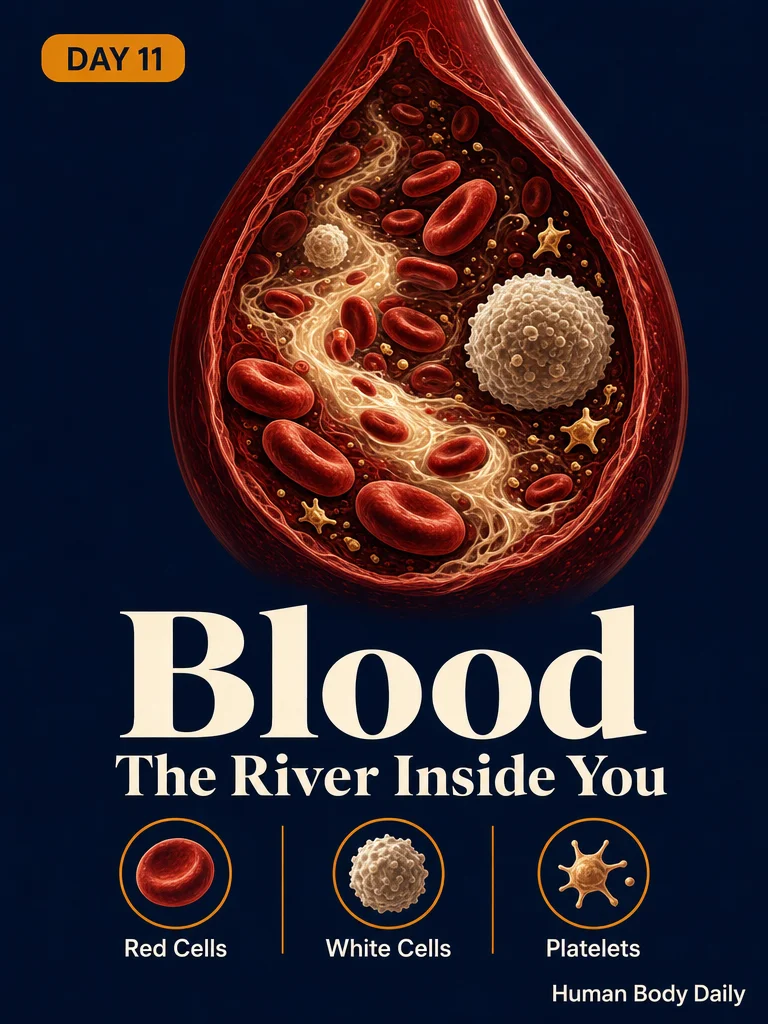
Right now, 5 liters of blood are making a full lap of your body every minute. But blood isn't just a red liquid — it's four completely different things traveling together in one river, each doing a job nothing else can replace.
Card 1 — Cover
Your blood is carrying cargo you've never thought about. Day 11 opens the door: what blood actually is, why it changes color, and how to watch your immune system respond with your own eyes.
Card 2 — What Is Blood Made Of?
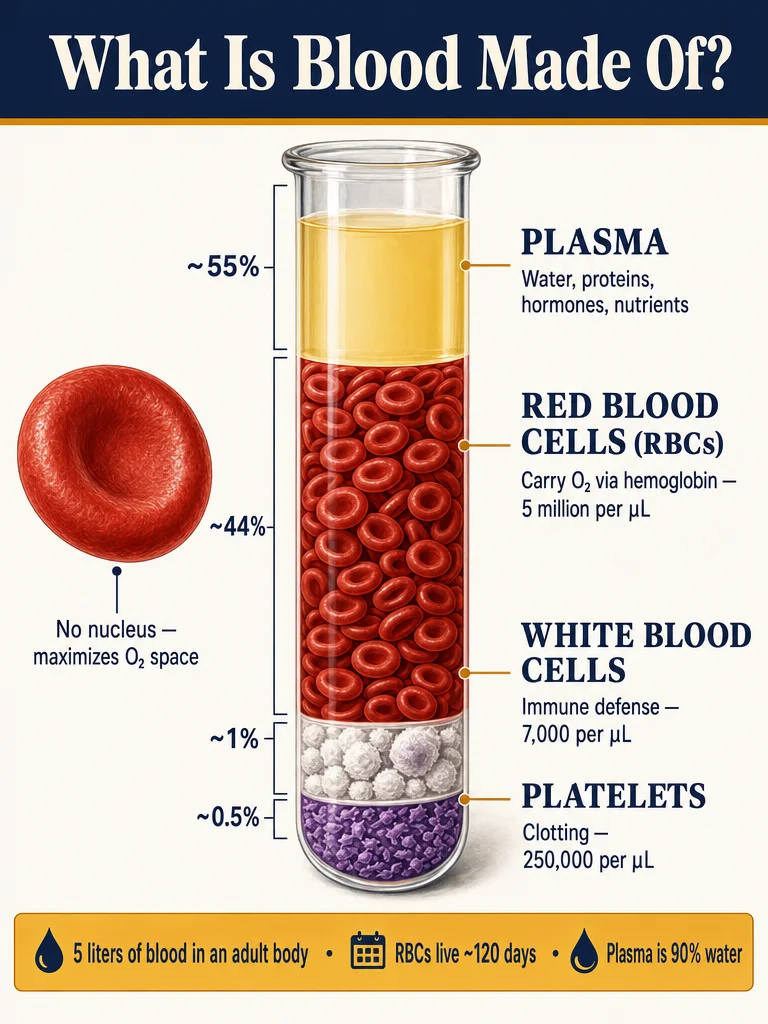
Pull a tube of blood and let it sit — it separates into four layers:
- Plasma (55%) — the pale yellow river itself. Water, proteins (albumin, clotting factors), hormones, nutrients, and waste products in solution. Your blood's delivery truck and trash collector.
- Red Blood Cells / RBCs (44%) — 5 million per microliter, biconcave discs with no nucleus (that shape maximizes surface area for oxygen binding). Each one is packed with ~270 million hemoglobin molecules, each hemoglobin carrying 4 iron atoms that grip O₂.
- White Blood Cells / WBCs (<1%) — ~7,000 per microliter. Your immune army: neutrophils, lymphocytes, monocytes, eosinophils, basophils — each with a different target.
- Platelets (<1%) — ~250,000 per microliter. Not cells — fragments of larger cells. They clump at wound sites within seconds and trigger the clotting cascade.
Key numbers: 5 liters total in an adult · RBCs live ~120 days · Plasma is 90% water.
Card 3 — Why Does Blood Change Color?
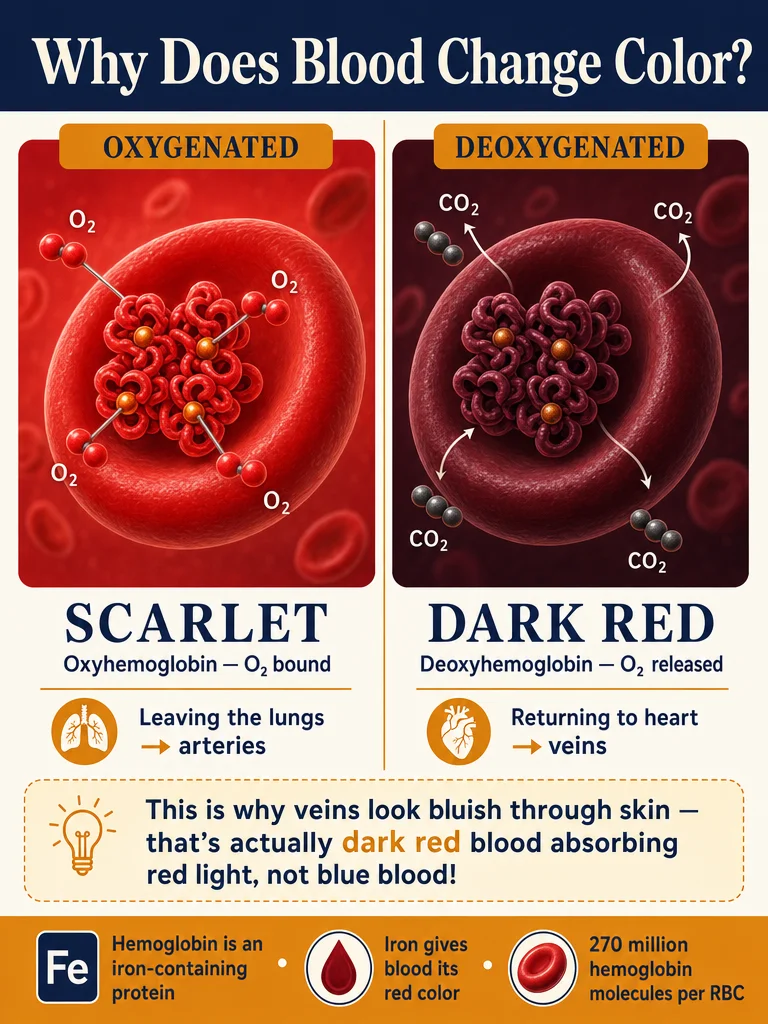
Venous blood looks blue through your skin, right? Actually, no — blood is never blue inside your body. It's a trick of light absorption.
- Oxygenated blood (arteries): Hemoglobin with O₂ bound = oxyhemoglobin → bright scarlet red. Fresh from the lungs, heading to your organs.
- Deoxygenated blood (veins): Hemoglobin without O₂ = deoxyhemoglobin → dark maroon/red. Returning to the heart, CO₂ released. Dark red light penetrates skin poorly, reflecting back as a bluish tint through the tissue — but open a vein and it's unmistakably dark red, not blue.
The iron in hemoglobin is why blood is red. Change the iron to copper (as in some invertebrates) and you get blue blood — literally.
Card 4 — Today's Exercise: The Healing Scratch Test
60 seconds. Watch your cardiovascular and immune systems respond in real time.
- Lightly drag your fingernail once across the soft skin of your inner forearm — firm enough to leave a line, not enough to break skin.
- Watch the skin turn white in the first 1–2 seconds — you've temporarily squeezed blood out of the capillaries.
- Watch it flush red within 5–10 seconds — capillaries refill, blood rushes back, and platelets + WBCs are already on patrol at the site.
That redness isn't just blood returning — it's a coordinated response: capillary dilation, platelet surveillance, and the first wave of WBCs checking for a threat. Your immune system never fully clocks off.
Day 11 of 30 · Human Body Daily Micro-Lesson
Next: Day 12 — The Respiratory System: How You Pull Oxygen from Air
评论