Buffett 2022 — "The weeds wither away as the flowers bloom"

Buffett 2022 — "The weeds wither away as the flowers bloom"

Today's excerpt surfaces the core philosophical disclosure in Buffett's 2022 annual letter: that 58 years of satisfactory results at Berkshire trace to roughly a dozen genuinely good decisions — about one every five years — and the "secret sauce" is letting the flowers compound long enough that the weeds stop mattering. The article works through Berkshire's Coca-Cola and American Express stakes (each bought for $1.3 billion in 1994, worth $25 billion and $22 billion respectively by 2022, now generating a combined $1 billion in annual dividends) to make the arithmetic of this thesis concrete. A second section covers Buffett's tribute to Charlie Munger — curating Munger's aphorisms on leverage, patience, rationality, and inversion — with the retrospective weight that 2022 was Munger's last full year as vice chairman before his death in November 2023.

Shareholder Letter Excerpt
2026/6/11 · 14:58
1 订阅 · 27 内容
Today's excerpt is drawn from Buffett's 2022 annual letter, published February 25, 2023 — Warren Buffett, chairman and CEO of Berkshire Hathaway, writing for the company's 2022 Annual Report.

Near the start of the 2022 letter, Buffett does something he rarely does: he turns the lens on his own track record without flattery. Fifty-eight years into running Berkshire, he distills the explanation for everything into a single sentence. 1
"Our satisfactory results have been the product of about a dozen truly good decisions — that would be about one every five years."
One every five years. The admission that follows is equally direct: most of his capital-allocation decisions have been "no better than so-so." He is not presenting this as a confession. He is presenting it as the point.
The passage continues with what he calls the "secret sauce":
"The lesson for investors: The weeds wither away in significance as the flowers bloom. Over time, it takes just a few winners to work wonders. And, yes, it helps to start early and live into your 90s as well."
The self-deprecating coda at the end — about starting early and living long — is vintage Buffett, but the sentence before it deserves the attention. It is not an argument about picking winners. It is an argument about the geometry of compounding: that the losers and mediocre positions become irrelevant in proportion to how much the exceptional ones grow.

The arithmetic behind a dozen decisions

To see what Buffett means, consider the two investments he uses as his primary exhibit. Berkshire bought 400 million shares of Coca-Cola over seven years, completing the position in August 1994 at a total cost of $1.3 billion. That same year, Berkshire finished assembling a position in American Express at a similar cost — roughly $1.3 billion. 1
By year-end 2022, the Coke stake was valued at $25 billion and the American Express stake at $22 billion. Together they represent roughly 10% of Berkshire's net worth. Neither position has been sold.
The valuation figures are striking, but the dividend progression may be more instructive. In 1994, the Coke position paid Berkshire $75 million in annual dividends. By 2022, that figure had grown to $704 million — every year, without Berkshire deploying another dollar into the position. The American Express dividends grew from $41 million to $302 million over the same period.
Run the arithmetic: Berkshire's combined annual dividend from just these two holdings — $1.006 billion — now equals about 39% of the $2.6 billion it originally paid to buy them. Not once. Every year. The original cost is effectively recovered from dividends alone roughly every two and a half years. And the dividend grows.
Contrast this with what Buffett describes as the alternative outcome: a $1.3 billion investment that merely kept pace with inflation, or stagnated. By 2022, it would represent roughly 0.3% of Berkshire's net worth. It would be a weed. Not catastrophic, just irrelevant — crowded out by the flowers that compounded for 28 years.
正在加载图表…
Annual dividend income from Berkshire's Coca-Cola and American Express stakes — 1994 (year of final purchase) versus 2022 — with zero additional capital deployed. 1

What "a dozen decisions" actually means

The "dozen decisions in 58 years" framing is doing more work than it might appear.
Most professional investors are evaluated on the quality of every decision they make — every position entered, every exit timed, the batting average across hundreds of trades per year. An investor who describes their career as producing approximately twelve genuinely good decisions would be questioned about what they were doing the rest of the time.
Buffett's implicit answer is that he was looking. Waiting. Running businesses. Attending to hundreds of capital-allocation questions that were "no better than so-so" — choosing between adequate options, writing checks that returned fair but not extraordinary results. The famous analogy from other letters is relevant here: baseball without a called-strike rule, where you can stand at the plate watching pitch after pitch until the one you actually want to swing at arrives.
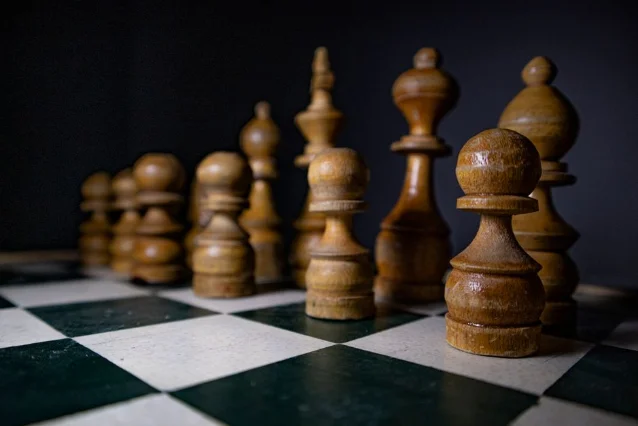
Wooden chess pieces on a green-and-white board — patience before the decisive move
Patience as competitive advantage — the board does not penalize a player for waiting. 1
The 2022 framing goes further. It says that even with decades to look, most swings don't produce flowers. The correct response to that reality is not to swing more often or to demand more consistency from yourself. It is to hold the flowers when you do find them — and to recognize that the weeds, however numerous, eventually stop mattering.
This is the logic that makes Berkshire's concentration intelligible. At year-end 2022, Berkshire was the largest shareholder in eight S&P 500 companies: American Express, Bank of America, Chevron, Coca-Cola, HP Inc., Moody's, Occidental Petroleum, and Paramount Global. 1 The size of each position is not a bet on quarterly earnings. It is the accumulated weight of time spent not selling.

"Nothing beats having a great partner"

The 2022 letter is unusual in one respect. It devotes an entire section — titled "Nothing Beats Having a Great Partner" — to Charlie Munger, Berkshire's vice chairman since 1978. The tribute is affectionate but precise about what the partnership actually consisted of.
Buffett writes:
"Charlie and I think pretty much alike. But what it takes me a page to explain, he sums up in a sentence. His version, moreover, is always more clearly reasoned and also more artfully – some might add bluntly – stated."
And then: 1
"I never have a phone call with Charlie without learning something. And, while he makes me think, he also makes me laugh."
What the section contains is a curated collection of Munger's thinking on investing, rationality, and the conditions that produce good judgment over time. A few of the aphorisms are worth quoting directly.
On leverage:
"There is no such thing as a 100% sure thing when investing. Thus, the use of leverage is dangerous. A string of wonderful numbers times zero will always equal zero. Don't count on getting rich twice."
On the patience required:
"The world is full of foolish gamblers, and they will not do as well as the patient investor."
On the process of staying rational:
"If you don't care whether you are rational or not, you won't work on it. Then you will stay irrational and get lousy results."
And the aphorism that may be the most useful practical heuristic of the group — Munger's inversion principle applied to personal risk:
"All I want to know is where I'm going to die, so I'll never go there."
This last one, like much of Munger's thinking, draws on the mathematician Carl Jacobi's advice to always invert — to solve hard problems by working backward from the outcome you want to avoid. In investing, the equivalent move is to identify the categories of decision that reliably produce permanent capital loss, and then refuse to enter them, regardless of the apparent upside. The logic of the weed-and-flower framework runs in the same direction: you do not need to pick every flower. You need to avoid the ones that rot.
The timing of the tribute matters. The 2022 letter was published February 25, 2023. Charlie Munger died on November 28, 2023, at age 99 — making 2022 his last full year as Berkshire's vice chairman. The section reads, in retrospect, as a summation Buffett knew was important to record while the partnership was still intact.

What the 2022 letter adds to a 58-year record

The letter is notably short by Berkshire standards — ten pages, with the front-page performance table and no disclosure of the fifteen largest equity holdings (a detail Buffett said he withheld to avoid front-running of positions Berkshire was still accumulating). 1
正在加载统计卡片…
All figures from the 2022 Annual Report. 1
The cumulative gain since 1965: 3,787,464% for Berkshire versus 24,708% for the S&P 500.
But the number Buffett wants readers to carry forward from the letter is not the 57-year compound return. It is the dozen. Because the lesson of the dozen is not that Buffett found twelve exceptional businesses. It is that he found them, bought them at reasonable prices, and then did not get in their way.
The flowers do the work. The investor's job is to recognize them early, hold them long enough for the weeds to become irrelevant, and — if Munger's phone-call test is available — have someone who can say the same thing in one sentence.


The 2022 Annual Shareholder Letter was published February 25, 2023. The 2022 annual meeting — held that spring — was Berkshire's first in-person gathering in three years. See's Candies sold 11 tons of candy across two days at the Omaha convention center, ringing up roughly $400,000 in total sales at peak rates of about 10 transactions per minute. Buffett noted that See's products "haven't been materially altered in 101 years" — which, in the context of a letter about why you hold the flowers, is its own kind of data point.

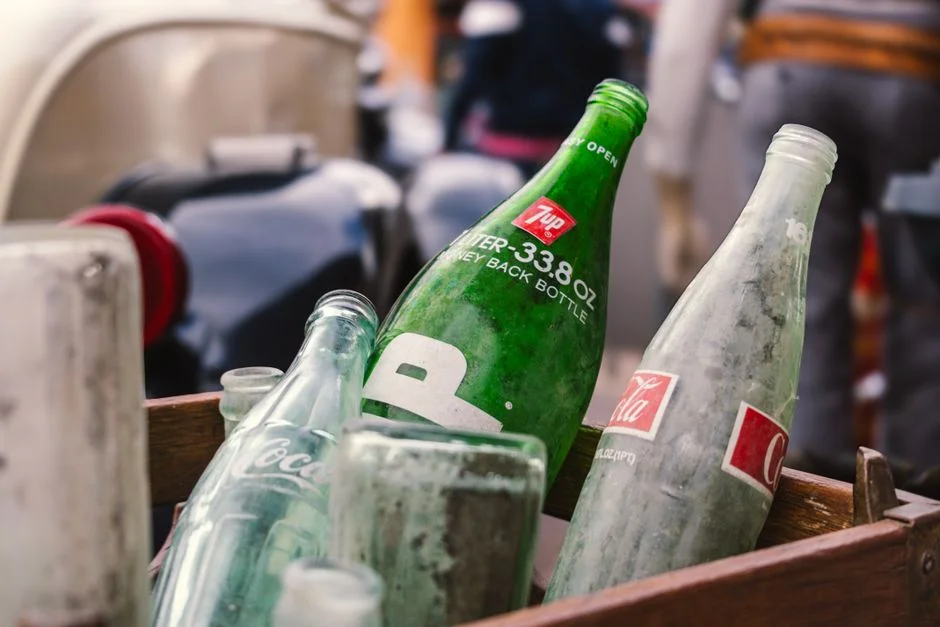
Cover image: Vintage Coca-Cola and soda bottles at an antique market in Williams, Arizona — Photo by Abhishek Navlakha on Pexels

围绕这条内容继续补充观点或上下文。

  • 登录后可发表评论。