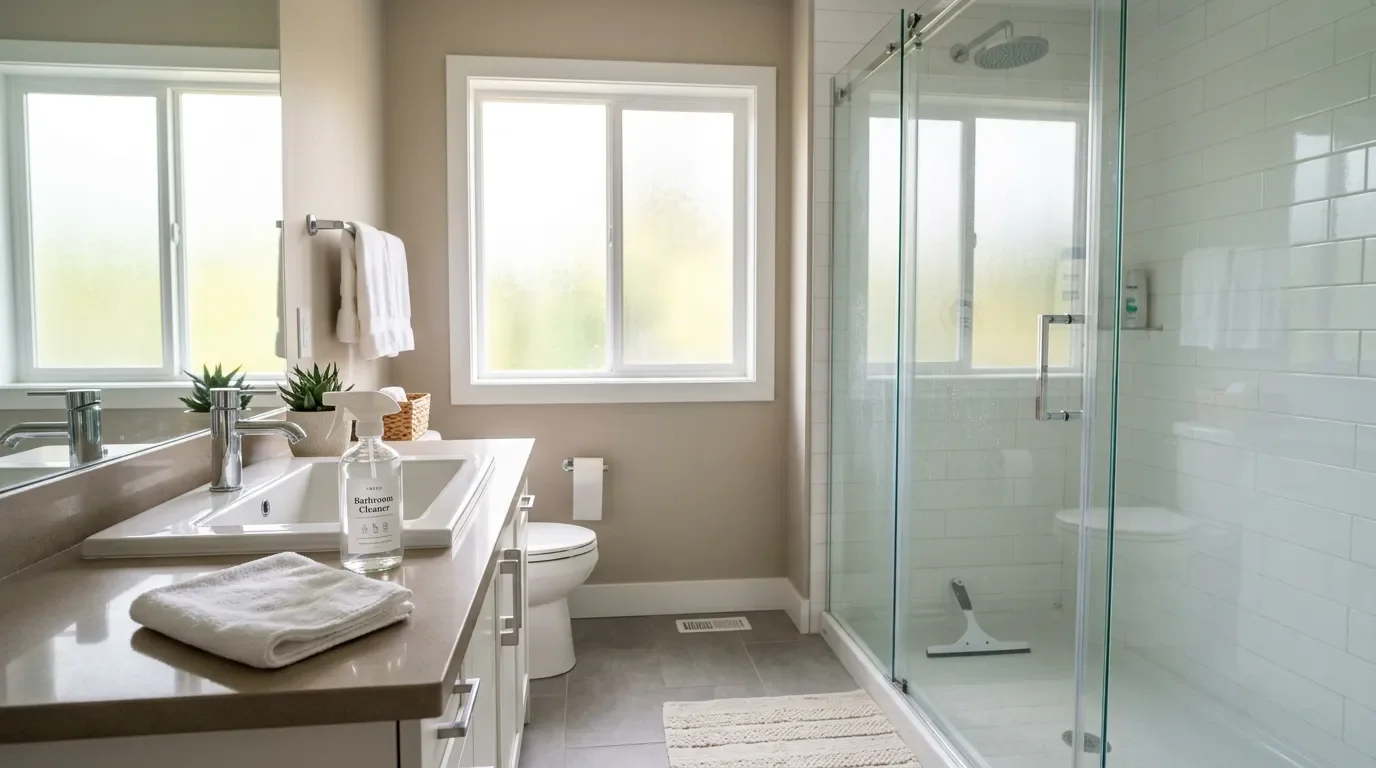
Your bathroom cleans itself — if you know these 6 tricks
Six free household hacks for the parts of your home that aren't the kitchen: dust ceiling fans without mess, descale your showerhead overnight, stop soap scum before it starts, clean blinds in one pass, erase water rings from wood furniture, and keep your toilet brush from becoming a germ farm. Each hack includes numbered steps, a why-it-works explanation, and honest caveats.

Your bathroom (and the rest of the house) cleans itself — if you know these tricks
The kitchen got its turn yesterday. Today it's everything else: the bathroom scum you swipe at weekly, the ceiling fan you last cleaned sometime in a previous administration, the shower door that clouds up three days after you scrubbed it. Six hacks, zero new products required.
Hack 1: Dust ceiling fan blades with an old pillowcase
What to do:
- Grab an old pillowcase you don't mind dirtying up.
- Slip it fully over one fan blade so the case envelopes both the top and bottom surfaces.
- Grip the pillowcase firmly, then slide it off toward the blade tip — all the dust falls inside the case, not onto your floor or furniture.
- Repeat for each blade.
- Take the pillowcase outside, turn it inside out, and shake it out. Launder normally.
Why it works: Dust clings to both surfaces of a fan blade. Every other method — a feather duster, a cloth — risks sending a small cloud of settled dust onto whatever is below. The pillowcase traps it mechanically in one motion. 1
Caveat: Do this before you vacuum the room, not after — you'll inevitably knock a little residual dust loose when you reposition the pillowcase. And check your fan's weight limit: older fans with worn motor mounts can wobble if you push down hard on a blade.

Hack 2: Soak the showerhead in a vinegar bag
What to do:
- Fill a small plastic bag (zip-lock or sandwich size) with undiluted white vinegar — enough to fully submerge the showerhead face.
- Place the bag over the showerhead so the face sits in the vinegar.
- Secure the bag with a rubber band or a zip tie around the neck of the fixture.
- Leave it for 2–3 hours (overnight for heavy mineral buildup).
- Remove the bag, run hot water for 30 seconds to flush loosened deposits, and wipe the face clean with a cloth.
Why it works: Mineral deposits (calcium and lime) are alkaline. White vinegar is acetic acid — it dissolves the deposits chemically without any mechanical scrubbing. 2
Caveat: If you have a brass or nickel-finish showerhead, don't leave vinegar on longer than 30 minutes — prolonged acid exposure can damage the finish. For those fixtures, dilute the vinegar 50/50 with water and check after 20 minutes. Also: this hack loosens deposits, it doesn't descale the interior pipes — if water pressure remains low after this, you may have a deeper plumbing issue.
Hack 3: Squeegee the shower after every use
What to do:
- Hang a cheap squeegee inside your shower (over the door, or on a suction-cup hook on the wall).
- After your last rinse, spend 20–30 seconds sweeping the squeegee across all tiled walls and the glass door — top to bottom, overlapping strokes.
- For extra prevention, follow with a quick spritz of equal-parts vinegar and water, and let it air-dry.
Why it works: Soap scum and hard-water stains form when water droplets evaporate and leave behind dissolved minerals and soap residue. Remove the water before it evaporates and you stop the deposit from forming in the first place. 2 3
Caveat: This only works if you actually do it every day — skipping a few days lets mineral deposits start to bond. If the glass is already cloudy with etched-in mineral stains, no amount of squeegeeing will clear them; you'll need a dedicated hard-water stain remover first.
Hack 4: Clean window blinds with kitchen tongs
What to do:
- Take a pair of kitchen tongs (the scissor kind with long handles).
- Wrap one microfiber cloth or an old sock around each arm, securing each with a rubber band.
- Clamp the tong arms around a single blind slat so both sides are gripped simultaneously.
- Slide from one end to the other in one motion.
- Rinse the cloths, and repeat.
Why it works: Blinds are dusty on both sides, and wiping one side at a time typically flips dust to the other. The tong method cleans both surfaces in the same pass. 3
Caveat: Works best on horizontal Venetian blinds (aluminum or plastic). Fabric or vertical blinds need a different approach — a light vacuum or a lint roller run along each panel. Also, tong-width cloths pick up surface dust but can't reach into corners of the slat where grease sometimes accumulates near kitchens; wipe those by hand.
Hack 5: Remove water rings from wood furniture with non-gel toothpaste
What to do:
- Squeeze a small amount of plain white toothpaste (non-gel, non-whitening is best) directly onto the ring.
- Rub gently in the direction of the wood grain with a soft damp cloth for about 60 seconds.
- Wipe clean with a separate damp cloth, then dry immediately.
- For stubborn rings, mix the toothpaste with a pinch of baking soda to add mild abrasion.
Why it works: The mild abrasives in toothpaste (calcium carbonate or silica) can buff out the whitish oxidation layer in the wood finish that causes a water ring — without scratching the surface the way sandpaper would. 4
Caveat: This works on lacquered or varnished finishes. It can dull or remove an oiled finish if you rub too hard. Always test on a hidden corner first. Won't work on deep stains that have penetrated the wood itself — those need a furniture restorer or light sanding.
Hack 6: Let your toilet brush dry before you put it away
What to do:
- After scrubbing the toilet, don't drop the brush straight back into its holder.
- Balance the brush handle across the toilet seat so the brush head hangs over the bowl.
- Close the lid gently on top of the handle to hold it in place.
- Let it air-dry for 30 minutes to an hour — drips fall into the bowl, not into the holder.
- Then return it to its caddy.
Why it works: A wet brush stored in a sealed holder creates the perfect warm, dark environment for bacteria and mildew to thrive. That holder becomes a source of the odors you're trying to eliminate. A dry brush stays cleaner longer and the holder stays odor-free. 2
Caveat: This only works if you remember to come back for the brush. Set a timer if needed — a brush left over the bowl for several hours isn't a hygiene issue, but it does look odd if you have guests. Also, every two weeks, pour a small amount of hydrogen peroxide or a diluted bleach solution into the caddy itself and let it sit for 10 minutes, then rinse and dry.
Pick whichever one you've been skipping, and do it today. The ceiling fan trick takes under two minutes. The showerhead soak does its work while you're asleep. The toilet brush habit costs exactly zero extra effort once it's automatic.
围绕这条内容继续补充观点或上下文。