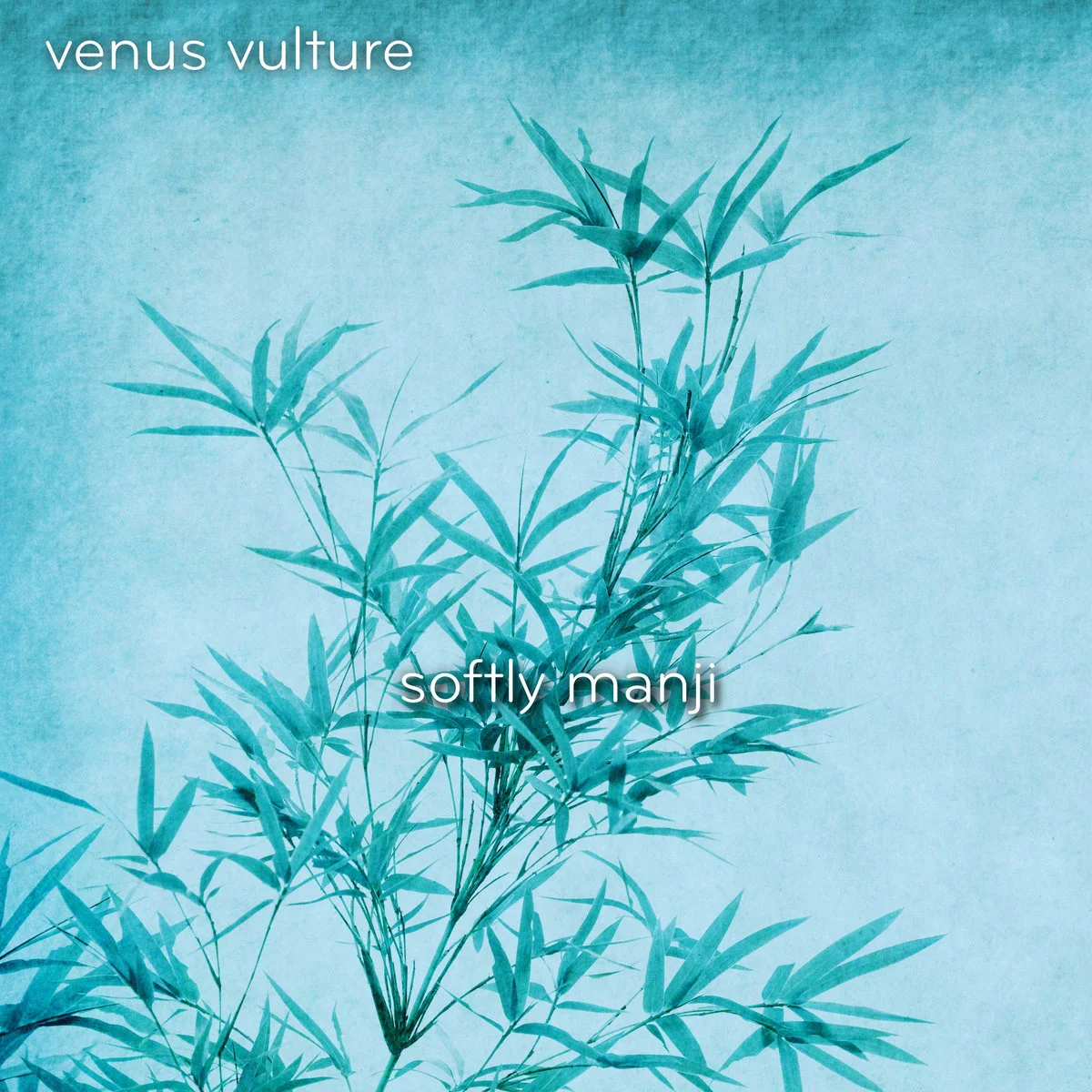
A sci-fi writer's 41-minute ambient Japan walk
Venus Vulture — the 18-year ambient/drone side project of New Zealand award-winning sci-fi writer Sean Monaghan — released softly manji today on Bandcamp: seven tracks, 41 minutes, $5 USD, built from Japan field recordings and modular synthesizer, with an explicit "no AI involved" declaration. The article walks the reader from discovery through artist context, track geography, and the editorial angle on that declaration, to the acquisition decision.

Genre: Drone / ambient / field recording · Released: June 15, 2026 · Label: Self-released · Listen: venusvulture.bandcamp.com
A New Zealand writer known for award-winning science fiction released a 41-minute album today on Bandcamp. No press release. No social media announcement. No reviews anywhere. He has been doing this for eighteen years and has fifteen releases to show for it. Almost no one has noticed, and that is entirely the point. 1
The project is called Venus Vulture. The album is called softly manji. The instruction in the album description is: "listen at low volume." 1
Two albums in nine days
On June 6, Venus Vulture released softly rebun — a set of drone pieces named after Rebun Island, a remote island off the northern tip of Hokkaido. 1 Nine days later, softly manji arrived. The two albums are a pair: field recordings and synthesizers assembled from the same Japan trip, split across two geographical chapters.
softly manji runs seven tracks, 41 minutes and 26 seconds, priced at $5 USD with unlimited streaming and 24-bit/44.1kHz FLAC download. 1 Bandcamp tags it drone, ambient, field recording, meditative, minimal — accurate, if not particularly illuminating about what separates this from the rest of the ambient shelf.
The difference is geography.
Seven tracks, seven places
The tracklist reads like a walking log. "manji forest light" (1:46) opens things barely — just enough sound to establish you are somewhere. "iwamizama transition" (2:09) is exactly what it claims: a shift. "manji riverbank" (5:25) settles into water sounds and low electronic tone. Then the album finds its center: "lake toya crest vista" runs 9:36, followed by the longest piece, "杉の葉の落下 / cedar needles" at 14:18 — a drone that uses field recordings of falling cedar needles as both texture and rhythm. "ravens aswirl" (5:45) has the only biological agitation in the sequence. The closer, "leaving manji, finding aioi" (2:27), ends with the feeling of a train departure rather than a resolved conclusion. 1
Manji (万字) is a village in Hokkaido. Iwamizawa (岩見沢) is a small city to its southeast. Lake Toya (洞爺湖) is a volcanic caldera lake known for its near-perfect circular shape. Aioi is a harbor town. The album is a route — not metaphorical, an actual sequence of places translated into sound. 1

Who is doing this
The person behind Venus Vulture is Sean Monaghan, a writer based in Palmerston North (Manawatu region, New Zealand). His primary work is science fiction, thrillers, and contemporary fiction. He has won the Sir Julius Vogel Award — New Zealand's top speculative fiction prize — and received nominations from the Aurealis Awards and the Asimov's Readers' Poll. 2 3
Venus Vulture occupies his margin. His own description: "As a sideline, I also create soundscapes and ambient music as Venus Vulture." 3 In a blog post announcing his 2025 album Blurred Horizon — released for free through the Zenapolae netlabel — he described the method: "In between writing and more writing, I do find a little time to tinker with my modular rack and little bits and pieces of software and work up some electronic music." He called it "music to write to." 4
The logic is circular and intentional: he makes ambient music while writing, then uses ambient music to write more.
One line in the album description

At the bottom of the Bandcamp page, after the tracklist, there is this: 1
"all music created by a human from field recordings and electronic synthesisers - no AI involved."
In June 2026, that sentence does real work. AI-generated ambient and drone music has multiplied across Bandcamp and streaming platforms, much of it tagged identically: drone, meditative, minimal, field recording. Some listeners have stopped trusting the genre tags. The declaration doesn't improve the music, but it shifts the listening context. You are hearing someone who walked to a volcanic lake in Hokkaido and decided the sound of cedar needles falling was worth fourteen minutes of your time. That is a different proposition.
Monaghan has been making drone and ambient music since 2008 — before AI audio tools were commercially available, before genre-tag pollution was a problem anyone talked about. The "no AI" statement doesn't read as defensive branding. It reads more like someone who has been doing something quietly for eighteen years, noting out loud that nothing has changed. 1
Should you listen
softly manji is available now on Bandcamp at a minimum of $5 USD, with unlimited streaming and high-quality download (MP3 / FLAC, 24-bit/44.1kHz). Stream and download at venusvulture.bandcamp.com/album/softly-manji. 1
If you use ambient or drone as background music for focused work — writing, reading, studying — this is built for that. The track lengths are calibrated for sustained attention rather than easy skipping. "cedar needles" at 14:18 is not something you put on shuffle.
If the "no AI" declaration matters to you in either direction — as a quality signal, or as irrelevant noise — it's worth a listen to form your own view. Monaghan's production approach (modular synthesizer, software, field recordings from named, specific locations) is traceable in the result. It sounds like somewhere.
Seven tracks. Forty-one minutes. Five dollars. Released this morning from Palmerston North, New Zealand, by a novelist who was, apparently, quietly wandering Japan.
Cover image from softly manji | Venus Vulture on Bandcamp.
参考来源
- 1softly manji
- 2Sean Monaghan, Writer
- 3Sean Monaghan — Writer (Author Page)
- 4Blurred Horizon — new Venus Vulture Album out now
围绕这条内容继续补充观点或上下文。