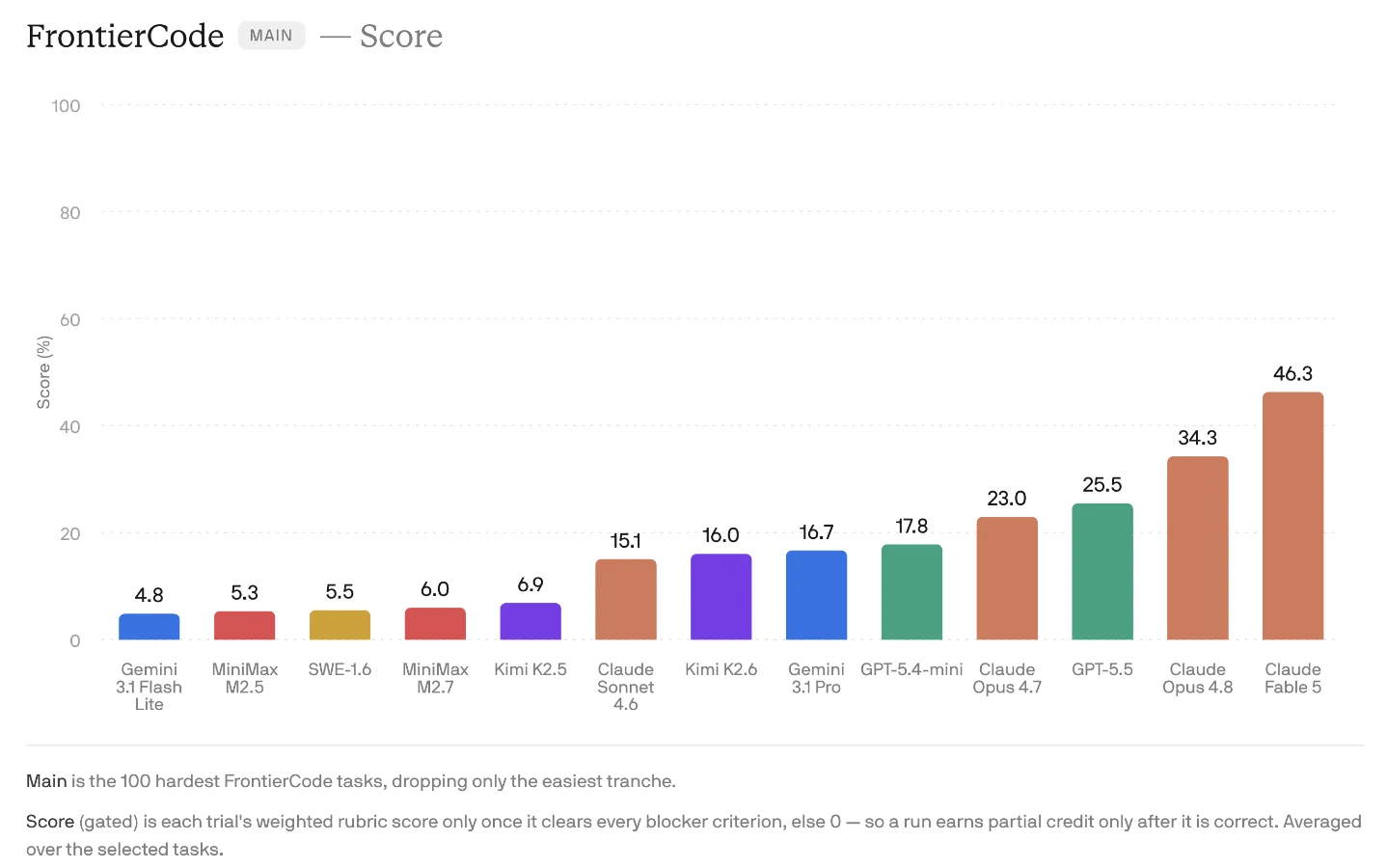
AI Coding Tools Weekly: Fable 5 tops FrontierCode

AI Coding Tools Weekly: Fable 5 tops FrontierCode

Claude Fable 5 — Anthropic's first publicly accessible Mythos-class model — debuted in Claude Code on June 9 and scored 46.3 on Cognition's new FrontierCode benchmark (vs. GPT-5.5's 25.5 and Opus 4.8's 23.0), a benchmark that scores real code-review mergeability rather than test passage. Despite a nominal 2x per-token price over Opus 4.8, independent MineBench testing found the real per-task cost premium was ~30%. The week also brought Claude Code v2.1.170–v2.1.175 (5-layer sub-agent recursion, enforceAvailableModels), Cursor Auto-review's classifier-based agent autonomy (4% intercept rate, now default for new users), Xiaomi's open-source MiMo Code V0.1.0 with a four-layer persistent memory architecture, GitHub Copilot's PAT-free Agentic Workflows, Replit's Package Firewall blocking 8,000 malicious packages per day, Kimi K2.7 Code (1T MoE, 30% fewer thinking tokens), and the Gemini CLI shutdown deadline at June 18 with migration tool gaps confirmed.

Global AI Coding Tools Update
2026/6/12 · 19:29
17 订阅 · 5 内容
Week of June 5–12, 2026
Claude Fable 5 — Anthropic's first publicly accessible "Mythos-class" model — arrived in Claude Code on June 9 and pulled away from every other model on the new FrontierCode benchmark the same day it launched. The timing was not a coincidence. Cognition built FrontierCode to measure whether AI-generated code would survive a real code review, not just pass automated tests; Fable 5 scored 46.3 on the main 100-task set while GPT-5.5 scored 25.5 and Opus 4.8 scored 23.0. At $10/$50 per million input/output tokens, Fable 5 costs twice what Opus 4.8 does at the API level — but an independent MineBench run across 15 builds found the real cost premium over Opus 4.8 came out closer to 30%, not 100%, because faster inference and shorter sessions offset the higher per-token rate. Xiaomi's MiMo Code launched the same week with a persistent-memory architecture aimed at long-horizon tasks — the first serious open-source challenge to Claude Code's CLI position in several months. Meanwhile, Gemini Code Assist consumer accounts shut down in 6 days, and the migration tool is still missing basic commands.
Here's what shipped.

Fable 5 and FrontierCode: what the benchmark gap means

Cognition published FrontierCode on June 8, one day before Fable 5 launched. 1 The benchmark is built with 20+ maintainers across 36 open-source repositories, each task taking over 40 hours to construct. The key difference from SWE-Bench (the most common agentic coding benchmark, which scores whether a test suite passes): FrontierCode scores whether the PR-shaped output would survive a real code review — checking correctness alongside scope discipline, style consistency, idiomatic patterns, test quality, and regression safety. 1
On the Diamond subset — the hardest 50 tasks — the top scores collapse dramatically: Claude Opus 4.8 leads at 13.4%, GPT-5.5 at 6.3%, Gemini 3.1 Pro at 4.7%, Kimi K2.6 at 3.8%. 2 The Diamond figures suggest that even the best models today rarely produce production-mergeable code on the hardest real-world tasks.
Third-party comparison work published the same week adds pricing context. LushBinary ran a standardized 200K-input / 50K-output task and found per-task costs of: Fable 5 at $4.50, GPT-5.5 at $2.50, Opus 4.8 at $2.25, Gemini 3.1 Pro at $1.00. 3 Their summary: "Fable 5's advantage is largest on hard, multi-step, autonomous work and smallest on tasks where all frontier models have converged." 3
On the SWE-Bench Pro leaderboard (which scores test passage, not review quality), Fable 5 scored 80.3% vs. GPT-5.5's 58.6% and Gemini 3.1 Pro's 54.2%. 3 One important fine print: LushBinary noted that starred benchmark entries belong to Mythos 5 — the restricted version not available for purchase — and that Fable 5 made 0% progress on offensive cybersecurity tasks (a hard content block, not a capability gap). 3
Community reaction was immediate. The main Hacker News thread for Fable 5 gathered 2,604 points and 2,144 comments — the highest-engagement AI thread of the week. 4 On Reddit, ENT_Alam, who ran the MineBench independent comparison across 15 builds, reported that Fable 5 averaged 18 minutes 4 seconds per build versus Opus 4.8's 24 minutes 48 seconds, at a total cost of $54.93 versus $41.52 — roughly 30% more expensive despite a 2x per-token price difference. 5
Decision point for engineering teams: Fable 5's per-task cost premium over Opus 4.8 is smaller than the raw pricing implies for medium-length sessions. The bigger question is task type — on hard, autonomous, multi-step work, the 80.3% vs. 69.2% SWE-Bench Pro gap is large enough to matter; on simpler tasks where all frontier models are converged, paying the premium for Fable 5 returns little. API model string is claude-fable-5; the model defaults to a 1M token context window. 6

Claude Code: 6 releases in 4 days, agent depth grows

Claude Code shipped from v2.1.170 to v2.1.175 between June 9 and June 12, a pace of roughly 1.5 releases per day. 7
The changes engineering teams should act on:
v2.1.170 (Jun 9): Fable 5 becomes available in Claude Code. It is the first Mythos-class model released to general users — defined by Anthropic as the tier above Opus. 7
v2.1.172 (Jun 10): Sub-agents can now spawn their own sub-agents, up to 5 levels of recursive depth. This applies to the Dynamic Workflows feature (where Claude Code orchestrates multiple parallel sub-agents). Practically: complex projects that previously required hand-stitching sub-tasks now have a deeper automation stack available. The same release also brought 22 additional fixes across Amazon Bedrock region reading, CPU idle optimization, and the /model picker. 7
v2.1.174 (Jun 12): The VS Code extension's /usage panel now breaks down consumption by cache hit/miss, long-context, sub-agents, and individual skills/agents/plugins/MCP servers, over 24h or 7-day windows. 7 For teams hitting unexpected token bills, this is the first tool that shows which specific agent or skill is responsible.
v2.1.175 (Jun 12): New managed setting enforceAvailableModels. When enabled, the availableModels whitelist also constrains the Default model — if Default is blocked, Claude Code falls back to the first permitted model in the list. User- or project-level settings cannot expand the managed list. 7 This closes a gap where managed environments had model whitelists that didn't actually prevent the Default model from resolving to a disallowed option.
The repository is at 132K GitHub stars as of June 12. 7

Cursor Auto-review: from binary permission toggle to classifier-based dial
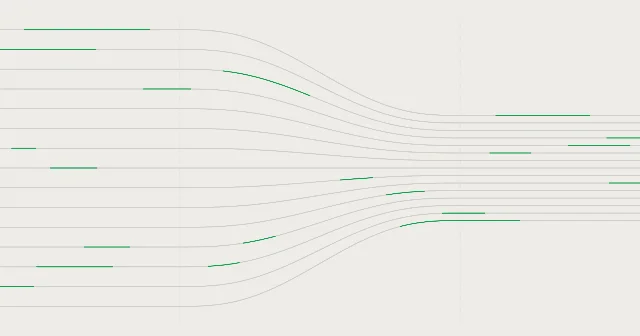
Cursor Auto-review Sankey flow diagram showing agent actions being routed through a classifier at two decision points, distributing across autonomy levels.
The Auto-review classifier routes each agent action based on risk context rather than a single global permission switch. 8
On June 11, Cursor published a technical deep-dive on Auto-review — its classifier-based agent autonomy system, authored by engineers David and Travis. 8
The design problem it solves: existing approval flows suffer from click fatigue. Users facing repeated confirmation dialogs stop reading them, making the approval loop meaningless. Cursor's approach is to replace the binary allow/block toggle with a dedicated classifier sub-agent that evaluates each action in real time.
By the numbers, across the training and evaluation dataset:
  • The classifier intercepts ~4% of all agent actions, returning an explanation to the parent agent rather than breaking the user's flow
  • In Auto-review sessions, ~7% of conversations trigger at least one user interruption — meaning 93% of sessions complete without the user needing to intervene
  • Before Auto-review, enterprise customers saw ~40% of agent actions blocked directly 8
The classifier itself is agentic: it can call ReadFile, Grep, Glob, and ListDir to inspect the workspace before making a decision, and it runs in the same RPC stream as the parent agent to avoid additional round-trip latency. Cursor evaluated model size for the classifier and found that using a smaller model with reasoning capability — rather than the smallest possible model — produced better results. The stated principle: "We want agents to have real autonomy, while making the decision to slow them down depend on context rather than a single global permission setting." 8
Auto-review is now the default setting for new Cursor users; existing users can enable it at Settings > Agents.

GitHub Copilot: PAT-free agentic workflows and Gemini 3.5 Flash GA

Two separate GitHub Copilot changes landed on June 11.
Agentic Workflows no longer require a Personal Access Token (PAT). Workflows can now authenticate using the built-in GITHUB_TOKEN from GitHub Actions — the same token that already scopes CI/CD runs. 9 This matters operationally: PATs require creation, rotation, and secret storage; GITHUB_TOKEN is automatic and scoped to the repo. For organizations, AI Credits now bill directly to the organization rather than the individual user's inference budget when the workflow runs in an org-owned repo. All Copilot plans (Free through Enterprise) are supported; workflows need copilot-requests: write permission in the YAML frontmatter. Run gh extension upgrade aw to get the latest CLI version. 9
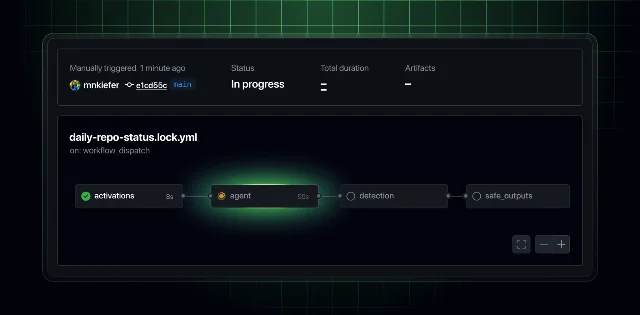
GitHub Agentic Workflows execution UI showing a daily-repo-status workflow running through four steps: activations, agent, detection, and safe_outputs.
Agentic Workflows pipeline running inside GitHub Actions with built-in AWF (Agent Workflow Firewall) sandboxing. 10
Gemini 3.5 Flash went GA in Google's own Gemini Code Assist on June 8, available in VS Code and IntelliJ for agent mode, chat, and code generation. 11 This is a separate event from its June 2 availability in GitHub Copilot — the June 8 GA is Google's own Code Assist product, targeted at teams on Google Cloud. Copilot's pricing page shows Gemini 3.5 Flash at $1.50/M input tokens and $9/M output tokens. 12

MiMo Code and Kimi K2.7: the open-source coding stack advances

Xiaomi MiMo Code V0.1.0

Xiaomi's MiMo AI team — led by Fuli Luo, previously on the DeepSeek R1 project — open-sourced MiMo Code V0.1.0 on June 10 under an MIT license (with use restrictions). 13 The project reached 5.7K GitHub stars and 456 forks within 48 hours of release. It is built as a fork of OpenCode (github.com/anomalyco/opencode), written in TypeScript/Bun, and installs via npm install -g @mimo-ai/cli or a one-line curl script.
The architectural differentiator is a four-layer persistent memory system: SQLite FTS5 full-text search history, a per-project MEMORY.md file, a global memory store, and session checkpoints. The team's framing: "What we need is not better compression, but an explicit storage-and-retrieval mechanism that decides what information should be written into persistent structures, and when it should be recalled." 14
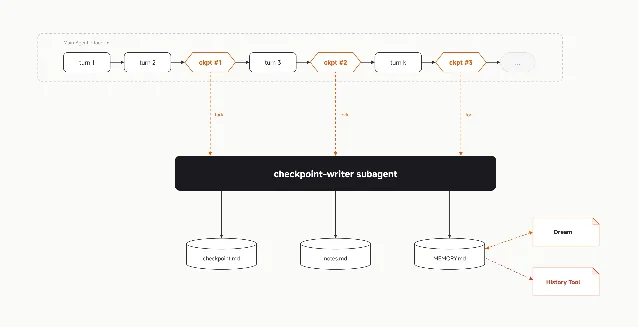
MiMo Code checkpoint-writer architecture: a dedicated subagent forks from the main agent loop at 20%, 45%, and 70% context utilization, writing structured checkpoints to checkpoint.md, notes.md, and MEMORY.md independently.
MiMo Code's checkpoint-writer subagent runs in parallel with the main agent, not in series, so checkpoint writes don't stall the primary task loop. 14
A dedicated checkpoint-writer sub-agent triggers at 20%, 45%, and 70% context utilization and writes structured state to disk — allowing arbitrarily long logical sessions. Additional features include Max Mode (5 parallel samples per turn with a judge model selecting the best output, which Xiaomi reports as a 10–20% SWE-Bench Pro improvement), a Goal mechanism that uses an independent judge to verify task completion before the agent stops, and /dream + /distill commands that consolidate memory on 7-day and 30-day cycles respectively. 14
Xiaomi self-reports: SWE-bench Verified 82% (vs. Claude Code + Sonnet 4.6's 79%), SWE-bench Pro 62% (vs. 55%), Terminal Bench 2 73% (vs. 69%). 14 These are self-reported and have not appeared on official SWE-bench or Terminal-Bench leaderboards as of June 12; VentureBeat noted that Codex CLI + GPT-5.5 holds the Terminal-Bench 2.0 official top slot at 82.2%, ahead of MiMo Code's self-reported 73%. 15 The memory architecture and checkpoint mechanism are verifiable and genuinely novel regardless of benchmark status.
MiMo Auto — the free tier running Xiaomi's MiMo-V2.5 model (310B MoE architecture, 15B active parameters, 1M context) — is available to all users for a limited period. 13 Claude Code configs, MCP servers, and skills import automatically.

Kimi K2.7 Code

Moonshot AI (the Beijing-based company that makes the Kimi series of models) released Kimi K2.7 Code to HuggingFace on June 12 under a modified MIT license. 16 Architecture: Mixture-of-Experts with 1T total parameters, 32B activated per forward pass, 384 experts (8 selected per token), and a 256K context window. The primary improvement over K2.6 is a ~30% reduction in thinking-token usage — meaning the model reasons more concisely to reach the same answer. 16
Benchmark scores on Moonshot's own Kimi Code Bench v2: 62.0 (vs. K2.6's 50.9); MCP Atlas: 76.0 (vs. 69.4); MCP Mark Verified: 81.1 (vs. 72.8). 16 API access is at platform.moonshot.ai; Moonshot recommends using it with the Kimi Code CLI. Community reaction on r/LocalLLaMA noted that K2.7's chain-of-thought has become significantly more concise compared to K2.6 — a practical improvement for long-running agent sessions where thinking tokens accumulate cost. 17

Replit: security infrastructure and agent customization

Three separate Replit launches between June 9 and June 10 add up to a meaningful capability shift.
Package Firewall (Jun 9) — built in partnership with Socket (a startup that specializes in supply chain security for JavaScript and Python packages). The firewall runs at install time and blocks packages before they reach the development environment. Since rollout, it has been blocking ~8,000 packages per day across Replit builders. 18 Threat types caught include typosquats (packages with names one character off from legitimate libraries), "slopsquats" (package names that LLMs commonly hallucinate), and stale packages with known CVEs. On by default for all users; no configuration required.
Agent Customization (Jun 10) — two components: Custom Instructions (always-on guidelines the Agent applies to every project in a workspace) and Skills (reusable task-specific instruction files stored as plain-text SKILL.md files in version control). Skills activate automatically based on task context; multiple Skills can stack for a single task. 19 Available on Pro and Enterprise plans.
Databricks U2M Connector (Jun 10) — upgrades the February 2026 machine-to-machine Databricks integration to a user-to-machine (U2M) model, enabling Unity Catalog's per-user data governance. With U2M, each user accessing data through Replit sees only the datasets their Databricks permissions allow — relevant for teams building internal data apps on regulated or tiered datasets. 20 Public preview sign-up is open; Databricks AI Summit booth runs June 15–18.

Google's Gemini CLI shutdown in 6 days — migration tool still rough

Gemini Code Assist consumer accounts shut down on June 18, six days from publication. The affected accounts: Gemini Code Assist for Individuals, Google AI Pro and Ultra tier users, Gemini CLI consumer use, and new installations of Gemini Code Assist for GitHub. Standard and Enterprise subscribers are not affected. 21
The official migration path leads to Antigravity CLI (AGY). The problem, flagged on June 12 by developer @HeyProtagonist: basic AGY CLI commands — /statusline, /init, and /clear — are either non-functional or missing, with no dedicated documentation site. "Right now, the most polished part of the experience appears to be the migration banner encouraging users to switch from Gemini CLI." 22 The deprecation page was last updated June 11; Google's developer blog has published no Antigravity-specific content since the May 19 I/O announcement.
If your team uses Gemini CLI for individual workflows, the June 18 cutoff is real. AGY CLI (brew install antigravity-cli on macOS) is available; the full workflow parity gap warrants testing before that date.

Codex CLI, Kimi Code CLI, and Grok Build

Codex CLI shipped v0.139.0 stable on June 9 with three notable additions: Code mode now supports independent web search (including nested JavaScript tool calls); tool and connector input schemas accept oneOf and allOf for more complex argument structures; and codex doctor now reports the editor and pager environment details for diagnostics. 23 The repository is at 90.6K stars. Separately, the v0.140.0-alpha series ran from alpha.4 through alpha.14 between June 10 and June 12, all labeled as Rust pre-releases with no detailed release notes — suggesting active infrastructure work is underway but nothing ready for production use yet.
Kimi Code CLI released v0.14.2 on June 12 with 8 patch changes. The most operationally relevant: --auto, --yolo, and --plan flags can now combine with --session and --continue (previously these flags were mutually exclusive with session resumption, requiring workarounds). Sub-skill names now show their parent prefix in the TUI as dot-separated slash commands. iTerm2 infinite desktop notification loop fixed. 24
Grok Build (xAI's terminal coding agent, available on SuperGrok) had zero releases this week. The last version, v0.2.20, shipped June 3. The daily release cadence that ran through late May and early June — 10 versions in six days — has gone quiet with no stated reason. 25 Teams evaluating Grok Build should treat the pause as a signal that its alpha iteration phase has stabilized into something, but it's unclear whether that's a stable product or a pending pivot.

CodeGraph hits 48K stars; dormant tools update

CodeGraph (github.com/colbymchenry/codegraph, note: not rui314/codegraph — a distinct project) re-validated its benchmark numbers on June 2 against Claude Opus 4.8 across 7 open-source codebases. Results: 16% cheaper, 47% fewer tokens, 22% faster, 58% fewer tool calls compared to running Claude Code without CodeGraph. 26 The tool builds a pre-computed semantic graph of a codebase so the model starts each session with structural understanding rather than exploring from scratch. Now at 48K stars, MIT licensed, and supporting Claude Code, Cursor, Codex, OpenCode, Gemini, Antigravity, Kiro, and Hermes Agent. A hosted platform at getcodegraph.com is on a waitlist.
Dormant tools (no activity in the June 5–12 window): Aider's last release remains v0.86.0 from August 2025, now 10+ months without an update. 27 Continue.dev's last release remains v1.3.38-vscode from March 2025, now 14+ months without an update. 28 Tabnine's last blog post was May 6, 2026; nothing published in this window. 29

What to watch next week

Whether FrontierCode gets independent third-party adoption. Cognition built it and Cognition's benchmark happened to crown Anthropic's model — which Cognition also uses. The benchmark methodology is transparent and technically sophisticated, but adoption by neutral parties (e.g., academic groups running open leaderboards) would change its weight in procurement decisions.
MiMo Code independent benchmark appearances. Xiaomi's self-reported numbers look credible architecturally, but the Terminal-Bench 2.0 official leaderboard still shows Codex CLI + GPT-5.5 at 82.2% as the top entry. If MiMo Code submits to an official leaderboard, it would confirm or revise the self-reported figures.
Gemini CLI shutdown fallout on June 18. With six days left and a migration tool missing core commands, there will either be a last-minute wave of migration guides from Google or a hard cutoff that pushes individual developers to Cursor, Claude Code, or Codex CLI by default.
Codex v0.140.0 stable release. Alpha.14 landed on June 12 — if the alpha track mirrors previous cycles, a stable release is close. The Rust rewrite it contains could affect CLI performance and plugin compatibility.

Cover image: FrontierCode benchmark scores from Devin's blog post, June 8, 2026.

参考来源

  1. 1AI Insiders - Cognition's FrontierCode asks if a model's PR would actually get merged
  2. 2Devin - Claude Fable 5 is now available in Devin
  3. 3LushBinary - Claude Fable 5 vs GPT-5.5 vs Gemini 3.1 Pro Compared
  4. 4Hacker News - Claude Fable 5
  5. 5Reddit r/ClaudeAI - Differences Between Claude Opus 4.8 and Claude Fable 5 on MineBench
  6. 6TrueFoundry - Claude Fable 5 API Benchmarks Pricing How to Use It
  7. 7Anthropic (GitHub) - Releases · anthropics/claude-code
  8. 8Cursor - Governing agent autonomy with Auto-review
  9. 9GitHub Changelog - Agentic workflows no longer need a personal access token
  10. 10GitHub Changelog - GitHub Agentic Workflows is now in public preview
  11. 11Google Cloud - Gemini Code Assist release notes
  12. 12GitHub Docs - Models and pricing for GitHub Copilot
  13. 13Xiaomi MiMo (GitHub) - GitHub XiaomiMiMo/MiMo-Code
  14. 14Xiaomi MiMo - MiMo Code: Scaling Coding Agents to Long-Horizon Tasks
  15. 15VentureBeat - Xiaomi's new open source agentic AI coding harness MiMo Code
  16. 16HuggingFace - moonshotai/Kimi-K2.7-Code
  17. 17Reddit r/LocalLLaMA - moonshotai/Kimi-K2.7-Code Hugging Face
  18. 18Replit Blog - Package Firewall: Blocking 8,000+ malicious packages daily
  19. 19Replit Blog - Customize Replit Agent with Skills and Custom Instructions
  20. 20Replit Blog - Replit Databricks: Where fast app building meets granular data governance
  21. 21Google for Developers - Gemini Code Assist consumer accounts deprecation
  22. 22X (@HeyProtagonist) - AGY migration feedback
  23. 23OpenAI (GitHub) - Releases · openai/codex
  24. 24Moonshot AI (GitHub) - Release @moonshot-ai/[email protected]
  25. 25xAI - Grok Build Changelog
  26. 26GitHub - colbymchenry/codegraph
  27. 27GitHub - Aider-AI/aider Releases
  28. 28GitHub - continuedev/continue Releases
  29. 29Tabnine Blog

围绕这条内容继续补充观点或上下文。

  • 登录后可发表评论。