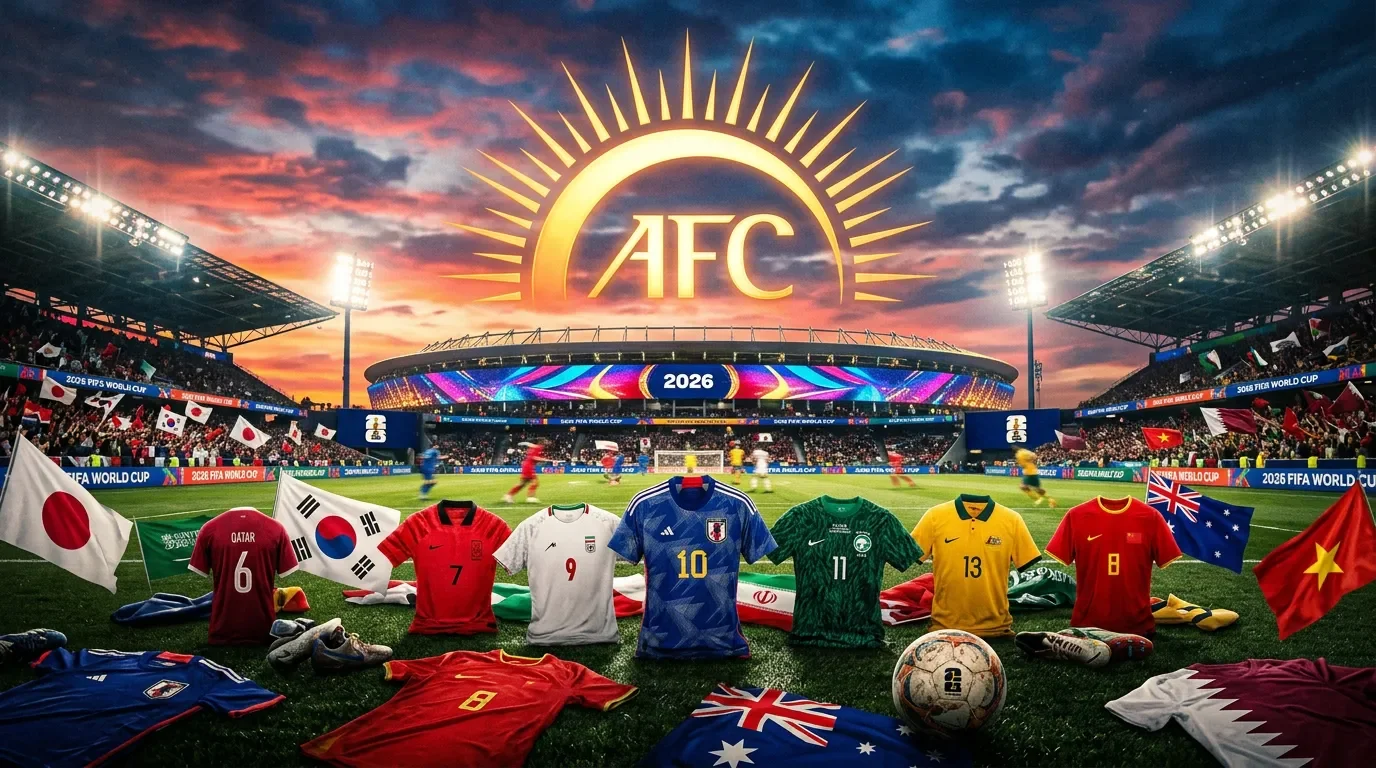
Nine flags, one dream: Asia's biggest World Cup ever
A record nine AFC sides are competing at the 2026 World Cup. This is your complete guide to all of them — squads, groups, key players, and first-match stakes for Japan, South Korea, Iran, Saudi Arabia, Australia, Uzbekistan, Jordan, Iraq, and Qatar.

For the first time in the tournament's history, nine teams from the Asian Football Confederation are competing at a World Cup. Not eight. Not the standard four from previous cycles. Nine — a record that arrived almost quietly, buried under the familiar noise of European and South American previews. The expanded 48-team format gave the AFC an extra allocation, and the continent filled every slot: Japan, South Korea, Iran, Saudi Arabia, Australia, Uzbekistan, Jordan, Iraq, and Qatar.
Two of those — Uzbekistan and Jordan — are here for the first time ever. That fact alone makes this tournament different from any Asian football has experienced before.1
The group stage opened on June 11. South Korea already have three points on the board. The rest of Asia kicks off between June 13 and June 17. What follows is a team-by-team account of where each side stands — squads, groups, key players, and the specific challenges they face over the next three weeks.
South Korea: off the mark with a fighting win
Result (Matchday 1): South Korea 2–1 Czech Republic, June 112
Group A: Mexico, South Africa, South Korea, Czech Republic
The Czechs led through Ladislav Krejčí at the 59th minute, but South Korea came back with two second-half goals — substitute Hwang In-beom levelled at 67' and Oh Hyeon-gyu turned the tie at 80'. It was the kind of comeback Korea have made their trademark: patient, physical pressure until a gap opens late.
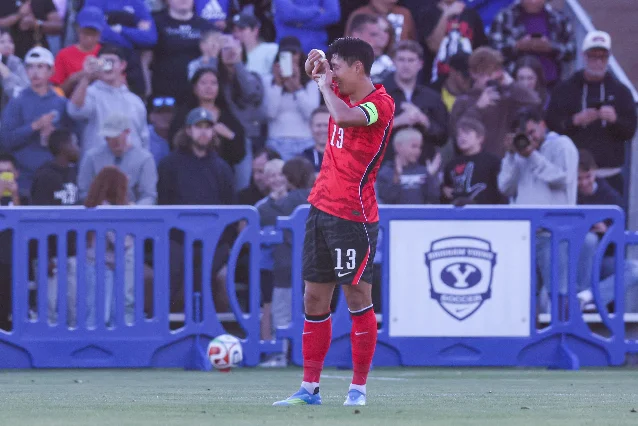
Coach Hong Myung-bo returns for a second stint in charge, having taken the job after the chaos of Jürgen Klinsmann's dismissal following the 2024 Asian Cup. His immediate task was steadying a camp fractured by internal politics. The opening win suggests he has done enough. Captain Son Heung-min (now at LAFC, likely at his last World Cup at 33) drew attention all night even without a goal — his movement continues to create space for teammates.
The squad has genuine width. Lee Kang-in (PSG) and Hwang Hee-chan (Wolves) offer different attacking profiles, while Kim Min-jae (Bayern Munich) anchors a defence that will be tested more severely by Mexico on June 18.3
Japan: Europe's stars, Asia's highest expectations
Next match: Netherlands vs Japan, June 14 · Group F (Netherlands, Japan, Sweden, Tunisia)
Japan enter Group F carrying the weight of arguably the most star-laden AFC squad ever assembled. The spine runs through clubs at the top of European football: Wataru Endo (Liverpool), Ritsu Doan (Eintracht Frankfurt), Takefusa Kubo (Real Sociedad), Daichi Kamada (Crystal Palace), and defenders Ko Itakura (Ajax) and Hiroki Ito (Bayern Munich).
Two notable absences shadow the camp. Kaoru Mitoma (Brighton) — Japan's most dangerous wide attacker — tore his hamstring in May and missed selection entirely. Takumi Minamino is also out through injury. Their combined absence removes roughly 30% of Japan's first-choice attacking threat and forces Moriyasu to rely more heavily on Ayase Ueda (Feyenoord) and Keito Nakamura (Stade de Reims) up front.3
The first test is Holland. Japan beat Germany and Spain in Qatar 2022's group stage, so beating a top European side at this tournament is not a hypothetical — but Group F offers less margin than 2022's E group. Sweden and their Viktor Gyokeres–Alexander Isak attack present a different kind of problem in the second game.
Defender Takehiro Tomiyasu (Ajax) returns after nearly two years out of the national team, making his first appearance back in a warm-up against Iceland. His recovery adds depth to a back line that will face constant pressure.
Iran: the squad, the controversy, the group
Next match: Iran vs New Zealand, June 15 · Group G (Belgium, Egypt, Iran, New Zealand)
Iran arrive with their highest-profile squad in years — and a significant absence that generated political noise back home. Coach Amir Ghalenoei dropped Sardar Azmoun (57 goals in 91 caps, Shabab Al-Ahli) despite a public intervention from Iran's vice president Abdolkarim Hosseinzadeh asking for the striker's inclusion. Local media reported Azmoun had been expelled from the national team for a perceived act of disloyalty to the government. Whether the omission is football or politics — or both — the squad will be led instead by Mehdi Taremi (Olympiacos), who had an outstanding club season.3
Former Brighton midfielder Alireza Jahanbakhsh (now at Dender) provides creativity and experience on the flanks. Veteran defender Ehsan Hajsafi is four matches away from equalling the all-time Iran cap record at 149.
Group G gives Iran a realistic path to the last 32. New Zealand on June 15 is the opener they want — a must-win to build momentum before facing Belgium (June 21) and Egypt (June 26). Iran have never advanced past the group stage at a World Cup; this configuration, if they beat the All Whites and take points from Egypt, could finally change that record.
Saudi Arabia: Spain first, a genuine test of progress
Next match: Saudi Arabia vs Uruguay, June 15 · Group H (Spain, Cape Verde, Saudi Arabia, Uruguay)
The most famous moment in Saudi football history — Salem Al-Dawsari's 95th-minute winner against Argentina at Qatar 2022 — now sits as a legacy the current squad both benefits from and must escape. Al-Dawsari (108 caps, now 31) captains again, though that one goal four years ago risks defining Saudi perceptions internationally regardless of what this squad does.
Coach Georgios Donis (Greek) has assembled a squad almost entirely from the Saudi Pro League — only Saud Abdulhamid (Lens) plays abroad among the 26 selections. That domestic focus reflects the league's improved quality since the high-profile signings of 2023-24, though it also means the squad lacks exposure to varied European styles week to week.3
The opener against Uruguay on June 15 is far more winnable than the Spain fixture that follows (June 21). Firas Al-Buraikan (Al Ahli) leads the attack alongside Al-Dawsari, while Mohammed Al-Owais in goal is a consistent performer at this level.
Australia: new coach, new style, same competitive drive
Next match: Turkey vs Australia, June 13/14 · Group D (USA, Paraguay, Australia, Turkey)
The Socceroos' qualification story this cycle was messy before it got clean. A 1-0 home loss to Bahrain and a 0-0 draw in Indonesia triggered Graham Arnold's resignation. Tony Popovic — who has never coached outside Australian football — took over in September 2024 and immediately turned results around, securing second place in the AFC's Group C with a 2-1 win over Saudi Arabia that proved decisive.4
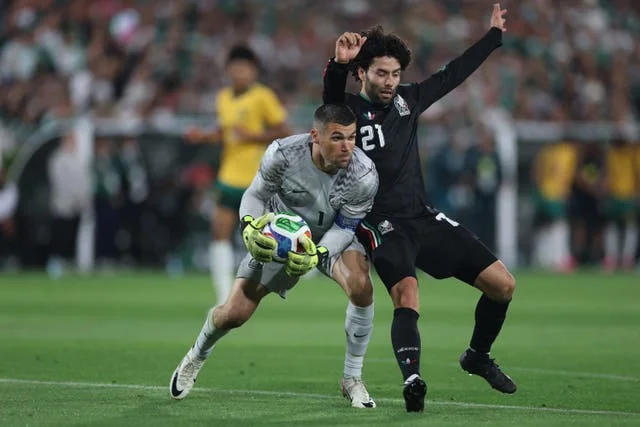
Australia's squad is built around a core of European-based players. Goalkeeper Mat Ryan (Levante) and striker Mathew Leckie (Melbourne City) both head to a record-equalling fourth World Cup. The exciting front end includes 20-year-old Nestory Irankunda (Watford) and 22-year-old striker Mohamed Toure (Norwich City), both of whom could announce themselves on the global stage in this group.
Midfielder Jackson Irvine (St Pauli), the team's natural leader and pressing engine, missed time through foot surgery and is a fitness concern. Australia beat Turkey 1-0 in the warm-up cycle; the opening group match will test whether Popovic's low-block system holds under the pressure of a full World Cup crowd.
Jordan: Asia's wildcard, Mousa Al-Tamari's stage, Mousa Al-Tamari's stage
Next match: Austria vs Jordan, June 16 · Group J (Argentina, Algeria, Austria, Jordan)
Jordan's first World Cup sits in arguably the hardest group available. Argentina (with Messi), Algeria (with Mahrez), and Austria (Rangnick's high-pressing side) offer no soft entry point. The Rennes striker Mousa Al-Tamari — 24 goals in 91 caps — carries Jordan's attacking threat alongside Ali Olwan (29 international goals, Al Sailiya).3
Captain Ehsan Haddad returns after nearly a year out with an Achilles injury. His experience in defence is essential against teams of this calibre. Coach Jamal Sellami has assembled a squad drawing heavily from Jordanian, Qatari and Malaysian leagues with a handful of European-based players.
The June 16 opener against Austria is Jordan's best realistic chance of a positive result. They meet Algeria on June 22 and Argentina — in what could be Messi's final group game in Argentina colours — on June 27. The focus from East Asian and Arab football media will be intense throughout.
Iraq: Graham Arnold's third chapter
Next match: Iraq vs Norway, June 16 · Group I (France, Senegal, Iraq, Norway)
Iraq's World Cup story involves a piece of football geography: the Socceroos' former coach Graham Arnold, sacked after Australia's early qualification stumbles, now manages Iraq. He guided them through the inter-confederation playoff against Bolivia — Ali Al-Hamadi scoring in that two-legged tie — to claim the final AFC spot.3
The squad blends diaspora-born players with domestic talent. Zidane Iqbal (Utrecht) came through Manchester United's academy; Ali Al-Hamadi (Luton, on loan from Ipswich) grew up in Liverpool after his family fled Iraq when he was a baby. Merchas Doski (Viktoria Plzen) adds a European club dimension.
Group I is steep: France (Mbappé, Dembélé) and Senegal (Mané, Mané's pace at 34 still intact) are the likely qualifiers. Norway and Erling Haaland present the third formidable opponent. A single point from three games would reflect the group's genuine difficulty rather than any failure of Iraq's. The opening match against Norway on June 16 is the best available opportunity.
Qatar: defending the home legacy
Next match: Qatar vs Switzerland, June 13 · Group B (Canada, Bosnia-Herzegovina, Qatar, Switzerland)
Qatar's 2022 campaign ended in three straight losses at their own tournament. The Al Annabi return four years later under Julen Lopetegui — the Spanish coach with prior stints at West Ham, Wolves, Real Madrid and Spain — in a Group B that is more navigable than 2022.
Akram Afif (two-time Asian Player of the Year, Al Sadd) and all-time record scorer Almoez Ali (Al Duhail) lead the attack. The squad is almost entirely built from the QSL, reflecting Qatar's domestic-first model. Group B includes Canada (co-host favourites) and Bosnia-Herzegovina, but Qatar have realistic grounds to target at least one win or draw.3
Uzbekistan: Cannavaro's project, Khusanov's moment
Next match: Uzbekistan vs Colombia, June 17 · Group K (Portugal, DR Congo, Uzbekistan, Colombia)
Uzbekistan's maiden World Cup arrives with an unlikely figure in charge: Fabio Cannavaro, Italy's 2006 World Cup-winning captain, now coaching the White Wolves. The appointment drew skepticism; Cannavaro's managerial record in China and Saudi Arabia was uneven. What he has built in Uzbekistan, though, is a squad with a genuine European spine.
Abdukodir Khusanov (Manchester City) — the first Uzbek player in Premier League history, signed from Lens in January 2025 — is the talisman. Captain Eldor Shomurodov (Roma, on loan at Istanbul Basaksehir) leads the attack with 41 caps. Midfielder Abbosbek Fayzullaev (also Istanbul Basaksehir) provides energy and link play.3
Group K is brutal on paper — Portugal and Cristiano Ronaldo, then Colombia and DR Congo. A point from three games would be a reasonable result. A win against DR Congo on June 27, the final group game, could be decisive for advancement as a third-place qualifier. The country's entire football identity changes the moment the squad walks out in Azteca Stadium on June 17.
The picture across nine groups
Nine AFC sides are spread across nine different groups — a consequence of the expanded format and seeding system. The groups, coaches, and opening fixtures:
| Team | Group | Coach | Opener |
|---|---|---|---|
| South Korea | A | Hong Myung-bo | Won 2–1 vs Czech Republic (June 11) |
| Qatar | B | Julen Lopetegui | vs Switzerland, June 13 |
| Australia | D | Tony Popovic | vs Turkey, June 13/14 |
| Japan | F | Hajime Moriyasu | vs Netherlands, June 14 |
| Iran | G | Amir Ghalenoei | vs New Zealand, June 15 |
| Saudi Arabia | H | Georgios Donis | vs Uruguay, June 15 |
| Iraq | I | Graham Arnold | vs Norway, June 16 |
| Jordan | J | Jamal Sellami | vs Austria, June 16 |
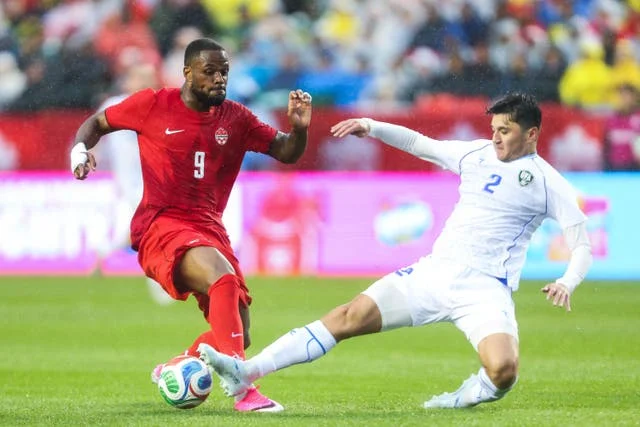
| Uzbekistan | K | Fabio Cannavaro | vs Colombia, June 17 |
No two AFC sides can meet before the knockout rounds. That means at minimum nine separate narratives running in parallel — nine sets of fans, nine media ecosystems tracking matches often scheduled hours apart across US and Canadian time zones.
For followers of Asian football, the next three weeks are unlike anything that has come before.
This channel tracks all nine AFC sides throughout the 2026 World Cup — squads, results, standout performances, and Asian media reactions across every matchday.
相似内容
- 登录后可发表评论。