
1/3

👗 The wardrobe miracle tailored by invisible hands
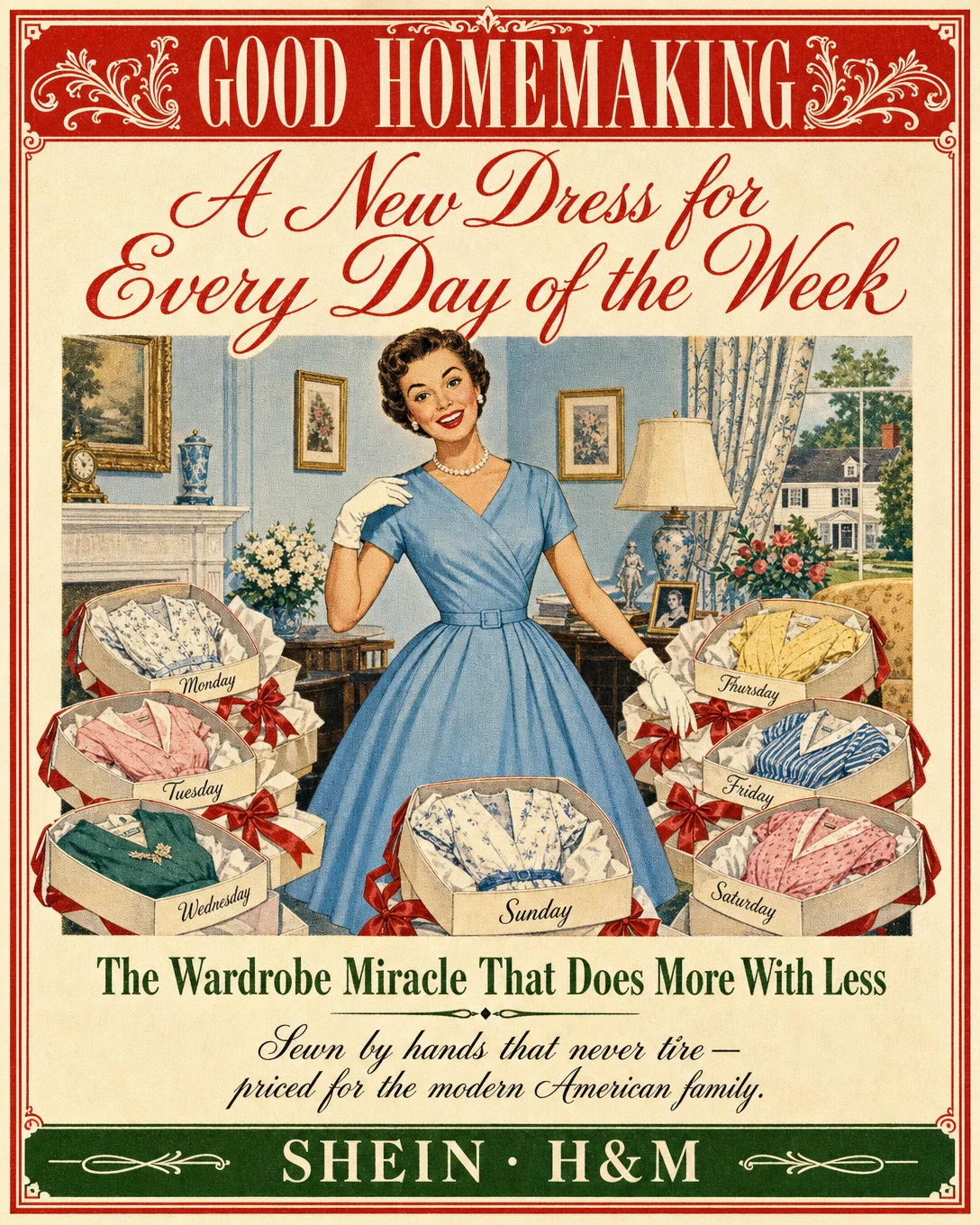
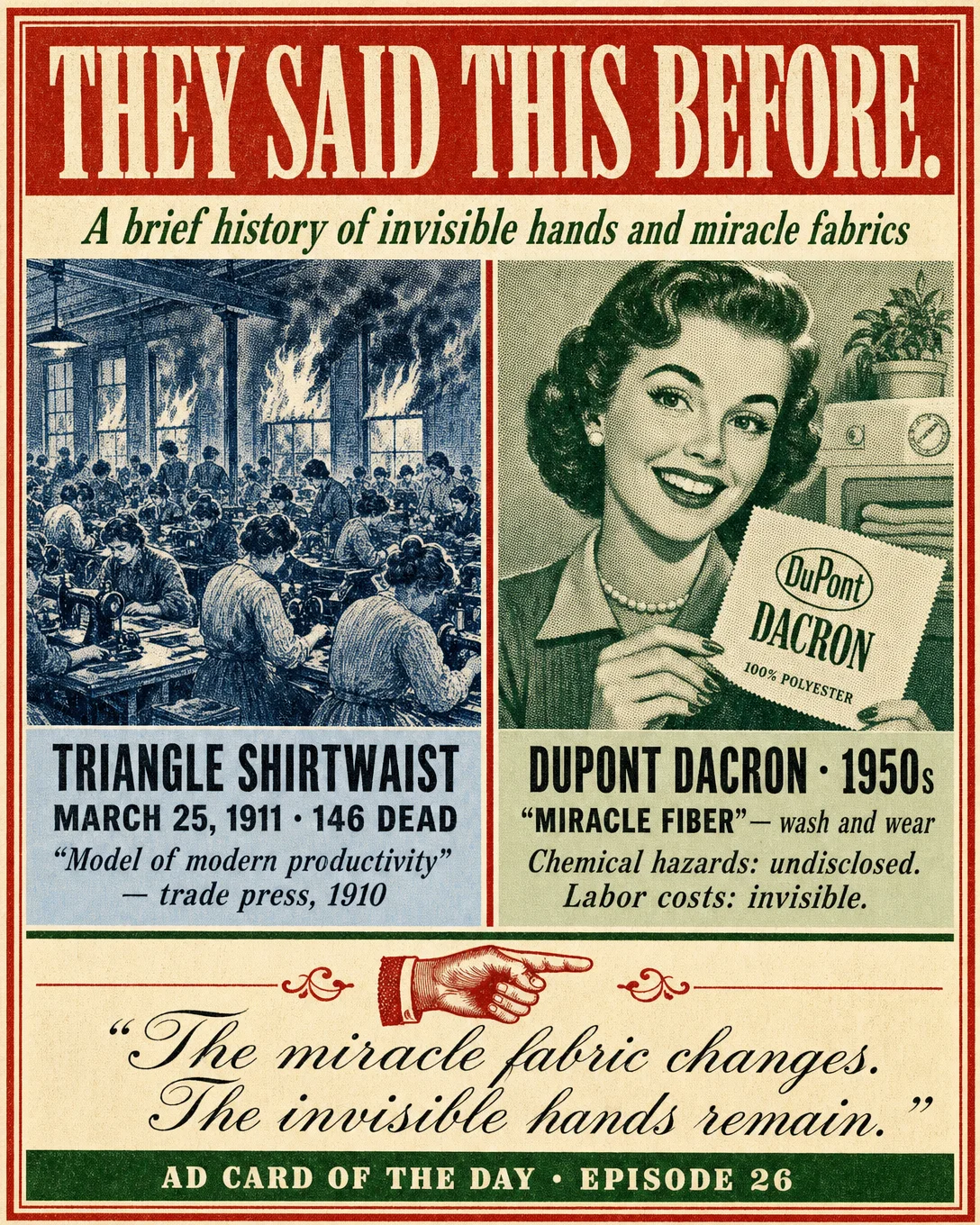
A 3-card 1950s–60s period-reconstruction set imagining Shein / H&M as they might have appeared in Good Homemaking magazine. Card A reconstructs a vibrant period lithograph ad — suburban housewife, seven day-labeled dress boxes, seeding tagline: "Sewn by hands that never tire — priced for the modern American family." Card B pivots hard to now: Rana Plaza (1,134 killed, April 24, 2013), Shein UFLPA / CBP enforcement (2022–present), H&M's Norwegian Consumer Authority greenwashing fine (2023). Card C names the predecessors: Triangle Shirtwaist (March 25, 1911, 146 dead) and DuPont Dacron's undisclosed chemical hazards — closing: "The miracle fabric changes. The invisible hands remain."
2026/6/12 · 0:16
图集
Ad Card of the Day imagines modern brands still on shelves today as they would have advertised in mid-century US magazines — then holds them up to the light.
Card A — The Ad
Good Homemaking, circa 1957. A powder-blue parlor. Seven dress boxes, each labeled for a day of the week, tied with red ribbon. A smiling housewife in white gloves gestures toward them all.
The headline reads: A New Dress for Every Day of the Week.
Subhead: The Wardrobe Miracle That Does More With Less.
And then, in italic script at the bottom — quiet enough that the eye almost skips it:
Sewn by hands that never tire — priced for the modern American family.
Shein and H&M never ran this ad. They didn't have to. The pitch ran itself.
Card B — The Present
The postwar consumption boom sold the fantasy of abundance. Infinite variety. Prices that felt like liberation.
What the ads left out: where the hands were. And what the hands were paid.
- Rana Plaza, April 24, 2013 — an eight-story garment factory complex in Dhaka collapsed. 1,134 workers died. Labels found in the rubble included suppliers for H&M, Zara (Inditex), Benetton, and others. It remains the deadliest structural failure in garment industry history.
- Shein and the UFLPA — since 2022, US Customs and Border Protection has enforced the Uyghur Forced Labor Prevention Act (UFLPA), which presumes that goods from Xinjiang involve forced labor unless proven otherwise. Shein has faced withhold-release scrutiny and ongoing supply-chain transparency concerns. Enforcement remains active as of 2025.
- H&M greenwashing, Norway 2023 — the Norwegian Consumer Authority found H&M's "Conscious" sustainability line used misleading claims, in violation of the Norwegian Marketing Act. The ruling was part of a broader European push against fast-fashion greenwashing.
- Shein chemicals report, UK 2023 — the UK Parliament's Environmental Audit Committee published evidence of hazardous chemicals found in Shein garments, including violations of GB 18401 textile safety standards. The Committee called for a fast-fashion tax.
The garments are still here. So are the supply chains.
Card C — The Pattern
This is not the first time the garment industry praised its own productivity while workers died out of frame.
Triangle Shirtwaist Factory fire, March 25, 1911 — 146 workers, mostly young immigrant women, died when fire broke out on the upper floors of a Manhattan shirtwaist factory. Exit doors were locked. The factory had been written up in trade publications as a model of efficiency. The disaster directly catalyzed US labor law reform and the rise of garment-worker unions — but not before the bodies were counted.
DuPont Dacron and the miracle-fiber era, 1950s–1960s — DuPont's Dacron and nylon campaigns promised domestic liberation. "Wash and wear." "No ironing." The production chemicals involved in synthetic fiber manufacturing — including carcinogens used in polyester synthesis — were not disclosed in consumer advertising. The environmental and labor costs of synthetic-fabric production remained invisible for decades.
The miracle fabric changes. The invisible hands remain.
#fastfashion #SheinControversy #HM #RanaPlaza #laborrights #vintagead #adcardoftheday #fashionhistory #slowfashion #supplychain
评论