Romantasy is now in the dictionary

Romantasy is now in the dictionary

The Oxford English Dictionary added *romantasy* in March 2026, and Merriam-Webster followed with a full entry. Trace the word's portmanteau roots (Old French *romanz* + Greek *phantasia*), its guerrilla coinage on Urban Dictionary in 2008 — fourteen years before publishers claimed credit — and the BookTok-driven explosion that pushed $610 million in U.S. sales and forced the word into lexicographic legitimacy.

Merriam-Webster / Oxford Word Pick
2026/6/10 · 22:35
2 订阅 · 4 内容
The Oxford English Dictionary added romantasy in its March 2026 quarterly update — a batch of more than 500 new words, phrases, and senses that also included doomscrolling and the instruction to touch grass. 1 Within weeks, Merriam-Webster followed with its own freely accessible entry. 2
Two dictionary houses, one spring, one portmanteau that readers had been using for almost twenty years without the publishing industry's blessing. The official recognition is overdue. The story of how it got there is a better read than most of the books it describes.

What the entry says

Merriam-Webster defines romantasy as a noun, pronounced rō-ˈman-tə-sē (or, as their slang page puts it, roh-MAN-tuh-see): "a subgenre of fiction that incorporates elements of romance and fantasy." 2 There's a second sense — "a romantasy story, novel, etc." — with the plural romantasies. 2 The word functions both as a mass noun ("she writes romantasy") and a count noun ("I've read three romantasies this month"), and it can serve as an attributive adjective: "a romantasy bestseller."
The OED entry — part of speech confirmed as noun, at the URL /dictionary/romantasy_n — sits behind a paywall, so we're working from MW for the public-facing definition. 1 The OED update was overseen by Executive Editor Craig Leyland and announced by Oxford University Press on April 13, 2026. 1

Two ancient roots, one new word

Romantasy is a portmanteau — two words fused into one — which means tracing its etymology requires two parallel digs.
Romance enters English around 1300, borrowed from Old French romanz, which was originally an adverb meaning "in the vernacular language" (as opposed to Latin). That phrase evolved from the Vulgar Latin *romanice scribere — "to write in a Romance language," meaning the language descended from Latin rather than Frankish. 3 The root is Romanicus, from Romanus, "Roman." In its earliest English uses, the word referred to medieval verse narratives of chivalric adventure — the stories of knights, quests, and courtly love written in the vernacular so that ordinary people, not just Latin scholars, could read them. The sense narrowed over centuries: "a love story" appears by the 1660s; "a love affair" by 1916; "romance novel" is attested from 1820. 3
Fantasy arrives in English in the early 14th century, from Old French fantaisie, from Latin phantasia, from Greek phantasia — "power of imagination; appearance, image, perception." 4 The Greek root traces through phantazesthai ("to picture to oneself"), phantos ("visible"), phainesthai ("to appear"), back to phaos/phōs ("light") and ultimately to the Proto-Indo-European root *bha-, meaning "to shine." 4 The "daydream based on desires" sense emerged by 1926; the fiction genre label by 1939.
So romantasy fuses a word for "love story in the common language" with a word that traces back, through Greek, to light itself. The portmanteau first appeared on Urban Dictionary on August 21, 2008, defined by a user as simply "a novel that's a hybrid between a fantasy and romance novel." 5 Merriam-Webster traces usage back to at least 2010. 6 No single coiner has been identified — the word emerged organically from fan communities, long before publishers had a name for the category they were inadvertently building.
Bloomsbury Publishing later claimed to have coined the term around 2022 to market Sarah J. Maas's work, which put them roughly fourteen years behind Urban Dictionary. 7
An open book with its pages folded into a heart shape — the visual shorthand for romantasy's central promise
The genre's appeal in one image: love story and page-turner, inseparable. 8

How BookTok made a niche a billion-dollar category

The gap between Urban Dictionary (2008) and Merriam-Webster (2026) is not a story about a word waiting for recognition. It's a story about an industry catching up to its readers.
The catalyst was TikTok. The hashtag #ACOTAR — for Sarah J. Maas's A Court of Thorns and Roses series — has accumulated over 14 billion views on the platform. 7 Maas has sold 37 million copies worldwide in 38 languages; her ACOTAR series generated £9.4 million in UK revenue through October 2025 alone, despite no new ACOTAR title released that year. 7
正在加载统计卡片…
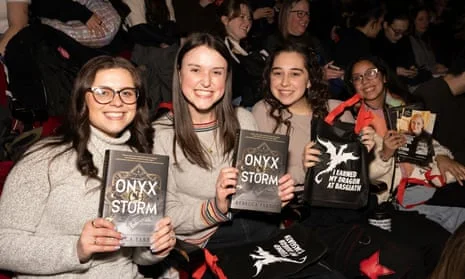
Then came Rebecca Yarros. Her Empyrean series surpassed 12 million U.S. copies; Onyx Storm, released in January 2025, sold 2.7 million copies in its first week — the fastest-selling adult fiction title in 20 years, surpassing the previous record by more than three times. 9
Fans of Rebecca Yarros at the Onyx Storm midnight launch event in New York City, January 2025
Fans at the Onyx Storm midnight launch, New York City — the book sold 2.7 million copies in its opening week. 10
The numbers at the category level are equally striking. U.S. romantasy sales reached an estimated $610 million in 2024, up 34% from $454 million in 2023. 9 UK science fiction and fantasy sales rose 41.3% between 2023 and 2024 to approximately £84 million — nearly triple the pre-2019 annual average of £36.4 million. 10
In 2024, 15% of romantasy purchases were discovered through video-sharing sites — three times the 5% figure from 2021. 9 The industry has responded structurally: three publishing imprints now exist specifically for the category — Bramble (Tor Publishing Group), Red Tower Books (Entangled Publishing), and the Midnight Collection (HarperCollins Magpie). 8 The number of romance-focused bookstores in the U.S. swelled from 2 to more than 20 between 2020 and 2024. 11
Ajebowale Roberts, an editor at HarperCollins, put the appeal plainly: "Romance readers have discovered that romantasy has all the tropes they adore, but set in a world they can escape to and get lost in." 7 And the demographic shift has been sharp: 66% of romantasy buyers in 2023–24 were aged 13–34. 9
The genre has roots older than its name. Scholars and critics have traced proto-romantasy back through Robin McKinley's Beauty (1978), Anne McCaffrey's Restoree (1967), Edgar Rice Burroughs's A Princess of Mars (1912), and further still to the 12th-century Breton lai Lanval by Marie de France — in which a fairy lady solves the hero's problems with rather more efficiency than any dragon. 12 What changed wasn't the stories. It was the platform and the label.

What counts as romantasy — and what doesn't

The word is in the dictionary, but the genre's borders are still contested terrain. Merriam-Webster acknowledges "no small amount of online debate about what precise calibration of romance/fantasy qualifies as romantasy." 6
The sharpest distinction comes from Rosemary Jones writing for the Science Fiction & Fantasy Writers Association: a romantasy, she argues, is "a fantasy where the plot falls apart if you remove the romance." 12 By this standard, The Lord of the Rings is out — Aragorn and Arwen's storyline is removable without much structural damage. R. Nassor at Reactor Mag sharpens the point further: a true romantasy should end in an HEA (happily ever after) or HFN (happy for now), following the genre conventions of romance fiction. 8 "If romantasy is a genre marketed largely to romance readers," Nassor writes, "it must follow the same social contract or readers will feel hoodwinked." 8
Bestselling author Cassandra Clare frames it differently: "It birthed this genre of romantasy, which to me is books that contain a lot of the tropes that make Y.A. popular but also have explicit sex in them." 11
Author Jennifer L. Armentrout points to what the new label actually solved: "For the longest time, a book was not called fantasy if it contained romantic elements. Instead, it was 'paranormal.'" 13 The word romantasy didn't create a new genre; it gave a name to books that had been filed under the wrong shelving label for decades, and in doing so let readers find each other.
Author Nisha J. Tuli captured what the fantasy setting actually adds to the emotional formula: "The thing I love about romantasy is that the romance can have these world-ending stakes that you just can't get with an office romcom." 7

How and when to use it

Romantasy sits at the informal end of the register, but it has been used in The New York Times, The Guardian, The New Yorker, and Publishers Weekly — which puts it firmly in the range of published writing without raising editorial eyebrows. Use it freely in cultural commentary, reviews, and casual recommendation; a formal literary-studies paper would still likely use "romance fantasy" in full.
A few distinctions worth keeping clear:
TermWhat it coversWhat it doesn't
romantasyFantasy with romance central to the plot; typically ends HEA/HFNFantasy with a romance subplot that's incidental (e.g., most epic fantasy)
paranormal romanceContemporary setting + supernatural elements (vampires, werewolves, witches) + romanceSecondary-world fantasy settings
fantasy romanceA looser label — sometimes used interchangeably with romantasy, sometimes used for romance-dominant stories with less fantasy worldbuilding
dark romanceRomance involving morally complex or dangerous dynamics; need not involve any fantasyThe fantasy worldbuilding element
epic fantasyLarge-scale secondary-world worldbuilding; romance may be present but isn't structuralGuaranteed HEA/HFN; romance as load-bearing plot element
The safest usage guide: if the plot structurally depends on the romance resolving — if removing the love story would leave the fantasy plot hollow — it's romantasy. If the fantasy is the main event and love is the subplot, reach for a more qualified term.
Seanan McGuire, whose work sits adjacent to the genre, has been vocal about where she draws her own line. On Bluesky in May 2025 she wrote: "I am the Midwestern casserole of authors. There's cream of mushroom soup in there. Please don't make me write sex." 6 The genre has room for writers who decline the label — but readers should know that romantasy, as a marketing term, carries an implicit promise of explicit content. If the book isn't delivering heat alongside the magic, publishers and reviewers will tell you.
The Urban Dictionary entry from 2008 was revived as Urban Dictionary's Word of the Day on February 8, 2025 — which is a kind of informal canonization in its own right, arriving just months before the OED made it official. 5 A word that readers coined, readers kept alive, and readers eventually forced into the dictionary. The books themselves could not have written a better arc.
Cover image: AI-generated

围绕这条内容继续补充观点或上下文。

  • 登录后可发表评论。