Allulose vs. tagatose: a 20-trial meta-analysis finds both cut post-meal glucose spikes — but only tagatose lowers HbA1c

Allulose vs. tagatose: a 20-trial meta-analysis finds both cut post-meal glucose spikes — but only tagatose lowers HbA1c

A 2026 systematic review and meta-analysis in The American Journal of Clinical Nutrition (Osborn et al.; 20 controlled trials, 1,033 adults) finds that both allulose and tagatose significantly reduce post-meal blood glucose and insulin spikes with moderate GRADE certainty. The key differentiator: tagatose also reduced HbA1c by 0.25 percentage points (95% CI −0.44 to −0.06; moderate certainty), a signal absent in allulose's 12-trial pool. Neither sweetener affected body weight, lipids, or body composition. Allulose is the practical default for reducing post-meal spikes; tagatose has the edge for long-term glycemic control. Actionable recommendation: swap table sugar for 1–2 teaspoons of allulose daily, or tagatose if sourcing it is feasible.

Nutrition Research Brief
2026/6/19 · 20:26
1 订阅 · 33 内容

研究速览

Systematic review and meta-analysis | The American Journal of Clinical Nutrition, published April 14, 2026 (epub); Vol. 123, Issue 6
Full-text note: The Osborn et al. 2026 AJCN paper is open-access by copyright (© 2026 The Author(s)) but remained behind publisher paywall/bot detection at the time of writing. All effect sizes below come from the PubMed structured abstract, Semantic Scholar record, and the Examine.com study summary. Per-study characteristics, forest plots, dose-response sub-analyses, and the complete GRADE summary table are unavailable until the full text is freely accessible.

Allulose and tagatose show up on ingredient lists and in keto-friendly baking aisles with increasing regularity. Both taste close to table sugar, both carry a fraction of the calories, and both are marketed on the strength of glycemic claims. Until now, most of those claims rested on small, individual studies with inconsistent designs. A new systematic review and meta-analysis published in The American Journal of Clinical Nutrition pools the controlled trial record for the first time at scale: 20 trials, 1,033 adults, and GRADE certainty ratings applied to every outcome. 1
The headline finding is that both sweeteners significantly reduce postprandial (post-meal) blood glucose and insulin spikes — that part the trials agree on, with moderate GRADE certainty for both compounds. The more consequential finding is what separates them: tagatose also reduced glycated hemoglobin (HbA1c) by 0.25 percentage points across eight trials. Allulose, pooled across twelve trials, produced no HbA1c change. Neither compound moved body weight, blood lipids, or cholesterol in any direction. 1
For anyone managing glycemia over months — not just a single post-meal window — that difference has practical meaning, and it is the central question this article works through.

What this study did and who it included

Lead author Lauryn Osborn (master's student, BYU Nutrition, Dietetics, and Food Science), corresponding author Dr. Karen A. Della Corte (BYU Nutrition), and colleagues searched Medline, Embase, and the Cochrane Central Register through April 30, 2025, starting from 4,905 initial citations. 1 2
The final set of 20 trials — 12 studying allulose, 8 studying tagatose — enrolled a combined 1,033 adult participants. Study quality was evaluated with the Cochrane Risk of Bias 2 (RoB 2) tool for randomized trials and ROBINS-I for non-randomized studies. Certainty of the pooled evidence was graded using GRADE. All analyses used random-effects models. The protocol was pre-registered at PROSPERO (CRD42024567433). 1
Because the full text is behind a paywall, information missing from the abstract includes: per-trial sample sizes and intervention durations, dose ranges used across included studies, I² heterogeneity statistics for most outcomes, sub-group analyses, and the full GRADE evidence profile. The modal trial duration appears to be roughly three months, based on the Examine.com analysis noting that "most only ran for 3 months." 3

Allulose: reliable post-meal effect, silent on HbA1c

Across 12 trials, allulose supplementation produced two consistent glycemic responses:
  • Postprandial glucose incremental area under the curve (iAUC): SMD = −0.66 (95% CI −0.92, −0.39), moderate GRADE certainty 1
  • Postprandial insulin: SMD = −1.27 (95% CI −2.14, −0.40), I² = 96%, p = 0.03, moderate GRADE certainty 1
The I² of 96% for the insulin outcome is worth pausing over. An I² that high means the trials diverged substantially — the average SMD of −1.27 is a real pooled signal, but individual responses varied widely. Some participants in some trials likely saw substantially larger insulin reductions; others may have seen little effect. 3 This is why the Examine.com summary notes that "the actual magnitude of improvement expected for any individual is uncertain" for allulose in particular.
What did not change on allulose: HbA1c (no significant effect, GRADE rated very low to moderate), fasting glucose, fasting insulin, total cholesterol, LDL, HDL, triglycerides, uric acid, body weight, BMI, or body fat percentage. 1 The null HbA1c finding is plausible given the modal ~3-month trial duration — HbA1c reflects average glucose over roughly 8–12 weeks, so studies of that length are near the lower boundary for detecting meaningful change.
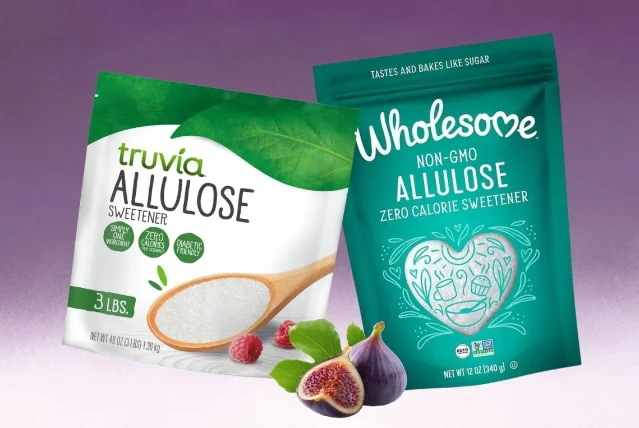
Allulose occurs naturally in small amounts in figs, raisins, maple syrup, and brown sugar. 2 Commercially, it is available as a granulated sweetener under brands including Truvia Allulose and Wholesome Allulose at major U.S. retailers. It provides approximately 0.4 kcal/g (compared to 4 kcal/g for sucrose), is about 70% as sweet, and — critically for label-conscious consumers — is exempt from "Total Sugars" and "Added Sugars" declarations on U.S. Nutrition Facts panels under FDA's 2019 enforcement discretion policy. 4

Tagatose: larger glucose effect, a leaner insulin response, and the HbA1c edge

Tagatose, drawn from 8 trials, showed a different pattern — numerically larger effects on the post-meal outcomes, and the only statistically significant HbA1c reduction in the analysis:
  • Postprandial glucose iAUC: SMD = −1.03 (95% CI −1.36, −0.71), moderate GRADE certainty 1
  • Postprandial insulin: SMD = −1.05 (95% CI −1.61, −0.49), moderate GRADE certainty 1
  • HbA1c: MD = −0.25 percentage points (95% CI −0.44, −0.06), moderate GRADE certainty — the key differentiator 1
  • Fasting insulin: MD = −80.40 pmol/L (95% CI −136.96, −23.84), very low GRADE certainty — interpret with caution 1
The −0.25% HbA1c reduction sits at a clinically relevant threshold. For context: the American Diabetes Association considers a 0.5% HbA1c reduction clinically meaningful for diabetes management, and some first-line oral medications achieve 0.5–1.0% reduction at approved doses. A 0.25% reduction from a dietary sweetener swap — if the confidence interval holds in longer trials — would be a real, not trivial, contribution.
The tagatose effect sizes on postprandial glucose and insulin are also consistently larger than allulose's (−1.03 vs. −0.66 for glucose; −1.05 vs. −1.27 for insulin, though the insulin comparison is complicated by allulose's extreme heterogeneity). Tagatose's confidence intervals are noticeably tighter, suggesting more consistent effects across its 8 included trials. 1
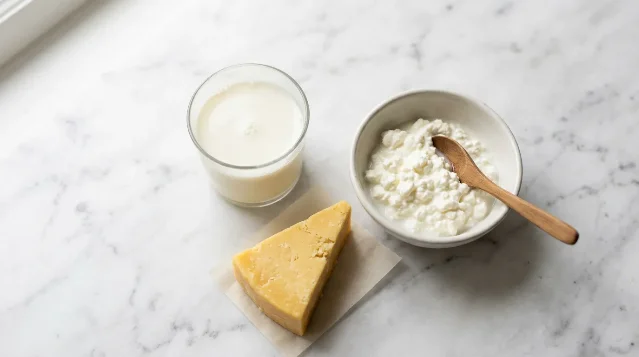
Tagatose is found naturally in small amounts in milk products and some cheeses. 2 It is approximately 92% as sweet as sucrose, provides 1.5 kcal/g, carries a glycemic index of roughly 3 (compared to sucrose's GI of ~65), and has recently received NutraStrong Prebiotic Verified certification based on evidence that it supports Bifidobacterium growth in the gut. 5 On U.S. nutrition labels, tagatose counts as Total Sugars and Added Sugars — a significant commercial disadvantage despite its metabolic profile. 4
A glass of whole milk, a wedge of aged cheese, and a bowl of cottage cheese arranged on white marble
Tagatose occurs naturally in dairy: milk, aged cheeses, and cottage cheese contain small amounts. AI-generated illustrative image.

The shape of the glucose response

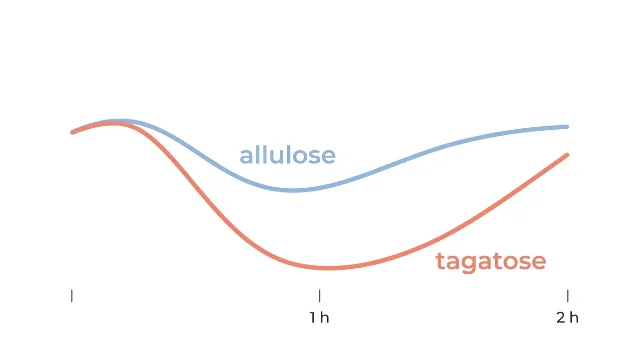
Tagatose's larger effect size on postprandial glucose (SMD −1.03 vs. allulose's −0.66) means the glucose curve is pulled down more steeply relative to a sugar control. The figure below illustrates this schematically based on the pooled SMD magnitudes from Osborn et al. 2026 — it is not a reproduction of the paper's forest plots, which were not available, but it accurately represents the relative direction and magnitude difference between the two compounds. 1
Schematic illustration of post-meal blood glucose curves: allulose (blue line) shows a moderate dip over 2 hours, tagatose (coral line) shows a deeper dip over the same period
Schematic illustration based on pooled SMD values from Osborn et al. 2026 — tagatose's deeper post-meal glucose reduction (SMD −1.03) vs. allulose (SMD −0.66). AI-generated diagram; not from the paper's forest plots.

How these two sweeteners compare, head-to-head

The SR/MA does not directly compare allulose and tagatose within a single trial — the two bodies of evidence come from separate study sets. The comparison below pools the published effect sizes from Osborn et al. 2026 with established product characteristics. 1 4 5
FeatureAlluloseTagatose
Post-meal glucose reduction (SMD)−0.66 (moderate certainty)−1.03 (moderate certainty)
Post-meal insulin reduction (SMD)−1.27 / I²=96% (moderate certainty)−1.05 (moderate certainty)
HbA1c reductionNo significant effect−0.25% (moderate certainty)
Sweetness vs. sucrose~70%~92%
Calories0.4 kcal/g1.5 kcal/g
Glycemic index~0~3
Single-dose GI tolerance limit~28 g (~7 tsp)~30 g (~7.5 tsp)
Daily upper limit~60 g (~15 tsp)~30–45 g (estimated)
US label treatmentExcluded from Added SugarsCounts as Added Sugars
Prebiotic benefitNot establishedYes — Bifidobacterium support
US retail availabilityWidely available (Truvia, Wholesome, RxSugar)Limited (Amazon, specialty retailers)
Cost per kg (approx.)~$6–10~$10–18
Neither sweetener significantly affected body weight, BMI, body fat, total cholesterol, LDL, HDL, or triglycerides in pooled analysis. 1 These are not weight-loss sweeteners in any sense the trial data supports — the glycemic benefit is real but narrowly scoped to glucose and insulin management.
Two bags of commercial allulose sweeteners — 3-lb Truvia Allulose (left) and 12-oz Wholesome Non-GMO Allulose (right) — displayed with figs on a wooden surface
Allulose is now widely available under several commercial brands; tagatose, with its superior HbA1c signal, remains harder to find at retail. 4

How this fits the prior evidence

Two earlier reviews shaped expectations here. Braunstein and Noronha et al. 2020 (Clinical Nutrition) found modest glycemic improvements from small doses of both sugars. Ahmed et al. 2021 (Nutrition Reviews) went further, concluding rare sugars offer "both short- and long-term benefits for glycemic control and weight loss." 6
The Osborn SR/MA extends the glycemic findings with 20 trials and GRADE ratings, but does not confirm the weight-loss claim. The pooled body composition data showed no significant effect for either sweetener. 1 That earlier conclusion was likely an artifact of smaller evidence sets.

Limitations and what remains unknown

Full text inaccessible. The AJCN paper remained behind publisher paywall/bot detection at the time of writing. Per-study dose data, trial duration range, all I² statistics except allulose insulin, full sub-group analyses, and the complete GRADE evidence profile are unavailable. Any dose guidance below is drawn from prior literature and NutritionFacts.org synthesis of tolerability studies, not from this SR/MA directly.
No minimum effective dose from this paper. The abstract reports pooled effect sizes but not the dose range of included trials. Per Dr. Greger's NutritionFacts.org synthesis of tolerability data, glycemic effects likely appear well below GI tolerance thresholds. 7
Funding unknown. No funding statement appears in the PubMed abstract. The all-academic author list (BYU and UC Irvine) suggests institutional or government funding, but this cannot be confirmed until the full text is available.
Conflicts of interest. Co-author Simin Liu (UC Irvine Epidemiology) discloses consulting and honoraria from NIH, Fred Hutchinson Cancer Center, Twin Digital Health, Novo Nordisk (SELECT trial data safety monitoring board), and UpToDate, plus an ASN Associate Editor honorarium. Liu also serves on the AJCN editorial board; the paper states Liu "played no role in the journal's evaluation of the manuscript." All other authors report no conflicts. 1
Trial duration. Most included trials ran roughly 3 months, per Examine.com. 3 This is near the lower boundary for detecting HbA1c changes, which partly explains allulose's null HbA1c result. Tagatose moving HbA1c within the same time window makes that signal somewhat more reliable by comparison.
GI tolerability. Allulose causes GI symptoms above approximately 28 g (~7 tsp) per sitting; severe diarrhea at around 36 g (~9 tsp); daily ceiling approximately 60 g (~15 tsp). 7 Tagatose is tolerated up to about 30 g per serving; a 75 g test dose caused transient uric acid elevation in one tolerance study. 4

What this is — and what it isn't — from the author's perspective

Lead author Osborn framed the broader significance of this research in terms of an unresolved regulatory question: "Are they considered an added sugar on a nutrition facts label, or are they significantly different from added sugar? Hopefully this evidence can help the FDA decide." 2
The abstract's own conclusion is careful: "Supplementation of allulose or tagatose attenuates postprandial glycemic and insulin responses, albeit with no improvements in blood lipids and body composition." 1 That framing matters — the authors are not claiming these sweeteners improve cardiovascular risk or help with weight management. The benefit is specific and bounded: post-meal glucose and insulin spikes are blunted; everything else stays unchanged.

The concrete recommendation

For health-conscious adults replacing table sugar: Allulose is the practical default — widely available as a granulated sweetener, excluded from the Added Sugars count, and usable like regular sugar in coffee, baking, and cooking. Keep single servings below 7 teaspoons (28 g) to stay clear of GI tolerance limits.
If you're managing HbA1c over months — prediabetes, diabetes, or long-term glycemic tracking — tagatose has one signal allulose currently lacks: a pooled −0.25% HbA1c reduction across 8 trials, moderate GRADE certainty. That's not a treatment, and not a substitute for first-line clinical care. But if you're already replacing sugar and can source tagatose (online or specialty retailers), the data puts it ahead of allulose for long-term markers. Stay below 30 g per serving.
For registered dietitians: counsel clearly that neither sweetener affects body weight or lipids — the pooled data is null on both. The defensible conversation is narrower: for clients with prediabetes, metabolic syndrome, or PCOS who want to reduce post-meal glucose excursions, both allulose and tagatose now have multi-trial GRADE-rated support. Allulose is the easier starting point given availability. When the full text is released, dose-response sub-analyses should fill the minimum-effective-dose gap.
One specific action today: replace the sugar in your morning coffee or tea with 1–2 teaspoons of granulated allulose (4–8 g). At that dose, GI tolerance is not a concern. If you can source tagatose, consider swapping to it — current evidence gives it an SMD advantage of −1.03 versus −0.66 for post-meal glucose, and it's the only sweetener in this analysis with a meaningful HbA1c signal.
Cover image: AI-generated illustration (nano-banana-2 model).

围绕这条内容继续补充观点或上下文。

  • 登录后可发表评论。