
1/5

Mount Rainier — Peak Field Guide No. 01
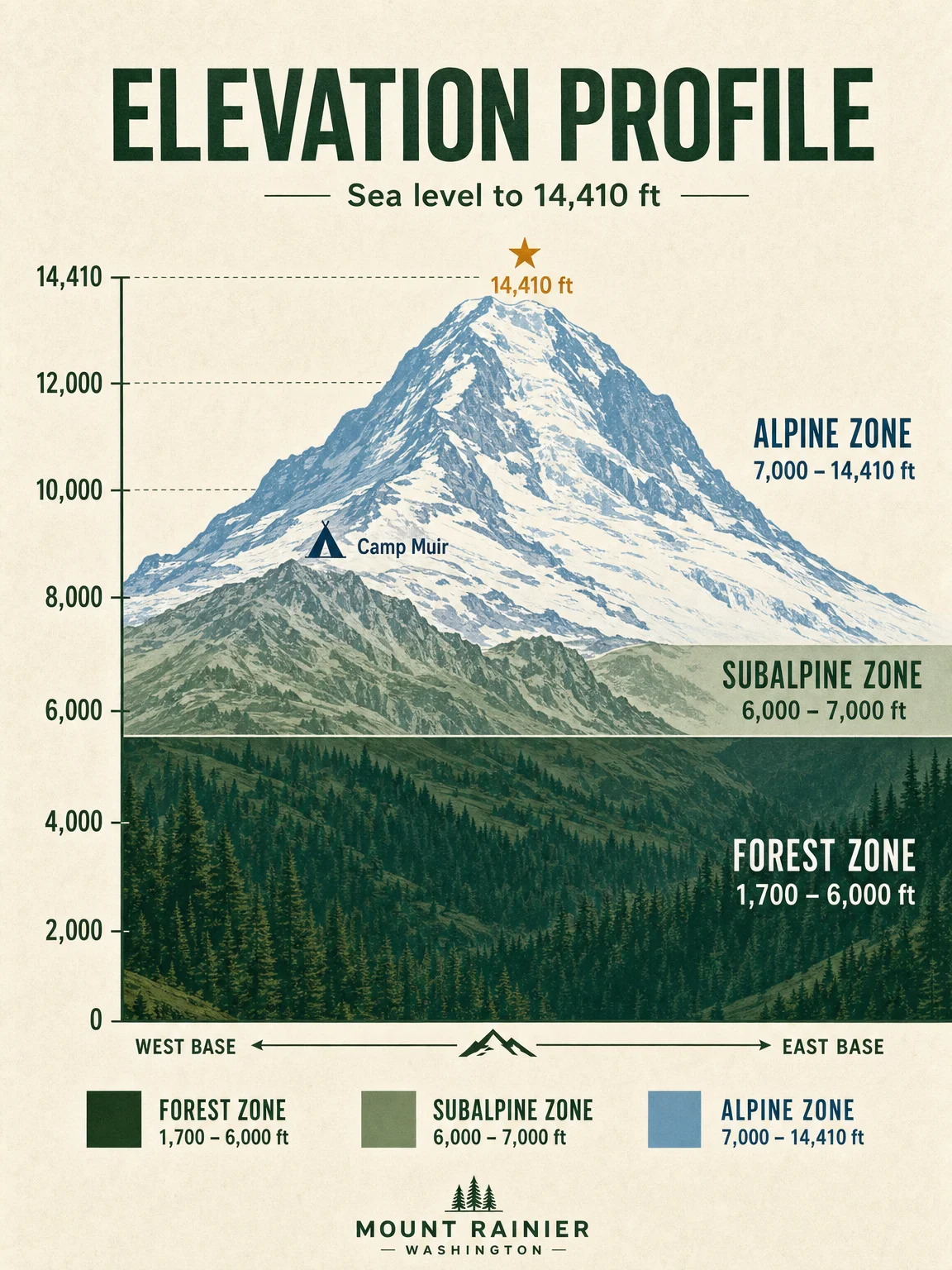
Swipe through Mount Rainier's complete field profile: terrain elevation cross-section, three vegetation zones (Forest 1,700–6,000 ft / Subalpine 6,000–7,000 ft / Alpine 7,000–14,410 ft), signature wildlife and plants by zone, best-season calendar, and trail difficulty from Moderate day hiking to Expert summit climbing. Vol. 01 of the North American Mountain Field Guide — Cascades series.
2026/6/11 · 18:12
图集
Mount Rainier — Peak No. 01
Cascade Range · Washington · 14,410 ft
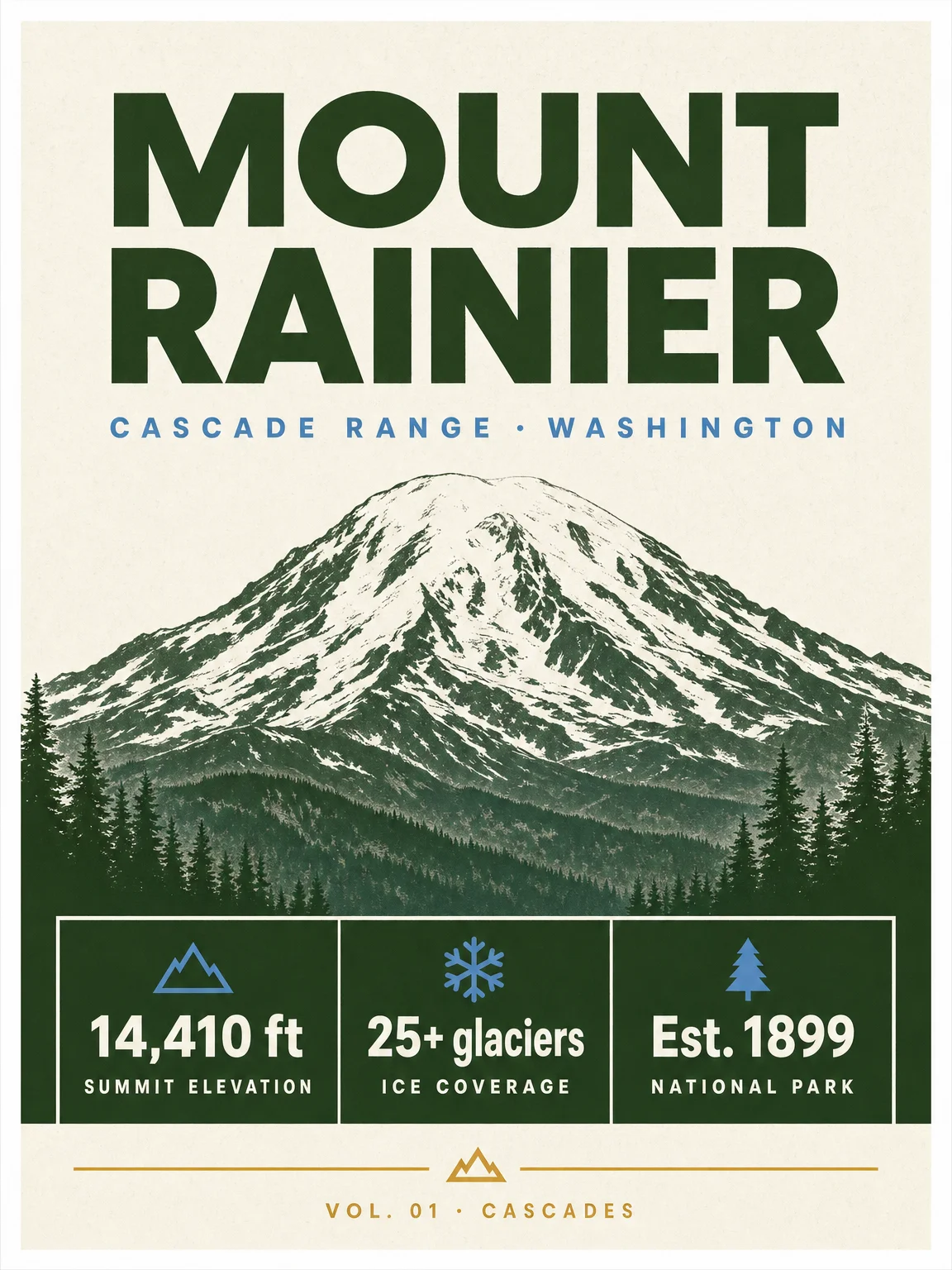
A stratovolcano so massive it creates its own weather. At 14,410 feet, Rainier holds more glacial ice than any other peak in the contiguous U.S. — over 25 glaciers draining into five major river systems. The mountain has three ecologically distinct life zones stacked from dense old-growth forest to permanent snowfield, making it one of the most compressed biodiversity gradients on the continent.
Card 1 — Identity
Range: Cascade Range. Elevation: 14,410 ft. National Park established 1899. Over 25 active glaciers covering approximately 35 square miles of ice. Five major rivers originate here: Nisqually, Puyallup, Carbon, White, and Cowlitz.
Card 2 — Elevation profile
Three life zones run from the park boundary at ~1,700 ft to the summit at 14,410 ft. The Forest Zone (1,700–6,000 ft) covers 60% of the park and transitions from old-growth western red cedar and Douglas fir at low elevations to mountain hemlock and subalpine fir near the upper edge. The Subalpine Zone (6,000–7,000 ft) hosts five distinct meadow community types — from heather/huckleberry shrub fields on the west side to green fescue grasslands on the rain-shadow east. The Alpine Zone (7,000–14,410 ft) is roughly 50% permanent snow and ice; the remaining ground is fell-fields, talus, snow beds, and 10,000-year-old heather communities. Camp Muir at ~10,000 ft is the primary high camp for the Disappointment Cleaver route.
Card 3 — Vegetation zones
Forest zone anchors: Douglas fir (some >200 ft, >1,000 years old), western red cedar, western hemlock at low elevations; Pacific silver fir, Alaska yellow cedar, noble fir in the mid zone. Subalpine anchor species: lupine, avalanche lily, Sitka valerian, paintbrush, glacier lily, American bistort. The park hosts 964+ plant species total, with 500+ lichen species in the alpine alone.
Card 4 — Wildlife
65 mammal species confirmed. Signature animals by zone: Hoary marmot and pika (subalpine/alpine, year-round), mountain goat (alpine, with suction-cup hooves adapted for rock), black bear (forest and subalpine), Roosevelt elk (forest meadows), Cascade red fox (subalpine). Bird highlights: northern spotted owl (endangered, permanent resident), peregrine falcon and bald eagle (protected under ESA), 65+ butterfly species in the subalpine during summer. In 2020, wolverines were photographed for the first time in 100 years.
Card 5 — Season & difficulty
Peak season: July–September — subalpine wildflowers peak mid-July, all trails snow-free. Shoulder: May–June (snow still on upper trails, but lower forests and some meadows accessible), October (crowds thin, autumn color). Off-season: November–April brings 54 feet average annual snowfall at Paradise (5,400 ft).
Day hiking: Moderate — Skyline Trail Loop is the benchmark: 5.5 miles round trip, 1,450 ft gain from Paradise, rated 4.9/5 on AllTrails with 29,000+ reviews.
Summit climbing: Expert — any route requires 9,000+ ft elevation gain, 10+ miles, technical glacier travel with rope teams, crampons, and ice axes. Permit required: $82/person climbing registration + $12/person/night wilderness permit (Recreation.gov). 20+ routes; most popular is Disappointment Cleaver via Camp Muir.
Entry fee: $35/vehicle (America the Beautiful Pass accepted). Nearest lodging hub: Ashford, WA. Visitor centers: Paradise and Sunrise.
Sources: NPS Mount Rainier (nps.gov/mora) · USGS Geology and Ecology of National Parks · NPS Climbing page (updated May 2026) · AllTrails Mount Rainier National Park
评论