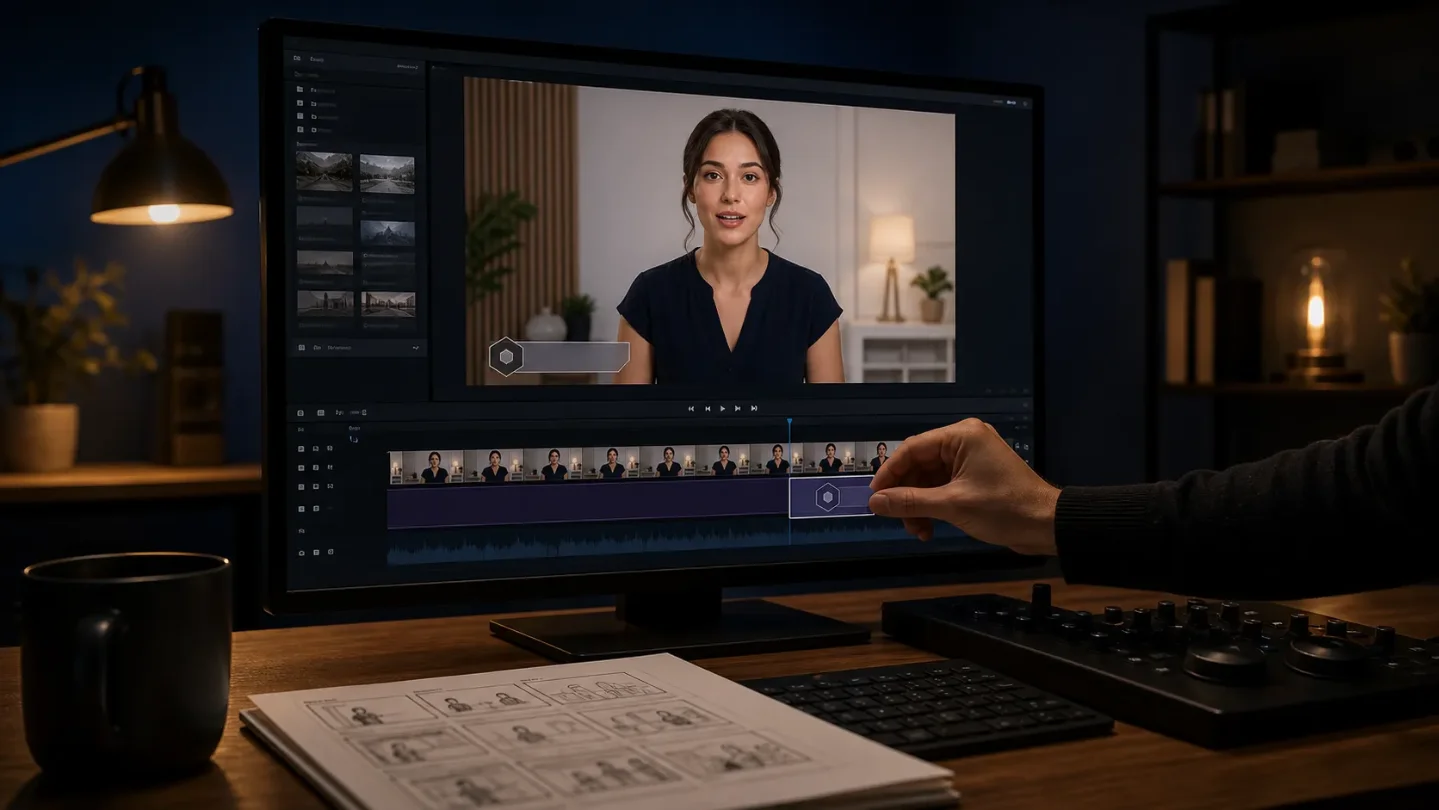
AI avatar radar: disclosure moves before the render
EU transparency obligations now make disclosure part of the avatar release path, while photo-to-presenter and storyboard workflows offer two concrete tests for production teams.
The short read
The strongest avatar change in this window was a release rule, not a new face model. The European Union's AI transparency obligations took effect on August 2: certain AI-generated or manipulated images, audio, and video that resemble real people or events must carry visible and machine-readable labels, and users must be told when they are interacting with an AI system such as an avatar or agent. The European Commission says companies can face fines of up to €15 million or 3% of global annual turnover. 1
This brief covers August 2, 2026, 7:15 a.m. through August 3, 2026, 7:15 a.m. Eastern Time. The practical response is to move disclosure into the production pipeline, then replace prompt roulette with a shot plan that can be repeated and audited.
| Signal | What changed | Test it like this |
|---|---|---|
| Disclosure becomes a delivery requirement | The EU rules cover certain deepfake-like content and require clear notice when a person is interacting with an AI avatar or agent. 1 | Render one avatar clip and run one live interaction. Check the visible label, machine-readable mark, and AI notice after platform resizing and upload. |
| Photo-to-presenter is a one-input workflow | Shorz says a portrait plus a script or audio can produce a talking presenter with synced lips and natural motion. That is a vendor description, not an independent quality result. 2 | Use one portrait and one 20-second voice track. Log lip-sync errors, identity drift, and how much repair is needed before publication. |
| Shot planning is replacing one-prompt improvisation | A creator's current recipe is: create the AI influencer, generate the first frame, build a 16-panel storyboard, then animate with Seedance 2.0. 3 | Lock the character and first frame, assign a purpose to each panel, then compare continuity and repair time across the sequence. |
The compliance step now belongs before the render
The Commission's guidance is specific enough to change a release checklist. Labels must be clear and visible for covered AI-generated or manipulated image, audio, and video content that resembles an existing person, object, place, entity, or event. The same page says those markings should also be machine-readable. It separately calls for clear notice when a user is interacting with an AI system, naming chatbots, AI agents, and avatars as examples. 1
The rule is broader than an on-screen "AI" badge. The Commission also lists emotion-recognition and biometric-categorisation systems, plus public-interest text published without human review or editorial control. National market-surveillance authorities, the EU AI Office for systems under its supervision, and the European Data Protection Supervisor for EU institutions are identified as enforcement bodies. The stated maximums are €15 million or 3% of global annual turnover for companies, and €750,000 for EU institutions, bodies, and agencies, with proportionality for smaller companies. 1
For an avatar team, the useful interpretation is operational: the asset is not finished when the mouth moves. A release also needs a disclosure state, a record of what was reviewed, and a check that the notice survives the channel where the audience will see or hear it. That is an inference from the rule's scope, not a claim that every platform already supports every marking format.
A minimum pre-publication gate:
- Classify the output: a synthetic likeness, a live AI interaction, a biometric or emotion-recognition use, or another covered case.
- Attach the required visible and machine-readable disclosure before the final export, using the Commission's transparency guidelines rather than inventing a house rule.
- Test the notice in the rendered video, the thumbnail or crop, the caption, and the live-avatar entry point.
- Keep human review evidence for public-interest claims and any factual script that the avatar will deliver.
- Repeat the check after localization, platform compression, and a handoff to another editor.
A useful product signal: one portrait, one voice track, one presenter
At 2:55 a.m. Eastern Time on August 3, the verified Shorz account described a path that starts with a portrait - either the user's own or one generated in the app - then accepts pasted text or uploaded audio. Shorz says its avatar model animates the face with synced lips and natural motion. 2 Its current avatar page presents the same basic route as a product capability. 4
The interesting part is not the number of inputs. It is the short path from identity reference to a publishable presenter. That makes the workflow easy to audition and easy to misuse: a fast render can hide weak consent records, unsupported claims, or a disclosure step that was added only after the video left the editor.
Run the feature as a constrained test rather than a face demo:
- Use one portrait with a clear consent record and one 20-second script.
- Upload a voice track with a pause, a proper noun, and one sentence that needs emphasis.
- Score lip timing, expression, identity retention, and repair minutes separately.
- Add the required AI notice before comparing the result with a filmed presenter.
The last step matters. A tool that looks good before disclosure but needs a manual rebuild to carry the notice is not a complete production path for EU-facing work.
The creator workflow: make the shot list do the remembering
Farhan AI's post, published at 7:12 a.m. Eastern Time on August 3, describes AI influencer dance videos as a controlled sequence rather than a lucky prompt. The stated workflow is four steps: create the influencer, generate the first frame, build a 16-panel storyboard, and animate it with Seedance 2.0. 3
正在加载内容卡片…
The post supplies a repeatable order, not a benchmark. A team can make it useful by assigning each panel a shot purpose, camera position, action, and continuity check before animation. Keep the identity reference and first frame fixed, then log where the model changes hair, clothing, body proportions, background geometry, or motion. Those checks are production advice, not results reported by the creator.
The payoff is easier diagnosis. If the character changes before animation, the reference set or first frame is the problem. If the character holds but movement breaks between panels, the storyboard or motion step is the problem. If the sequence is coherent but takes too long to repair, the workflow is not yet cheaper than filming the shot.
The scale claim needs a measurement plan
A separate public post from Michael Godzic argues that successful AI UGC campaigns do not stop at testing three to five variants; they test at scale. 5 The post provides no campaign size, spend, conversion data, or control group, so it is a directional claim rather than evidence of a winning test strategy.
It still suggests a useful question for avatar teams: are you measuring one impressive clip, or the failure rate of a repeatable batch? Pair every creative variant with the same identity reference, disclosure state, and review gate. Then record:
- time from reference upload to usable render;
- identity and lip-sync failures per batch;
- manual repair minutes;
- disclosure failures after export or platform upload;
- business metric by variant, with the control and spend stated.
Without that ledger, "scale" is just more files. With it, a team can tell whether an avatar workflow reduces production work or merely moves the work into review and repair.
What to test next
- Disclosure smoke test: publish nothing. Render one synthetic presenter clip and one live avatar interaction, then verify the visible label, machine-readable marking, and AI notice across the intended distribution path. 1
- Shot-control test: build one 16-panel sequence from a locked first frame. Compare identity drift, motion continuity, and repair minutes against a single-prompt version. 3
- Presenter test: run Shorz's portrait-to-presenter route with a consented reference and a known script. Treat the output as a baseline for sync and repair, not as proof of production readiness. 2
- Batch test: run a structured set of variants with the same review gate and compare the complete cost, not just render speed. The public scale claim is a hypothesis to test, not a result to borrow. 5
Bottom line
For avatar teams, disclosure is moving from a legal afterthought into the asset itself. Put it beside the identity reference, script, and approval record before rendering. For creative control, use a fixed first frame and a shot list that can explain a failure. A quick photo-to-presenter demo is worth testing; it is not a substitute for consent, labeling, continuity, and batch-level measurement.
参考来源
- 1European Commission: Safer and more transparent AIcommission.europa.eu
- 2
- 3
- 4Shorz avatar product pageshorz.ai
- 5
相似内容
- 登录后可发表评论。