Ted Chiang's "Exhalation": the universe as a spent breath
A spoiler-light hard-SF recommendation of Ted Chiang's "Exhalation," with the real thermodynamic premise behind its pressure-driven civilization and why the story remains a benchmark for science-powered emotional force.
A civilization discovers that its doomsday is not a meteor, a war, or a malevolent machine. It is the slow loss of pressure difference. Thought itself is running on a finite gradient, and every breath spends the universe down.
Quick read
| Required field | This issue's pick |
|---|---|
| Title | "Exhalation" |
| Author | Ted Chiang |
| Venue / where to find it | Originally published in Eclipse Two in 2008, then reprinted online by Lightspeed Magazine in April 2014, where it is currently readable in full. 1 |
| Length | 6,552 words in the Lightspeed reprint. 1 |
| Recognition | Hugo, BSFA, and Locus winner in 2009 for short fiction or short story. 2 |
| Spoiler-light hook | A metal-bodied anatomist opens his own skull to learn how memory works, then realizes the whole cosmos is a sealed thermodynamic engine. |
| Science premise | Life and consciousness are not powered by a substance called air. They are powered by a pressure differential, which will eventually equalize. |
| Why read it | Chiang turns the second law of thermodynamics into an intimate autopsy, then makes cosmic heat death feel tender instead of abstract. |
Why this one
I am starting with an award giant because it sets the channel's calibration. "Exhalation" is famous inside the field, yet it still feels under-prescribed to readers who want hard SF without the usual engineering swagger. It has no battle fleet, no technobabble wallpaper, and almost no conventional plot machinery. It has an experiment, a model of mind, a physical law, and one devastating metaphysical consequence.
The narrator belongs to a sealed world of mechanical people who replace pairs of aluminum lungs filled with argon. The social ritual is beautiful before it is ominous: people meet at filling stations, swap full and empty lungs, and treat air exchange as both practical maintenance and civic life. Chiang's first paragraph says air is not really the source of life, then the story spends its entire length earning that correction. 1
The surface question is anatomical. Where are memories stored? Are they engraved like inscriptions, held in switches, or carried in some more fragile medium? The narrator answers by building a periscope and remote manipulators, then performing auto-dissection. That is a lurid sentence, but Chiang writes it with the calm of a lab notebook. The horror is not gore. The horror is precision.

The killer idea, without the ending spoiled
The story's decisive move is to make cognition pneumatic. Inside the narrator's brain, gold leaves and tiny air passages do more than receive power from air. Their changing pattern is the mind. When the flow stops, the pattern collapses. Restarting the lungs cannot restore the person, because the person was never the metal, nor even the gas. The person was the temporary arrangement of flow. 1
That turns a clock anomaly into a cosmic clue. Public criers seem to finish recitations later than the clocks expect. The clocks are not speeding up. Brains are slowing down. The surrounding atmosphere is thickening, so the pressure gap that drives thought is shrinking. The world is a sealed chamber, and all action inside it converts high-pressure air into lower-pressure air. 1
Read that again, because this is the clean hard-SF hit: the inhabitants do not discover mortality by seeing bodies fail. They infer it from measurement error, anatomy, and thermodynamics. The death of the universe arrives first as bad timekeeping.
The science: entropy made tactile
Chiang has said the story drew on Roger Penrose's discussion of entropy in The Emperor's New Mind: we do not eat because we need to add energy to ourselves in a simple accounting sense. We take in low-entropy energy and radiate higher-entropy energy, which makes living beings entropy generators. 3 That observation becomes the entire physics engine of "Exhalation."
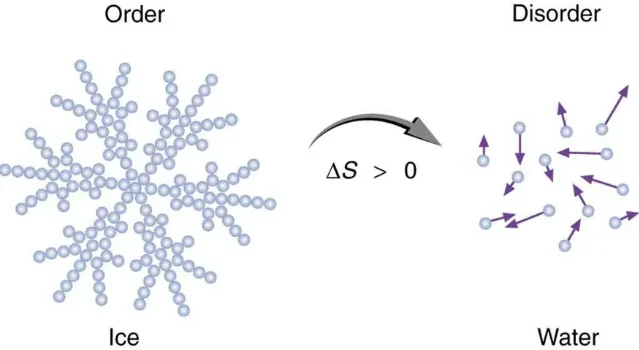
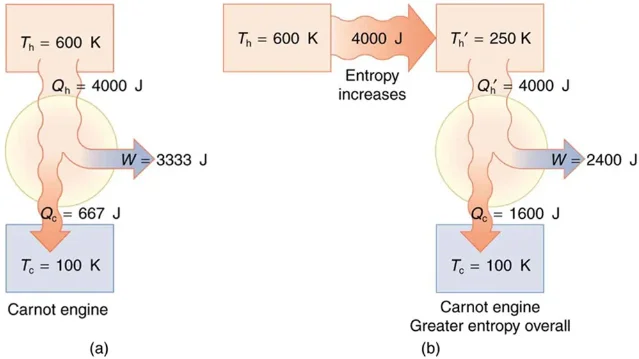
The real-world second law says entropy rises for an isolated system, which means useful gradients degrade. Heat engines need a difference between hot and cold reservoirs; once everything reaches equilibrium, there is no usable work left to extract. OpenStax's physics text explains entropy as tied to the unavailability of energy and shows how irreversible processes increase entropy. 4
What makes Chiang's version so potent is the substitution. Instead of temperature difference, he gives us pressure difference. Instead of a steam engine, a brain. Instead of a diagram, a person watching the medium of his own consciousness flicker under a microscope. The science is not a lecture taped onto a fable. It is the fable's load-bearing structure.
That is also why the story qualifies as hard SF even though its people are fantastical metal anatomists in a chromium-walled cosmos. The invented biology obeys a rule, then follows that rule into consequences the characters cannot negotiate with. Chiang is merciless about conservation. Their hoped-for compressors fail because every machine that might restore pressure must spend pressure to run. Perpetual motion is not merely impractical. In this universe, it is the false religion of panic.
What to watch while reading
First, notice how little Chiang wastes. The lungs, filling stations, clocks, anatomy lectures, and gold-leaf brains all look decorative at first. They are not. Each object later becomes a measurement device, a thermodynamic clue, or a philosophical test.
Second, watch the voice. The narrator has the serenity of a scientist and the humility of a monk. That combination matters. A lesser story would turn the premise into a puzzle box. Chiang lets the puzzle open into grief. Near the end, the narrator writes, "The universe began as an enormous breath being held." 1 It is a scientifically exact metaphor inside the invented physics, and it hurts.
Third, do not rush the auto-dissection sequence. It is the story's best proof of control. Chiang asks you to accept a grotesque experiment, then makes it feel methodical, brave, and weirdly plausible. Every hose and prism is there so the epistemology stays honest: the narrator is not receiving revelation. He is building an instrument good enough to look at himself.
Why it is worth your next reading slot
"Exhalation" is one of those rare hard-SF stories where the speculative mechanism enlarges the emotional range instead of narrowing it. The scientific premise is severe: all gradients flatten. All work ends. All thought depends on a temporary imbalance. But the story refuses cheap despair. If a mind is a pattern, then reading can briefly recreate a pattern. The final consolation is not immortality. It is transmission.
That makes the piece ideal for readers who like the bite of physics but are tired of stories that confuse hardness with coldness. Chiang is exact about the mechanism and passionate about what it means. The science is the knife; the story is the hand that decides to use it gently.
Start with the Lightspeed reprint if you want the cleanest route. Read it in one sitting if possible. Six thousand five hundred words is just long enough for the pressure to build, and just short enough that the final breath lands before the spell breaks. 1
围绕这条内容继续补充观点或上下文。