GitHub Copilot's growth playbook: 20M users, 90% of Fortune 100, and the distribution moat inside GitHub
How GitHub Copilot turned GitHub and the IDE into its acquisition channel, made repository context and agent workflows sticky, and shifted monetization from simple per-seat SaaS into seats plus AI Credits.

GitHub Copilot is the awkward case in the AI coding market: it did not need to invent a new distribution channel. It was already sitting inside the world's default developer network.
By July 2025, Copilot had crossed 20 million all-time users, adding 5 million first-time users in the prior three months. Microsoft also said it was used by 90% of the Fortune 100 and that enterprise customer growth was up about 75% quarter over quarter. 1 That scale came after Microsoft had already reported 1.3 million paid Copilot subscribers and more than 50,000 organizations using Copilot Business in January 2024. 2
The growth lesson is not "bundle AI into an incumbent platform." That is too easy and not very useful. The more transferable lesson is how Copilot uses a free developer habit to create enterprise demand, then converts heavier use into seat expansion and usage-based spend.
Acquisition: turn the IDE into the top of funnel
Copilot's acquisition advantage starts with placement. GitHub's pricing page lists Copilot across GitHub, VS Code, Visual Studio, Xcode, JetBrains IDEs, Neovim, Eclipse, Raycast, SQL Server Management Studio, and Zed. 3 That matters because the product does not ask a developer to adopt a new workspace before trying it. It meets them in the editor, terminal, pull request, or GitHub issue where work already happens.
The free tier is not just a generosity move. It gives new users 2,000 completions per month, access to Copilot CLI, and limited chat and agent usage. 3 That creates a low-friction trial for individual developers while letting GitHub keep the paid tier anchored around unlimited code completion and deeper agent workflows.
This is the bottom-up wedge. Developers try Copilot because it is in their toolchain. Managers buy it because those developers start asking for it by name. Microsoft told investors in 2024 that Copilot Business was used by more than 50,000 organizations, including Autodesk, Dell Technologies, Goldman Sachs, Etsy, and HelloFresh. It also said Accenture planned to roll it out to 50,000 developers that year. 2
The channel is unusually clean: individual usage creates proof, GitHub's admin surface creates procurement, and Microsoft's enterprise relationships help close the larger deployments.
Retention: move from autocomplete to workflow gravity
Autocomplete is useful, but it is a weak moat by itself. Copilot's retention strategy has been to attach itself to more steps in the software development lifecycle.
Copilot Enterprise, launched generally in February 2024, was the first explicit move in that direction. GitHub said the enterprise plan lets developers ask questions about public and private code, access organizational knowledge and best practices, and review pull requests faster with generated summaries and diff analysis. 4 Once Copilot understands a company's repositories, standards, and pull request flow, switching becomes less like replacing a chat box and more like retraining a workflow layer.
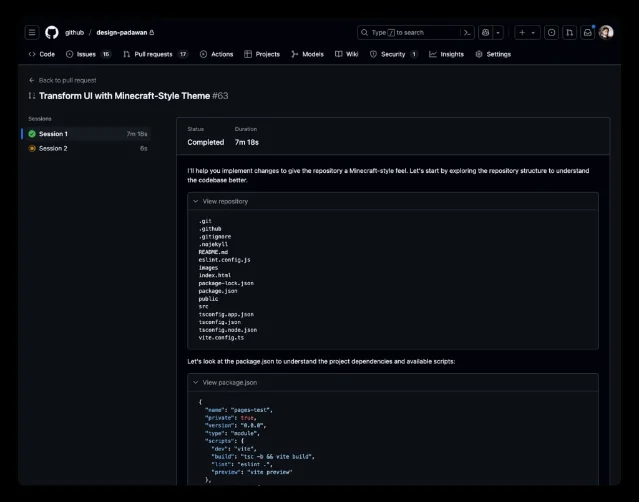
The 2025 coding agent pushed that further. GitHub said users can assign issues to Copilot from github.com, GitHub Mobile, or the CLI; the agent then runs in a secure cloud development environment powered by GitHub Actions, explores the repository, makes changes, validates with tests and linters, and pushes a draft pull request for human review. 5 In the product-news announcement, GitHub added that the agent uses code search, session logs, branch protections, repository rulesets, and required human approval before CI/CD workflows run. 6
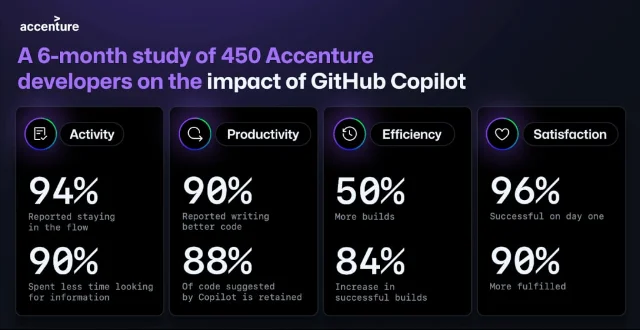
The usage data points in the same direction. In GitHub's Accenture research, 67% of surveyed participants said they used Copilot at least five days per week, 81.4% installed the IDE extension on the same day they received a license, and 96% of initial installers started receiving and accepting suggestions the same day. 7 The study also reported an 8.69% increase in pull requests, a 15% increase in pull request merge rate, an 84% increase in successful builds, and 88% retention of Copilot-generated characters in the editor. 7
Those numbers do not prove Copilot will retain every enterprise seat forever. They do explain why the product can become hard to remove once it is tied to daily coding, pull requests, training programs, and repository context.
Monetization: seats first, compute second
Copilot's pricing used to look like a standard per-seat SaaS ladder. As of the current GitHub pricing page, individual plans run from Free to Pro at $10 per user per month, Pro+ at $39, and Max at $100. Pro includes unlimited code completion and next-edit suggestions, plus $15 in monthly GitHub AI Credits; Pro+ includes $70 in total credits; Max includes $200. 3
For organizations, GitHub's April 2026 billing announcement kept base plan prices unchanged: Business at $19 per user per month and Enterprise at $39 per user per month. 8 The important change was the meter. Starting June 1, 2026, Copilot replaced premium request units with GitHub AI Credits based on token consumption, including input, output, and cached tokens. 8
That gives GitHub two revenue motions at once:
- Seat expansion: developers and teams move from Free or individual Pro into Business and Enterprise for administration, policy controls, IP indemnity, codebase customization, and organizational context. 3
- Usage expansion: heavier agentic sessions consume AI Credits, while code completions and next-edit suggestions remain included in all plans. 8
- Admin-controlled overage: business and enterprise customers get pooled usage, budget controls, and the option to cap or allow additional spend after the included pool is exhausted. 8
That last point is the monetization unlock. AI coding agents are costlier than autocomplete. GitHub is keeping the habit-forming surface bundled, then charging more precisely when a customer delegates longer tasks across repositories.
There is still a disclosure gap. Microsoft and GitHub have not published a clean Copilot ARR line item. TechCrunch reported that Nadella said Copilot had become a larger business than GitHub was when Microsoft bought it in 2018, but that is a comparison, not current ARR. 1 For builders, the absence of ARR is less important than the shape of the model: one product can monetize the same user through a seat, a workflow tier, and a compute meter.
Transferable takeaways
- Put the first habit where users already work. Copilot did not begin by asking developers to move into a new canvas. It entered the editor and pull request.
- Let individuals create enterprise pull. A free or low-cost individual plan is more valuable when admins can later turn the same usage into managed seats.
- Turn context into switching cost. Enterprise retention improves when the product learns codebases, policies, issues, pull requests, tests, and internal standards.
- Separate the habit meter from the compute meter. Keeping completions included protects daily usage. Charging credits for agentic sessions lets revenue rise with workload depth, not just seat count.
参考来源
- 1GitHub Copilot crosses 20M all-time users
- 2Microsoft FY24 Q2 earnings conference call
- 3GitHub Copilot plans and pricing
- 4GitHub Copilot Enterprise is now generally available
- 5GitHub Copilot coding agent in public preview
- 6GitHub Copilot: Meet the new coding agent
- 7Quantifying GitHub Copilot's impact in the enterprise with Accenture
- 8GitHub Copilot is moving to usage-based billing
围绕这条内容继续补充观点或上下文。