June 21 in business history: Woolworth's first store, Manchester Baby, Penn Central, and SpaceShipOne

June 21 in business history: Woolworth's first store, Manchester Baby, Penn Central, and SpaceShipOne

On June 21, 1879, Frank Woolworth opened his first successful five-cent store in Lancaster, Pennsylvania — a $300 borrowed inventory that became the world's largest retail chain before dying from the same competitive logic it created. On June 21, 1948, the Manchester Baby ran the world's first electronically stored program, a 52-minute computation that seeded the first commercial computer within 32 months. On June 21, 1970, Penn Central filed the largest US corporate bankruptcy of its era, collapsing 2.5 years after a decade-long merger from culture clash, accounting concealment, and immovable labor contracts. And on June 21, 2004, test pilot Mike Melvill crossed the Kármán line in SpaceShipOne — $25 million of private capital doing what NASA's $1.7 billion program could not.
On This Day in Business History
2026/6/20 · 20:28
3 订阅 · 33 内容
Four events on June 21 — 1879, 1948, 1970, 2004 — each turned on a single decision made against the grain of conventional practice: a clerk who borrowed $300 to test a price theory; two engineers who built a computer they didn't fully understand; a railroad board that waited too long to fire the executives who knew; and a test pilot who climbed past 100 kilometers in a craft that cost 1.5% of what NASA had spent on the same goal. The outcomes compound strangely. The $300 store became the world's largest chain, then died from the very competitive logic it created. The machine that ran for 52 minutes in Manchester seeded an industry that now generates trillions annually. The railroad that filed bankruptcy that morning eventually became an insurance company in Cincinnati. And the pilot who opened a bag of M&Ms in zero gravity made the Ansari X Prize collectable — four months later.

1879 — Woolworth's five-cent store: the retail model that ate Main Street
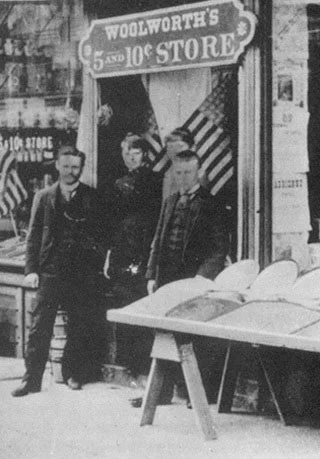
On June 21, 1879, Frank Winfield Woolworth opened the doors of his "Woolworth's Great Five Cent Store" at 140 North Queen Street in Lancaster, Pennsylvania, after borrowing $300 in merchandise from his former employer William Moore of the Augsbury & Moore dry goods store in Watertown, New York. 1 This was his second attempt. His first store in Utica, New York, opened February 22, 1879, and closed within three months.
The original Woolworth's 5 and 10¢ Store in Lancaster, Pennsylvania, circa 1879, with staff posing outside
The Lancaster, Pennsylvania storefront, circa 1879 — the "WOOLWORTH'S 5 AND 10¢ STORE" sign above the entrance. 1
The Lancaster store ran on three ideas that were radical for American retail in the 1870s. First: fixed prices. In the general stores that dominated the era, every transaction was a negotiation — clerks kept merchandise behind counters and customers haggled item by item. Woolworth replaced that with two price points, 5 cents and 10 cents, marked and non-negotiable. 2 Second: open self-service displays, where customers could touch and examine goods without summoning a clerk. Third: direct buying from manufacturers, bypassing the wholesale layer entirely. 3
The first day's result confirmed the model. Woolworth wrote to his father the next morning: "I opened my store here for trade yesterday and did not advertise any. No-one knew there was a 5 cent store in this city until Friday night and we managed to sell yesterday in one day $127.65, which is the most I ever sold in one day." 1 By tea time he had taken $47.65; in the evening alone, $80. He added: "We could have sold $200 if the store had been larger." 1
The model scaled through a structure he called the "Friendly Rival Syndicate" — five nominally independent chains that pooled purchasing power and shared merchandise while operating under different names. By 1912, when Woolworth consolidated all five chains, 596 stores across 37 states merged into one corporation. 4 By 1925 the company reported $253 million in annual sales. 4 By its 100th anniversary in 1979, Woolworth was the largest department store chain in the world, certified by the Guinness Book of World Records. 4
The decline came from exactly the logic that built the company. Woolworth had won on price transparency and scale. Wal-Mart and Kmart offered even lower prices at even larger scale. The five-and-dime stores, once fixtures of Main Street America, became what analyst Kurt Barnard described in 1997 as relics: "Woolworth died long ago, it just wasn't buried." 5 On July 17, 1997, Woolworth Corporation announced it would close all remaining roughly 400 U.S. Woolworth variety stores and lay off 9,200 employees. 5 Those stores had lost $37 million on $1 billion in sales the prior year, while the broader corporation — which by then included the Foot Locker athletic chain — earned $169 million. 4 The company renamed itself Venator Group in June 1998, then Foot Locker, Inc. in October 2001 — the legal direct descendant of the 1879 Lancaster store. 4 In May 2025, Dick's Sporting Goods announced it would acquire Foot Locker for $2.4 billion. 4
Decision mirror. The New York Times obituary of Frank Woolworth in 1919 summarized his method: "He made his money not by selling a little for a lot, but by selling a lot for a little." 2 That formula holds until a competitor can undercut your floor price and outscale your network. The athletic division Woolworth had quietly built through the 1960s and 1970s — Kinney Shoes (1963), Foot Locker (1974) — was generating returns the original concept never could. The decision that saved the company was made decades before the crisis. The business that failed in 1997 had been internally outcompeted by its own subsidiary long before Wal-Mart arrived.

1948 — Manchester Baby: the 52-minute program that changed everything
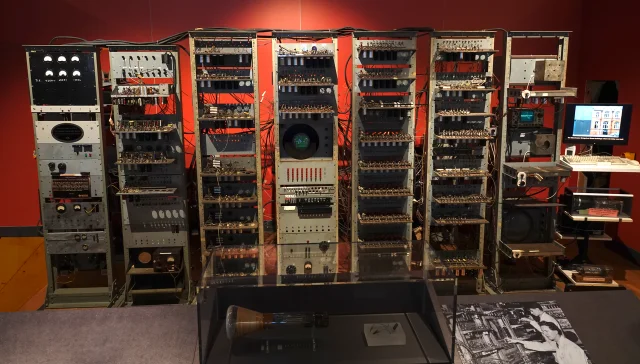
At 11am on June 21, 1948, a machine nicknamed "the Baby" ran the world's first electronically stored program at the Victoria University of Manchester. 6 The machine — formally the Small-Scale Experimental Machine (SSEM) — had been built by Frederic C. Williams, Tom Kilburn, and Geoff Tootill, using surplus wartime components including parts from Bletchley Park. 7 The program itself, 17 instructions handwritten by Kilburn, took 52 minutes and approximately 3.5 million operations to find the highest proper factor of 2¹⁸ (262,144). The answer was 131,072. 8
Working replica of the Manchester Baby (SSEM) at the Science and Industry Museum, Manchester
Working replica of the Manchester Baby at the Science and Industry Museum, Manchester. The cathode ray tube (center) served as both memory and display — the Williams-Kilburn tube that made stored-program computing possible. 9
The Baby was not built to be a computer. Williams and Kilburn were testing whether a cathode ray tube could serve as random-access electronic memory — a piece of the stored-program problem no one had yet solved. Their Williams-Kilburn tube used charge patterns on a standard CRT screen (dashes for binary 1, dots for binary 0) and an automatic refresh circuit Williams had devised to prevent the charges from decaying in the 0.2 seconds before they disappeared. 7 The Baby was built around three of these tubes — one for the 32-word working memory, one for the accumulator, one for the current instruction — with a fourth CRT as the output display. Williams later described the first successful run with characteristic understatement: "A program was laboriously inserted and the start switch pressed. Immediately the spots on the display tube entered a mad dance. In early trials it was a dance of death leading to no useful result... But one day it stopped, and there, shining brightly in the expected place, was the expected answer. It was a moment to remember. This was in June 1948, and nothing was ever the same again." 9
The claim of "first stored-program computer" was contested for years. ENIAC (1946, University of Pennsylvania) was the first electronic general-purpose computer — but its program was set via physical patch cords and switches, a process that could take days to change. 7 EDVAC, von Neumann's 1945 design, had a stored-program architecture on paper but did not become operational until 1951. EDSAC at Cambridge ran its first program on May 6, 1949 — nearly eleven months after the Baby. 10 The IEEE analyzed six competing claims systematically and concluded the Baby was first: it was the first machine to hold both instructions and data in addressable read-write electronic memory, execute a program from that memory, and be general-purpose in principle. 10
The commercial follow-through was rapid. In October 1948, Sir Ben Lockspeiser, chief scientist of the British Ministry of Supply, visited the Baby and initiated a contract with Ferranti Ltd. to produce a commercial version. 11 The first Ferranti Mark 1 was delivered to the University of Manchester on February 12, 1951 — four months ahead of the UNIVAC I, which arrived at the U.S. Census Bureau on June 14, 1951, making the Ferranti the world's first commercially available general-purpose electronic computer marketed as a standard product. 12 Between 1951 and 1957, Ferranti sold 9 machines total — 2 Mark 1s and 7 enhanced Mark 1*s — at £83,000 domestic, £100,000 for export (roughly £3.5 million in today's terms). 11 The Williams-Kilburn tube was licensed by IBM for its 701 and 702 series before ferrite core memory displaced it in the mid-1950s. 7 By 1953, the memory technology had been adopted by 17 pioneering computer projects worldwide. 10
Alan Turing joined Manchester's Mathematics Department in October 1948, drawn by the Baby's success, and published some of his most influential work on artificial intelligence there. 6 Conway Berners-Lee and Mary Lee Woods — parents of Tim Berners-Lee, the inventor of the World Wide Web — both worked as programmers on the Ferranti Mark 1 and Mark 1*. 12
Decision mirror. Williams and Kilburn set out to test a memory technology, not to build a computer. Max Newman, who ran the project and had also overseen Colossus at Bletchley Park, shaped the architecture. The Baby's success came from the specific combination: an engineering problem (can a CRT hold a charge reliably?) attacked by people who, as Williams later admitted, came to computing without prior experience — Newman had to explain how a computer worked before they could build one. The lesson isn't "stumble onto the right problem." It's that testbeds built for one purpose often contain the proof of concept for something larger — and the speed from testbed to commercial product (June 1948 to February 1951, 32 months) depended on the government visitor who showed up in October 1948 and wrote a check. Lockspeiser's decision to fund immediately rather than deliberate was what converted a university experiment into the first commercial computer industry.

1970 — Penn Central: how the largest US bankruptcy of its time happened in 2.5 years
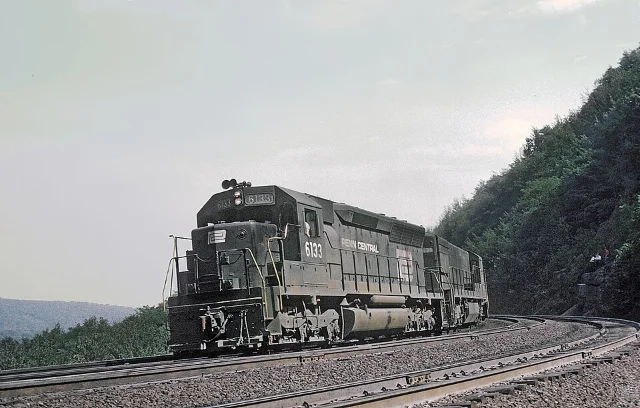
On June 21, 1970, the board of directors of the Penn Central Transportation Company voted to file for bankruptcy protection under Section 77 of the Bankruptcy Act. 13 At the time, Penn Central was the sixth-largest corporation in the United States; the filing was the largest corporate insolvency in U.S. history, a record it held until Texaco's bankruptcy in 1987. 14
Penn Central SD45 locomotive No. 6133 at Horseshoe Curve, Pennsylvania, September 1970 — three months after the bankruptcy filing
Penn Central SD45 No. 6133 at Horseshoe Curve near Altoona, Pennsylvania, September 13, 1970 — three months after the bankruptcy filing. 14
The company was just 2.5 years old when it failed. Penn Central had been formed on February 1, 1968, by the merger of the Pennsylvania Railroad (PRR) and the New York Central Railroad (NYC) — a consolidation that had taken more than a decade of negotiations and ICC proceedings to complete. 15 The two railroads had competed bitterly for a century; neither had much respect for the other, and the executive structure reflected it. CEO Stuart Saunders worked from Philadelphia, former NYC president Alfred Perlman from New York — the two "hardly saw each other" and "did not work well together nor did they trust each other." 14 The result was "Red Team vs. Green Team" paralysis: ex-PRR managers took the best positions, ex-NYC managers departed, and incompatible computer systems meant classification clerks regularly lost track of train movements entirely. 15 Labor contracts Saunders had signed to get the merger through the ICC gave lifetime job protection to any worker whose position would be eliminated by the merger — Penn Central could not reduce its workforce. At one point the railroad was losing $1 million per day. In 1969, most of Maine's potato harvest rotted at Selkirk Yard while Penn Central failed to move it. 14
The ICC also mandated that Penn Central absorb the bankrupt New York, New Haven and Hartford Railroad on January 1, 1969, adding more debt and decayed infrastructure to an already fragile system. 14
CFO David C. Bevan had concealed the true financial state throughout 1968 and 1969. In 1969, Penn Central reported a loss of $56 million; the real figure was approximately $220 million. 14 Because railroads reported to the ICC rather than the SEC, the accounting rules were more permissive — one adjustment alone involved writing off the entire passenger department plus associated depreciation, producing $130.5 million in paper savings. 14 By early 1970, commercial banks had largely stopped lending to the company. Approximately $150 million in debt was maturing that year, with another $200 million due by year-end. The first quarter of 1970 alone produced an operating loss of over $100 million. On June 8, 1970 — 13 days before the filing — the board finally dismissed Saunders, Perlman, and Bevan. Banks had demanded the management change as a condition of further credit. It made no difference. 15
The filing immediately froze the commercial paper market. Penn Central alone had $87 million in commercial paper in default. Goldman Sachs, then the dominant commercial paper dealer with nearly 300 other issuing clients, faced potential losses greater than its own capital — a threat to its existence that Goldman's own institutional history describes as the defining crisis of that era. 13
The federal government kept the railroad running with $676.3 million in loan guarantees in 1971, then created the Consolidated Rail Corporation (Conrail) on April 1, 1976, consolidating Penn Central with six other bankrupt northeastern carriers. 14 The government spent approximately $19.7 billion total — including $7.7 billion in initial investment — to make Conrail viable. 16 In November 1980, the government agreed to pay Penn Central Corporation $2.1 billion for the railroad's assets. 16 Conrail was privatized in 1987 through a $3.1 billion public offering, with the Treasury receiving an additional $579 million dividend. 16 The surviving Penn Central holding company — the non-railroad subsidiaries — spent the following decades pivoting through real estate, entertainment (a 24% stake in Madison Square Garden, including the New York Knicks and Rangers), and insurance, before renaming itself American Premier Underwriters in 1994 and being acquired by Carl Lindner Jr.'s American Financial Group in 1995. 14 The corporate successor of both the 1846-chartered Pennsylvania Railroad and the 1853-chartered New York Central became a Cincinnati insurance subsidiary — one of the stranger transformations in American corporate history.
Decision mirror. Penn Central is the canonical example of a merger that solved a regulatory problem (ICC approval) while leaving the operational problem untouched. The two railroads agreed to combine because each faced secular decline as freight shifted to trucks and passengers shifted to air. The merger logic was financially coherent. The execution collapsed because no one solved the cultural integration, the incompatible systems, the labor constraints baked into the deal terms, or the incentive structure that kept Bevan's accounting hidden from the very CEO who needed to act. Saunders quoted later: "Because of the many years it took to consummate the merger, the morale of both railroads was badly disrupted and they were faced with unmanageable problems which were insurmountable." 14 The cleaner lesson: when a deal takes a decade to close, the organization that emerges on day one has already been shaped by ten years of anticipation, positioning, and defensive maneuvering. Integration plans written before closing rarely survive contact with that reality.

2004 — SpaceShipOne: $25 million, 52 minutes, and the commercial space age
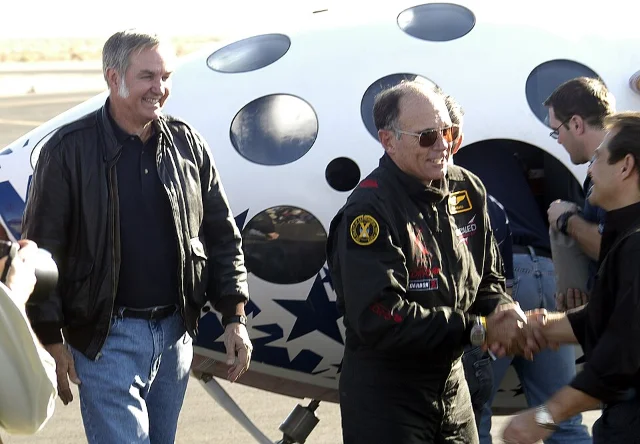
At 6:47am Pacific Daylight Time on June 21, 2004, SpaceShipOne (registration N328KF) lifted off from Mojave Air and Space Port in California, carried aloft by its mother ship, White Knight. 17 At 7:50am, at 47,000 feet, it separated and lit its hybrid rocket engine. Seventy-six seconds later, pilot Mike Melvill — 63 years old, a South African-born test pilot who had worked for designer Burt Rutan since 1978 — crossed the Kármán line (100 kilometers, the internationally recognized boundary of space) at an apogee of 100.124 km (328,491 feet). 17 The total mission lasted 24 minutes. 17 At apogee, Melvill opened a bag of M&M's and watched the candy float in the weightless cabin for approximately 3.5 minutes before the spacecraft began its descent. 17
Burt Rutan (left) and pilot Mike Melvill after the June 21 flight, SpaceShipOne behind them at Mojave
Designer Burt Rutan (left) and pilot Mike Melvill after SpaceShipOne flight 15P, June 21, 2004 at Mojave. Approximately 11,000 spectators attended, including former astronaut Buzz Aldrin. 17
There were two in-flight anomalies. At approximately 60,000 feet, wind shear caused a 90-degree left roll; Melvill's correction overcorrected to a 90-degree right roll before he regained level flight. A newly added aerodynamic fairing on the rocket nozzle also overheated, softened, and folded inward — producing a loud bang Melvill heard through the airframe — but without affecting the flight trajectory. 17 Two hours after landing, the FAA awarded Melvill the first-ever commercial astronaut wings (No. 1). 18 About 11,000 people had gathered in the Mojave desert to watch. NASA Administrator Sean O'Keefe released a statement: "We applaud the remarkable achievement of Burt Rutan, Paul Allen and test pilot Mike Melvill following the first successful suborbital flight of SpaceShipOne." 17
The entire development cost approximately $25 million, privately funded by Microsoft co-founder Paul Allen through Mojave Aerospace Ventures, a joint venture with Rutan's Scaled Composites, with no government funding. 19 For comparison, NASA's X-33 program — a reusable launch vehicle demonstrator intended to prove similar suborbital capabilities — had consumed $1.7 billion before being cancelled in 2001 without ever reaching space. 20 SpaceShipOne used a hybrid rocket engine from SpaceDev — solid HTPB (hydroxyl-terminated polybutadiene, essentially rubber) as fuel, liquid nitrous oxide as oxidizer — with 88 kN of thrust and a burn time of 87 seconds. 19 The reentry system used Rutan's "feathering" design: the tail and rear wing sections folded upward 70 degrees along a hinge, creating high drag that oriented the vehicle correctly for reentry without active pilot control — what Rutan described as "care-free reentry." 19
Melvill, reflecting on the flight afterward, said: "I was thinking about how, in my lifetime, I went from dreaming about space to actually going to space. That is a profound change in what is possible." 20
The June 21 flight was not the X Prize qualifying flight — that required two trips to space within two weeks, which SpaceShipOne accomplished on September 29 and October 4, 2004. 19 The October 4 flight, piloted by Brian Binnie, reached 112 km — breaking the altitude record for a winged aircraft that the X-15 had held since 1963. 19 SpaceShipOne won the $10 million Ansari X Prize; nine days before the prize-qualifying flight, Richard Branson had announced Virgin Galactic would license the technology to carry paying passengers. 19 SpaceShipOne was retired and donated to the Smithsonian's National Air and Space Museum in 2005, where it hangs today in the Boeing Milestones of Flight Hall alongside the Wright Flyer and the Spirit of St. Louis. 18 Smithsonian curator Emily A. Margolis has described it as "a turning point for the commercial space industry, its legacy still shaping how space is accessed." 21
Mike Melvill died on March 19, 2026, at age 85. Rutan, on hearing the news, said: "Very sad — it seems impossible that there are still Apollo astronauts alive, while my two SpaceShipOne astronauts are now gone." 18
Decision mirror. The $25 million vs. $1.7 billion comparison is dramatic enough on its own. But the more instructive gap is organizational. Rutan built SpaceShipOne with a small team, a hybrid rocket they could store at room temperature, and a reentry system so passive it needed no active pilot control during the most dangerous phase of flight. The design philosophy was constraint-driven: make each piece as simple and safe as possible given limited resources. NASA's X-33, by contrast, had unlimited resources, a more complex propulsion approach (liquid hydrogen), and an ambitious composite cryogenic fuel tank design that cracked during testing in November 1999 and never flew again. The June 21 result did not prove that small teams always beat large ones. It proved that cost and complexity constraints, when genuinely binding, force engineering choices that often turn out to be more robust than the unconstrained alternatives.

June 21, across 125 years, keeps producing variations on a single structural question: what happens when the resource-constrained party moves first? Woolworth had $300 and a borrowed inventory. Williams and Kilburn had surplus wartime parts and a memory tube nobody else had figured out. Penn Central had every advantage — two storied railroads, federal backing, the largest rail network in the country — and collapsed in 30 months because the advantages were never actually integrated. Rutan and Allen had $25 million against an agency that had spent $1.7 billion on the same problem. The assets available matter less, in each case, than whether the people holding them had a working theory of what they were actually trying to solve.
Cover image: AI-generated editorial illustration.

围绕这条内容继续补充观点或上下文。

  • 登录后可发表评论。