
2026/6/24 · 19:25

The Fleet That Sailed to Its Doom — Tsushima, 1905

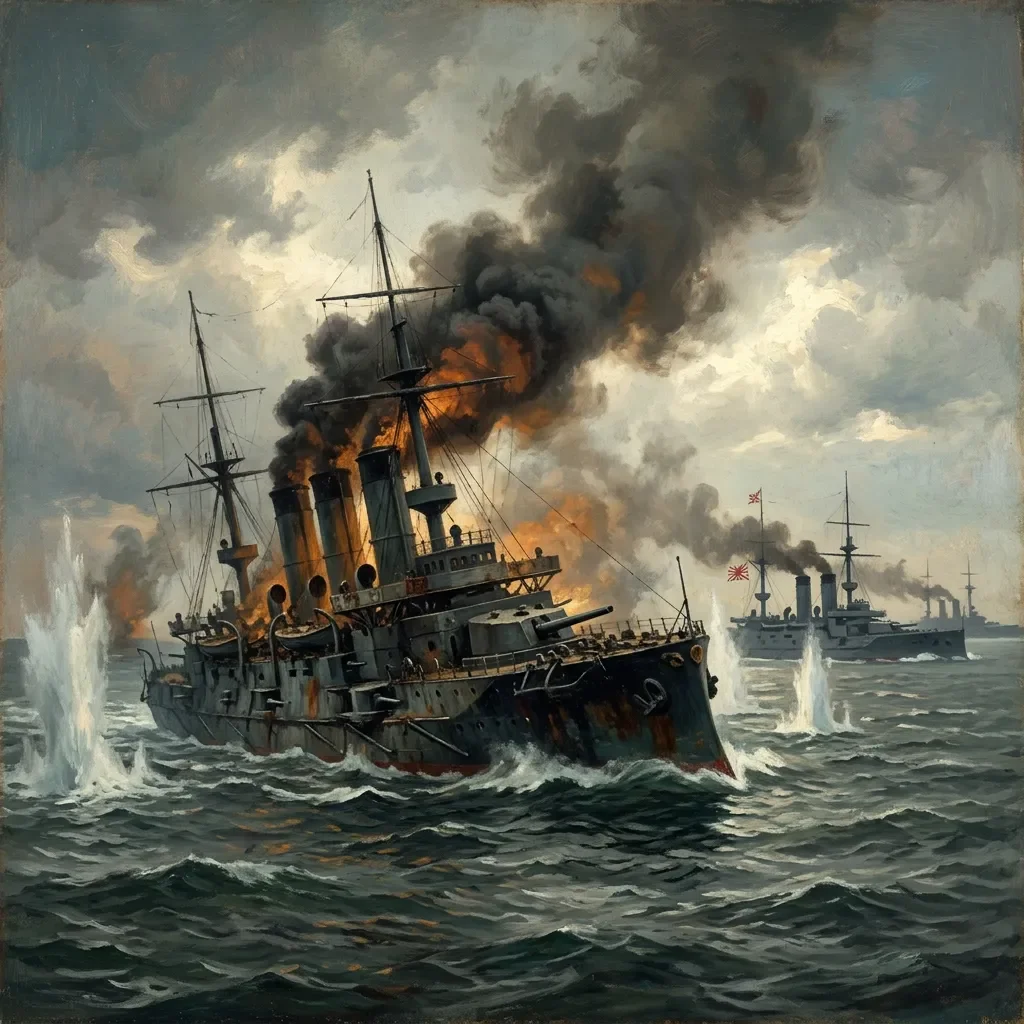
In May 1905, Russia's Baltic Fleet arrived at Tsushima Strait after an 18,000-mile, eight-month voyage from Europe — only to be annihilated by Japan's Admiral Tōgō in less than two days. It was the most lopsided naval battle of the modern era, and it shocked the world by proving a European great power could be decisively beaten by an Asian nation.

The Fleet That Sailed to Its Doom — Tsushima, 1905
0:0014:17
In the early hours of May 27, 1905, a Japanese hospital ship crossing the Korea Strait spotted something in the dark: dozens of massive warships moving without lights. That sighting touched off a battle that would shock the world and, many historians argue, mark the beginning of the end for European dominance in Asia.
The story behind it is almost absurd in its scale. Russia's Baltic Fleet — one of the largest naval forces ever assembled — had spent seven and a half months sailing 18,000 miles from the Baltic coast of Latvia, around Africa, across the Indian Ocean, all the way to Japanese waters. By the time they arrived, the ships were barnacled, the crews were spent, and the gunnery was poor. Their commander, Admiral Rozhestvensky, chose the shortest route through the Korea Strait rather than the long way around Japan — and Admiral Tōgō Heihachirō, who had trained in Britain and drilled his fleet to a razor's edge, was waiting for him.
What followed was one of the most decisive military engagements of the modern era: Tōgō's famous T-crossing maneuver, the devastating effect of Japan's high-explosive shimose shells on Russian warships, and a rout so complete that only three Russian vessels out of 38 ever reached Vladivostok. About 5,000 Russian sailors died. Japan lost three torpedo boats.
The consequences rippled outward far beyond Russia and Japan. Tsar Nicholas II was forced to negotiate the Treaty of Portsmouth, ending the Russo-Japanese War in September 1905. And for colonial subjects across Asia and Africa watching from afar, Tsushima sent an unmistakable signal: a European great power could be beaten, decisively, by a non-European nation — and that assumption, once shattered, could not be put back together.

围绕这条内容继续补充观点或上下文。

  • 登录后可发表评论。