Wreckage and Witness: The Story of The Raft of the Medusa

Wreckage and Witness: The Story of The Raft of the Medusa

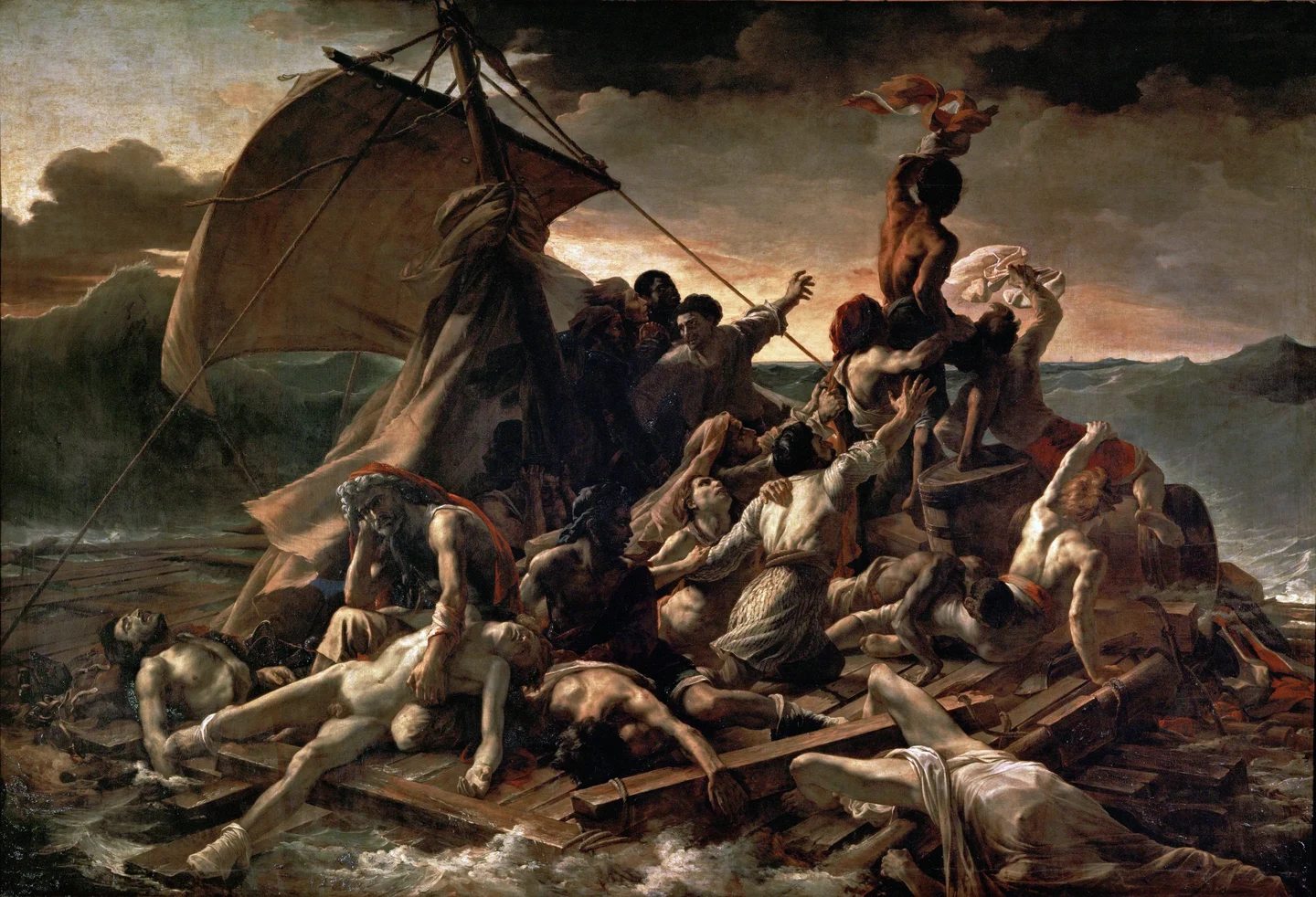
In July 1816, the French frigate Méduse ran aground off Mauritania through the incompetence of a politically-appointed royalist captain. Of the 147 people abandoned on a makeshift raft, fifteen survived thirteen days of starvation, mutiny, and cannibalism. Théodore Géricault spent eighteen months transforming that atrocity into a 4.91 × 7.16-meter canvas — interviewing survivors, sketching the dead, shaving his head, keeping a severed head in his studio — that became the manifesto of French Romanticism. The painting won a gold medal at the 1819 Salon, earned 40,000 London visitors in 1820, and reached the Louvre in 1824 through an auction ruse orchestrated by Géricault's closest friend. It now hangs in Salle 700, Denon wing, as the permanent rebuke its creator intended.

Museum Artifact Story Pick
2026/6/21 · 23:26
2 订阅 · 36 内容

Wreckage and Witness: The Story of The Raft of the Medusa
On July 2, 1816, the French frigate Méduse ran aground on the Banc d'Arguin, a sandbar off the coast of present-day Mauritania. The ship had drifted 160 kilometers off course. 1 Captain Hugues Duroy de Chaumareys, a Viscount and returned royalist émigré who had not sailed in twenty years, had been given command through Bourbon political preferment — a reward for loyalty to the restored monarchy rather than any demonstrable competence at sea. 2 He had allowed an inexperienced passenger named Richefort to serve as navigator. The result was a maritime disaster, a political scandal, and, three years later, one of the most disturbing paintings ever to hang in the Louvre.
The painting that came out of the wreck of the Méduse measures 4.91 meters tall and 7.16 meters wide — roughly the size of a tennis court standing on end. 3 It shows approximately twenty figures on a makeshift raft, most of them dead or dying, a few of them desperately waving toward a speck on the horizon that is a ship called the Argus. Théodore Géricault (1791–1824), the twenty-seven-year-old who painted it, had shaved his head, lived like a monk, studied corpses at the hospital morgue, borrowed a severed head from a lunatic asylum, and spent eighteen months transforming a real atrocity into a nine-by-sixteen-foot accusation. 2 He died five years after completing it, at thirty-two, from tuberculosis compounded by riding injuries, before he could see what it became: the founding document of French Romanticism, and one of the permanent collection's most visited works at the Louvre. 4
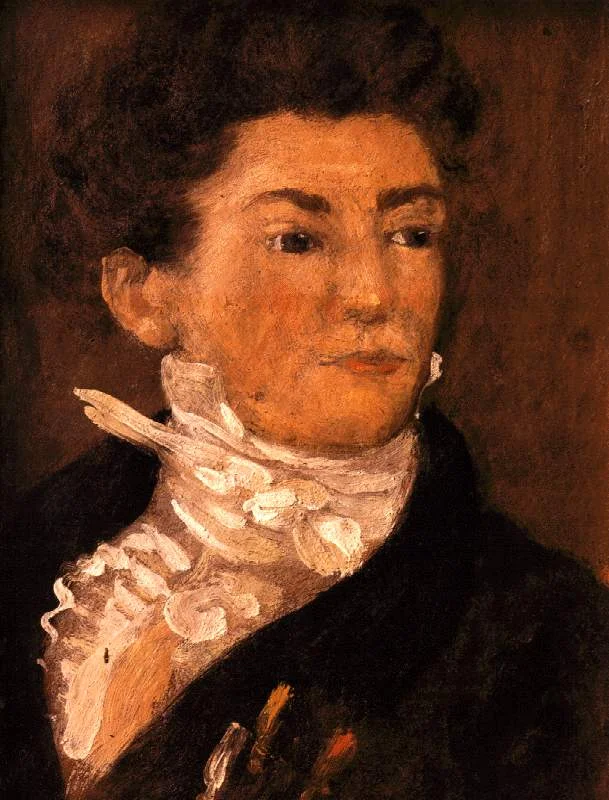
Théodore Géricault, self-portrait, c. 1808–1812
Géricault painted this self-portrait in his late teens or early twenties — perhaps a decade before he began the Raft. 4

The disaster that made the painting possible

The Méduse sailed from Rochefort on June 17, 1816, as part of a convoy bound for Saint-Louis, Senegal, which France was reclaiming from Britain under the terms of the Peace of Paris. 1 She carried 400 people, including the appointed governor Colonel Julien-Désiré Schmaltz, his wife Reine, and their daughter. Three weeks later, with the ship hard aground and impossible to refloat, Captain Chaumareys ordered the construction of a raft.
What went onto that raft — at least 146 men and 1 woman, crowded onto a platform 20 meters long and 7 meters wide — was already a statement about who mattered. 2 The officers and prominent passengers took the six lifeboats. The raft received one bag of ship's biscuit (eaten on the first day), two casks of water (both washed overboard), and six casks of wine. The lifeboats were supposed to tow the raft. After a few miles, the tow ropes were cut. The Méduse's captain had abandoned his own passengers at sea. 1
Over the next thirteen days, the raft descended into something that survivors could barely put into words. Jonathan Miles, who wrote a book on the subject, described what they experienced as a journey "to the frontiers of human experience. Crazed, parched and starved, they slaughtered mutineers, ate their dead companions and killed the weakest." 2 On July 17, 1816, the brig Argus spotted the raft by chance — no rescue had been dispatched. Of the original 147 aboard, fifteen were still alive. 1
The political fallout was immediate. Two survivors — Henri Savigny, the ship's surgeon, and Alexandre Corréard, an engineer — published their account, Naufrage de la frégate la Méduse, in 1817. 2 It went through five editions by 1821 and was translated into English, German, Dutch, Italian, and Korean, making the incompetence and cruelty of Chaumareys's command an international story. 2 At his 1817 court-martial, Chaumareys was acquitted of abandoning the raft but convicted of incompetent navigation and sentenced to three years in jail — a verdict widely seen as a whitewash that protected the Bourbon monarchy from the full implications of its patronage system. 1 The scandal subsequently helped drive the Gouvion de Saint-Cyr Law, which mandated that French military promotions be based on merit rather than political loyalty. 2
Géricault was twenty-five when the Méduse sank. He read the accounts. He clipped the newspaper articles. And then, apparently, he waited — not passively, but in the way that a certain kind of artist waits: accumulating, brooding, letting the subject find its own shape.

The monk's studio and the borrowed head
In February 1818, Géricault ordered his canvas. 3 The marchand-restaurateur Étienne Rey delivered a stretched support measuring approximately 15 by 22 pieds — the standard French measure — for 440 francs. Géricault had already rented a studio at 80 rue du Faubourg-du-Roule, across from the Beaujon Hospital, in what now reads less like a practical choice than a deliberate one. The morgue was next door. 5
What followed, over the next eighteen months, was a program of research that veered between the scholarly and the macabre. Géricault tracked down Savigny and Corréard, the two survivors who had written the published account, and spent hours with them; their testimony, he later said, set the emotional tone for the entire composition. 2 He found the ship's carpenter, Lavillette, a third survivor, and had him build a scale model of the actual raft — accurate enough, the art historian Georges-Antoine Borias later noted, that the finished painting reproduces "even the gaps between some of the planks." 2 He traveled to Le Havre to study the sea and sky in storms. He sketched the dying in Beaujon Hospital. He brought severed limbs back to his studio — hospital waste, or worse — to watch what happened to human flesh over days. 5 For two weeks he kept a severed head borrowed from a lunatic asylum on his studio roof, drawing it at intervals. 2
Georges-Antoine Borias, the art historian who compiled the most detailed early account of this period, wrote: "Behind locked doors he threw himself into his work. Nothing repulsed him. He was dreaded and avoided." 2
Starting in November 1818, Géricault shaved his head and adopted what he called a monastic regimen: he and his eighteen-year-old assistant Louis-Alexandre Jamar slept in a small room adjacent to the studio, meals brought by a concierge, visitors discouraged. 2 He worked in total silence. Even the noise of a mouse, a friend noted, was enough to break his concentration. 2
His friend Montfort, who watched him paint, described a method that sounds almost paradoxically calm given the subject: "He seemed to proceed slowly, when in reality he executed very rapidly, placing one touch after the other in its place, rarely having to go over his work more than once." 2 He painted figure by figure, completing each one before moving to the next, working "directly on the white canvas, without rough sketch or any preparation of any sort, except for the firmly traced contours." 2
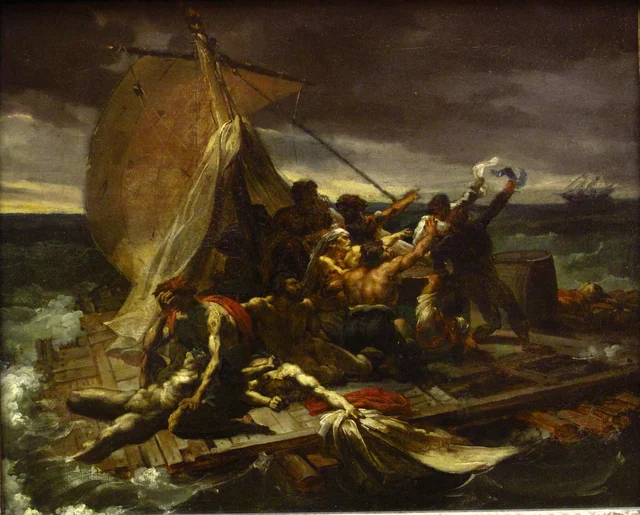
Géricault's preparatory oil study for *The Raft of the Medusa*, c. 1818–19, Louvre (RF 2229)
This oil study, 38 × 46 cm, is one of several Géricault made before committing to the final canvas. The overall composition is already largely resolved, though the final work is considerably darker and more tightly controlled. 3
Among the models who came to the studio: Eugène Delacroix (1798–1863), then a young painter and Géricault's close friend, who posed for the foreground figure lying face down with one arm extended. 2 Jamar posed nude for the dead youth slipping off the left edge. Savigny, Corréard, and Lavillette were painted from life for the three figures huddled in shadow near the mast. A Haitian-born model known as Joseph — described in period records as "le modèle noir" — was hired to paint at least two Black figures on the raft, including the one at the composition's apex. 2
Delacroix later described seeing the painting while it was still in progress. "It made so tremendous an impression on me that when I came out of the studio I started running like a madman and did not stop till I reached my own room." 2

What the painting shows — and what it argues
The canvas, 491 by 716 centimeters in its final dimensions, is built around two intersecting diagonal lines. 3 The first runs from lower left — where the dead and near-dead accumulate — upward and to the right along the mast's direction toward a wave bearing down on the raft. The second, opposing diagonal is formed by the surge of living figures reaching toward the upper right, where a tiny shape sits on the horizon: the Argus, the ship that had already passed by once without seeing them. The survivors' own account records the moment: "From the delirium of joy, we fell into profound despondency and grief." 2
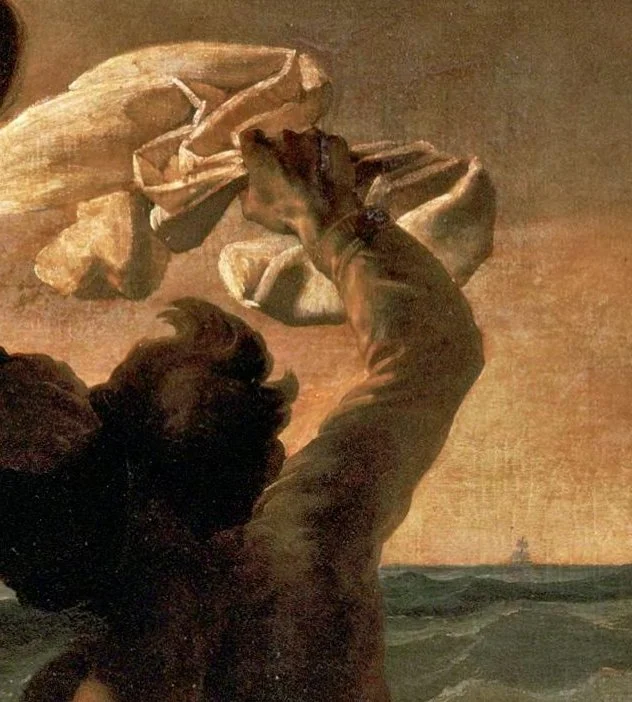
At the apex of the composition, standing on an empty barrel, is a figure who dominates the painting. Géricault modeled him on Joseph — Jean Charles, a Black military officer, waving a dark red handkerchief toward the retreating ship. 2 That placement was not incidental. Géricault was an abolitionist, and positioning a Black figure as the painting's central act of will — the strongest body, the highest gesture, the one point where survival is still being actively fought for — was a deliberate reversal of the convention in European painting that had traditionally depicted Black figures as supplicants or subordinates. Art historians Klaus Berger and Diane Chalmers Johnson noted that Géricault made Jean Charles "the focal point of the drama, the strongest and most perceptive of the survivors, in a sense, the 'hero of the scene.'" 2
Detail: Jean Charles at the apex of the composition, waving toward the *Argus*
The tiny silhouette of the Argus is visible on the horizon at right. The ship had already passed without seeing the raft; the survivors' subsequent despair became the painting's emotional subject. 2
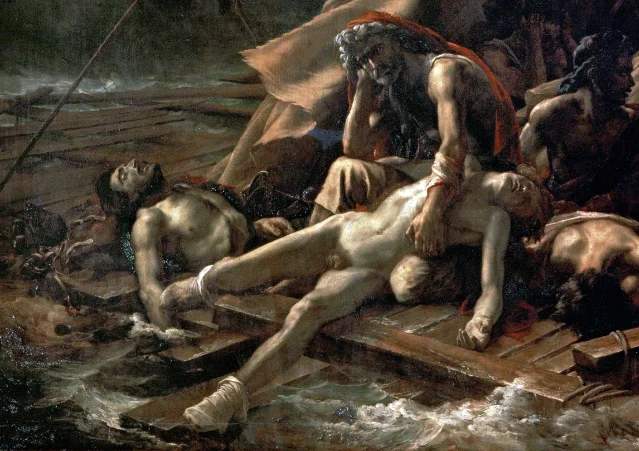
In the lower left foreground, Géricault placed an old man cradling a young man's corpse across his knees. The pose references the Ugolino story from Dante's Inferno — the count who, imprisoned with his sons and grandsons, was forced to watch them die of starvation, and in some readings of the poem, subsequently ate them. 2 Géricault knew the figure from prints after Henry Fuseli's treatment of the same subject; in borrowing it, he embedded a coded reference to cannibalism — the raft's most unspeakable episode — in a pictorial convention that viewers of his era would have recognized without having it stated.
Detail: the old man and dead youth at the lower left of the canvas, echoing Ugolino from Dante's *Inferno*
Géricault reversed the emotional weight of the Ugolino motif: where Dante's count stares inward with guilt, this old man stares outward with vacancy — past grief, past rescue, past the painting itself. 2
The palette is overwhelmingly brown and gray — what contemporaries called "bistre," a tone Géricault believed "effective in suggesting tragedy and pain." 2 His documented sixteen pigments included vermilion, white, Naples yellow, two yellow ochres, two red ochres, raw sienna, light red, burnt sienna, crimson lake, Prussian blue, peach black, ivory black, Cassel earth — and bitumen. 2 That last ingredient has proved irreversible: bitumen darkens over time into a black treacle, contracting the paint surface into wrinkles that cannot be reversed. As a result, significant areas of the canvas are now significantly darker than Géricault intended, and details that would once have been legible are gone. The sea, which Géricault rendered in dark greens rather than deep blue specifically to avoid contrast with the raft's figures, has in places darkened further still. 3 The full-size copy made in 1859–60, now in Amiens at the Musée de Picardie, gives some sense of what the tonal range was before the bitumen took hold. 2
The single area of chromatic intensity — the red handkerchief in Jean Charles's raised hand — burns against the surrounding murk. It reads now the same way it would have in 1819: as the painting's one note of defiance.

The Salon of 1819 and the quip that missed the point

The painting was accepted for the Salon of 1819 under the carefully neutral title Scène de naufrage — Shipwreck Scene. 2 No one was fooled. The Méduse disaster was three years old and still raw in public memory. Three days before the Salon opened, Louis XVIII came to view the work. His remark has been quoted ever since: "Monsieur, vous venez de faire un naufrage qui n'en est pas un pour vous" — loosely, "Monsieur Géricault, your shipwreck is certainly no disaster for you." 6 It was diplomatic to the point of evasion: a compliment to the painter that said nothing about the painting's subject, which was, in part, an indictment of the political system that had made Louis XVIII's restoration possible.
The Salon opened on August 25, 1819. The painting was initially hung above a doorway leading to the Grande Galerie — a position Géricault regarded as a mistake, high enough that the scale was difficult to read. In late October it was moved to the front row, and from then on it dominated the room. 3
Critics divided with unusual sharpness. Devotees of Neoclassicism, for whom history painting meant idealized subjects drawn from antiquity or Scripture, called it "a pile of corpses" and professed to find it repellent. The painter Marie-Philippe Coupin de la Couperie put the objection with accidental precision: "Monsieur Géricault seems mistaken. The goal of painting is to speak to the soul and the eyes, not to repel." 2 What Coupin had identified — correctly — was that Géricault was doing something new: insisting that the hideous could be the proper subject of great painting. The liberal critic Auguste Jal praised it for exactly that reason, noting its political theme, its advancement of a Black figure to the painting's center, and its critique of the ultra-royalist administration that had appointed Chaumareys. 2 The jury awarded a gold medal. The Louvre did not purchase it. Instead, Géricault received a commission for a Sacred Heart of Jesus painting — which he quietly passed to Delacroix, signing Delacroix's finished canvas as his own. 2

London, 40,000 visitors, and the return home

In April 1820, Géricault signed a contract with James William Bullock, a British entrepreneur who ran the Egyptian Hall at 170 Piccadilly. 2 The painting went to London. From June 12 to December 30, 1820, it was on view at the Egyptian Hall — hung deliberately low to the ground, closer to the viewer than the Salon's elevated placement, letting the scale do what scale does when you stand five feet from a painting that is five meters tall. 2 Approximately 40,000 people saw it. Géricault earned close to 20,000 francs from the exhibition. 3
The British reception was warmer than Paris had been. An American newspaper, the American Beacon and Norfolk and Portsmouth Advertiser, reported in September 1820 that "the work far excels anything we have ever seen of the school to which it belongs." 7 The art historian Christine Riding has noted that the positive reception in Britain may have had something to do with the country's anti-slavery movement, which was at a peak of political activity in 1820 — the painting's centering of a Black figure as the figure of hope resonated differently in London than it had in Paris. 2 The painting then moved to Dublin's New Rotunda in early 1821, where it drew smaller crowds — a competing theatrical panorama titled The Wreck of the Medusa, allegedly produced with a survivor's input, drew much of the audience away. 2
The painting was rolled up and returned to France. Auguste de Forbin, director general of the Royal Museums, made two separate attempts to purchase it for the national collection — 6,000 francs in February 1822, then 5,000 to 6,000 francs later that year, with the idea of sending it to Versailles. Both offers were rejected, most likely because the price was considered too low and because the painting's political charge still made the Ministry of the King's Household uneasy. 3 The painting stayed in Géricault's possession, unsold.

The auction, the ruse, and 6,005 francs
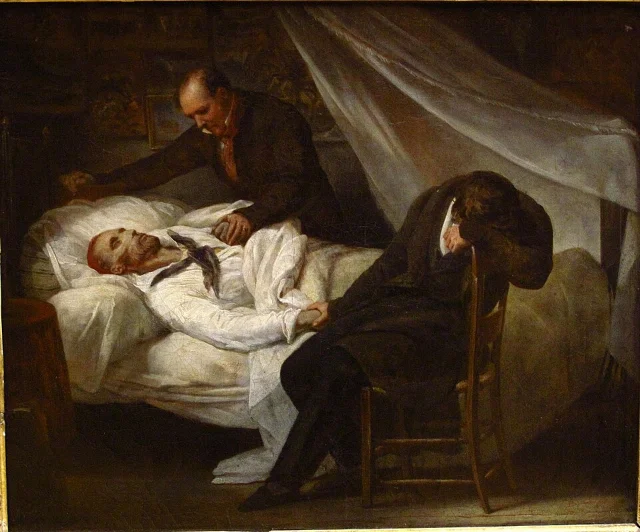
Géricault died on January 26, 1824 (the Louvre catalog gives January 28), aged thirty-two. 3 Tuberculosis had been consuming him for years; multiple riding accidents had weakened him further. During his final long illness, he had stayed in the home of his closest friend, Pierre-Joseph Dedreux-Dorcy (1789–1874), a painter who had trained alongside him in Pierre Guérin's atelier. Dedreux-Dorcy was at his bedside when he died. 8
In his final months, Géricault was working on preliminary drawings for two large compositions he would never paint: The Opening of the Doors of the Spanish Inquisition and The African Slave Trade. The second subject, in particular, suggests where his mind was turning — the abolitionist argument implicit in the Raft would have become explicit. 4
He is buried at Père Lachaise Cemetery in Paris, under a tomb designed by Antoine Étex. A bronze figure lies on top, brush in hand. On the low relief panel at the tomb's base: the Raft of the Medusa. 4
The posthumous auction of his estate took place on November 2, 1824, at the Hôtel de Bullion, 3 rue Jean-Jacques Rousseau, Paris. The Raft of the Medusa was Lot Number 1. 3
Forbin had not given up. He arranged for Dedreux-Dorcy — who was present at the auction as a mourner, as a friend, as the man who had watched Géricault die — to bid on the painting on behalf of the Ministry of the King's Household, acting as a straw buyer. The Ministry's own representative in the room was not authorized to go above 5,000 francs. When bidding exceeded that, Dedreux-Dorcy kept going. The hammer fell at 6,005 francs. 3 8 Forbin advanced the payment from his own funds. A week later, an American buyer offered three times the price — reportedly around 18,000 francs — to purchase the painting from Dedreux-Dorcy. He declined. He sold it back to the French government for the 6,000 francs he had paid, on one condition: that the painting be placed in the Louvre. 8 On November 12, 1824, the Vicomte de La Rochefoucauld, head of the Department of Fine Arts, wrote to Forbin confirming the Crown's acquisition. 3
Ary Scheffer, *The Death of Géricault*, 1824. Pierre-Joseph Dedreux-Dorcy, who bought the *Raft* at auction on behalf of the Louvre, is the figure seated in the foreground, head bowed.
Scheffer painted this memorial scene in the same year as Géricault's death. The figure standing at the bedside is the painter Louis Bro; Dedreux-Dorcy sits in the foreground. Seven months after this scene, Dedreux-Dorcy would use his presence at the auction to ensure the painting reached the Louvre. 8

What the Louvre did with it

The painting entered the collection under Charles X and was registered as C 51 in the royal acquisitions ledger. 3 It went on public display in 1826, first in the Salon Carré, then in the Grande Galerie. By 1833, an American visiting the collection wrote to the New Hampshire Sentinel that "no man of taste, no lover of the arts can ever visit this noted collection without pausing to admire this chef d'oeuvre of sea pieces." 7 Between 1852 and 1860, the conservator Frédéric Villot re-inventoried the Louvre's holdings and assigned the painting the number it carries today: INV 4884. 3
The painting's life in the Louvre has been peripatetic by the standards of a permanent collection. In late 1848, a falling ladder tore the canvas; it was repaired that year and moved to the Salle des Sept-Cheminées. 3 In 1859–60, concern about the bitumen's worsening darkening led the Louvre to commission a full-size copy — the painters Eugène Ronjat and Pierre Désiré Guillemet spent fifteen months on a 493 × 717 cm reproduction that now hangs in the Musée de Picardie in Amiens. 2 When the Franco-Prussian War threatened Paris in September 1870, the painting was taken down, rolled up, and stored in the Louvre's ground floor. 3
The most dramatic evacuation came in 1939. On the night of September 3 — one day after Britain declared war on Germany — a scenery truck from the Comédie-Française transported the painting, unrolled, to the Orangerie of the Château de Versailles. 3 That it was moved unrolled — a canvas nearly five meters tall and more than seven meters wide — speaks to the logistical care the Louvre applied to paintings it could not risk rolling for fear of cracking degraded paint. From Versailles it traveled to the Château de Louvigny in the Sarthe department, then to the Château de Sourches in Saint-Symphorien. It came home on July 11, 1946, after nearly seven years away. 3 The same precaution — transporting the canvas unrolled, flat — had been taken during the First World War, when the painting was moved to the Église des Jacobins in Toulouse for the war's duration. 3
Post-war conservation work in 1948 involved a new stretcher frame and the installation of tension bands along the canvas edges. René Longa carried out partial cleaning of the varnish in 1949. 3 The most recent conservation, in November and December 2018, was performed by Jean-Pascal Viala and Luc Hurter — renewal of the edge tension bands and re-stretching, the kind of structural maintenance a painting of this scale and age requires periodically. 3

The manifesto that changed the room

What the painting had already done to French art before Géricault died is measurable in the career of Eugène Delacroix, who posed for it as a model and then left the studio running. Delacroix's Barque of Dante (1822), his Massacre at Chios (1824), Liberty Leading the People (1830), and The Shipwreck of Don Juan (1840) all carry the Raft's fingerprints: the monumental canvas, the contemporary subject treated with the gravity that Neoclassicism reserved for ancient myths, the refusal to prettify death. 2 Art historian Hubert Wellington identified the debt directly: "Delacroix's masterpiece of 1830, Liberty Leading the People, springs directly from Géricault's The Raft of the Medusa." 2
The influence crossed the Channel. J.M.W. Turner's A Disaster at Sea (c. 1835) and The Slave Ship (1840) both extend what Géricault had opened — particularly the latter, which places a person of color at the center of a maritime atrocity, continuing an argument the Raft had initiated. 2 The line from Géricault runs forward to Courbet and Manet, both of whom treated unglamorous contemporary subjects with the scale and seriousness that Neoclassicism had kept for gods and heroes. 2
The art-historical claim is often summarized as "Géricault laid the foundations of an aesthetic revolution," but what that phrase means concretely is this: he was the first major French painter to insist that a hideous event from the news could be the proper subject of a large-format history painting, and that the painting's value was not diminished — might even be increased — by the ugliness of its content. Coupin de la Couperie had called that a mistake. Within a generation, it was the definition of serious painting. 2
The historian Jules Michelet, writing decades later, distilled the painting's political charge into a sentence that became famous: "our whole society is aboard the raft of the Medusa." 2 The painting had by then been recognized as exactly what it was — not a nautical disaster painting, but a statement about who gets thrown off the lifeboat when the ship goes down.

Salle 700, Denon wing

The painting now hangs in Salle 700, also known as the Salle Mollien, in the Denon wing of the Louvre, Level 1. 3 It has been in that gallery continuously since 1995, having previously occupied the Salle Mollien from 1949 to 1969, then the Salle Daru from 1969 to 1994. It is displayed among works of French Romanticism, which is the movement it created.
Standing in front of it, several things become clear that do not transfer in reproduction. The painting is big enough that you cannot take it in at a single glance — you move across it the way you move along a diorama, and different figures demand attention at different stops. The foreground dead are at roughly eye level, their bodies too large and too close to aestheticize. The figure of Jean Charles at the apex is above your eyeline; you look up toward him the way the figures on the raft look up toward the ship they are trying to reach. The handkerchief's red is the only warm color in the room.
The Louvre's own display caption for the painting reads: "The only hero in this poignant story is humanity." 3 That is a generous reading. The painting also contains a specific accusation: that the people on the raft were put there by incompetence rewarded with command, by a political system that valued loyalty to a monarch over the lives of ordinary people at sea. Captain Chaumareys's appointment was not an accident — it was policy. Géricault spent eighteen months of his short life making that argument on a canvas large enough that no one could look away.
Cover image: Théodore Géricault, Le Radeau de la Méduse, 1818–19, oil on canvas, 4.91 × 7.16 m. Musée du Louvre, INV 4884. Public domain.

围绕这条内容继续补充观点或上下文。

  • 登录后可发表评论。