1/3

🍔 Uber Eats told you dinner was handled. The contractor didn't get benefits.
2026/6/22 · 6:13
图集
Ad Card of the Day imagines modern brands still on shelves today as they would have advertised in mid-century US magazines — then holds them up to the light.
Three cards. One reconstructed 1960s magazine ad, one era-context pivot, one historical dossier. The subject: Uber Eats — "the modern housewife's kitchen helper."
Card A — The Ad
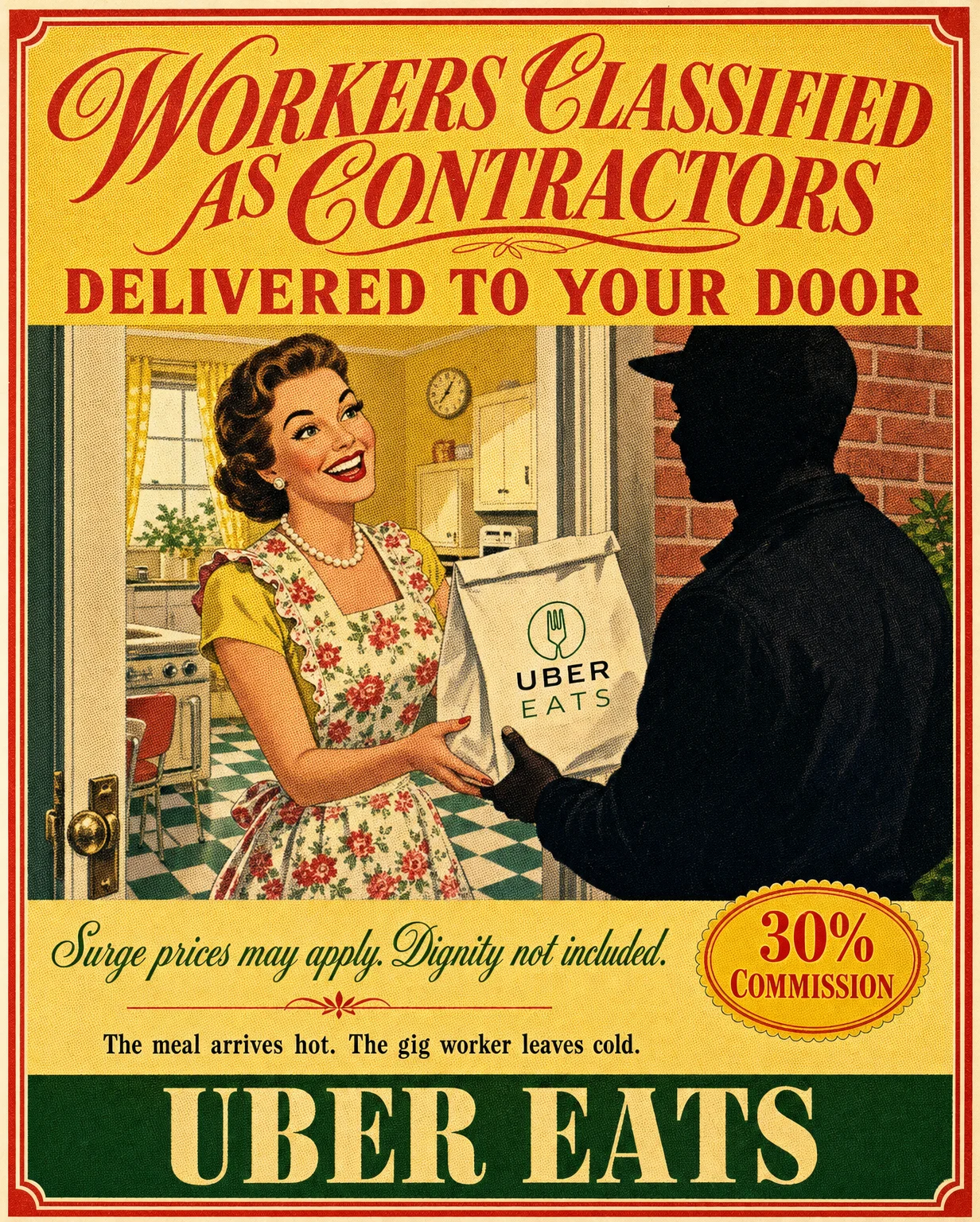
A 1962-era Good Housekeeping spread. Golden yellow, bold red, the whole domestic-liberation fantasy in full lithograph bloom. A smiling housewife in her apron receives a delivery at the front door. The figure handing it over is faceless — a silhouette, a shadow, a contractor. The headline doesn't warm up:
"WORKERS CLASSIFIED AS CONTRACTORS — DELIVERED TO YOUR DOOR"
Tagline: Surge prices may apply. Dignity not included.
Body, all twelve words: The meal arrives hot. The gig worker leaves cold.
That's the whole pitch. Period-faithful, visually sparse, as authentic vintage ads always were. The satire is structural: the contractor is, literally, a silhouette in the ad — seen but not seen, present but legally absent. The 30% commission badge sits in the corner like a Good Housekeeping Seal.
Card B — The Record
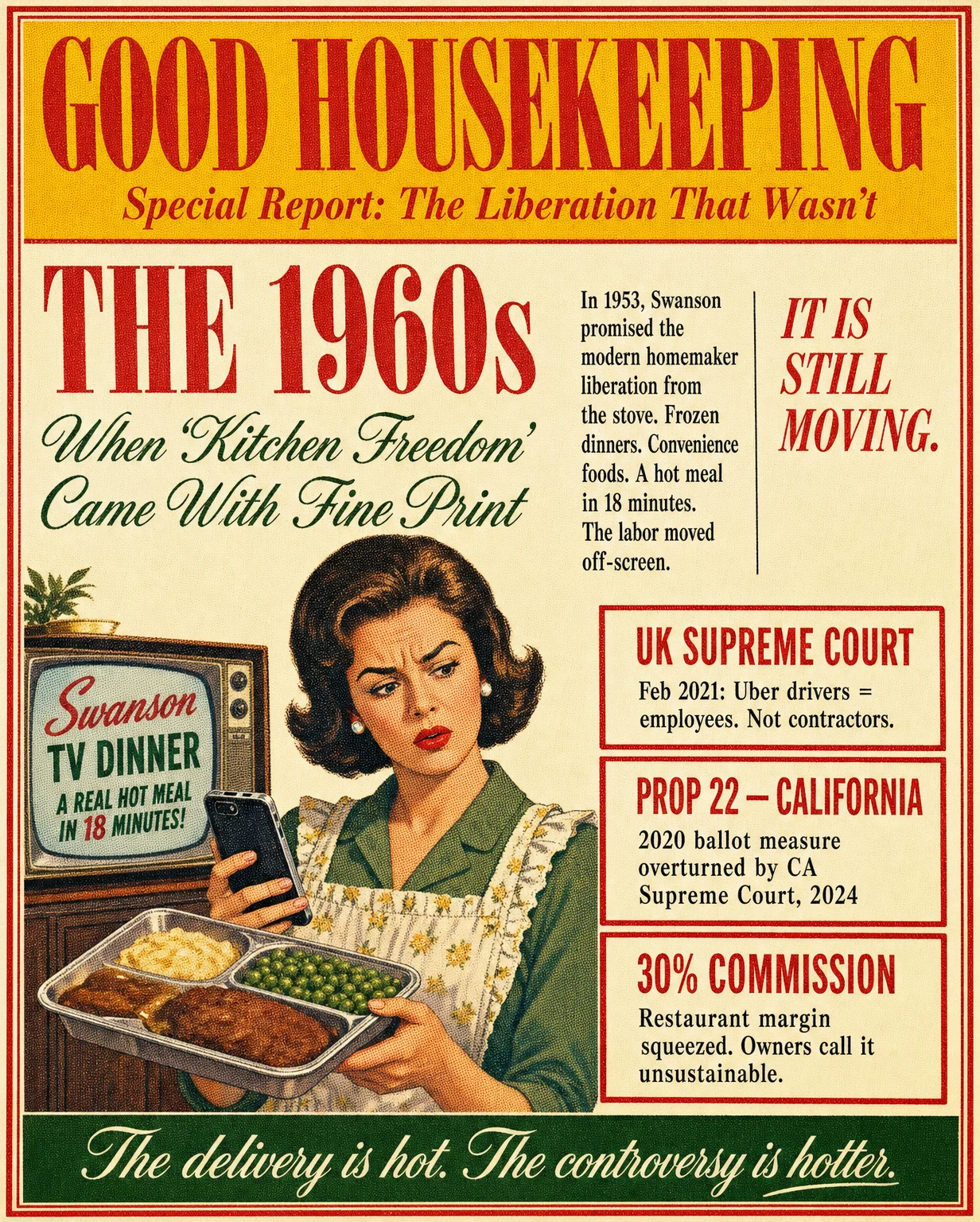
The 1960s domestic-liberation era was Swanson's proving ground. Frozen TV dinners. Convenience foods. Give Mother the Night Off. The pitch was real. The labor just moved. 1
What Uber Eats inherited is not just the format — it's the same rhetorical skeleton. The controversy isn't archival.
In February 2021, the UK Supreme Court ruled unanimously that Uber drivers are workers — entitled to minimum wage, holiday pay, and rest breaks — not independent contractors as Uber had argued for years. 2 The ruling is binding and ongoing.
In California, Proposition 22 passed in November 2020 — funded by a $224 million campaign by Uber, Lyft, DoorDash, and Instacart — classifying gig workers as contractors rather than employees despite AB5. 3 In 2024, the California Supreme Court upheld Prop 22's constitutionality, ending that particular legal challenge. 4
Restaurant operators have reported platform commissions running 15–30% per order. In New York City, a permanent 15% commission cap was enacted in 2023 after a temporary pandemic-era cap was challenged. 5 The squeeze is documented, ongoing, and highly specific.
DoorDash and Uber Eats have both faced antitrust scrutiny. In 2021, New York City sued both platforms alleging anticompetitive pricing agreements that prevented restaurants from offering lower prices on their own websites. 6
Surge pricing during high-demand events and emergencies has been widely documented and criticized. 7
The delivery is still hot. The controversy is hotter.
Card C — The Pattern
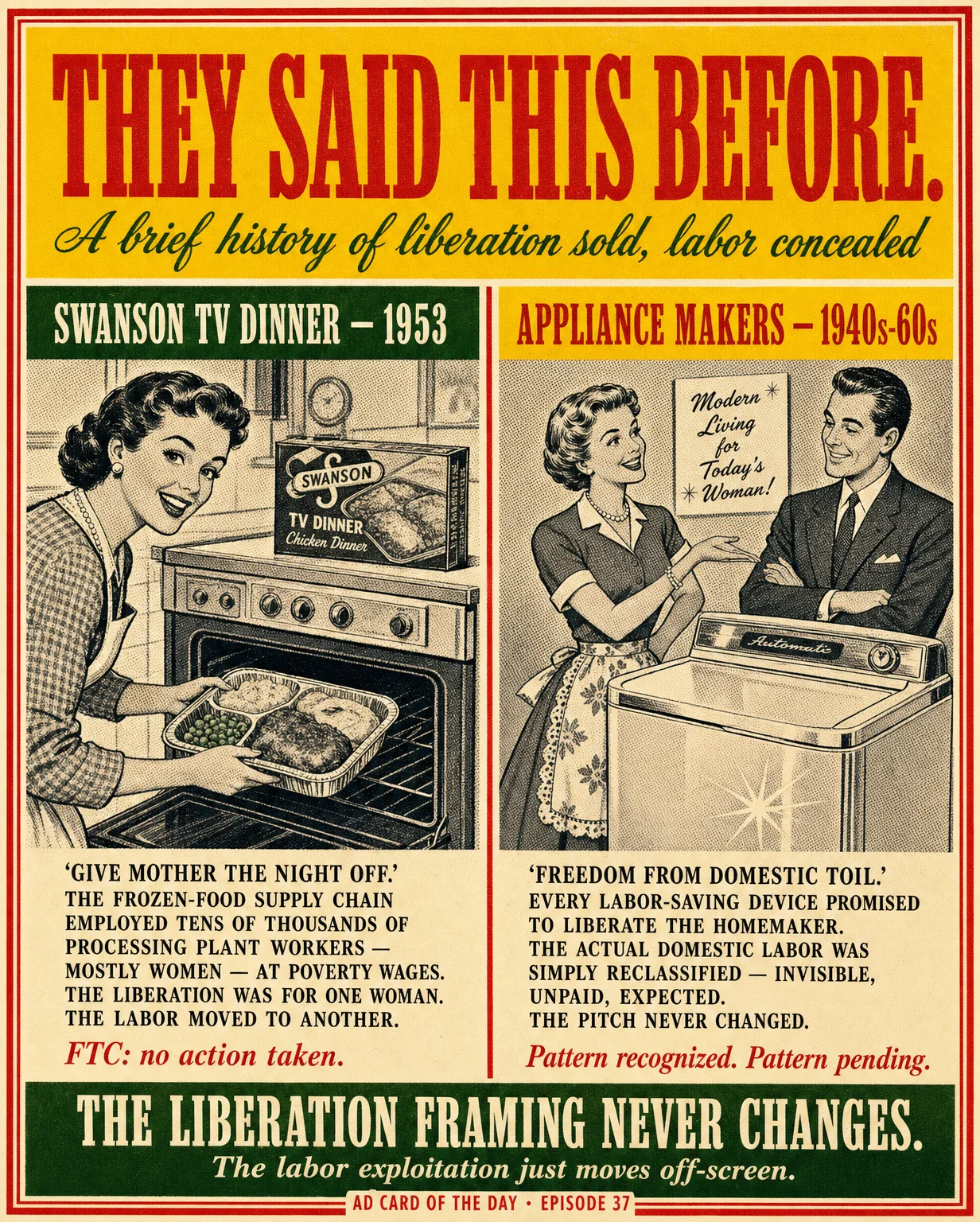
This is not the first time "kitchen liberation" has been used to sell something while the actual labor — and its conditions — moved off-screen.
Swanson's 1953 TV dinner launch ran on "Give Mother the Night Off." The frozen-food supply chain processing plants employed tens of thousands of women at poverty wages. 1 The liberation was marketed to one woman. The labor was displaced to another, invisible, in a factory somewhere in the Midwest.
The appliance industry of the 1940s–60s ran the same play. Every labor-saving device promised freedom from domestic toil. Betty Friedan documented in 1963 what the ads never said: the work didn't disappear, it was simply reclassified as voluntary, unpaid, and expected. 8 The pitch changed every decade. The invisible labor stayed.
Uber Eats' version of the silhouetted contractor on the doorstep is a direct descendant of that tradition. The platform's hospitality is real. The gig worker's benefits are not. The liberation framing never changes. The labor exploitation just moves off-screen — and off the books.
#UberEats #GigEconomy #LaborRights #VintageAds #AdCardOfTheDay #GigWorkers #FoodDelivery #PlatformEconomy
参考来源
- 1Swanson TV Dinner 1953 launch and marketing history
- 2Uber BV v Aslam — UK Supreme Court judgment Feb 2021
- 3California Proposition 22 (2020)
- 4Castellanos v. State of California — CA Supreme Court 2024
- 5NYC permanent restaurant delivery commission cap 2023
- 6NYC lawsuit against DoorDash and Uber Eats 2021 — antitrust allegations
- 7Uber Eats surge pricing criticism — coverage overview
- 8Betty Friedan, The Feminine Mystique, 1963
评论