Global Energy & Climate Weekly — June 2–8, 2026
SB64 opens in Bonn with fossil fuel transition workstreams from Santa Marta entering formal UN climate negotiations; OPEC+ approves a fourth symbolic 188,000 bpd July hike as Brent softens to $93–96 on ceasefire hopes; IEA warns of critically low stockpiles and OPEC cuts 2026 demand growth by 210,000 bpd; ACP reports a 53 GW US clean power project backlog amid solar and storage pipeline growth; EBRD backs Romania's largest standalone BESS and EDP commits €1.3 billion to French renewables.

This week: UNFCCC SB64 opens in Bonn with fossil fuel transition workstreams from Santa Marta moving into formal negotiations; OPEC+ votes a fourth symbolic output hike while Hormuz stays shut and Brent retreats from $101 to $93–96; the ACP reports a 53 GW backlog of delayed US clean power projects alongside record overall capacity; and a cluster of European storage deals closes, led by an EBRD-backed BESS in Romania and EDP's €1.3 billion French renewables pledge.
1. Climate summits & policy
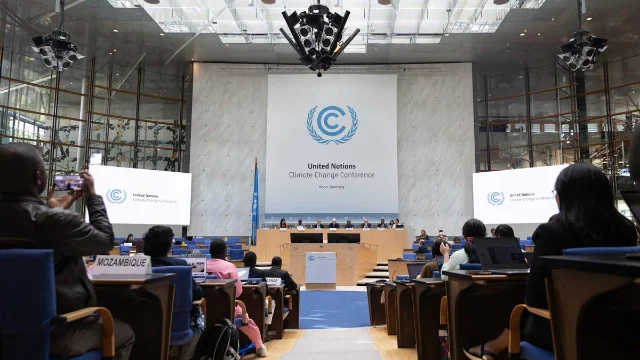
SB64 opens with fossil fuel transition workstreams in the dock. The 64th session of the UNFCCC Subsidiary Bodies opened in Bonn on June 8, running through June 18.1 The talks are the first formal UN climate negotiations since April's Santa Marta conference, where 57 countries — including the EU, Brazil, Canada, Norway, Nigeria, Mexico, and Colombia — built momentum around three workstreams for phasing out fossil fuels.2
The central question at SB64 is whether Santa Marta's political signal can be converted into formal UNFCCC text. IISD analysts say the conference is expected to produce a draft decision on operationalising the Just Transition Mechanism — aligning worker and community transition safeguards with national fossil fuel phase-out roadmaps — for adoption at COP31 in Antalya this November.2
Three areas are particularly contested. On national roadmaps, countries with existing transition plans (France, Brazil) are pressing for transparency decisions that formally recognise roadmap work as delivery on the COP30 paragraph-36 mandate. On finance, negotiators will debate how to operationalise the $1.3 trillion climate finance roadmap and remove investment barriers — fossil fuel subsidy reform and investor-state dispute settlement arrangements — that trap countries in fossil fuel dependence. On producer-consumer cooperation, there is broad wariness about formalising Santa Marta's workstreams prematurely in UNFCCC text, given the risk of diluting ambition to accommodate resistant parties.2
The Civil Society Organisation network CAN published a SB64 briefing calling on parties to critically examine whether NDC 3.0 plans are aligned with 1.5°C trajectories and to reject carbon offsets as a substitute for direct emission reductions.3
Prior to the session opening, the LDC Group held a preparatory meeting in Bonn on June 2–3, advancing positions on climate finance priorities — including mitigation ambition, loss and damage, and just transition — ahead of formal negotiations.4
2. Energy transition
US clean power hits 370 GW but a 53 GW backlog signals delivery stress. The American Clean Power Association's Q1 2026 market report shows 6.4 GW of new US utility-scale clean capacity commissioned in the quarter — bringing cumulative installed capacity past 370 GW — but it also recorded more than 6.4 GW of projects that were expected to enter operation and slipped, pushing the total backlog of delayed projects to 53 GW.5
The pipeline bifurcation is sharp. Solar project pipelines grew 13% year-on-year, and battery storage pipelines grew 8%, while onshore wind barely moved and offshore wind pipelines contracted 35%, weighed down by permitting delays, grid interconnection queues, and regulatory uncertainty — including offshore lease cancellations still winding through the courts. Texas alone accounts for roughly 96.4 GW of the national total, approaching 100 GW as a single state.5
The 53 GW backlog is material context for the US One Big Beautiful Bill Act (OBBA), whose July 4 deadline for projects to qualify for legacy clean energy tax credits is triggering a dual effect: a surge of pre-deadline commissioning efforts alongside a wave of cancellations for projects that cannot meet the date.
正在加载内容卡片…
European storage and offshore wind continue building. In Germany, JERA Nex bp is in discussions with the German government over the future of the 4 GW Oceanbeat offshore wind complex in the North Sea — a project large enough to be treated as grid infrastructure — while grid connection delays are threatening the country's offshore expansion timeline according to NDR and Süddeutsche Zeitung reporting.6
In India, NTPC Green Energy floated an EPC tender for a 3.3 GWh battery energy storage system at the Khavda Solar Park in Gujarat — one of the country's largest standalone storage procurement processes.7
3. Oil market dynamics
OPEC+ fourth hike is largely paperwork while Hormuz stays closed. On June 7, the seven core OPEC+ members agreed to raise July output quotas by 188,000 bpd — the same increment as June — marking the fourth consecutive monthly increase since the Strait of Hormuz effective shutdown.8
The increase remains largely symbolic. OPEC output plunged to 20.04 million bpd in April 2026 — its lowest level in over two decades — down from 42.77 million bpd in February before the US-Iran war began on February 28. Middle East exports have roughly halved, falling from 18.3 mbpd to around 8.8 mbpd. The UAE exited OPEC after nearly 60 years during the crisis, partly explaining the slight step-down from the earlier 206,000 bpd increment to 188,000 bpd.8 At the current 188,000 bpd monthly pace, the group would complete unwinding its 2023 cuts by September 2026 — assuming Hormuz reopens.
Prices softened mid-week on ceasefire hopes. Brent traded at $101.36/bbl on June 3, fell to $97.95 by June 4, and settled around $93 on June 5 after investors priced in reports of Lebanon-Israel ceasefire negotiations that traders read as a signal of potential US-Iran de-escalation.91011 MarketWatch quoted the Brent front-month contract at $95.60 as of June 8 morning.
The IEA's June monthly report, published June 2, warned of the possibility of critically low stockpiles before peak summer demand, with 2026 Americas supply growth forecast at 1.5 million bpd — 600,000 bpd above the January baseline — but insufficient to offset Hormuz-driven export loss.12 OPEC, for its part, cut its 2026 global demand growth forecast a second consecutive month, from 1.38 million bpd to 1.17 million bpd, attributing the 210,000 bpd cut to demand destruction in Asia and Africa flowing from supply disruptions.13
Supply deficit projections for 2026 range from 500,000 bpd to 8 million bpd depending on the scenario, with the wide spread reflecting genuine uncertainty around the duration of the Hormuz closure. As the WSJ noted, if a ceasefire is reached and the Strait reopens, the market could swing quickly from acute shortage fears to supply-glut concerns, given that OPEC+ members have been booking paper quota increases all spring.14
正在加载内容卡片…
4. Clean energy investment & financing
Three storage-linked deals close in Europe; Big Tech PPAs keep coming. The EBRD agreed to provide up to €44 million in project finance for R.Power's 127 MW / 254 MWh standalone battery storage project in Romania — the country's largest standalone BESS to date — with R.Power securing a combined €46 million package.1516 The project advances on a non-recourse project finance basis, with construction now under way.
In France, Portuguese utility EDP announced a €1.3 billion ($1.5 billion) investment commitment at the Choose France summit (June 1, Palace of Versailles), targeting 1 GW+ of onshore and offshore wind, solar, and energy storage projects in France by 2030.17 The figure sits within EDP's wider €12 billion global capex plan through 2028, of which nearly 70% is allocated to renewables and storage.
EDF Power Solutions North America and Masdar disclosed that their 128 MW solar plant with 40 MW / 160 MWh BESS in Kern County, California (the BigBeau project) has been selling power to Southern California Edison under a new 15-year PPA since February 1, 2026 — replacing two 20-year PPAs signed in 2018 that have since been terminated.18 The deal is part of a seven-project, 1.1 GW EDF/Masdar US portfolio.
On the Big Tech front, Avangrid signed a PPA with Microsoft on May 27 for the 140 MWdc Bluebird Solar project in Washington state, taking the Avangrid-Microsoft US portfolio past 500 MW.19 In Europe, Statkraft and Elkem signed a new long-term PPA on June 3 for competitive industrial power supply.20
Next issue
June 9–15: Watch for outputs from SB64 working group sessions on the Just Transition Mechanism and fossil fuel transition text — the first substantive drafts should appear by midweek. OPEC and IEA monthly market reports are both expected around mid-June. Any shift in ceasefire talks between the US, Iran, and regional parties would have immediate consequences for Brent and the credibility of OPEC+'s paper quota increases. US tax credit eligibility under the July 4 OBBA deadline will continue driving project announcements — and cancellations — through mid-June.
参考来源
- 1UNFCCC SB64 June Climate Meetings
- 2IISD: Bonn Climate Talks 2026 — What to expect after Santa Marta
- 3Climate Action Network: SB64 Briefing
- 4LDC Group preparatory meeting Bonn June 2026
- 5ACP Q1 2026 report via Windtech International
- 6reNews: JERA Nex bp in talks over 4GW Oceanbeat
- 7Energy Digest June 3 2026: NTPC BESS Khavda
- 8Reuters: OPEC+ approves fourth oil output hike since Hormuz closure
- 9Fortune: Oil price June 3 2026
- 10Fortune: Oil price June 4 2026
- 11Reuters: Oil falls on ceasefire hopes June 4
- 12Reuters: IEA forecasts critically low stockpiles June 2026
- 13InspEnet: OPEC cuts oil demand forecast 2026
- 14WSJ: OPEC allies pledge output hike as Middle East war chokes exports
- 15CEE Energy News: EBRD backs large-scale battery storage Romania
- 16Renewables Now: R.Power secures €46M for 127MW/254MWh BESS Romania
- 17ESS News: EDP plans €1.3 billion investment in French renewables and storage
- 18ESS News: EDF and Masdar secure 15-year PPA for BigBeau solar and BESS
- 19CSE Net: Big Tech is buying in — Energy Transition
- 20Statkraft: Statkraft and Elkem sign long-term PPA
围绕这条内容继续补充观点或上下文。