Glean: how enterprise search became the Work AI context layer
A growth teardown of Glean's move from enterprise search into Work AI: the acquisition wedge, context-graph retention loop, Enterprise Flex monetization, and what builders can copy.

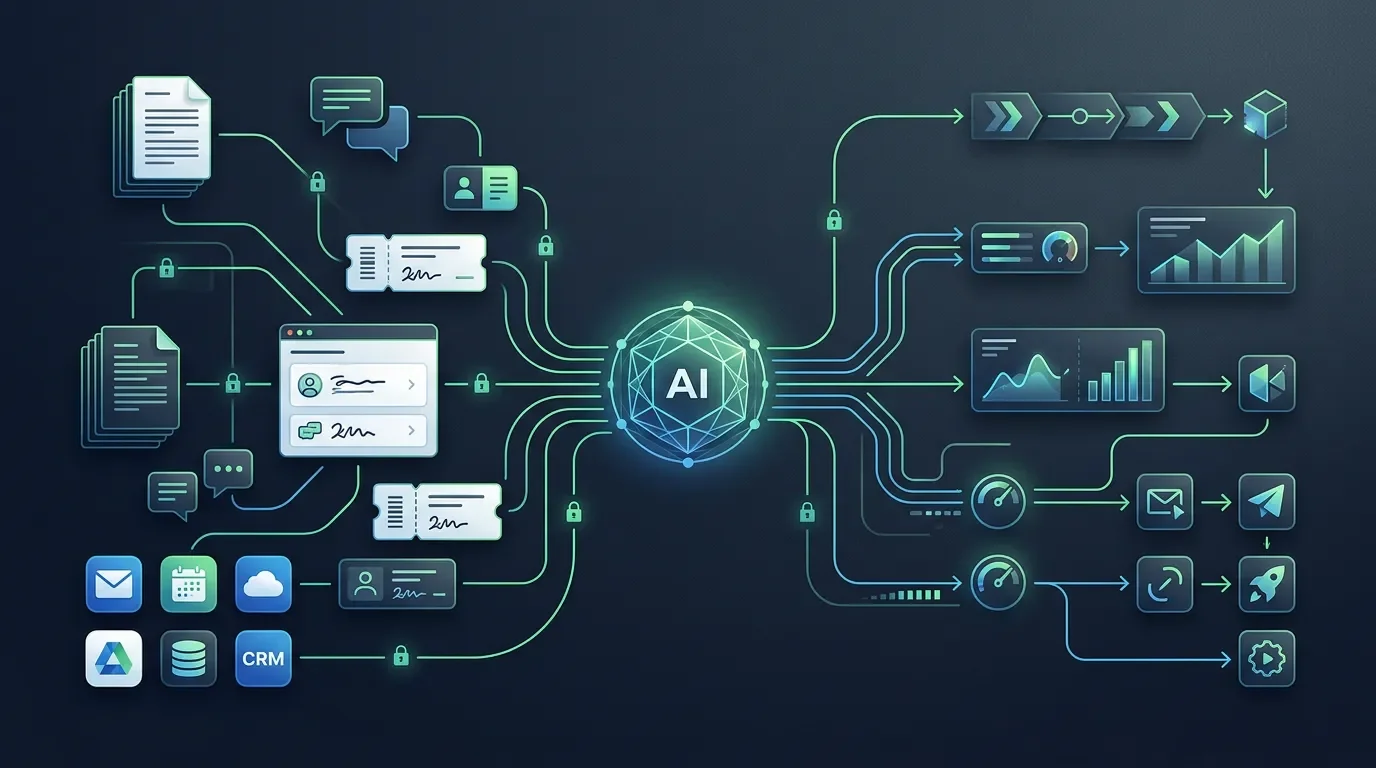
Glean is no longer just selling enterprise search. Its growth story is now about becoming the context layer that lets large companies use AI without dumping every workplace document, ticket, Slack thread, and policy into a generic model.
That shift shows up in the numbers. TechCrunch reported that Glean reached $300 million in annual recurring revenue or annualized run-rate revenue, up from $100 million 15 months earlier; the same piece notes that part of the figure includes consumption-based revenue, so it should not be read as pure subscription ARR. 1 CNBC separately listed Glean at a $7.2 billion valuation, $765.3 million in funding, and a 2019 launch year in its 2026 Disruptor 50 profile. 2
The interesting part is not that Glean grew. It is that its wedge has aged well. Search was a narrow, painful workflow. Work AI is a broader budget category.
Acquisition: sell the pain of scattered company knowledge
Glean's original hook was simple: employees cannot find the right internal answer fast enough. That is still the cleanest acquisition wedge because almost every large company has the same mess, but each thinks its mess is unique.
The current homepage positions Glean as a platform that connects knowledge, systems, and context across Slack, Google Drive, Jira, Confluence, SharePoint, GitHub, and Salesforce. 3 That is a better enterprise pitch than generic AI productivity. The buyer can map it to a known problem: too many tools, too many permissions, too many stale documents, too much employee time lost to internal search.

The ICP is also broader than the old enterprise-search buyer. CNBC describes Glean's move from search into "Work AI," where systems do not just surface information but execute tasks across a business. 2 That lets Glean enter through IT and knowledge management, then expand into engineering, HR, support, sales, and operations.
Customer logos reinforce that top-down motion. Glean's site lists customers such as Rivian, Samsung, Vanta, Wealthsimple, Intercom, SeatGeek, Webflow, BetterUp, Zillow, Motive, Intuit, Zapier, Booking.com, Canva, Reddit, Databricks, Pinterest, and Rubrik. 3 A founder cannot copy that logo wall. But the playbook underneath is copyable: enter through a universal work pain, then reframe the product as infrastructure for many departments.
Retention: the context graph becomes the switching cost
Search tools can be replaced if they are only a front end. Glean's retention comes from the back end it builds around each customer: connectors, permissions, usage patterns, agents, and company-specific context.
TechCrunch quotes CEO Arvind Jain saying Glean's AI understands customer business needs by connecting to and learning from enterprises' internal software systems, a layer the article calls a "context graph." 1 CNBC gives the same logic from the buyer side: Glean ingests data from workplace tools such as emails, chats, documents, and internal tickets to create a real-time map of how work happens, while preserving company structure, permissions, and workflows. 2
That is why the customer stories matter more than the homepage language. Zillow says Glean connects more than 30 data sources and 138 million documents, saves each employee 1.5 hours per week on information searching, and has more than 80% adoption across 7,000 employees. 4 Zillow also reported that 500 Glean agents were created within six weeks of launch and more than 3,400 had been created in total. 4

Booking.com is the same retention loop in a different shape. Its case study says Glean became the first AI platform adopted company-wide across 14,000 employees, cut promotional video creation time from eight weeks to two, increased output from two to five videos per month, and helped IT technicians reduce ticket-answering research from up to 10 minutes to little or no time. 5
The retention mechanism is not daily active use alone. It is organizational embedding. Once a company has indexed its documents, tuned permissions, built agents, trained workers, and attached workflows to Slack or coding tools, replacement means rebuilding company memory.
Monetization: seat access plus FlexCredit expansion
Glean's pricing is not fully public in dollar terms, and the company should not be treated as if it had a simple SaaS price card. What is public is the structure.
The Glean Enterprise Flex documentation says Enterprise Flex combines a per-user, per-month license with a pooled allowance of pay-per-use credits for advanced AI features. 6 It includes unlimited Fast Mode queries for Glean Assistant, while Thinking Mode queries with standard models are included up to 100 per user per week, with excess usage consuming FlexCredits. 6 Premium-model queries, code writer queries, slide generation, deep research, meeting notes, and Glean Agent runs consume FlexCredits. 6
That monetization design matches the product ladder:
- Basic search and assistant usage justify broad employee deployment.
- Advanced reasoning and agents create the expansion meter.
- Developer access lets Glean sit inside other AI workflows, not only its own app.
- Premium support and Protect+ create enterprise add-ons for compliance-heavy customers.
TechCrunch reports Jain said Glean offers both consumption-based pricing and a hybrid model that combines a fixed monthly fee for active users with separate usage fees for model consumption. 1 The same TechCrunch piece notes that Glean now sells AI cost reduction as part of the pitch, with Jain arguing that connecting AI to Glean can reduce the number of operations and tokens used. 1
That is the monetization trick. Glean does not only charge for AI usage. It also sells the idea that better enterprise context makes AI usage cheaper and safer.
Transferable takeaways
- Start with a universal workflow failure, not an AI category. "Employees cannot find the right internal answer" is easier to budget for than "enterprise AI transformation."
- Turn integrations into retention. Every connector, permission model, agent, and workflow attachment makes the product harder to rip out.
- Use customer metrics as product education. Zillow's adoption and agent counts explain the expansion path better than abstract platform copy.
- Price for two motions at once. Seats create deployment breadth. Usage credits capture heavy AI work. The best enterprise AI products will need both.
围绕这条内容继续补充观点或上下文。