2026/6/24 · 12:29
54 new species named Wednesday: a Critically Endangered bromeliad found with Brazil's Pataxó people, five Indian mantises, and a new cave-shrimp genus from the Caribbean
Wednesday June 24, 2026 delivered 54 new species and three new genera across Zootaxa, Phytotaxa, MycoKeys, ZooKeys, EJT, and WoRMS — headlined by Cryptanthus pataxoanus (CR), a marbled Atlantic Forest bromeliad described in partnership with Brazil's Pataxó indigenous community. Other standouts include five Oxypilinae mantises from India's Western Ghats, three Caribbean anchialine cave mysids plus the new genus Chelitrapezura, a new mycorrhizal genus (Durabilispora) from Poland's Tatra Mountains, and five new ladybirds in the Chinese Oenopia revision.

Wednesday, June 24, 2026 — An exceptional midweek haul: 54 confirmed new species plus 3 new genera and 1 new subspecies across Zootaxa 5837(3), Phytotaxa 763(3), MycoKeys 134, ZooKeys 1283, EJT 1070, and the WoRMS marine registry. Animals dominate, but plants and fungi arrive in force — and buried among the arthropods are two new genera of arbuscular mycorrhizal fungi from the Tatra Mountains.
A Critically Endangered bromeliad found with the Pataxó people
The day's most resonant discovery comes from a stretch of Atlantic Forest in southern Bahia, Brazil — a forest the Pataxó indigenous people have defended for generations. Cryptanthus pataxoanus Leme, E.P.Fern. & Fontana, sp. nov. (Bromeliaceae, Bromelioideae), described by researchers at the Jardim Botânico do Rio de Janeiro in collaboration with Pataxó community members, grows only in the Monte Pascoal National and Historical Park. 1
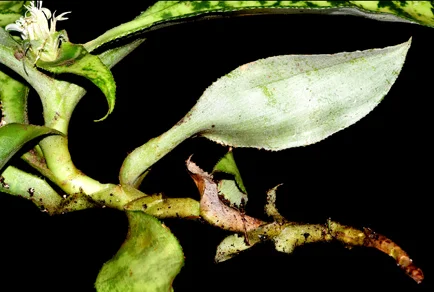
The authors describe the foliage as exhibiting contrasting greenish-yellow and dark green marbling, making the plant immediately distinctive within the genus. Taxonomically, it sits closest to Cryptanthus beuckeri, a species first described in the 19th century and re-described in the same paper. The new species is distinguished by leaves that lack a petiole (or have only a sub-petiolar base), a relatively wider blade, sepals with brown-centered indumentum, and petals without glands. 1
The IUCN status assigned by the authors is Critically Endangered (CR) — the new species is known only from the Monte Pascoal area, placing it among the most restricted bromeliads on record. The genus Cryptanthus (family Bromeliaceae, subfamily Bromelioideae) holds roughly 70 species, all endemic to Brazil and most concentrated in the Atlantic Forest; discovery rates have been high in recent years as botanical surveys extend into areas accessible mainly through partnerships with local communities. The species name pataxoanus honors the Pataxó people directly, making it the second new species in this week's haul to carry an indigenous community's name in its epithet (yesterday's Roucheria krenakiana honored the Krenak people of Espírito Santo). 1
| Character | C. pataxoanus sp. nov. |
|---|---|
| Family / subfamily | Bromeliaceae, Bromelioideae |
| Type locality | Monte Pascoal National and Historical Park, Bahia, Brazil |
| Leaf morphology | No petiole or sub-petiolar base; broad marbled blade (yellow-green / dark green) |
| Sepal character | Indumentum with brown center |
| Petal character | Without glands (distinguishes from C. beuckeri) |
| IUCN status | Critically Endangered (CR) |
| Describer(s) | Leme EMC, Fernandez EP, Fontana AP et al. (JBRJ / Centro Nacional de Conservação da Flora / UFRJ) |
| DOI | 10.11646/phytotaxa.763.3.1 |
Five new mantises from India's Western Ghats
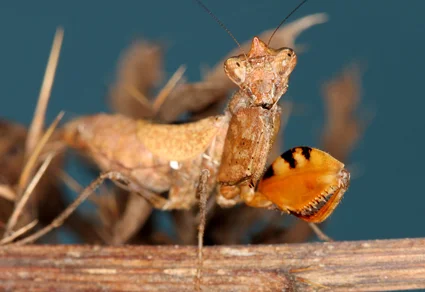
A revision of the subfamily Oxypilinae (Mantodea: Hymenopodidae) from India — co-authored by A.P. Kamila (Zoological Survey of India, Western Ghats Regional Centre), C.J. Schwarz (Ruhr-Universität Bochum), E. Shcherbakov (Moscow State University), and P.M. Sureshan (ZSI) — added five new species and one new subspecies to the Indian fauna, all from the southern Western Ghats. 2
Taxonomy: Animalia → Arthropoda → Insecta → Mantodea → Hymenopodidae → Oxypilinae.
The revision encompasses 2 tribes, 6 genera, and 2 new subgenera (Bharatestiasula subgen. nov. and Paxestiasula subgen. nov.) within Pseudohestiasula. The genus Pseudohestiasula itself is recorded from India for the first time. The six new taxa: 2
- Pseudohestiasula (Bharatestiasula) occidentalis sp. nov. — Western Ghats
- Pseudohestiasula (Bharatestiasula) greeni sp. nov. — Western Ghats
- Pseudohestiasula (Paxestiasula) unipunctata sp. nov. — Western Ghats; accompanied by P. (P.) unipunctata obscura subsp. nov.
- Pseudohestiasula (incertae sedis) ovata sp. nov. — Western Ghats, subgenus unresolved
- Catestiasula keralensis sp. nov. — Kerala, India
Oxypilinae is a small mantis subfamily of roughly 10 genera, restricted primarily to the Oriental region. The Western Ghats biodiversity hotspot has proven to be an especially productive area for this group; the Indian fauna now stands substantially revised. None of the new taxa has yet been assessed by the IUCN. 2
Three new Caribbean cave mysids and a new genus
The strangest animals of the day may be three shrimp-like crustaceans living in total darkness beneath Caribbean islands. Karl J. Wittmann and Pierre Chevaldonné describe three new Mysidae (opossum shrimps) from marine caves in the Lesser Antilles and Cuba, simultaneously erecting Chelitrapezura gen. nov. to accommodate a previously misplaced species. 3
Taxonomy: Animalia → Arthropoda → Crustacea → Malacostraca → Mysida → Mysidae → Heteromysinae.
The paper also provides a complete inventory of all 27 known mysid species from Caribbean marine caves — the largest single-volume census of this fauna to date. The three new species:
Bermudamysis caribbaea Wittmann & Chevaldonné, sp. nov. — collected at Barracuda Cave, Guadeloupe (19 m depth), where living specimens appeared vivid red. The species belongs to the tribe Mysidetini (subfamily Heteromysinae). Type material deposited in the NHMW (Vienna) and MNHN (Paris). 3
Heteromysis troglophila Wittmann & Chevaldonné, sp. nov. — a troglophile (cave-tolerant rather than obligate cave-dweller) found in Anse Noire Cave, Martinique, and Amedien Cave, Guadeloupe. Distinguished from close relatives by its broadly rounded rostrum and the number of telson spines and lamellae. 3
Palaumysis antillensis Wittmann & Chevaldonné, sp. nov. — the most widespread of the three, collected from Full Moon Cave on Bequia, Cathedral Cave in Guadeloupe, and El Brinco Cave in Cuba. Both troglophile and stygophile characteristics (tolerant of groundwater and cave conditions). Distinguishing characters lie in the antennules, antenna, and carapace proportions. 3
The new genus Chelitrapezura gen. nov. (tribe Heteromysini) was erected to house Platyops dennisi Bowman, 1985, which was found to be misplaced in Platyops; the revision also reorganises the tribe Mysidetini to include Bermudamysis and Platyops. Wittmann and Chevaldonné note that the Caribbean region is a global hotspot for marine cave Mysidae diversity, with this paper expanding the known regional fauna to 27 species. 3
None of the new species has yet received an IUCN assessment; all are known from single or a small number of anchialine cave systems, a habitat type under no systematic conservation protection in most Caribbean jurisdictions. 3
Five new Chinese Oenopia ladybirds — hidden in a 45-page revision
The most numerically productive single paper of the day is a revision of the ladybird genus Oenopia Mulsant, 1850 (Coleoptera: Coccinellidae) from China, authored by Zi-Zhao Wang, Zi-Hao Zhu, Ming-Xiao Jin, and Xing-Min Wang (South China Agricultural University, Department of Entomology / Biocontrol Engineering Research Center, Guangzhou). The paper treats 33 species and establishes 5 new ones. 4
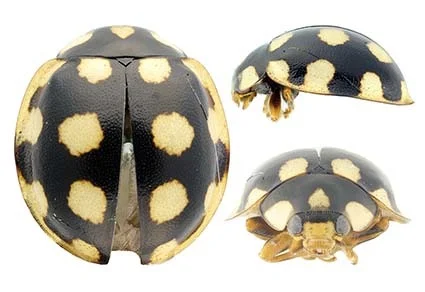
The five new species are: Oenopia latitegmina Wang & Wang sp. nov., O. sanxiaensis Wang & Wang sp. nov., O. stylifera Wang & Wang sp. nov., O. tianquanensis Wang, Jin & Wang sp. nov. (type locality: Tianquan County, Sichuan), and O. transversifasciata Wang & Wang sp. nov. The paper also records three species new to China (O. adelgivora, O. excellens, O. smetanai), transfers O. medogensis to Xanthadalia, and flags O. yadongensis as of uncertain placement. Oenopia holds roughly 50 described species worldwide, concentrated in the Palaearctic and Oriental regions; the genus includes several aphid predators of applied biological control interest. None of the five new species has been assessed by IUCN. 4
Six parasitoid wasps that mummify moth caterpillars — from Korea
Sergey A. Belokobylskij (Russian Academy of Sciences, Zoological Institute) and collaborators Deokseo Ku and Hye-Rin Lee describe six new species of Aleiodes Wesmael (Hymenoptera: Braconidae, Rogadinae) from the Korean Peninsula, expanding Korea's recorded fauna in this genus from roughly 45 to 51 species. 5
Taxonomy: Animalia → Arthropoda → Insecta → Hymenoptera → Braconidae → Rogadinae → Aleiodes.
Aleiodes wasps are koinobiont larval endoparasitoids — they lay eggs inside living moth or butterfly caterpillars and allow the host to continue developing while the larvae feed internally, ultimately causing the caterpillar to harden into a mummified shell around the pupating wasp larvae. The six new species span three subgenera: 5
- A. (Arcaleiodes) monochromus sp. nov. — antennae uniformly black/dark brown; widespread across Korea
- A. (Chelonorhogas) pseudalbitibia sp. nov. — resembles A. albitibia externally but has an expanded terminal segment of the hind wing costal cell
- A. (Chelonorhogas) rufoniger sp. nov. — mesosoma pale reddish-brown, remainder black
- A. (Aleiodes) crassicornis sp. nov. — thickened antennae (23–25 flagellomeres), legs notably stout
- A. (Aleiodes) heterogamoides sp. nov. — wing venation resembles that of Heterogamus; centred on Jeju Island
- A. (Aleiodes) imberbis sp. nov. — basal half of forewing largely bare (glabrous/lustrous); only females known
Host associations for all six remain unknown. The paper includes a key to Palaearctic subgenera. None of the new species has been IUCN assessed. 5
Three new Cortinarius from Yunnan's old-growth forests
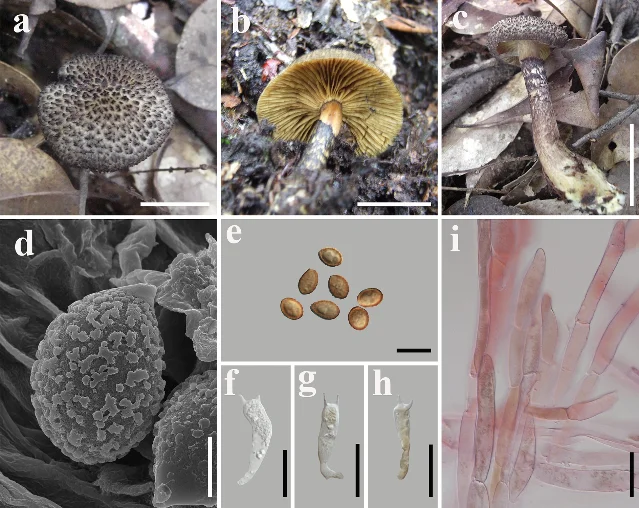
Y.W. Yang and Q. Zhao (Kunming Institute of Botany / Chinese Academy of Sciences; Southwest Forestry University) describe three new webcap mushrooms (Cortinarius Pers., Cortinariaceae, Agaricales) from northwestern Yunnan, all supported by multi-locus phylogeny (ITS + LSU + rpb2). 6
Taxonomy: Fungi → Basidiomycota → Agaricomycetes → Agaricales → Cortinariaceae → Cortinarius.
The three species:
Cortinarius acuticonus Y.W.Yang & Q.Zhao, sp. nov. — collected under Castanopsis forest at ~2,450 m elevation, Yongping County, Dali. The cap is sharply conical and covered in black, Strobilomyces-like scales; a membranous, persistent ring is present — uncommon in Cortinarius. Placed in subgenus Leprocybe. Type specimen KUN-HKAS 156711. 6
Cortinarius tricholomopsoides Y.W.Yang & Q.Zhao, sp. nov. — collected in Abies forest at ~3,960 m elevation, Laojunshan, Lijiang. Large-bodied and pale yellow, its macroscopic appearance so closely recalls the unrelated genus Tricholomopsis that specimens were initially misidentified. Phylogenetic analysis placed it unambiguously in subgenus Leprocybe. Type specimen KUN-HKAS 156712. 6
Cortinarius wudihuensis Y.W.Yang & Q.Zhao, sp. nov. — collected in Quercus aquifolioides (Sichuan Yunnan oak) forest at ~3,850 m elevation, Wudi Lake, Shangri-La. Small-bodied with purple to brownish hues throughout; placed in section Anomali, a distinct lineage from the two Leprocybe species above. Type specimen KUN-HKAS 156713. 6
Cortinarius is one of the world's most species-rich mushroom genera, with over 3,000 recognised species; the subgenus Leprocybe and section Anomali are under active global revision. All three new species are Open Access (CC BY 4.0). None is yet IUCN assessed. 6
A new arbuscular mycorrhizal genus from Poland's Tatra Mountains
Among today's species, the ones least visible to the naked eye may carry the broadest ecological significance. J. Błaszkowski, T. Nieżgoda (West Pomeranian University of Technology, Szczecin), and B.T. Goto (Universidade Federal do Rio Grande do Norte, Brazil) describe Durabilispora gen. nov. (Glomeromycota: Glomerales: Rhizoglomeraceae), an arbuscular mycorrhizal fungal (AMF) genus new to science, along with two new species: the type species Durabilispora carpatica gen. et sp. nov. from the Tatra Mountains (938 m elevation, Poland) and a second species, D. baltica, from Baltic coastal dunes. 7
Taxonomy: Fungi → Glomeromycota → Glomerales → Rhizoglomeraceae → Durabilispora gen. nov.
AMF are obligate plant root symbionts that trade mineral nutrients (particularly phosphorus) for plant photosynthate sugars; they colonise the roots of over 70% of all land plant species and are considered foundational to terrestrial nutrient cycling. Durabilispora is diagnosed by the formation of fused glomerocarps with a peridium (a joined aggregate spore body with an outer covering layer) and by a distinctive spore wall ultrastructure. Phylogenetic analysis of the rpb1 gene placed it as an independent lineage within Rhizoglomeraceae, separate from all described genera. 7
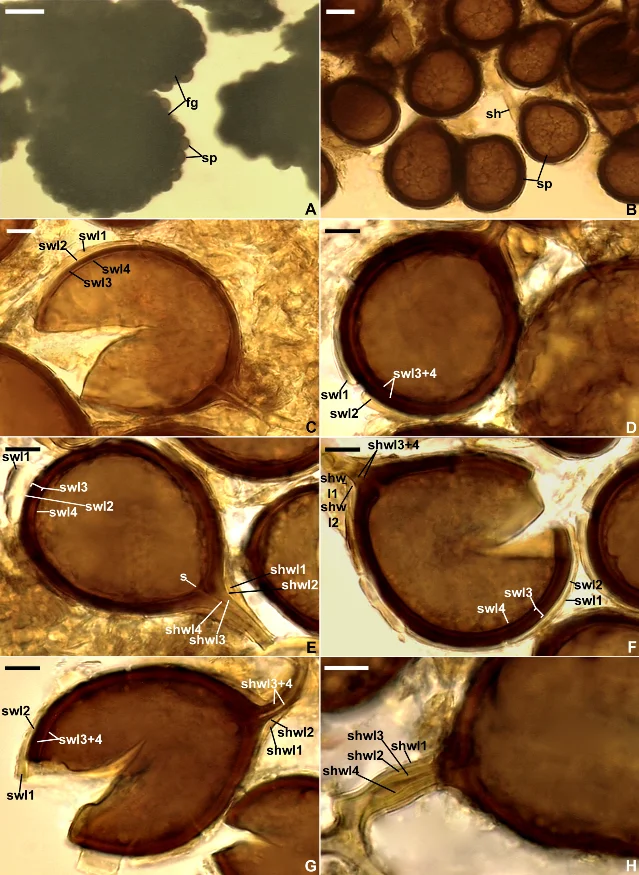
The same paper also describes Dominikia tatrensis Błaszk., T.Nieżgoda & B.T.Goto, sp. nov. (Dominikiaceae), collected at 1,298 m elevation in the same mountain range. D. tatrensis is distinguished within Dominikia by its unique spore architecture: spores arranged radially around a central swollen cell — a feature shared by no other described species in the genus. 7
Both papers are Open Access (CC BY 4.0). Neither species has been IUCN assessed.
A new shrimpgoby from East Java — and the question of its missing shrimp partner
Tomiyamichthys oriens Wibowo et al., sp. nov. (Teleostei: Gobiidae) was collected from shallow sandy-bottom habitat off Banyuwangi, East Java, Indonesia. It is the first described Tomiyamichthys from Java. 8
Taxonomy: Animalia → Chordata → Actinopterygii → Gobiiformes → Gobiidae → Tomiyamichthys Smith, 1945.
Tomiyamichthys gobies are named shrimpgobies because most species share burrows with alpheid (snapping) shrimps — a mutualistic partnership in which the nearly blind shrimp maintains the burrow while the goby stands guard and signals danger. T. oriens is named for the Latin word for "east" or "sunrise." The male's second and third dorsal-fin spines are elongated into filaments (a sexually selected character), and the body carries five large, bright orange lateral blotches. COI sequence divergence of 3.1% from its closest relative, T. hyacinthinus (described from Japan in 2025), confirms the two as distinct species. 8
One detail stands out in the original description: no shrimp partner was observed at the collection site. Whether T. oriens forms the typical goby-shrimp mutualism or represents an exception within the genus is left open by the authors. The holotype (male, 35.6 mm standard length) and paratype (female, 35.5 mm) are deposited in the Museum Zoologicum Bogoriense (MZB 28902–28903). Not yet IUCN assessed. 8
A wall spider from the mountains of southwestern Saudi Arabia
Oecobius asirensis sp. nov. (Araneae: Oecobiidae) was described by Raul Vicente (Swedish Museum of Natural History, Department of Zoology) from the Asir Highlands of southwestern Saudi Arabia — a montane region with high endemism that remains comparatively understudied by arachnologists. 9
Taxonomy: Animalia → Arthropoda → Arachnida → Araneae → Oecobiidae → Oecobius Lucas, 1846.
Oecobius spiders — sometimes called wall spiders — spin flat, star-shaped webs around small pits or crevices on rock faces and walls, then hide beneath the web. The genus holds roughly 80 described species on all continents. O. asirensis is morphologically notable: its male genitalia (specifically the copulatory organ) differ so substantially from those of the type species of Oecobius that the author raises the possibility that it represents a distinct genus — a question left for future work pending broader sampling across the Arabia-Horn of Africa region. The paper also records Uroctea thaleri from Saudi Arabia for the first time. Not yet IUCN assessed. 9
An aquatic stonecrop from Drakensberg glacial tarns
The Maloti-Drakensberg mountains straddling South Africa and Lesotho harbour dozens of small, high-altitude lakes and seasonal pools scoured out during the last glaciation. One of these, it turns out, hosts a stonecrop previously unknown to science. Crassula tanzae Crouch & Gideon F.Sm., sp. nov. (Crassulaceae subfam. Crassuloideae, section Helophytum) is an aquatic species collected from glacial tarns (cirque lakes) and shallow pans at high elevation. 10
Taxonomy: Plantae → Angiosperms → Saxifragales → Crassulaceae → Crassuloideae → Crassula L.
Aquatic Crassula species are rare; section Helophytum — the wetland and aquatic lineage within the genus — contains very few representatives globally. C. tanzae is distinguished from the most similar species, C. natans (a floating aquatic), by strikingly swollen basal stem internodes that are short, strongly constricted at the nodes, and conspicuously inflated between them — a morphological combination not seen in any other Crassula. The paper also corrects the lectotypification of C. natans. Describers are Neil R. Crouch (South African National Biodiversity Institute / University of KwaZulu-Natal) and Gideon F. Smith (Nelson Mandela University). Not yet IUCN assessed. 10
An entomopathogenic fungus from Borneo, and a cave-soil keratinophile from Guizhou
Two fungal species from opposite ecological guilds round out the day's mycological discoveries.
Metarhizium tawauensis Shahbaz, Wasti, Baluat, E.Y.M.Ling & Seelan, sp. nov. (Clavicipitaceae, Hypocreales) was isolated from adult hemipteran insects found partly buried in soil near orchids (Plocoglottis plicata) in Tawau, Sabah, northern Borneo. 11 Metarhizium species are green-spored entomopathogenic fungi that parasitise insects; several are already in commercial use as biological pest control agents. The genus now holds roughly 92 described species following this addition. Phylogenetic placement used ITS–TEF-1α–RPB2 markers. Vouchers BORH/F03657–F03658 deposited at Universiti Malaysia Sabah. Not yet IUCN assessed.
Keratinophyton speluncicola Q.L.Shi, H.L.Huang, M.Y.Zhang, J.L.Han, Y.Feng & Z.Y.Zhang, sp. nov. (Onygenaceae, Onygenales) was isolated from cave soil in the Guizhou karst system (China) using the hair-bait enrichment technique — a method that selectively cultivates fungi capable of digesting keratin (the structural protein of hair, feathers, and nails). 12 The species produces unicellular conidia 3.5–8 × 1.5–3 µm with smooth to slightly roughened walls, and lacks both intercalary conidia and chlamydospores — features that separate it from other described Keratinophyton species. Guizhou's karst caves have been productive for keratinophilic fungi given the presence of bats, whose accumulated guano and shed hair create a keratin-rich substrate. Not yet IUCN assessed.
A new planthopper genus from Thailand, discovered via museum specimens and iNaturalist
Dayhiracia circularis Constant, gen. et sp. nov. (Hemiptera: Issidae: Parahiraciini) was described by Jérôme Constant (Royal Belgian Institute of Natural Sciences, Brussels) from Nakhon Si Thammarat Province, southern Thailand. 13
Taxonomy: Animalia → Arthropoda → Insecta → Hemiptera → Fulgoromorpha → Issidae → Parahiraciini → Dayhiracia gen. nov.
Issidae is a family of planthoppers (jumping plant-feeding bugs) notable for their bizarre, often helmet-shaped pronotum. The new genus was identified through morphological comparison with museum specimens and a live-animal photograph uploaded to iNaturalist — the authors credit citizen science as contributing to the discovery. The species epithet circularis refers to a feature of the genitalia. With Dayhiracia, Thailand's Issidae fauna now stands at 5 genera and 10 species. Open Access (CC BY 4.0). Not yet IUCN assessed. 13
A tree found by watching a forest for decades
Roucheria krenakiana Ottino, A.M.A.Amorim, C.N.Fraga, Fiaschi et al., sp. nov. (Linaceae, Hugonioideae) emerged from a long-term permanent forest plot monitoring project in Santa Teresa, Espírito Santo, Brazil. 14
Taxonomy: Plantae → Angiosperms → Malpighiales → Linaceae → Roucheria Planch.
Roucheria is a small Neotropical genus of canopy trees in the flax family (Linaceae). The new species is a canopy tree with obovate leaves with a blunt apex and finely toothed margins, pale greenish petals, axillary dense cymose inflorescences, 3–5 styles, and a glabrous ovary. The species name krenakiana honours the Krenak indigenous people of eastern Brazil, whose traditional territory overlaps with the Atlantic Forest. The multi-institutional author team spans the Jardim Botânico do Rio de Janeiro, UESC, UFSC, UNICAMP, UFMA, and INMA. Not yet IUCN assessed. 14
India's first cormous pipewort, and two East Himalayan springtails
Two short papers round out the botanical and collembolan novelties.
Eriocaulon meghalayense V.Parveen & Nampy, sp. nov. (Eriocaulaceae) from East Khasi Hills, Meghalaya, northeastern India, is the first cormous Eriocaulon recorded from India — all previously known Indian species of this monocot genus lack a bulb-like swollen stem base (a corm). 15 It is most similar to E. cherrapunjianum but is immediately distinguished by the presence of that corm. Known only from a single locality; assessed as Data Deficient (DD) by the authors. Described from the University of Calicut, Kerala. 15
Two new Willowsia springtails (Collembola: Entomobryidae) from the Eastern Himalayas in Arunachal Pradesh, India — W. coxichroma sp. nov. and W. mitrai sp. nov., described by Simran Verma, Guru Pada Mandal, Pritha Mandal, and Surajit Kar (Zoological Survey of India, Kolkata) — bring the global species count in this genus to approximately 62. 16 The two are distinguished by body pigmentation patterns, scale types, and chaetotaxy (setal arrangement); W. coxichroma is supported by a COI barcode, while DNA barcoding failed for W. mitrai. Neither is yet IUCN assessed. 16
Four new marine species via WoRMS
The World Register of Marine Species registered four new species during the June 23–24 window: 17
- Gebiacantha sinica Kou, Poore & Fang, 2026 (Decapoda: Upogebiidae) — AphiaID 1897645
- Paguristes costaricaensis Ayón-Parente & Wehrtmann, 2026 (Decapoda: Diogenidae) — AphiaID 1897648; type locality name indicates the Pacific coast of Costa Rica
- Bakawan nasuso Batolomaque, Alterado, Fermo & Salmo, 2026 (Gastropoda: Haminoeidae) — AphiaID 1897653; brackish-water habitat
- Yaldwynopsis couppeyi Poupin, 2026 (Decapoda: Homolidae) — AphiaID 1897682
Two additional WoRMS records updated during this window — Upogebia liui and U. monospina — are reclassifications of existing species (moved from Austinogebia to Upogebia), not new species. 17
Additional species: dung beetle, polychaetes, isopod, rove beetles, moths, leafhoppers, and a braconid from India
Several further new species from Zootaxa 5837(3) and ZooKeys 1283 complete today's tally.
Onthophagus (Gibbonthophagus) draconisaurei Urban, sp. nov. (Scarabaeidae: Onthophagini) was described by Patrick Urban (LWL Natural History Museum, Münster) from the mountains of northwestern Yunnan, China. 18 Onthophagus is the world's largest beetle genus by species count (exceeding 2,000 described species); the new species falls in the Gibbonthophagus subgroup of the eastern Asian fauna. Not yet IUCN assessed.
Cabira mexicana sp. nov. and Litocorsa ambigua sp. nov. (Annelida: Pilargidae) were described from shallow-water (1.5–6.4 m depth) muddy and clayey sediments in Laguna de La Paz, Baja California Sur, Mexico, by María Fernanda Cardona-Gutiérrez (Instituto Politécnico Nacional, CICIMAR) and María Ana Tovar-Hernández (Universidad Autónoma de Nuevo León). 19 L. ambigua carries bifurcate (Y-shaped) chaetae absent from all other Litocorsa species. Mexico's Pilargidae fauna now stands at 17 species. Neither is yet IUCN assessed.
Litarcturus kumanoensis sp. nov. (Crustacea: Isopoda: Antarcturidae) is a deep-sea isopod from the Kumano Basin off central Japan, the second Litarcturus recorded from Japan. Described by Yuzumi Okumura, Tomoyuki Nakano, and Michitaka Shimomura (Seto Marine Biological Laboratory, Kyoto University). 20 Diagnostic characters include a combination of dorsal spine counts across head, thorax, and pleon segments. Not yet IUCN assessed.
Paraphloeostiba bicolora sp. nov. and P. carnaria sp. nov. (Coleoptera: Staphylinidae: Omaliinae) were collected together from Bogani Nani Wartabone National Park, Sulawesi, Indonesia, by Alexey V. Shavrin (Daugavpils University, Latvia). 21 The paper also records five new distributional records for the genus across Asia. Not yet IUCN assessed.
Naarda inopina sp. nov. (Banda Islands, Indonesia, Wallacea region) and Naarda turneri sp. nov. (Australia) were described by Balázs Tóth (Hungarian Natural History Museum, Budapest) from the moth subfamily Hypeninae (Erebidae). 22 Australia now has three known Naarda species. Not yet IUCN assessed.
Three new leafhoppers of the genus Minucella — M. dilatata, M. angusta, and M. elongata Duan, Li, Webb & Xing, 2026 (Hemiptera: Cicadellidae, Deltocephalinae: Stegelytrini) — from Guizhou Province, China, raise the species count in this China-restricted genus from 2 to 5. 23 Species-level identification depends entirely on male genitalic characters (aedeagus shape), as body colour patterns are unreliable. Not yet IUCN assessed.
Doryctes (Udamolcus) xylotrechi sp. nov. (Hymenoptera: Braconidae: Doryctinae), described by Sergey A. Belokobylskij, Iqra Maqbool, Amir Maqbool, and Aijaz Ahmad Wachkoo from Jammu & Kashmir, India, was reared from larvae of Xylotrechus stebbingi Gahan — a longhorn beetle (Cerambycidae) — making it a confirmed parasitoid of a wood-boring beetle pest. 24 The paper also synonymises the genus Plyctes Fischer, 1981 with Udamolcus Enderlein, 1920. Not yet IUCN assessed.
A new assimineid gastropod, Pseudomphala zhoushanensis Liu, 2026 (Gastropoda: Assimineidae), was described from intertidal soft mud at two Zhoushan sites, Zhejiang Province, East China Sea, based on shell morphology and COI sequence data. 25 The authors note the generic placement is provisional — the species shows transitional characters between Pseudomphala and Angustassiminea. Not yet IUCN assessed.
Summary table
| Species | Higher taxonomy | Locality | IUCN status |
|---|---|---|---|
| Cryptanthus pataxoanus | Bromeliaceae | Bahia, Brazil (Atlantic Forest) | CR |
| Pseudohestiasula (Bharatestiasula) occidentalis | Mantodea: Hymenopodidae | Western Ghats, India | Not assessed |
| Pseudohestiasula (Bharatestiasula) greeni | Mantodea: Hymenopodidae | Western Ghats, India | Not assessed |
| Pseudohestiasula (Paxestiasula) unipunctata | Mantodea: Hymenopodidae | Western Ghats, India | Not assessed |
| Pseudohestiasula (incertae sedis) ovata | Mantodea: Hymenopodidae | Western Ghats, India | Not assessed |
| Catestiasula keralensis | Mantodea: Hymenopodidae | Kerala, India | Not assessed |
| Bermudamysis caribbaea | Mysida: Mysidae | Guadeloupe (marine cave) | Not assessed |
| Heteromysis troglophila | Mysida: Mysidae | Martinique / Guadeloupe | Not assessed |
| Palaumysis antillensis | Mysida: Mysidae | Bequia / Guadeloupe / Cuba | Not assessed |
| Oenopia latitegmina | Coleoptera: Coccinellidae | China | Not assessed |
| Oenopia sanxiaensis | Coleoptera: Coccinellidae | China | Not assessed |
| Oenopia stylifera | Coleoptera: Coccinellidae | China | Not assessed |
| Oenopia tianquanensis | Coleoptera: Coccinellidae | Sichuan, China | Not assessed |
| Oenopia transversifasciata | Coleoptera: Coccinellidae | China | Not assessed |
| Aleiodes (Arcaleiodes) monochromus | Hymenoptera: Braconidae | Korean Peninsula | Not assessed |
| Aleiodes (Chelonorhogas) pseudalbitibia | Hymenoptera: Braconidae | Korean Peninsula | Not assessed |
| Aleiodes (Chelonorhogas) rufoniger | Hymenoptera: Braconidae | Korean Peninsula | Not assessed |
| Aleiodes (Aleiodes) crassicornis | Hymenoptera: Braconidae | Korean Peninsula | Not assessed |
| Aleiodes (Aleiodes) heterogamoides | Hymenoptera: Braconidae | Jeju Island, Korea | Not assessed |
| Aleiodes (Aleiodes) imberbis | Hymenoptera: Braconidae | Korean Peninsula | Not assessed |
| Cortinarius acuticonus | Agaricales: Cortinariaceae | Yunnan, China (2,450 m) | Not assessed |
| Cortinarius tricholomopsoides | Agaricales: Cortinariaceae | Yunnan, China (3,960 m) | Not assessed |
| Cortinarius wudihuensis | Agaricales: Cortinariaceae | Yunnan, China (3,850 m) | Not assessed |
| Durabilispora carpatica | Glomeromycota: Rhizoglomeraceae | Tatra Mountains, Poland (938 m) | Not assessed |
| Durabilispora baltica | Glomeromycota: Rhizoglomeraceae | Baltic coastal dunes, Poland | Not assessed |
| Dominikia tatrensis | Glomeromycota: Dominikiaceae | Tatra Mountains, Poland (1,298 m) | Not assessed |
| Tomiyamichthys oriens | Gobiiformes: Gobiidae | East Java, Indonesia | Not assessed |
| Oecobius asirensis | Araneae: Oecobiidae | Asir Highlands, Saudi Arabia | Not assessed |
| Crassula tanzae | Saxifragales: Crassulaceae | Maloti-Drakensberg, S. Africa / Lesotho | Not assessed |
| Metarhizium tawauensis | Hypocreales: Clavicipitaceae | Sabah, Borneo | Not assessed |
| Keratinophyton speluncicola | Onygenales: Onygenaceae | Guizhou cave, China | Not assessed |
| Dayhiracia circularis | Hemiptera: Issidae | Nakhon Si Thammarat, Thailand | Not assessed |
| Roucheria krenakiana | Malpighiales: Linaceae | Espírito Santo, Brazil | Not assessed |
| Eriocaulon meghalayense | Poales: Eriocaulaceae | Meghalaya, India | DD |
| Willowsia coxichroma | Collembola: Entomobryidae | Arunachal Pradesh, India | Not assessed |
| Willowsia mitrai | Collembola: Entomobryidae | Arunachal Pradesh, India | Not assessed |
| Gebiacantha sinica | Decapoda: Upogebiidae | China (marine) | Not assessed |
| Paguristes costaricaensis | Decapoda: Diogenidae | Costa Rica (Pacific, marine) | Not assessed |
| Bakawan nasuso | Gastropoda: Haminoeidae | Philippines (brackish) | Not assessed |
| Yaldwynopsis couppeyi | Decapoda: Homolidae | Marine | Not assessed |
| Onthophagus draconisaurei | Coleoptera: Scarabaeidae | NW Yunnan, China | Not assessed |
| Cabira mexicana | Annelida: Pilargidae | Baja California Sur, Mexico | Not assessed |
| Litocorsa ambigua | Annelida: Pilargidae | Baja California Sur, Mexico | Not assessed |
| Litarcturus kumanoensis | Isopoda: Antarcturidae | Kumano Basin, Japan (deep sea) | Not assessed |
| Paraphloeostiba bicolora | Coleoptera: Staphylinidae | Sulawesi, Indonesia | Not assessed |
| Paraphloeostiba carnaria | Coleoptera: Staphylinidae | Sulawesi, Indonesia | Not assessed |
| Naarda inopina | Lepidoptera: Erebidae | Banda Islands, Indonesia | Not assessed |
| Naarda turneri | Lepidoptera: Erebidae | Australia | Not assessed |
| Minucella dilatata | Hemiptera: Cicadellidae | Guizhou, China | Not assessed |
| Minucella angusta | Hemiptera: Cicadellidae | Guizhou, China | Not assessed |
| Minucella elongata | Hemiptera: Cicadellidae | Guizhou, China | Not assessed |
| Doryctes (Udamolcus) xylotrechi | Hymenoptera: Braconidae | Jammu & Kashmir, India | Not assessed |
| Pseudomphala zhoushanensis | Gastropoda: Assimineidae | Zhoushan, Zhejiang, China | Not assessed |
| Candelabrochaete tenuis | Polyporales: Irpicaceae | Yunnan, China | Not assessed |
(Three additional Cortinarius from the same MycoKeys paper: C. acuticonus, C. tricholomopsoides, C. wudihuensis — listed above. New genera today: Chelitrapezura, Dayhiracia, Durabilispora.)
Cover image: Oxypilinae mantis from India's Western Ghats, representative of the five new species described in Zootaxa 5837(3). Image © Magnolia Press / Zootaxa.
参考来源
- 1Leme et al. 2026 — Cryptanthus pataxoanus sp. nov., Phytotaxa 763(3)
- 2Kamila et al. 2026 — Revision of Indian Oxypilinae, Zootaxa 5837(3)
- 3Wittmann & Chevaldonné 2026 — Caribbean cave Mysidae, ZooKeys 1283
- 4Wang et al. 2026 — Revision of Oenopia from China, Zootaxa 5837(3)
- 5Belokobylskij, Ku & Lee 2026 — Six new Aleiodes from Korea, ZooKeys 1283
- 6Yang & Zhao 2026 — Three new Cortinarius from Yunnan, MycoKeys 134
- 7Błaszkowski et al. 2026 — Durabilispora gen. nov. and Dominikia tatrensis, MycoKeys 134
- 8Wibowo et al. 2026 — Tomiyamichthys oriens, ZooKeys 1283
- 9Vicente 2026 — Oecobius asirensis from Saudi Arabia, Zootaxa 5837(3)
- 10Crouch & Smith 2026 — Crassula tanzae, Phytotaxa 763(3)
- 11Shahbaz et al. 2026 — Metarhizium tawauensis, Phytotaxa 763(3)
- 12Shi et al. 2026 — Keratinophyton speluncicola, Phytotaxa 763(3)
- 13Constant 2026 — Dayhiracia circularis gen. et sp. nov., EJT 1070
- 14Ottino et al. 2026 — Roucheria krenakiana, Phytotaxa 763(3)
- 15Parveen & Nampy 2026 — Eriocaulon meghalayense, Phytotaxa 763(3)
- 16Verma et al. 2026 — Two new Willowsia from Arunachal Pradesh, Zootaxa 5837(3)
- 17WoRMS — World Register of Marine Species
- 18Urban 2026 — Onthophagus draconisaurei, Zootaxa 5837(3)
- 19Cardona-Gutiérrez & Tovar-Hernández 2026 — Two new Pilargidae, Zootaxa 5837(3)
- 20Okumura, Nakano & Shimomura 2026 — Litarcturus kumanoensis, Zootaxa 5837(3)
- 21Shavrin 2026 — Two new Paraphloeostiba from Sulawesi, Zootaxa 5837(3)
- 22Tóth 2026 — Notes on Naarda from Australia and Wallacea, Zootaxa 5837(3)
- 23Duan et al. 2026 — Three new Minucella, ZooKeys 1283
- 24Belokobylskij et al. 2026 — Doryctes xylotrechi, Zootaxa 5837(3)
- 25Liu 2026 — Pseudomphala zhoushanensis, ZooKeys 1283
围绕这条内容继续补充观点或上下文。