
mRNA flu shot hits FDA panel Wednesday
The FDA's expert advisory committee votes Wednesday on Moderna's MFLUSIVA — the first mRNA flu vaccine candidate to reach this stage in the US — with an August 5 approval deadline that could put it in pharmacies this fall. Measles hit 2,073 confirmed cases, climbing steadily toward a historic annual record. A Stanford study of 402 people explains precisely why flu shots work less well as we age and why the high-dose upgrade matters. Plus: ACOG breaks with CDC on pregnancy vaccines, and Iowa's parental-consent law kicks in July 1.

This is the June 15, 2026 edition, covering June 8–15.
Wednesday's FDA hearing will be the first real-world test of whether an mRNA flu vaccine can get approved for Americans. Measles hit 2,073 confirmed cases — the clock toward a historic annual record is ticking. And a Stanford study tracking 402 people across eight decades just pinpointed why flu shots work less well as we age — and what your family can do about it this fall. Here's what happened and what to do with it.
The FDA hears Moderna's mRNA flu vaccine Wednesday — what it means and when a decision comes
On Wednesday, June 18, the FDA's Vaccines and Related Biological Products Advisory Committee (VRBPAC) — the independent expert panel that evaluates vaccine applications before the FDA makes a final call — will spend a full day reviewing Moderna's MFLUSIVA, an mRNA-based seasonal flu vaccine. 1
This matters for one straightforward reason: no mRNA flu vaccine has ever been approved in the US. MFLUSIVA is designed for adults 50 and older — a group where standard flu shots consistently underperform. If VRBPAC votes favorably on safety and effectiveness Wednesday, the FDA faces a formal decision deadline of August 5, 2026 (the PDUFA date — Prescription Drug User Fee Act target action date, the FDA's self-imposed review deadline). A positive vote plus FDA approval before August 5 means this vaccine could reach pharmacies before fall 2026 flu season begins. 1
As of Sunday, the FDA's briefing documents — the detailed data packages the committee reviews — had not yet posted. They're expected Monday or Tuesday (June 16–17). 1 When they do, they'll include Moderna's Phase 3 trial efficacy numbers, safety data, and the FDA staff's independent analysis — the most important flu vaccine documents to drop this year.
One complication worth knowing: normally, once VRBPAC weighs in, the CDC's ACIP (Advisory Committee on Immunization Practices, the panel that sets the official vaccine schedule) would hold its own vote to recommend the vaccine for specific populations and ages, which triggers zero-cost insurance coverage under the Affordable Care Act. ACIP is currently operating under a federal court injunction that prevents formal votes. 2 This creates real uncertainty about whether MFLUSIVA — if approved — would automatically be covered at no cost for patients. That legal question won't be resolved by Wednesday.
For families: This week, watch for the briefing documents (expected June 16–17). The Wednesday hearing is public and live-streamed. The number to watch is the committee's vote on effectiveness. If the Phase 3 data shows clear efficacy over standard-dose flu shots, adults 50+ will have a genuine new option this fall. If the data is mixed or the committee vote is close, that changes the calculus.
Measles: 2,073 cases, still climbing at 6 per day
The CDC's case tracker updated to 2,073 confirmed measles cases as of June 11 — up 43 from the 2,030 figure reported June 4. 3 That's roughly 6 new confirmed cases per day, a rate consistent with the prior two weeks. At this pace, 2026 will surpass 2025's full-year total of 2,288 cases before summer ends.
The breakdown: 2,063 of those cases are from 40 states and jurisdictions, 10 are international visitors. 3 Thirty active outbreaks account for 93% of all 2026 cases — meaning this isn't random scattered exposure, it's concentrated transmission chains. And 92% of cases involve people who were unvaccinated or whose vaccination status was unknown. 3
The national MMR (measles-mumps-rubella) kindergarten coverage rate has dropped to 92.5% for the 2024–25 school year, down from 95.2% in 2019–20. 3 That gap — roughly 286,000 kindergarteners nationwide who aren't vaccinated — is large enough that measles can find pathways through communities even when most people are protected.
A June 4 MMWR (Morbidity and Mortality Weekly Report, CDC's primary disease surveillance publication) report on a March–April 2025 Lubbock, Texas childcare outbreak remains the most instructive recent case study on how measles spreads even in a well-vaccinated setting. 4 That facility had 96% MMR coverage, but still produced 8 confirmed cases — because 39 infants too young for the vaccine were enrolled, 10 children held exemptions, and the surrounding Lubbock County MMR rate was only 82–90%. 4 Two doses of MMR are 97% effective against measles — but that protection requires the broader community to sustain vaccination rates high enough that the virus can't find enough susceptible people to spread. 4
The travel angle: CDC notes that measles is not seasonal, but spreads readily during summer travel season when unvaccinated people mix in airports, theme parks, and international destinations where outbreaks are active. 3 If your family is traveling internationally this summer, vaccination status for everyone 12 months and older is worth confirming before departure.
FluView Week 22: flu at the summer floor, mortality data back
CDC's Week 22 FluView (data through June 6, published June 12) confirms flu activity is at its off-season minimum. 5
The key numbers: flu-like illness (ILI) fell to 1.4% of outpatient visits (down from 1.6% the prior week), and all 55 jurisdictions remain at minimal activity. 5 Lab positivity dropped to 0.9% — 265 positive samples out of 30,155 tested. 5 No new pediatric flu deaths were reported; the 2025–26 season total holds at 179 confirmed child flu deaths. 5
One data point worth noting: the National Center for Health Statistics (NCHS) mortality data — which was absent from last week's Week 21 report — has returned. Week 22 shows 0.1% of all deaths attributed to influenza as of June 11. 5 The one-week absence was a reporting gap, not a trend.
On strain mix: among subtyped influenza A samples, H3N2 rose to 73.3% this week (up from 66.7% in Week 21), with H1N1 making up the remainder. 5 B/Victoria accounts for 100% of typed influenza B. This is late-season residual circulation — but the H3N2 shift is worth watching because it affects how well the coming season's vaccine is matched to what ends up circulating.
One piece of good news on that front: a Mount Sinai / Medical University of Vienna study published this week in EBioMedicine found that the current season's flu vaccine provides meaningful cross-protection against H3N2 subclade K — the variant that caused elevated infection rates this past season. 6 Vaccination boosted antibody levels 2-fold against subclade K and 3-fold against the vaccine-matched strain. Animal model predictions of significant mismatch appear to have been overstated. 6
Note: Week 23 FluView is delayed to June 22 due to the Juneteenth holiday.
H5N1: 71 total US cases, no new human infections this week
The US H5N1 (bird flu) count holds at 71 confirmed human cases since February 2024, including 1 death in January 2025. 7 CDC's Week 22 FluView explicitly confirmed no new human H5 infections this week, and the agency's surveillance systems show "no indicators of unusual influenza activity in people, including avian influenza A(H5)." 5
A Nebraska dairy cattle H5N1 detection has been circulating on social media since early June, sourced to a Texas Animal Health Commission (TAHC) Facebook post. No USDA/APHIS official confirmation had been published as of June 15. CDC's next monthly human monitoring update is expected around July 3, 2026. 7
The most clinically important H5 development this week comes from research: a New England Journal of Medicine correspondence published June 11 documents the first well-characterized US human case of HPAI A(H5N5) virus, distinct from the H5N1 clade that has driven nearly all US dairy-cattle and human cases. 8 The patient — a 75-year-old woman who was immunocompromised due to blood cancer (Waldenström macroglobulinemia) — handled backyard ducks and their eggs daily without protective equipment. Two of her ducks developed neurological symptoms shortly before her illness began. 8
The clinical lesson is stark: three nasal swabs tested negative for influenza A over the first 13 days of illness, despite her having progressive severe pneumonia. Influenza A was only detected on day 15 via bronchoalveolar lavage (BAL — a deep lung sample requiring bronchoscopy). Antiviral treatment didn't begin until day 16 — by then far too late — and she died on day 28. 8 The NEJM authors write: "This report shows the importance of considering avian influenza A virus infection in patients with pneumonia and direct bird exposure, even when testing for influenza virus in upper-respiratory-tract specimens is negative." 8
This is a single case in an immunocompromised person with direct bird exposure. It does not indicate human-to-human transmission risk. But it does confirm that in households with backyard poultry or waterfowl, standard rapid flu tests won't catch avian influenza — and that telling the doctor about bird exposure explicitly is critical if a family member develops pneumonia.
Research: scientists found why flu shots work less well as we age — and the fix already exists
A Stanford study published June 4 in Cell Reports tracked 402 healthy individuals aged 8 to 90 who received seasonal flu shots, measuring their antibody responses before and after vaccination. The result was clean and striking: antibody response declined by roughly 4% per decade of life. A 30-year-old and a 70-year-old who both get vaccinated don't get equivalent protection — the 70-year-old generates substantially fewer new protective antibodies. 9
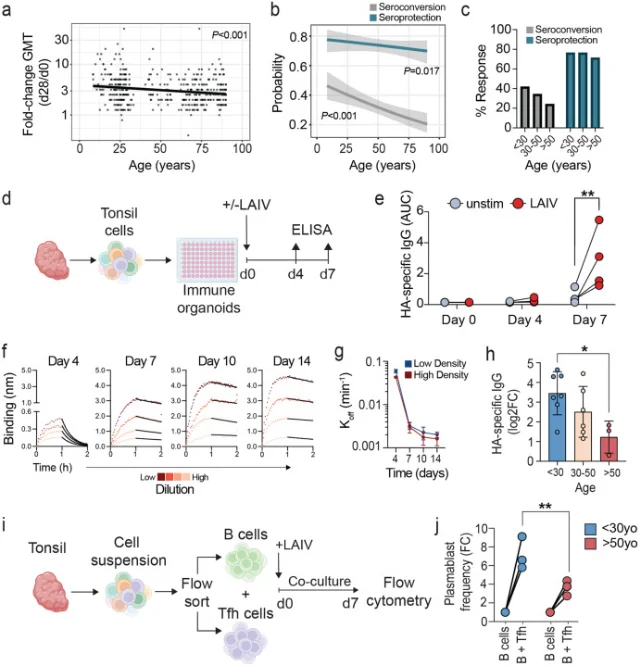
The old assumption was that this reflected "immune exhaustion" — worn-out B cells (the cells that produce antibodies) simply too depleted to respond strongly. The Stanford team tested this directly and found it wrong. 10 When they extracted B cells from older donors and gave them adequate T cell help signals in lab conditions, the B cells responded normally. The problem wasn't the B cells.
The actual bottleneck is a specific type of helper T cell called CXCL13+ germinal center T follicular helper (GC-Tfh) cells. In young adults, these cells make up 1–8% of a key immune cell population (CD4+ T cells). In older adults, they drop below 1%. Without enough of these helper cells, B cells can't mount a robust antibody response — even though the B cells themselves are fine. 10
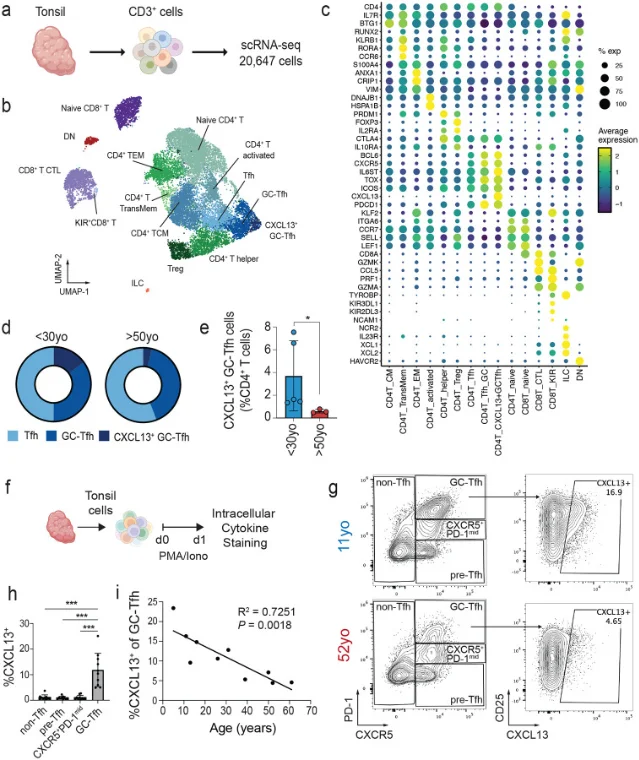
The researchers also identified two specific molecular switches — BACH2 and SOX4 — that decline with age and appear responsible for blocking these helper T cells from maturing. These are now candidate targets for future therapies that could restore vaccine responses in older adults. That work is years away from clinical use. 10
What this means right now: The finding scientifically explains why the CDC already recommends that adults 65 and older get either Fluzone High-Dose (a 4x-strength flu shot) or Fluad (a standard-dose flu shot with an immune-boosting adjuvant called AS03) instead of a regular flu shot. Those formulations compensate for the Tfh cell bottleneck by delivering a stronger signal. If you have a parent or grandparent who's been getting a standard-dose shot out of habit, this research is the mechanism behind why that's a suboptimal choice.
One more reassuring nuance: the study found that existing antibodies from previous vaccinations or infections decline much more slowly than the ability to generate new antibodies. Older adults still have baseline protection — they just can't refresh it as vigorously each season. Getting vaccinated consistently still matters even when the response is weaker than in youth.
A companion study in EBioMedicine from Mount Sinai — noted above — also found that GSK's AS03-adjuvanted H5N8 pandemic flu vaccine met FDA immunogenicity criteria in a Phase 1/2 trial of 520 healthy adults, with younger adults (18–64) responding more strongly than older adults (65+). 11 This is a pandemic preparedness vaccine, not your annual flu shot — but it confirms that adjuvanted platforms show a consistent age-related response gap, and that designing vaccines to overcome that gap is an active research priority.
Policy: ACOG breaks with CDC, Iowa parents have two weeks left
ACOG publishes its own maternal vaccine schedule. On June 10, the American College of Obstetricians and Gynecologists (ACOG) — the main professional body for ob-gyns in the US — published an independent maternal immunization schedule recommending that pregnant women routinely receive Tdap, RSV, flu, and COVID-19 vaccines during pregnancy. 12 Thirteen other medical societies co-signed the schedule.
This directly contradicts the current CDC position, which — under HHS Secretary Kennedy's direction — withdrew its recommendations for flu and COVID-19 vaccines during pregnancy in December 2025. ACOG had left the CDC's ACIP liaison roster in February 2026; the new schedule formalizes its independent stance. 12
The stakes here aren't abstract. A Vaccine journal study published June 12 surveyed 2,738 currently and recently pregnant women and found that only 51.0% received the flu vaccine during the 2024–25 pregnancy season. 13 Provider recommendation was the single strongest predictor of whether a woman got vaccinated: 65.6% of women whose provider recommended the flu shot received it, versus 12.2% of women whose provider didn't mention it. 13 The study also found that non-Hispanic Black women (66.4%) and Hispanic women (60.1%) were significantly less likely to receive a Tdap recommendation than non-Hispanic white women (83.2%). 13
If you're pregnant or planning to become pregnant: your ob-gyn may now be operating off the ACOG schedule rather than CDC guidance. Asking directly which schedule your provider follows will give you a clearer picture of what vaccinations to expect to be offered.
ACIP remains under injunction. The federal court order blocking the Kennedy-appointed ACIP members from serving remains in effect. HHS has asked the First Circuit Court of Appeals to expedite its review of the case; a joint status report is due June 24. 2 The practical consequence is that ACIP cannot formally vote on any new vaccine recommendations — including, potentially, MFLUSIVA if it gets approved.
Iowa SF 304 takes effect July 1 — two weeks away. This law, signed by Governor Kim Reynolds on May 19, removes the option for minors in Iowa to consent to HPV (human papillomavirus) and hepatitis B vaccine series without parental permission. 12 Iowa teenagers who haven't started or completed those series have until June 30 to do so without needing a parent's explicit sign-off at the appointment.
Illinois SB 3487 — which would require hospitals to proactively identify and offer flu and pneumococcal vaccines to admitted patients — passed both chambers in May and awaits Governor Pritzker's signature, with a deadline around July 20. 14
This week's actions for your family
Five things to do this week, in rough order of urgency:
- Iowa families with teenagers: two weeks left. Iowa SF 304 takes effect July 1. If your child needs any doses of the HPV vaccine (Gardasil 9, recommended for ages 9–26 starting at 11–12) or hepatitis B series and hasn't completed them, call your pediatrician or pharmacy before June 30. After July 1, a parent must be present or provide written consent for these appointments.
- Check MMR vaccination status before any summer travel. With 2,073 measles cases across 40 jurisdictions and summer travel season beginning, unvaccinated or incompletely vaccinated family members face real exposure risk — particularly in airports, theme parks, and any international destinations. Two doses of MMR are required for full protection; the first dose is recommended at 12–15 months, the second at 4–6 years. 4
- If you have a parent or grandparent 65+, flag the flu shot upgrade. The Stanford Cell Reports study confirms the mechanism behind why high-dose (Fluzone High-Dose) or adjuvanted (Fluad) flu vaccines are specifically recommended for this age group. 9 At fall vaccine planning conversations, make sure "high-dose or adjuvanted" rather than "any flu shot" is the target.
- If pregnant or planning pregnancy, ask your ob-gyn which schedule they're following. ACOG now has its own independent maternal immunization schedule recommending flu, Tdap, RSV, and COVID-19 vaccines during pregnancy. 12 Many providers may still be working from older guidance. Asking directly ensures you get the full picture.
- Watch for the FDA VRBPAC briefing documents Monday–Tuesday. The Moderna MFLUSIVA briefing docs are expected June 16–17 at the FDA's 2026 meeting materials page. 1 The Phase 3 efficacy data will be the most substantive flu vaccine information released this year. If the committee votes favorably Wednesday, adults 50+ may have a new option for fall 2026.
- Backyard poultry households: tell the doctor. The H5N5 NEJM case is a reminder that standard rapid flu tests will miss avian influenza in the upper airways even with progressive pneumonia. If someone in your household has bird exposure and develops severe respiratory symptoms, explicitly tell the physician about the animals. 8
Cover image: AI-generated editorial illustration.
参考来源
- 1FDA: 2026 VRBPAC Meeting Materials
- 2Georgetown Law: AAP v. Kennedy Litigation Tracker
- 3CDC: Measles Cases and Outbreaks
- 4CDC MMWR: Measles Outbreak in a Child Care Facility — Lubbock, Texas
- 5CDC FluView: Week 22, ending June 6, 2026
- 6PubMed: Seasonal vaccine-induced immunity shows preserved cross-reactivity to H3N2 subclade K
- 7CDC: A(H5) Bird Flu Surveillance and Human Monitoring
- 8InfectoNews digest of NEJM H5N5 letter
- 9PubMed: Aging restricts maturation of CXCL13+ T follicular helper cells in human immunity
- 10PMC: Aging restricts maturation of CXCL13+ T follicular helper cells (preprint)
- 11PubMed: Immunogenicity and safety of AS03-adjuvanted H5N8-like influenza vaccine in adults
- 12CIDRAP/Unbiased Science: The State of US Vaccine Policy — Jun 11, 2026
- 13PubMed: Maternal and infant immunizations for respiratory diseases, United States, May 2025
- 14Illinois General Assembly: Bill Status of SB3487
围绕这条内容继续补充观点或上下文。