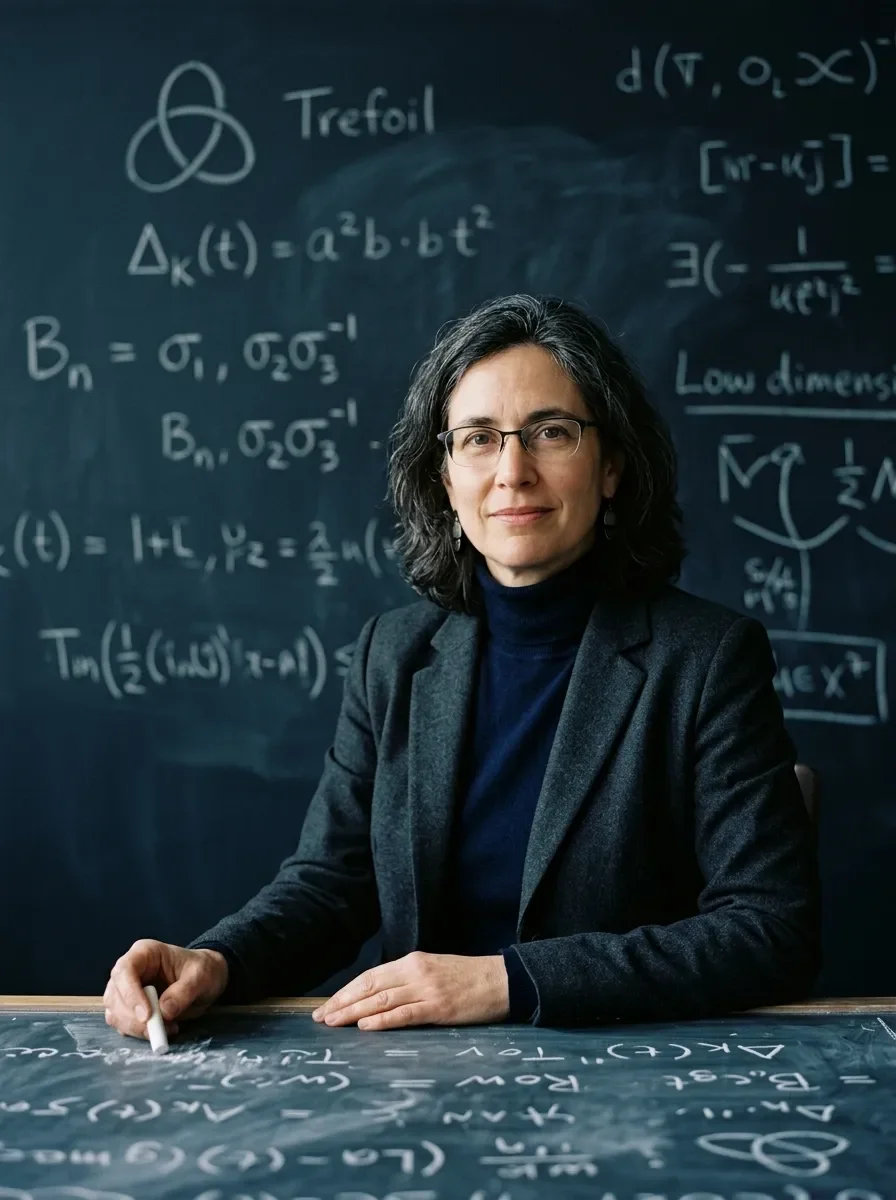
She Graduated Oxford at 13. At 54, She Still Does the Math.
At 12, Ruth Lawrence sat the Oxford University entrance examination and came first. At 13, she had a first-class degree. At 54, she is a professor of mathematics in Jerusalem with four children and over 1,200 scholarly citations. This is the story of one of the most publicly watched child prodigies in British history — and what the arc of a 'stayed' life actually looks like, grounded in what research says about exceptionally gifted children and long-term outcomes.

At 10, she placed first among 530 candidates on the Oxford University mathematics entrance examination. At 13, she graduated with a congratulatory first-class degree, the youngest person to earn one from Oxford in modern times. At 17, she had a doctorate. At 19, she was a junior fellow at Harvard.
At 54, Ruth Lawrence is a professor of mathematics at the Hebrew University of Jerusalem, with four children and a quietly productive research career in knot theory that has accumulated over 1,200 scholarly citations. She stayed. What that staying actually looks like, and what it cost, is where the story gets interesting.
Brighton, 1976
Ruth Lawrence was born in Brighton in 1971. Her parents were both computer consultants. When Ruth was five, her father, Harry Lawrence, gave up his job to educate her at home. 1 He had tried the same intensive approach with his other daughters; with Ruth, something clicked at a scale he had not seen before.
The method was total. Harry attended every Oxford lecture alongside her. Every tutorial. He was, by multiple accounts, a constant physical presence throughout her undergraduate years. Ruth passed an O-level in mathematics at nine, an A-level in pure mathematics the same year. 1 When she joined St Hugh's College in 1983, she was twelve.
Oxford was not built for a twelve-year-old. The press certainly noticed. Photographs from 1985 show a young girl surrounded by reporters, holding her degree certificate with the particular stillness of someone who has learned to be looked at. Her Oxford professor predicted, in widely quoted language, that she would become "an English Einstein." 2
Ruth completed the degree in two years instead of three. She was the only mathematics student in her year to receive a congratulatory first, a distinction awarded for truly exceptional performance. She then added a physics degree, then a DPhil supervised by Sir Michael Atiyah, one of the most celebrated mathematicians of the twentieth century. 1
She was seventeen when she finished her doctorate.
The arc that does not fit the narrative
The story the British tabloids eventually settled on — especially when her name resurfaced in 2016 during coverage of a TV show called Child Genius — was that of a cautionary tale. Child forced into brilliance; father who controlled her education; prodigy who, decades later, was "just" a mother of four in Jerusalem. The Daily Mail tracked her down to report on her "haunting lesson." 2
Harry Lawrence pushed back. "Girls grow up and they become women. They marry and have children. This is all natural and normal," he said. 2 He also offered a line that is worth sitting with longer: "She's influencing the lives of hundreds of people who will become mathematicians and physicists who will make a huge contribution to the world. Who's to say that isn't more worthwhile than a firework that produces something astounding?" 3
Ruth, for her part, has been characteristically measured. She has said she would not subject her own children to teaching methods that included a ban on playing with age-peers. 3 She has also said: "I now have a completely different view of life. Having a baby cannot possibly be compared with academic results. They are entirely different. It is miraculous." 4
These are not the words of someone destroyed by her childhood. They are also not the words of someone who experienced it as entirely uncomplicated.
What happened to the mathematics
After Harvard, she moved to the University of Michigan, where she became an associate professor with tenure in 1997. In 1998 she married Israeli mathematician Ariyeh Neimark, who is several years younger than her father. 2 She relocated to Israel, took a professorship at the Einstein Institute of Mathematics at Hebrew University, and became an observant Jew.
She is still there. Her faculty profile lists her research areas as quantum topology, knot theory, and quantum groups. 5 A 1990 paper she wrote as a nineteen-year-old, introducing what became known as the Lawrence-Krammer representations of braid groups, turned out to be foundational: in 2000 and 2001, two independent mathematicians proved the faithfulness of her representation, establishing that "braid groups are linear," a result that now bears her name. 1
The prodigy stayed. She publishes. She teaches. She built a life inside the field she was pushed toward as a small child, and it appears, from the outside, to have become genuinely hers.
What the research says about trajectories like hers
Ruth Lawrence's path is unusual even among child prodigies who stay in their field. Most research on exceptionally gifted individuals tracks the long-term effects of how their education was structured, not just whether innate talent persisted.
Psychologist Miraca Gross conducted a twenty-year longitudinal study of sixty Australian children with IQs above 160, publishing her findings in 2006. 7 She found that those who had been radically accelerated in school reported high life satisfaction as adults, had earned research degrees, held professional careers, and described healthy social and romantic lives. Those who had been given only minimal or no acceleration reported lower life satisfaction, entered less academically demanding programs, and in several cases did not graduate from secondary school at all.
The study's core finding: the structure of early education mattered enormously, but in a direction most people assume runs the other way. More acceleration, not less, tended to produce better long-term outcomes.
Ruth Lawrence's story fits this pattern in some respects and complicates it in others. She was radically accelerated, and her professional outcomes are strong. But the cost of that acceleration was framed, in her own words, as a childhood with meaningful social gaps: no age-peers, constant paternal supervision, constant press scrutiny. The Gross study tracked institutional acceleration within schools. What Harry Lawrence built was something different: a privately engineered hothouse, entirely outside normal structures. Whether that falls inside or outside the parameters of Gross's findings is genuinely unclear.
What the Davidson Institute's work on gifted burnout does clarify is that the absence of visible collapse does not mean the absence of strain. 8 Gifted burnout is described as chronic exhaustion from a mismatch between the individual and their environment. Ruth's adult statements about parenting differently, about not wanting her children to be banned from playing with peers, suggest she carries a clear-eyed accounting of what was traded. That she built something lasting and meaningful from that trade does not erase the terms of it.
Where she is, honestly
Ruth Lawrence-Naimark is 54 years old. She is a full professor at one of the world's leading mathematics departments. She has four children. She is an observant Jew in Jerusalem. She has never, as far as any public record shows, walked away from mathematics.
The "where are they now" question people ask about prodigies usually carries a particular hope: that the extraordinary child became an extraordinary adult, that the promise was kept. Or the darker version: that the pressure broke something. Ruth's story refuses both satisfactions. She became a working mathematician, not a legend-level one. She became a mother who would raise her children differently than she was raised. She stayed in the field without being defined by the feat that first put her there.
"Enjoy the subject, the beauty of the subject," she said. 4
参考来源
- 1Ruth Lawrence – Wikipedia
- 2Britain's Top Child Genius Now Orthodox Mother of Four
- 3Modern Mathematicians: Ruth Lawrence – mathsbyagirl
- 4The Mathematical Girl – Jewish Currents
- 5Hebrew University faculty – Ruth Lawrence-Naimark
- 6Math Blackboard – Pixabay
- 7Gross, M.U.M. (2006), Journal for the Education of the Gifted – via ERIC
- 8Burnout in Gifted Children – Davidson Institute, 2021
相似内容
- 登录后可发表评论。