2026/6/23 · 10:23
A Coptic parchment from an Egyptian monastery tells a story both Christians and Muslims know

A 9th–11th-century Sahidic Coptic hagiographic fragment — five parchment leaves telling the legend of the Seven Sleepers of Ephesus — was digitized by the Vatican Apostolic Library on June 21, 2026, as part of a batch of 22 Borg.copt.109 manuscripts. The fragment, gathered from Egypt's White Monastery by Cardinal Stefano Borgia's missionaries in the 18th century, carries a legend shared by both Christian tradition and the Quran (Sura 18, verses 9–26). First published in scholarly form by Ignazio Guidi in 1887, it is now freely viewable at DigiVatLib.
Sometime between the ninth and eleventh centuries, a monk in Upper Egypt copied a saint's story onto five leaves of parchment. The text was in Sahidic Coptic — the southern dialect of the ancient Egyptian Christian language — and the story it told was one that Christians across the Mediterranean already knew by heart: seven young men of Ephesus who fled Roman persecution, fell into a miraculous sleep inside a cave, and woke to find the world transformed around them. On June 21, 2026, the Vatican Apostolic Library put those five leaves online. 1
The shelfmark is Borg.copt.109.cass.XXVIII.fasc.156. It decodes as box 28, fascicle 156 of the Borgia Coptic collection — one small folder in a much larger archive of Egyptian Christian manuscripts assembled by an eighteenth-century Italian cardinal and held in Rome ever since. The catalog title, supplied by the third-party tracking site Wiglaf.org, is plain: The Seven Sleepers. 2
The legend
The Seven Sleepers of Ephesus are seven young Christians — named in the manuscript's archival folder as Archalides, Diomedes, Eugenius, Probatius, Sabbadius, Stephanus, and Cyriacus — who refused to sacrifice to Roman gods during the persecutions of Emperor Decius around 250 CE. 1 They fled into a cave outside Ephesus, fell asleep, and woke centuries later under a Christian emperor. Believers at the cave sealed them in, assuming they had died; when they awoke, they walked into a city they no longer recognized.
The story began circulating in Syriac in the fifth century and spread quickly through Greek, Coptic, Latin, and eventually Arabic. It was the kind of legend that a storyteller could trim or expand to suit an audience — and scribes did. The version held in the Vatican is one link in that chain of transmission.
The archival folder
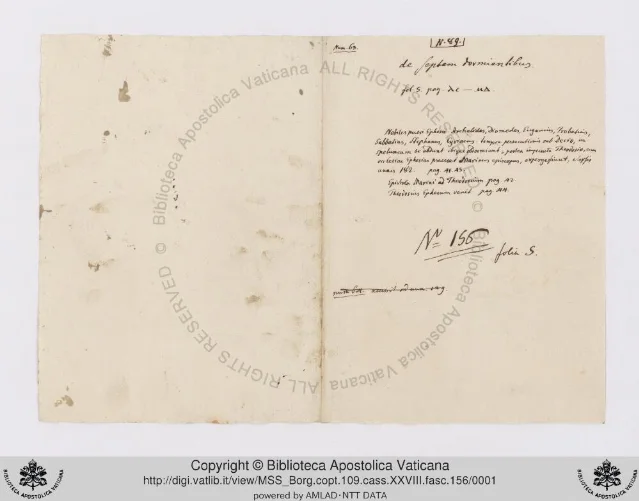
Before the parchment itself comes the wrapper: a folded paper folder bearing a handwritten Latin description of the contents. The note opens "de Septem dormientibus" — about the seven sleepers — then records the number of folios and lists the seven young men by name in Latin transliteration. The large numeral "Nº 156, folio 5" marks its place in the archive. It is the first image in the digitized set; the parchment leaves follow.
A story that crossed into Islam
What makes this particular fragment unusual is where the legend traveled after leaving Egypt. The Seven Sleepers are not only a Christian saint story. The Quran devotes seventeen verses of Sura 18 (al-Kahf, the Cave) to a group of young believers who sheltered in a cave, slept for an age, and woke to witness God's power — verses 9 through 26. 1 The Quran does not name them or specify a number, but the resonance with the Ephesian legend was recognized early. Later Islamic commentary tradition supplied the name Ahl al-Kahf — the People of the Cave — and debated how many there were.
The Coptic fragment sits at a junction in that story. Syriac was the first language to carry the tale; Coptic was a parallel branch; Arabic received it partly through both. The Vatican manuscript cannot prove the chain of transmission — no single text can — but it is the kind of object that makes the question concrete rather than abstract.
Cardinal Borgia's collection
The parchment reached Rome through Cardinal Stefano Borgia (1731–1804), secretary of the Congregation for the Propagation of the Faith, who spent his career building one of the largest Coptic manuscript collections outside Egypt. 3 The fragments came through Jesuit missionaries working in the Nile Valley, who gathered leaves from the White Monastery — Dayr al-Abyad — near Panopolis (modern Akhmim) in Upper Egypt. The White Monastery had been one of the great centers of Coptic learning under Abbot Shenoute in the fourth and fifth centuries; by the eighteenth century, its library had scattered across many hands. 3
When Borgia died in 1804, his collection was split. Manuscripts from Naples went to the Biblioteca Nazionale there; the Vatican retained the biblical and hagiographic fragments now cataloged as Borg.copt.109. Georg Zoega published the first catalog of the collection in 1810. The scholar Ignazio Guidi produced the first scholarly edition (editio princeps) of the Seven Sleepers text in 1887, publishing it in the Atti dell'Accademia Nazionale dei Lincei as "Testi orientali inediti sopra i Sette Dormienti di Efeso." 1
What the pages look like
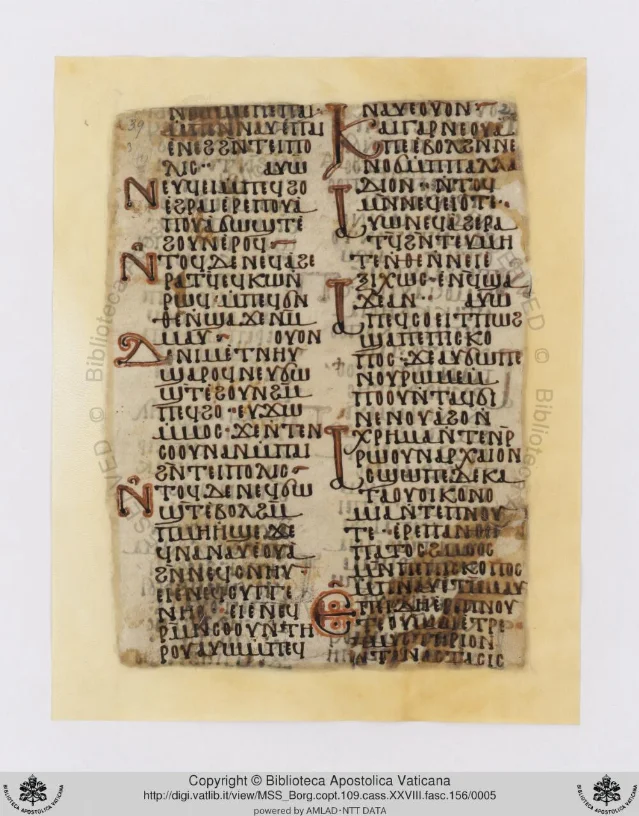
The five parchment leaves are written in two columns in a clear Coptic majuscule — the upright, uncursive capital-letter style characteristic of Egyptian Christian manuscripts before the smaller minuscule hands took over. The most distinctive feature is the rubrication: large initial letters in red ink mark section or paragraph openings throughout the text. On folio 2r, at least four such initials are visible in the left column alone, giving the page an almost architectural rhythm. The parchment has darkened at the edges and shows some discoloration, but the writing surface is largely intact and legible. 4
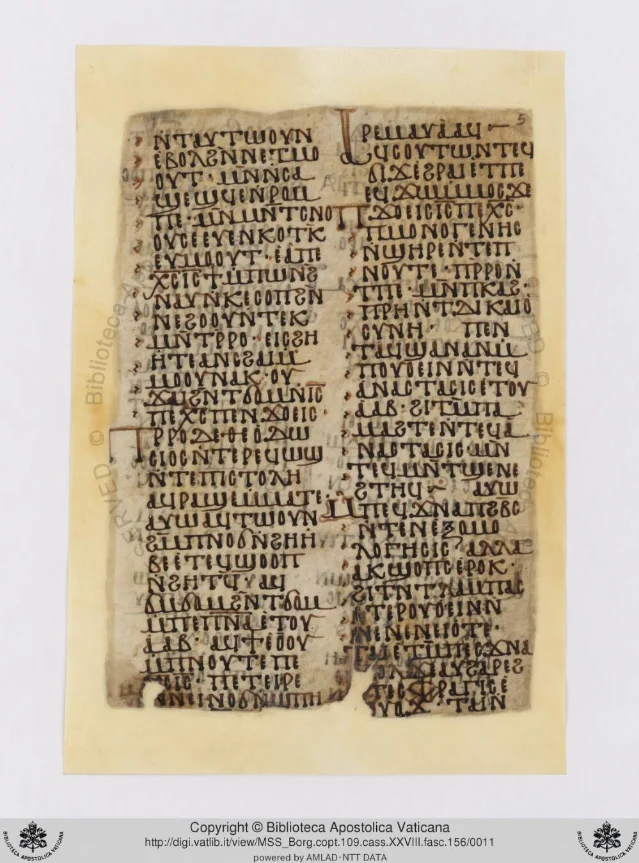
The digitization includes 14 IIIF canvases: 10 pages of text (5 leaves, recto and verso), two imaging views of the first leaf, a color checker, and a millimeter scale. 4 The first leaf was imaged in two modes — the manifest labels them "cy" and "fa" — probably different lighting conditions for capturing faded or contrasting ink.
Browse it now
The full set is open at the DigiVatLib viewer: digi.vatlib.it/view/MSS_Borg.copt.109.cass.XXVIII.fasc.156. 5 The archival folder opens the set; the parchment leaves follow. The IIIF manifest, which allows direct navigation to any leaf, is at digi.vatlib.it/iiif/MSS_Borg.copt.109.cass.XXVIII.fasc.156/manifest.json. 4
This fragment was first described in print in 1887. The images went online on June 21, 2026, as part of a batch of 22 Borg.copt.109 manuscripts digitized in Week 25 of the year. 2
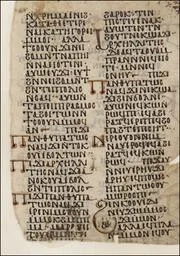
Cover image: Borg.copt.109.cass.XXVIII.fasc.156 — Sahidic Coptic parchment folio, 9th–11th century. Biblioteca Apostolica Vaticana / DigiVatLib
围绕这条内容继续补充观点或上下文。