Dalio: being right about AI and losing money are not mutually exclusive
Ray Dalio's June 3 Bloomberg TV appearance introduced a two-part framework: believing in AI as a technology is a separate decision from owning AI stocks, and bubbles burst not when the technology fails, but when liquidity pressure forces paper-wealth holders to convert wealth into money — "the pricking is the converting of wealth into money."

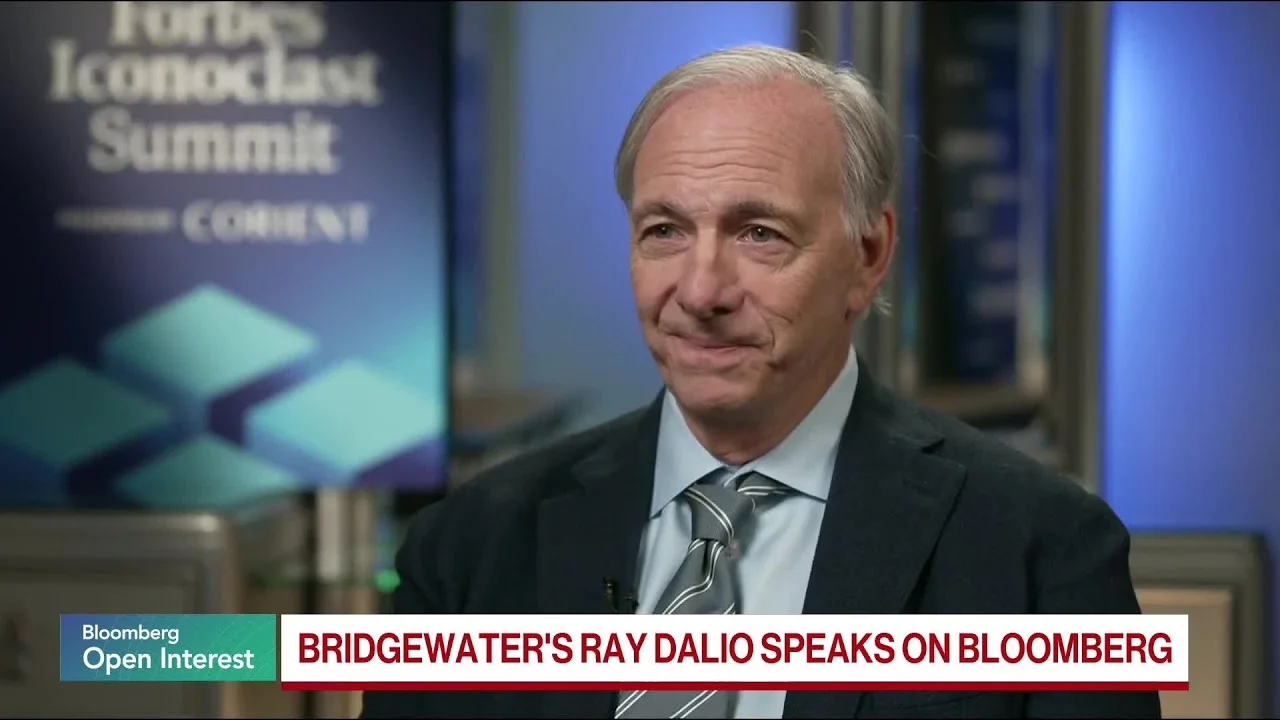
Ray Dalio — founder of Bridgewater Associates, the hedge fund that grew to over $100 billion in assets under management and is best known for its All Weather risk-parity strategy — sat down with Bloomberg TV's Dani Burger at the Forbes Iconoclast Summit in New York on June 3. 1 It was his first substantive public statement in over a month, and the core of it was a single clean distinction that most retail investors miss: you can believe in AI as a technology and still be wrong about AI as a trade.
"People bet on the technology, which, I'll bet on the technology, but they think that buying the stocks is betting on the technology, which is a different thing, because the stocks can be expensive." 2
The Internet changed the world. That did not prevent Cisco from losing more than 85% of its market value after the 2000 peak, or hundreds of dot-com companies from going to zero. Dalio pointed to that precedent explicitly. His argument is not that AI will fail as a technology — he said outright he would bet on it — but that the stocks may already reflect a far more optimistic outcome than the underlying businesses will deliver.
正在加载内容卡片…
Why bubbles form in transformative technology
Dalio's explanation of how the AI bubble inflated is structural rather than behavioral.
"All great technology changes produce bubbles. Nobody can get it exactly right. You have to either spend a ton of money to capture your market share and don't worry about whether it's too much or not, or you don't spend enough money and you lose your market share." 1
The logic is a competitive trap. No individual cloud giant (Alphabet, Amazon, Microsoft, Meta) can afford to pull back on AI infrastructure spending without ceding ground to rivals, so the industry spends collectively far more than the eventual revenue pool can justify. According to Bridgewater's estimates cited by BeInCrypto, Alphabet, Amazon, Meta, and Microsoft — the four largest AI infrastructure spenders — are projected to invest roughly $650 billion in AI buildout in 2026, up from an estimated $410 billion in 2025. 3 The spending increase is not recklessness; it's rational behavior that, when multiplied across every competitor, produces industry-wide overinvestment.
正在加载图表…
How the bubble actually bursts
This is where Dalio's framework goes beyond the standard "overvaluation" warning. He draws a precise distinction between wealth and money — and locates the burst trigger in that gap.
"You cannot spend wealth. You have to sell wealth to get money, because you can only spend money." 2
A startup that raises $50 million but gets valued at $1 billion holds wealth on paper. So do early employees, venture funds with lock-up periods, and retail investors sitting on unrealized gains. That wealth cannot pay a margin call, cover a redemption, or fund a tax bill. When those needs arise — when someone must convert wealth into spendable money — the only mechanism is selling. That selling is, by definition, what pops a bubble.
"The pricking is the converting of wealth into money." 2
The implication for investors: bubble timing is not about identifying when the technology thesis breaks down. It's about identifying when enough holders face enough liquidity pressure to force significant selling. Dalio flagged US fiscal dynamics as one accelerant — government spending running roughly $7 trillion against $5 trillion in annual revenue means a steady supply of new Treasury issuance competing for capital in an already stretched bond market. 3
The two-question test
Dalio is not calling a date. His point is narrower: conviction about AI as a technology is not the same as investment analysis. Two separate questions require separate answers — is the technology real, and are the stocks priced for a reality that hasn't arrived yet? Answering yes to the first says nothing about the second.
The variable worth watching is the bond market. If long-dated Treasury yields rise enough to tighten financial conditions, the liquidity squeeze Dalio describes — paper wealth holders forced to sell — becomes a lot more concrete.
Cover: Ray Dalio speaking with Bloomberg TV's Dani Burger at the Forbes Iconoclast Summit, New York, June 3, 2026. Image from AI Bubble Will Burst Eventually Says Bridgewater's Ray Dalio
围绕这条内容继续补充观点或上下文。