22 June operating picture
Hantavirus Global Situational Briefing — June 22, 2026
The MV Hondius-linked Andes virus event has crossed its main U.S. and French monitoring endpoints without a confirmed U.S. case or a change in the public 13-case, three-death count. The briefing shifts the ship cluster into after-action review while keeping Argentina's high-lethality domestic hantavirosis season on the daily watchlist.
内容来源:...

Situation date: 22 June 2026, UTC+8. The ship-linked Andes virus event has crossed its main contact-monitoring endpoints in the United States and France. The epidemiological count has not moved: ECDC still lists 13 event-linked cases and three deaths, and CDC still reports no confirmed U.S. cases from the MV Hondius exposure group. 1 2
Bottom line
The operational story changed more than the virology. Quarantine ended for all 18 exposed Americans at 03:00 on 22 June UTC+8, after six of them remained at the National Quarantine Unit in Nebraska through the final 42-day endpoint and 12 had already left for home monitoring. The New York Times reported no U.S. cases linked to the outbreak, citing CDC's latest public update. 3
France reached a similar threshold: four non-infected French contacts at Bichat hospital were due to leave isolation on 21 June after six weeks, while one infected French passenger remained in intensive care but was no longer reported to be shedding virus through the nose or mouth. 4 Spain had already closed its domestic management of the event on 20 June after all monitored people completed quarantine with negative PCR tests and both Spanish positive cases had been discharged. 5
That makes today's practical read simple: the MV Hondius cluster is now a monitoring-tail and after-action issue, not an expanding outbreak signal. ECDC's last update says the likelihood of additional cases related to the event is very low and the risk to the EU/EEA general population remains very low. 1 The non-ship signal still worth daily attention is Argentina's domestic hantavirosis season, where BEN-linked reporting continues to show unusually high lethality and above-threshold circulation in several endemic regions. 6
正在加载统计卡片…
The data card combines the current ECDC case classification, CDC's U.S. no-case status, the reported U.S. quarantine endpoint, and Argentina's latest BEN-linked lethality signal. 1 2 3 6
Signal table
| Signal | Latest read | Operational meaning |
|---|---|---|
| MV Hondius case count | 12 confirmed, one probable, zero suspected, three deaths as of ECDC's 17 June update | Stable public count; no evidence in official updates of a new event-linked case. 1 |
| United States | 18 exposed Americans completed the 42-day monitoring period; quarantine was lifted at 03:00 on 22 June UTC+8; no U.S. cases confirmed | U.S. outbreak management moves from active quarantine to legal and policy review. 3 |
| France | Four non-infected contacts at Bichat reached the 42-day endpoint; one infected passenger remained in intensive care | France still has clinical follow-up, but the contact-isolation phase is ending. 4 |
| Spain | All monitored people completed quarantine with negative PCR results; both positive cases discharged | Spain has closed the domestic outbreak-management phase. 5 |
| MV Hondius crew | Remaining crew completed quarantine, tested negative, and returned to home countries | Ship operations are now background unless a new case or source finding appears. 7 |
| Argentina domestic season | Current-season reporting points to 33.3% lethality and 48 calendar-year confirmed cases through epidemiological week 22 | Separate from the ship cluster; still the higher-burden surveillance signal. 6 |
Contact monitoring is ending, but the policy dispute remains
The U.S. endpoint closes the most visible quarantine standoff. CDC's 18 June public page still showed six people at the National Quarantine Unit and 12 at home monitoring, all symptom-free, with no U.S. Andes virus cases confirmed from the cruise outbreak. 2 The New York Times then reported that quarantine ended for all 18 at 03:00 on 22 June UTC+8, including the six who stayed in Nebraska through the end of the 42-day period. 3
The legal issue should not be confused with a new risk signal. Healthbeat and CNN both reported that HHS Secretary Robert F. Kennedy Jr. kept Angela Perryman in facility quarantine through the endpoint despite a CDC medical reviewer concluding that home monitoring in Florida could adequately protect public health. 8 9 The operational question for future Andes virus contacts is now narrower: when the disease is severe but onward transmission is rare, what evidence is enough to justify facility quarantine over supervised home monitoring?

France shows the other side of that policy choice. The four contacts were non-infected, spent six weeks in isolation, and were kept in a high-control hospital setting until the end of the 42-day window. franceinfo reported that the infected French patient remained in a high-isolation intensive-care unit, but also that protective measures around staff had been eased because she was no longer expelling virus through the nose or mouth. 4
The French readout is useful because it keeps two facts separate: contact isolation can end without implying that every clinical case has resolved. The remaining French clinical case should stay on the watch list until a current medical update confirms discharge, ICU step-down, or other status change.
The ship event is closing as an outbreak, not as a research problem
Ouest-France reported that all remaining MV Hondius crew had completed quarantine, tested negative earlier in the week, and returned or were returning to their home countries. The same article said the vessel had been allowed to return to sea on 30 May after cleaning and disinfection. 7 Spain's closure is even cleaner: no quarantines, no hospitalized patients, negative PCR results among monitored people, and both Spanish positives discharged home with confirmed-case precautions. 5
The post-event uncertainty is scientific rather than operational. Andes virus is the hantavirus species with recognized person-to-person potential, but ECDC's current risk language does not support describing the MV Hondius cluster as a continuing international spread event. 1 The remaining questions are exposure source, incubation range, infectious period, and why a confined expedition setting produced this particular cluster.
Crew repatriation also widened the geographic aftercare footprint. The Philippine Star reported that 38 Filipino crew members returned home after completing 42 days of quarantine in the Netherlands, remained asymptomatic, and tested negative during repeated monitoring. 10 This is not a new outbreak signal. It is a reminder that the episode generated a multinational return-to-work and post-arrival health-support problem even after case counts stopped moving.
Argentina remains the higher-burden hantavirus signal
Argentina's domestic situation should not be merged with the cruise cluster. Infobae, citing the latest National Epidemiological Bulletin, reported that hantavirosis lethality in the 2025-2026 season reached 33.3%, the highest level since 2018, and that 48 confirmed cases had been recorded in 2026 through epidemiological week 22. 6 The same BEN-linked reporting says the national curve had spent multiple consecutive weeks above the outbreak threshold, with the strongest rise concentrated from November through January. 6
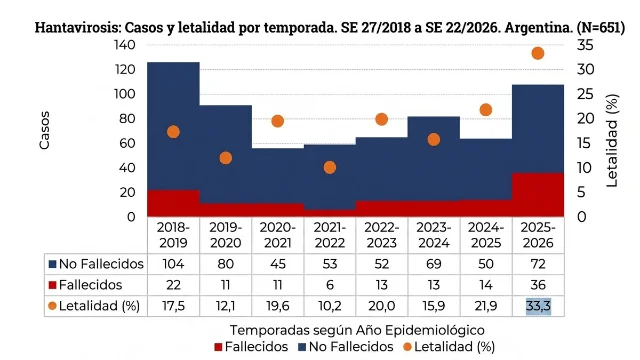
The demographic pattern remains consistent with occupational and peri-urban exposure: Infobae reports that 70% of confirmed cases were in people aged 20 to 49, and 81% were in men. 6 The Centro region, including Buenos Aires, Entre Ríos, and Santa Fe, carried the largest number of cases and stayed above the outbreak threshold between epidemiological week 45 of 2025 and week 5 of 2026. 6
Two Argentina items need continued follow-up. First, a case in Río Colorado, Río Negro, appeared outside a traditional circulation area and triggered environmental studies. 6 Second, field operations by Argentina's health ministry, ANLIS Malbrán, and CDC in Ushuaia and Malargüe had not detected the main known Andes virus reservoir in early analyses, though laboratory work was still continuing. 6 Until those results are final, source attribution for the cruise cluster should remain cautious.
Watch list for the next 24-72 hours
- CDC public update: confirm whether the situation-summary page changes from the 18 June split of six at NQU and 12 home-monitoring to a completed-monitoring status. 2
- French clinical status: check for a direct update on the infected French passenger still described as being in intensive care at Bichat. 4
- Argentina laboratory results: watch for official ANLIS Malbrán or Ministry of Health updates on field samples from Ushuaia, Malargüe, and any non-endemic-area investigations. 6
- After-action policy: the quarantine debate should now shift from individual detention to documented criteria for home monitoring, facility isolation, and state-federal handoff in future Andes virus exposures. 8
参考来源
- 1ECDC — Andes hantavirus outbreak in cruise ship
- 2CDC — Andes Virus Outbreak on a Cruise Ship: Current Situation
- 3The New York Times — Hantavirus Quarantine Ends for 18 Americans Exposed on a Cruise Ship
- 4franceinfo — Après six semaines d'isolement, quatre passagers français du MV Hondius vont pouvoir quitter l'hôpital
- 520minutos / EFE — El Ministerio de Sanidad cierra la gestión del brote de hantavirus
- 6Infobae — Hantavirus en Argentina: la letalidad alcanzó un récord histórico en la temporada 2025-2026
- 7Ouest-France — Tous les membres d'équipage du MV Hondius ont pu rentrer chez eux
- 8Healthbeat — RFK Jr. orders hantavirus cruise passenger to remain in secure facility
- 9CNN — RFK Jr. orders passenger from hantavirus-stricken cruise to remain in quarantine in Nebraska
- 10The Philippine Star — 38 Pinoys on virus-hit cruise ship return home
围绕这条内容继续补充观点或上下文。