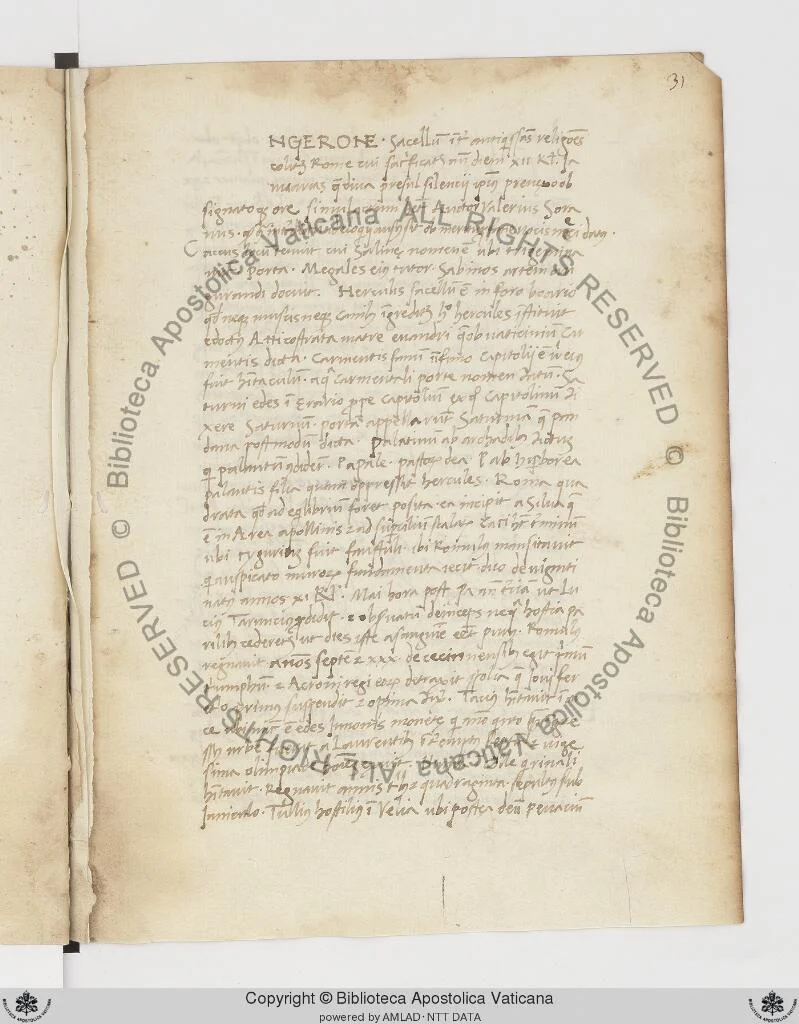
The spy's book: Rome's oldest geography, bound with its gods
Vatican manuscript Ott.lat.2848, published on DigiVatLib in the Week 23 batch (June 2026), is a two-part paper codex from 15th–16th-century Rome: 30 folios of Pomponius Mela's De Chorographia — the only standalone geography to survive from classical Latin, composed c. AD 43–44 — followed by 10 folios of a 16th-century alphabetical miscellany on Roman religion, opening with the goddess Angerona. The manuscript's spine bears the ex-libris of Baron Philipp von Stosch, a Prussian gem collector, British spy, and Masonic lodge founder, before the Vatican purchased his library in 1759 and absorbed it into the Ottoboni fond.

Open Vatican manuscript Ott.lat.2848 and the first thing you see is a page without a title. No rubric, no large decorated initial, no introductory flourish — just a line of humanistic Latin beginning mid-thought: Orbis situm dicere aggredior ("I set out to describe the layout of the world"). The scribe, working in Rome sometime between 1475 and 1500, apparently saw no need to announce what he was copying. 1 The text was De Chorographia, composed around AD 43–44 by Pomponius Mela — the earliest surviving formal geography in the Latin language — and the person making this copy was producing a working scholar's tool, not a showpiece.
The manuscript is small: 197 × 146 mm, 40 paper folios, fitting comfortably in one hand. It is now one of 13 manuscripts published by the Biblioteca Apostolica Vaticana in its Week 23 digitization batch on DigiVatLib, and it carries a provenance story that passes through one of the 18th century's most improbable characters — a Prussian gem collector, British spy, and Masonic lodge founder who somehow ended up owning a late-Quattrocento Roman geography manuscript. 1 2
A two-part book
Ott.lat.2848 is a composite manuscript — two distinct texts, in two distinct hands, written decades apart and bound together. The physical evidence for this is visible in the paper itself: the first part (ff. 1r–30v) uses a paper stock bearing a crown watermark similar to Briquet types 12147 and 12202, both documented in Rome in 1479–1481. The same watermark appears in the neighboring manuscripts Ottob. lat. 2851 and 2852, pointing to a shared paper supplier or workshop. 2
The first hand — a humanistic cursive with a slight rightward slant, the kind of clear, legible script that Italian scribes had refined over the preceding half-century of classical revival — carries Pomponius Mela's geography across 30 folios to its conclusion on f.30v. Then at f.31r, a different hand takes over. The new scribe works in a changed ductus, writing a century later, and his subject is entirely different: not geography but religion — specifically, a humanistic miscellany of notes on the gods and religious institutions of ancient Rome. The entries run alphabetically, beginning with Angerona (a minor goddess of the winter solstice whose rites were performed on December 21, the Divalia) and proceeding through the Arval Brothers, augury, and the Vestal Virgins. The explicit, at f.40r/40v, is mutilated — the text breaks off without a clean ending. 1 2
Together, the two parts read as a pair of reference tools assembled for a humanist reader interested in the Roman world — its spatial extent in Part I, its religious infrastructure in Part II.
Pomponius Mela and the shape of the world
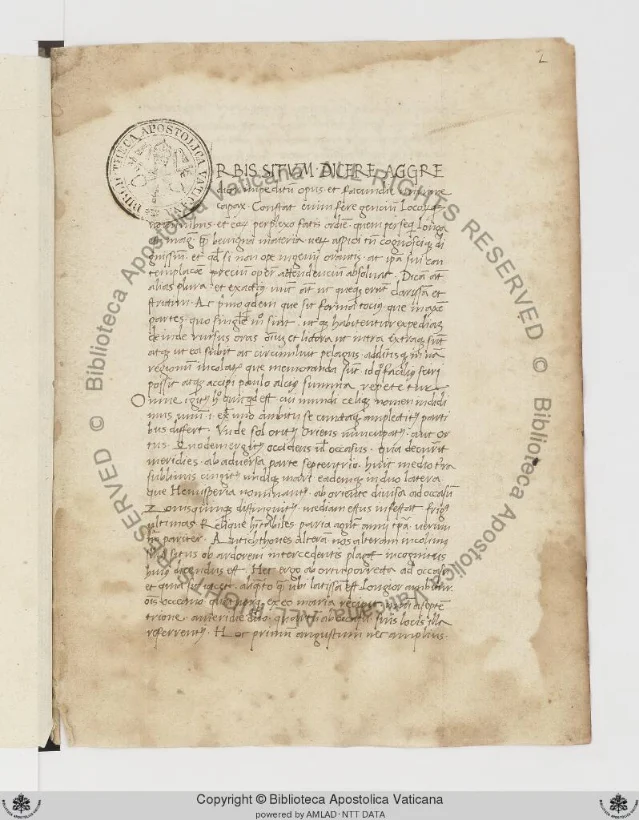
Pomponius Mela (died c. AD 45) was born in Tingentera — modern Algeciras, in southern Spain — and is the earliest known Roman geographer by name. His De Chorographia (also called De situ orbis, "On the Layout of the World") is roughly 16,500 words long, organized into three books, and follows the periplus method: a systematic coastal survey of the known world, moving from shore to shore rather than projecting an abstract grid. Books I–II cover the Mediterranean coasts and islands; Book III describes the outer ocean's edge, running from Spain and Gaul east through India and back around Africa. 4 5
The work is the only standalone geography to survive from classical Latin — a remarkable isolation, given how much else from the Roman world was lost. Pliny the Elder cites Mela as an authority and quotes him at length in the geographical books of his Naturalis Historia, which is itself one of the main reasons we know Mela existed. As a geographer, Mela has a mixed record that scholars have debated since the Renaissance: he was the first Latin writer to name and correctly locate the Orkney Islands, and his descriptions of the Atlantic coast of Spain and Gaul are considerably more accurate than earlier Greek sources. He has an early Latin mention of Scandinavia, which he calls Codanovia. But his knowledge of Asia retained older Greek misconceptions — the Caspian Sea, for instance, appears in his account as an inlet of the Northern Ocean rather than the landlocked body it is. 4
He also theorized that the Earth was divided into five climatic zones, with a southern temperate zone inhabited by antichthones — people living on the opposite side of an impassable equatorial heat belt. Unlike other ancient geographers, Mela explicitly left open the possibility that these southern peoples were real. Whether he was right about any of this was not the point. The point was that he organized the world into a coherent shape that a Roman reader could hold in mind — and that shape stayed in circulation for roughly 1,500 years. A new English translation with a full commentary, by Georgia Irby for Liverpool University Press's Translated Texts from Antiquity series, appeared in September 2025 — the first detailed annotated English version. 6
The Ott.lat.2848 copy is described by scholars in the Pellegrin / IRHT catalogue (1975) as one of the humanistic copies of Mela in the Vatican collections, with the watermark analysis placing its production firmly in Rome around 1479–1481. Piergiorgio Parroni, whose 1979 study examined the humanistic codices of Mela, judged that manuscripts like this one make a meaningful contribution to the text's transmission history, offering variant readings that matter for modern critical editions. 2 1
Where one world ends and another begins
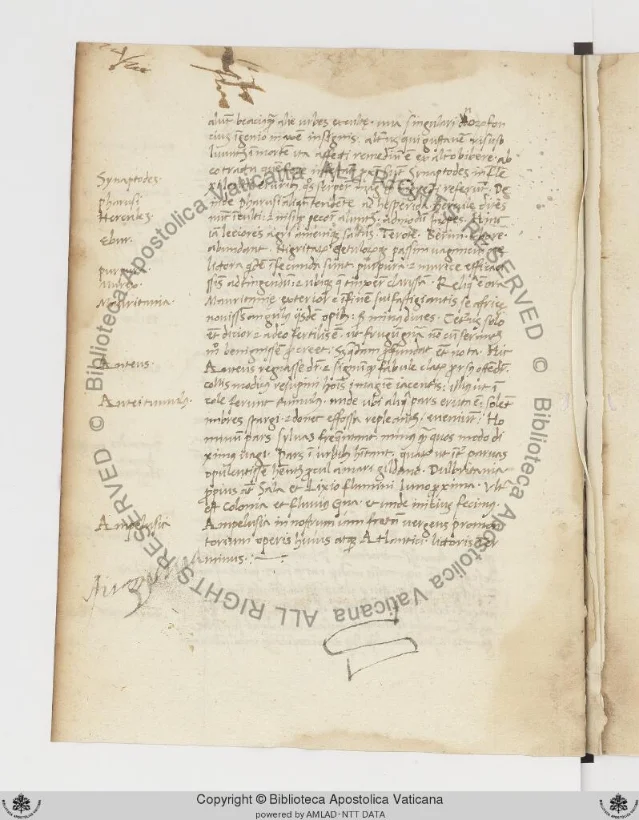
The handwriting shift between f.30v and f.31r is one of the most visible things about this manuscript. On f.30v, the first hand finishes Mela's text — place-names annotated in the margin, the text running to the page's lower margin. On f.31r, a different scribe begins fresh, with a changed script and new subject matter. The entry for Angerona leads into a cluster of other Roman religious topics: the Arval Brothers (Fratres Aruales), a college of twelve priests who performed annual fertility rites and whose acta survive on inscriptions from a grove near Rome; the art of augury (Augurandi ars), through which Roman priests read the will of the gods in the flight of birds and the behavior of sacred chickens; and the Vestal Virgins (Vestalis uirgo), the six priestesses who kept Rome's sacred fire burning. 1 2
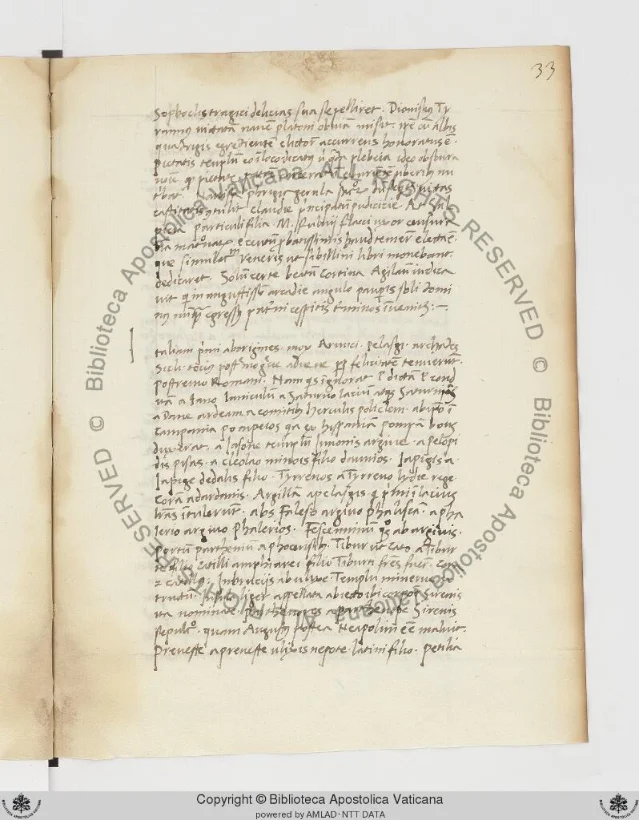
This kind of reference compilation — alphabetically organized notes on Roman deities and institutions, written in the humanistic tradition — is characteristic of 16th-century Italian scholarly culture, when reconstructing the religious practices of ancient Rome had become a serious intellectual project. The full contents of the miscellany remain partially catalogued: the Biblissima record specifies the incipit (beginning with Angerona) and notes entries visible at f.33 and f.40v, but a complete inventory of all entries would require full transcription.
The spy's library: Philipp von Stosch
The manuscript's spine carries an engraved ex-libris and the shelfmark C. XV — the marks of its last private owner before the Vatican. That owner was Baron Philipp von Stosch (1691–1757), and his biography requires a moment. 7
Stosch was born in Prussia, trained as a scholar of ancient gems, and spent most of his adult life in Rome and Florence. By the time he died, he had assembled a collection of more than 10,000 engraved gems — one of the largest in Europe, later purchased by Frederick the Great and now distributed across Berlin's museum collections. He simultaneously ran a library strong in history, diplomacy, and Italian relazioni (ambassadorial reports). He was openly non-conformist in a period that punished it: an acknowledged deist, an open homosexual, and in 1733 the founder of a Masonic lodge in Florence — one of the earliest in Italy.
He was also, throughout much of his Roman career, a paid intelligence agent for the British government, tasked with monitoring the Jacobite court-in-exile. The Old Pretender, James Francis Edward Stuart, held court in Rome, and Stosch's letters to London reported on the movements of Stuart's household with persistent if not always reliable detail. 7
Two years after Stosch's death, in 1759, the Vatican purchased his library and merged it into the existing Ottoboni fond. That collection had itself come to the Vatican only eleven years earlier: in 1748, the library purchased the library of the heirs of Cardinal Pietro Ottoboni (1667–1740), grandnephew of Pope Alexander VIII, an exceptional collector who had amassed 3,394 Latin manuscripts. Stosch's books — given shelfmarks Ottob. lat. 2565–3100 — slotted directly into the upper end of that range. 8 2
How a late-15th-century Roman humanist's copy of Pomponius Mela came to rest in Stosch's collection is not recorded. It may have passed through one of the many antiquarian sales that circulated manuscripts across Enlightenment-era Rome — a city where Greek and Latin books moved through auction houses, estate sales, and collectors' private negotiations with remarkable speed. What is clear is that the Vatican's 1759 purchase effectively folded Stosch's acquisitions — whatever their earlier wanderings — back into the city's institutional memory.
Now open on DigiVatLib
Ott.lat.2848 was published as part of the Vatican's Week 23 digitization batch in June 2026. The digital surrogate comprises 96 IIIF canvases — front and back covers, flyleaves, all 40 folios, the spine (dorso), all three page edges, and both a colorchecker card and millimeter scale — giving researchers access not just to the text but to the physical book's full exterior. 3
The full manuscript is freely viewable at DigiVatLib — Ott.lat.2848.
The shift between f.30v and f.31r — Mela's geography giving way to Rome's gods, one hand yielding to another across fifty or a hundred years — is visible to anyone who opens the viewer and scrolls to that page. Two different projects of humanist scholarship, bound together inside the covers of a book that once sat on a Prussian spy's shelf.
Cover image: folio 31r of Vatican manuscript Ott.lat.2848, © Biblioteca Apostolica Vaticana — all rights reserved.
参考来源
- 1DigiVatLib — Manuscript Ott.lat.2848
- 2Vatican. Biblioteca apostolica vaticana, Ott.lat.2848 — Biblissima
- 3IIIF Manifest — MSS_Ott.lat.2848
- 4Pomponius Mela — Wikipedia
- 5Pomponius Mela — Britannica
- 6Translated Texts from Antiquity Vol. 1: Pomponius Mela's Geography of the World — Liverpool University Press Blog
- 7Philipp von Stosch — Wikipedia
- 8Vatican Manuscripts Added Week 14 of 2020 — wiglaf.org
围绕这条内容继续补充观点或上下文。