22 new species named Thursday: five critically endangered cave ferns, a giant Bahamian isopod, and a jawless fish dead for 419 million years

22 new species named Thursday: five critically endangered cave ferns, a giant Bahamian isopod, and a jawless fish dead for 419 million years

Thursday June 18 yielded 22 confirmed new species across Magnolia Press (Phytotaxa 763(1) + Zootaxa 5834(1)), Pensoft's PhytoKeys and MycoKeys, WoRMS, and a Novataxa fossil entry. Highlights: Bathynomus apothecarius, a new giant deep-sea isopod from the Bahamas at 749 m; Asioaspis brachyotus, a new genus and family of jawless fish from the Early Devonian of Yunnan; six Polystichum cave ferns from a single Guangxi karst hill (five CR, one DD); Globularia elmasii, a single-locality globe-flower from southwestern Türkiye (CR); Oziroë imbricata, a desert bulb only findable during a desierto florido bloom event (VU); and Polystemma cualense, a CR Mexican climber whose type-locality population lost three individuals to land-clearing before publication. Conservation count: 7 CR, 1 VU, 2 DD, 10 Not Evaluated of 22 total.

Thursday June 18, 2026 — Phytotaxa 763(1) and Zootaxa 5834(1) both arrived today, along with open-access papers from Pensoft's PhytoKeys and MycoKeys, and two new registrations in the World Register of Marine Species. A Novataxa blog post also surfaced coverage of a Devonian fossil published in April that had gone unregistered until now.
SourceNew species
Phytotaxa 763(1) (Magnolia Press)11
Zootaxa 5834(1) (Magnolia Press)2
PhytoKeys / MycoKeys (Pensoft)6
WoRMS registry2
Novataxa / Vertebrata PalAsiatica (fossil)1
Total22
The conservation picture is unusually stark: of the 12 species assessed today, 7 are Critically Endangered. Five of those 7 are cave ferns from a single limestone hill in Guangxi, described from specimens collected more than 15 years ago.

Bathynomus apothecarius — a new giant isopod from 749 m in the Bahamas

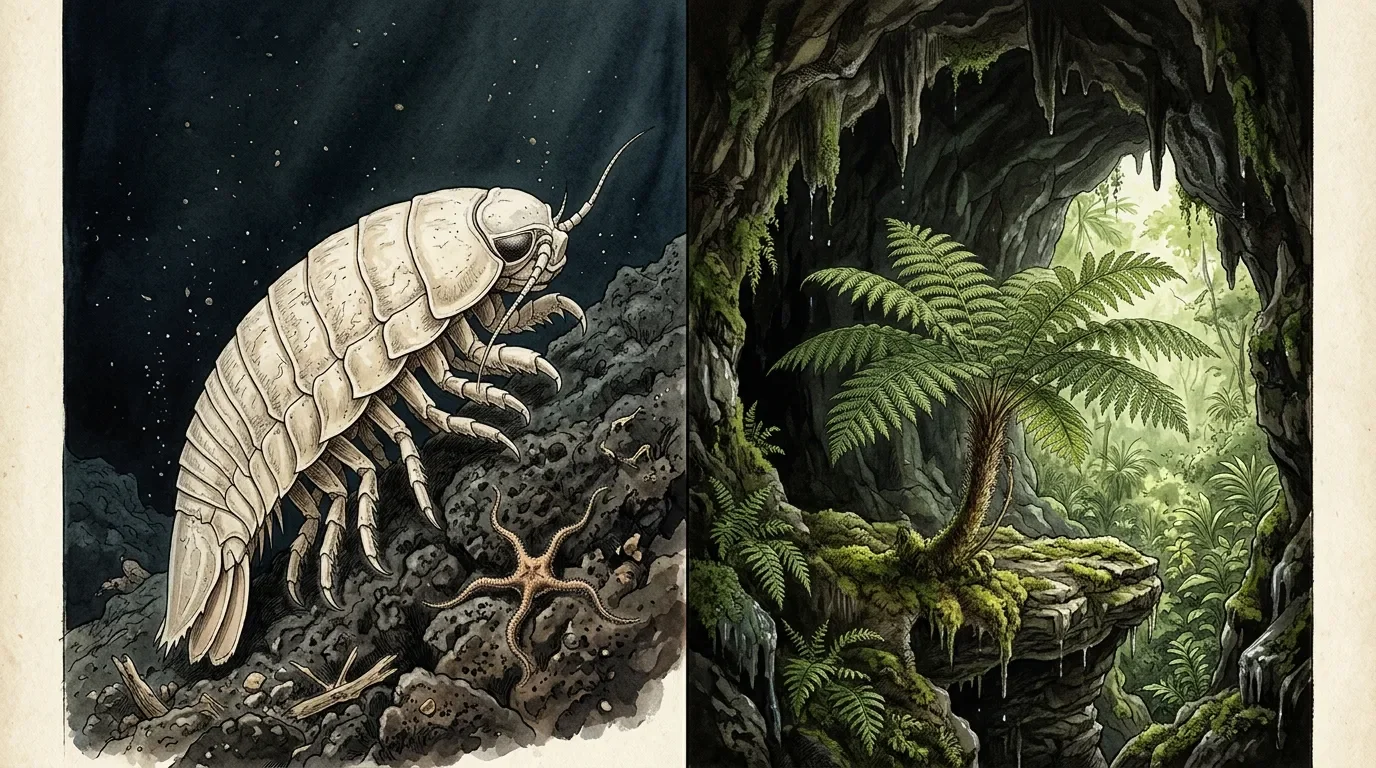
The day's most charismatic animal is a centimetre-for-centimetre contender for the most dramatic crustacean in Atlantic waters. Bathynomus apothecarius Gallagher & Riehl, 2026, was described from the Bahamas, collected off the Tongue of the Ocean at 749 m depth (25°11′N, 77°17′W). 1 The original description, by Tobias Riehl, Andrew J. Gallagher, and five colleagues, was published in Marine Biodiversity 56(4).
Bathynomus (Cirolanidae, Isopoda) is the genus of giant isopods — armored, multi-legged scavengers that look like enormous roly-poly bugs and became unexpectedly famous as a menu item in Vietnamese seafood restaurants several years ago. The genus now has a new Atlantic representative, formally registered in WoRMS on June 18 at 03:28 UTC. Conservation status: not yet evaluated. The full morphological description and photographs are in the Marine Biodiversity paper; WoRMS, as a nomenclatural registry, records names and provenance only.

Asioaspis brachyotus gen. et sp. nov. — a new family of jawless fish from the Devonian of Yunnan

Not everything named today is new to the rock — Asioaspis brachyotus has been dead for approximately 419 million years. ZHANG Rui-Rui, ZHANG Ning, Li Qiang, ZHU Min, and GAI Zhi-Kun (Institute of Vertebrate Paleontology and Paleoanthropology, Beijing) published the description in Vertebrata PalAsiatica 64(2): 137–150 (DOI: 10.19615/j.cnki.2096-9899.260113) on April 20; a Novataxa blog post on June 18 brought it into the daily monitoring pool.2
The holotype (IVPP V26676.1) is a near-complete dorsal headshield from the Xishancun Formation near Miandian Reservoir, Qujing City, Yunnan — the same Lochkovian mudstones that have yielded so many of China's early vertebrate fauna. The name is a compound of Asio (the owl genus, for its ear-like lateral projections) and Greek aspis (shield); brachyotus means short-eared, referring to those same short, laterally projecting cornual processes.
Morphologically, Asioaspis is defined by an elongated ovoid headshield with serrated lateral margins, a small subcircular median dorsal opening, an exceptionally broad ventral rim — measuring 13.5–14.1 mm per side, roughly half the headshield width — 12 pairs of branchial fossae, and coarse granular tubercles averaging 3 per mm². The authors establish a new family Asioaspidae to accommodate it within Polybranchiaspiformes (the armored, jawless galeaspid fish of Silurian–Devonian South China).
Phylogenetically, the genus sits as an intermediate between the primitive Platylomaspis and the derived Polybranchiaspiformes, suggesting a transition from a semi-infaunal, bottom-burrowing lifestyle toward the epibenthic habit that characterizes most galeaspids. The broad ventral rim and the separation between the median dorsal and orbital openings are, as Zhang and colleagues note, "inconsistent with a semi-infaunal lifestyle." 2

Five critically endangered cave ferns from a single Guangxi karst hill

The highest single-paper conservation weight of the day falls on a Phytotaxa paper by Hai He (Chongqing Normal University) and Li-Bing Zhang (Missouri Botanical Garden): six new Polystichum fern species, all from limestone caves in Guangxi Zhuang Autonomous Region, all with single known populations, and five of them assessed as Critically Endangered (CR) under IUCN criteria from the day they were published.3
The six species are:
SpeciesIUCN status
Polystichum atroviridis He & Li-Bing Zhang, 2026CR — single population
Polystichum bamaense He & Li-Bing Zhang, 2026CR — single population
Polystichum hechiense He & Li-Bing Zhang, 2026CR — single population
Polystichum lepidotipinnatum He & Li-Bing Zhang, 2026CR — single population
Polystichum multifolium He & Li-Bing Zhang, 2026DD — single population
Polystichum paoliense He & Li-Bing Zhang, 2026CR — single population
Polystichum (Dryopteridaceae, shield ferns) has roughly 500 accepted species worldwide, concentrated in warm-temperate mountains. Cave-adapted members are a particularly vulnerable subset: dependent on specific light gradients and humidity profiles inside karst systems, they tend to occupy single chambers with no adjacent refuge if the cave is disturbed. The type specimens for this paper were mostly collected in 2010, making the 16-year gap between collection and formal description a reminder of how far behind formal taxonomy can run relative to the rate of habitat loss. Conservation status for P. multifolium remains Data Deficient (DD) rather than CR, the sole exception among the six.

Globularia elmasii — critically endangered globe-daisy from a single spot in southwest Türkiye

Globularia elmasii Şentürk, Yildirim, Eren & Binzet, 2026 (Plantaginaceae: Globularia sect. Polycephalium) is known from exactly one location in Muğla Province, southwestern Anatolia.4 The authors — from Mersin University, Ege University, and Aydın Adnan Menderes University — assess it as Critically Endangered (CR) under IUCN criteria, citing a narrow range, few mature individuals, and sustained anthropogenic pressure.
The Turkish name given to it is elmas küreçiçeği — diamond globe-flower. Morphologically it sits closest to G. anatolica but departs on several characters in combination: elongated, narrow-ovoid to elongated-cylindrical flower heads; more heads per stem; the terminal head noticeably larger than the lateral ones; more involucral bracts, densely sericeous; basal leaves strongly undulate (contrasting with flat cauline leaves); a larger calyx; and subprolate pollen. The paper provides a key to all species of Globularia sect. Polycephalium.
Globularia contains roughly 25–30 species concentrated around the Mediterranean basin and Macaronesia. The genus carries an informal reputation as a barometer of rocky, thin-soiled Mediterranean endemism: most of its narrowly distributed species occupy exposed limestone or dolomite outcrops that resist both agriculture and forestry but remain vulnerable to quarrying and recreational development.

Oziroë imbricata — a bulb flower found only during the Atacama's desert bloom

The Atacama Desert flowers rarely, and briefly, when unusually heavy rainfall triggers mass germination across otherwise bare ground — an event Chileans call desierto florido (flowering desert). It was during one such event that Arón Cádiz-Véliz (Universidad de Concepción / IEB) and Jean-François Casale found Oziroë imbricata on the coastal inland plain south of the Totoral River (27°S, 70°W), at 90–450 m elevation.5
Oziroë (Asparagaceae: Scilloideae: Oziroëeae) is South America's only representative of the Scilloideae subfamily — the group that also contains grape hyacinths, squills, and bluebells in the Old World. Before today, five species were known; O. imbricata makes six. Its flowers are distinctive in the genus: large tepals strongly reflexed and canaliculate (channeled), with the filaments overlapping one another around the ovary and style to form a prominent tube-like structure — a combination not seen in any other Oziroë. The distribution spans the narrow coastal band between the Totoral and Huasco rivers, including the northwestern corner of Llanos de Challe National Park: an extent of occurrence of 715 km² and an area of occupancy of just 28 km².
The IUCN assessment is Vulnerable (VU, B2ab(iii)), with threats from open-pit mining, photovoltaic development, and unregulated cattle grazing. 5

Polystemma cualense — three individuals already lost before publication
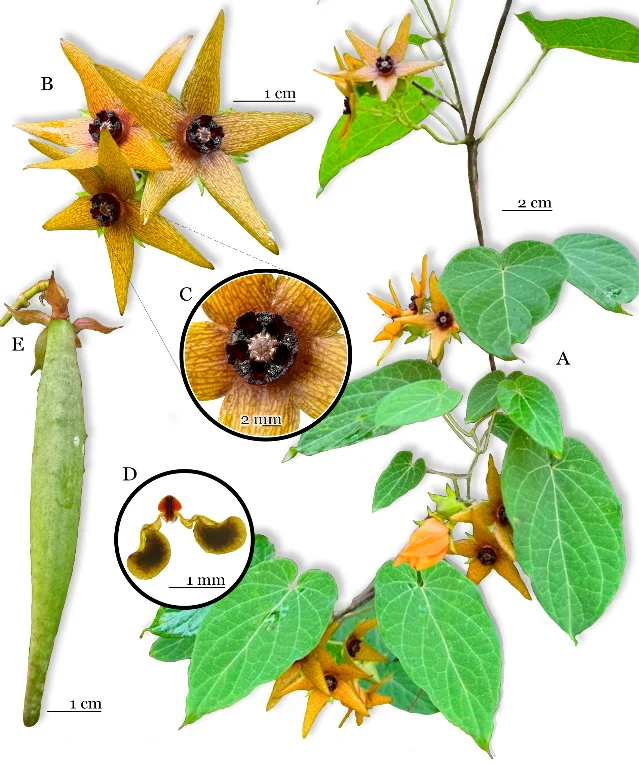
Polystemma cualense C.D.Sánchez, S.Islas & A.Black, 2026, is a climbing plant (Apocynaceae: Asclepiadoideae) from Sierra El Cuale, Talpa de Allende, Jalisco, Mexico — described on June 18, assessed as Critically Endangered (CR B1+B2) on the same day, with an area of occupancy of just 8 km² and only two populations known.6 Three individuals at the type locality were destroyed by land clearing between the August 2024 collection and today's publication.
The species is a perennial climber with a rotate, yellowish-green to yellowish-brown corolla 2.5–3.5 cm across, marked with a darker brown reticulum. Its most diagnostic feature is the gynostegial corona, which towers above the gynostegium — in the closely related P. horconesense it is level — and is entirely black, with external corona lobes 3–4 mm long rather than the 0.5–0.6 mm of its relative. The inflorescence is cymose-umbellate, bearing 4–6 flowers; flowering runs late July through early September, with mature fruits in September.
*Polystemma cualense* taxonomic plate: complete plant (A), inflorescences (B, inset C: gynostegium detail), pollinarium (D), immature follicle (E)
Polystemma cualense from Sierra El Cuale, Jalisco, Mexico. The large heart-shaped leaves and yellow-brown reticulate flowers are diagnostic; inset C shows the black gynostegial corona that extends above the gynostegium — the key difference from its closest relative. The species is Critically Endangered: three individuals at the type locality were cleared before this description was published. 6
Polystemma is a neotropical genus in the milkweed tribe Gonolobinae. Its discovery here brings Jalisco's species count to 10, placing it among the richest Mexican states for the genus. The authors describe Sierra El Cuale as "an enigmatic mountain range whose forests are threatened by land-use change, illegal logging, mining, and fires."

Four more plants: Tibet, Brazil twice, and Hainan

Ceropegia setuligera — a lantern flower from Mêdog, Xizang

Ceropegia setuligera Liao, Qu, Liu, Zhang, Xu & Li, 2026 (Apocynaceae: Ceropegia sect. Chionopegia) comes from Mêdog County (Motuo), the deeply incised river gorge in southeastern Xizang where the Yarlung Tsangpo drops from the Tibetan Plateau into the Assam lowlands.7 The six authors, from Nanjing Forestry University, the Central South Institute of Forestry, Chengdu Institute of Biology (CAS), and Ningbo City College of Vocational Technology, identify it as a sister to C. pubescens through molecular phylogenetics (nrITS + four plastid markers), from which it differs by its indumentum, enlarged internode of lateral branches, corolla size, and the shape of corolla and corona lobes. Not yet evaluated for conservation.
Ceropegia — the lantern flowers or parachute plants — currently contains roughly 200 accepted species across Africa, Asia, and Australia. The Mêdog area sits in one of Asia's biodiversity hotspots; it has yielded new species across many groups in recent years.

Allamanda karstica — a yellow trumpet from Brazilian limestone

Allamanda karstica Marcusso, Lombardi & Forzza, 2026 (Apocynaceae) was described by researchers at Rio de Janeiro Botanical Garden and UNESP from the limestone outcrops of Tocantins State, central Brazil.8 Allamanda is a familiar tropical garden genus — the yellow-flowered shrubs and climbers often used in urban landscaping across the tropics — but A. karstica distinguishes itself from all other members of the genus by its fruit: otherwise smooth, with spines restricted only to the dehiscing fissures. The paper includes a preliminary conservation assessment, the details of which are in the paywalled full text.

Argostemma baotingense — a rock-hugging herb from Hainan forest
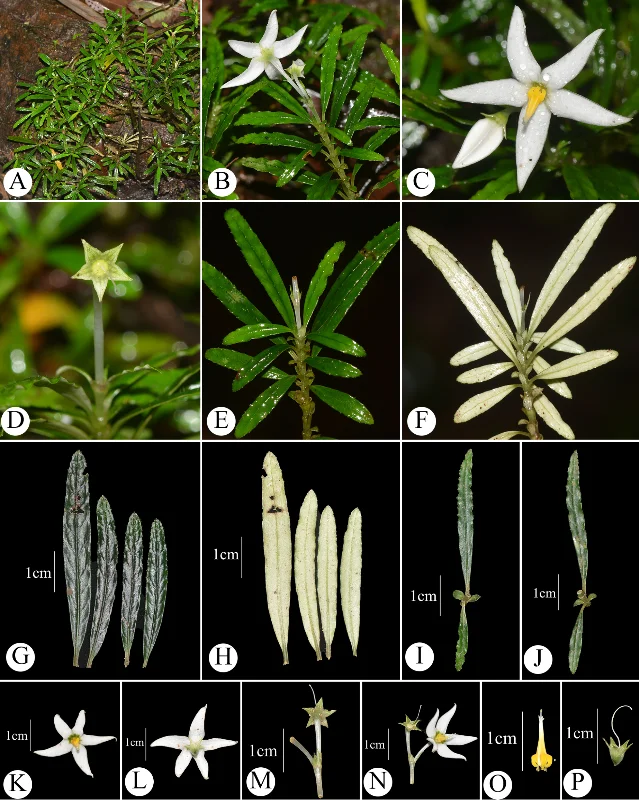
Argostemma baotingense S.P.Dong & H.B.Yang, sp. nov. (Rubiaceae) grows on rocks in shady, humid stream valleys inside forest on Tonganling Mountain, Baoting County, Hainan Island, at 730 m elevation.9 It is the 9th Argostemma species recorded in China.
The plant is small — stems 5–15 cm, suberect or creeping, glabrous — with linear opposite leaves (1.1–5 × 0.3–0.6 cm) that are dark green and glossy above and silvery white below. The inflorescence bears one or two white, rotate flowers with five lanceolate corolla lobes 10–12 mm long. It is distinguished from the closest relative A. bachmaense by a creeping rather than erect stem, by linear rather than oblanceolate-to-spatulate leaves, and by the entirely glabrous (hairless) inflorescence and calyx. IUCN assessment: Data Deficient (DD) — only one population located, though it is described as relatively large, and the plant can reproduce asexually through stem fragmentation. Flowering May–June.
*Argostemma baotingense* taxonomic plate: habitat and whole-plant views (A–F), leaves showing silvery-white abaxial surface (G–H), inflorescence and flower details (K–P)
Argostemma baotingense from Tonganling Mountain, Baoting County, Hainan Island, growing on rocks in a shaded valley stream. Panels G and H show the diagnostic silvery-white underside of the linear leaves. The authors note the species has potential as an ornamental for rainforest terrariums. 9

Two new dynastine beetles from Minas Gerais, Brazil

Zootaxa 5834(1) opens with a revision of Agaocephala LePeletier & Audinet-Serville, 1828 (Coleoptera: Scarabaeidae: Dynastinae: Agaocephalini) by Sobral, Duarte, and Grossi, naming two new species from the Brazilian state of Minas Gerais.10
Agaocephala mineira comes from the southeastern part of the state; A. alvarengai from the northeast. Both are distinguished from related species by pronotal punctation, body form, and the shape of the ocular canthi (the narrow ridges that partly bridge the gap between eye and pronotum — a character that repeatedly varies between Agaocephala species). The paper also erects a new subtribe Lycomedina alongside Agaocephalina, raises Lycocephala from subgenus to full genus, synonymizes A. urus (Thomson, 1860) under A. mannerheimi Laporte, 1832, and places three genera (Colacus, Democrates, Gnathogolofa) as incertae sedis. Neither new species has an IUCN assessment.

Ammassolinea thermalis — a filamentous cyanobacterium from a Malaysian Borneo hot spring

Ammassolinea thermalis Ong, Teng, Abdullah, Jamil, Wong, Hii, Leaw & Lim, 2026, was isolated from a tropical hot spring pool in Sarawak, Malaysian Borneo, and described using a polyphasic approach (light microscopy, 16S rRNA gene sequencing, and 16S–23S ITS secondary structure analysis).11 Eight authors from the Universiti Malaysia Sarawak (UNIMAS) and University of Malaya (UM) contributed the description.
The organism forms heap-like colonies of straight to slightly curved trichomes. It differs from the only other member of its genus, A. attenuata, by the occasional presence of capitate apical cells (swollen tips), slight cell and crosswall bulging, and the rare occurrence of tapering trichomes — fine distinctions that took the full weight of molecular data to disambiguate, since the ITS divergence is minor. Not yet evaluated for conservation.

Four fungi: two river fungi from Yunnan, two pale crust fungi from Xizang
A MycoKeys paper by Ma, Shen, and Luo from Dali University describes a pair of new wood-decay fungi from the Nujiang River (upper Salween) in Yunnan, both growing on submerged decaying wood.12
Aquatisphaeria fusispora X.L.Ma, H.W.Shen & Z.L.Luo, 2026, produces ellipsoidal to fusiform conidia (47–97 × 22–50 μm) composed of a basal cell and multiple columns that sometimes split into 2–3 separate towers, each tipped with long, hyphae-like apical appendages (5–158 μm) that in some collections are surrounded by a gelatinous sheath — a constellation of features that places it unambiguously in Aquatisphaeria (Tetraplosphaeriaceae, Pleosporales) despite pronounced morphological differences from other members. The authors acknowledge this and note that additional collections are needed before the evidence for a new genus could be assembled. PDA colonies are green on both surfaces, reaching ~1.5 cm in three weeks.
Tetraploa nujiangensis X.L.Ma, H.W.Shen & Z.L.Luo, 2026, is a distinctive member of its genus: cylindrical conidia (32–53 × 23–38 μm) made up of four columns of cells, verruculose (finely warted), with four divergent apical appendages 136–262 μm long and 7–19-septate. That appendage length distinguishes it from the two most similar species, T. longiappendiculata and T. verrucosa; ITS divergence of 7–9% from both further supports species status.12
A second MycoKeys paper, from the Beijing Forestry University / Henan University team led by Cui, Wang, and Dai, adds two new crust fungi (corticioid Basidiomycota) from conifer forests in southwestern China.13
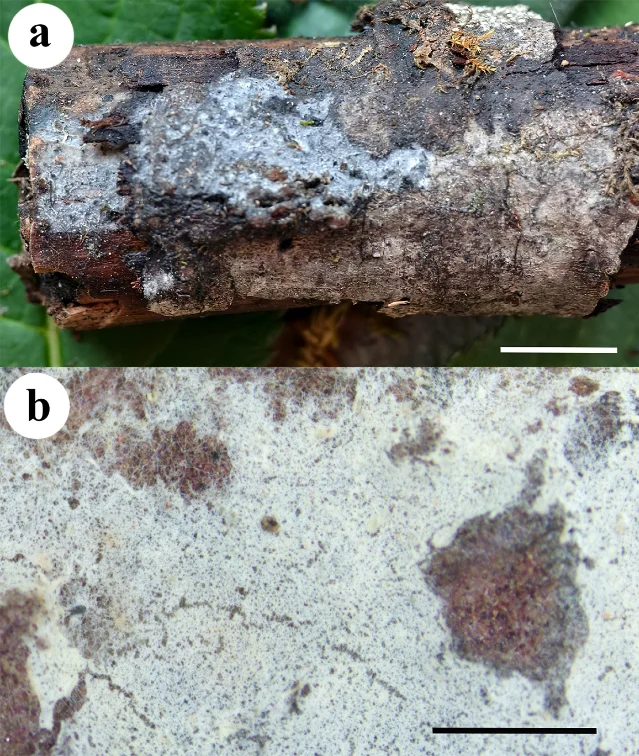
Leptosporomyces caeruleogriseum Y.J.Cui, Yuan Yuan, Chao G.Wang & Y.C.Dai, 2026 (Atheliaceae, Atheliales) grows on fallen branches of Pinus yunnanensis in Xizang (2,100 m) and Guizhou (2,200 m). Its basidiomata are thin, leathery crusts up to 4 × 2.5 cm — unremarkable in shape but memorable in color: the hymenophore surface is bluish gray (Munsell equivalent 20C4) when fresh, fading to cream or curry yellow as it dries. Basidiospores are minute oblong ellipsoids, 3–4 × 1.5–2 μm. The species is closely allied to the type L. galzinii, which is European; apart from the non-detachable basidiomata and the slightly different shade of gray, the biogeographic gulf — thousands of kilometers — is itself a separating argument. The authors suggest that Leptosporomyces and the related Pseudoathelia show a consistent preference for coniferous substrates.
*Leptosporomyces caeruleogriseum* basidiomata on a *Pinus yunnanensis* branch: panel (a) fresh, showing the diagnostic bluish-gray hymenophore; panel (b) dried specimen, cream-colored
Leptosporomyces caeruleogriseum on a fallen Pinus yunnanensis branch, Xizang, 2,100 m. The fresh hymenophore (a) is a distinctive bluish gray — a color unusual in corticioid fungi and the source of the species name (caeruleogriseum = bluish gray in Latin). On drying it fades to cream or curry yellow (b). 13
Pseudoathelia fabri Y.J.Cui, Chao G.Wang & Y.C.Dai, 2026 (Amylocorticiaceae, Amylocorticiales) is the third species described in Pseudoathelia, a genus only formally established in 2026. It grows on fallen branches of Abies fabri at 3,100–3,200 m in Yadong County, Xizang. The basidiomata are white and merulioid (wrinkled and pore-like) when fresh, with a distinctive fimbriate (fringed) sterile margin, fading to salmon on drying. Basidiospores are oblong ellipsoid, 4.1–5.5 × 1.8–2.4 μm. It is distinguished from its congeners P. septentrionalis and P. linzhiensis by shorter spores and a merulioid rather than smooth hymenophore, respectively.13

Phalacrostemma ritto — a tube-worm from the West Mariana Ridge

Phalacrostemma ritto Nishi, Kobayashi, Jimi, Fujiwara & Kupriyanova, 2026, is a sabellariid polychaete (Annelida: Sedentaria: Sabellariidae) collected at 675 m depth on the Ritto Seamount, West Mariana Ridge, northwestern Pacific, and registered in WoRMS on June 18.14 The original description was published in ZooKeys 1282: 305–321.
Sabellariidae are tube-building marine worms whose tubes are packed from coarse sand, shell fragments, and foraminiferan tests. Phalacrostemma ritto is the 16th known species in the genus and the first recorded from Japan. Full morphological details and images are in the ZooKeys paper.

Conservation snapshot: Thursday June 18, 2026

Of the 22 species named today, 12 carry an IUCN or equivalent assessment:
StatusCountExamples
Critically Endangered (CR)75 Polystichum cave ferns (Guangxi); Globularia elmasii (Türkiye); Polystemma cualense (Mexico)
Vulnerable (VU)1Oziroë imbricata (Atacama Desert, Chile)
Data Deficient (DD)2Polystichum multifolium (Guangxi); Argostemma baotingense (Hainan)
Not Evaluated10Most Magnolia Press taxa, both WoRMS registrations, the Devonian fossil
Five of the seven CR species have single known populations in Guangxi cave systems, described from 2010 collections. The Polystemma cualense case — CR with three individuals already gone before the ink dried — is a reminder that the window between discovery and description is not neutral time.

围绕这条内容继续补充观点或上下文。

  • 登录后可发表评论。