Lorgar Aurelian, Part I: The Rain-Caller of Colchis
The first episode of the Lorgar arc — from his infant capsule crashing on the desert world of Colchis and his brutal upbringing under the manipulative Kor Phaeron, through the six-year Schism Wars and the miracle at Gahevarla, to the Emperor's devastating humiliation of Monarchia and Lorgar's pilgrimage into the Eye of Terror where the Chaos Gods showed him everything he'd always needed to know.
Before there was a Heresy, there was a prayer.
Before Horus raised his hand against the Emperor, before a single traitor legion crossed into treachery, a child on a desert world was already on his knees — not in defeat, but in devotion. He was asking the sky a question that no one in the Imperium of Mankind was supposed to ask: Is there something worth worshipping here?
That child was Lorgar Aurelian. And the answer he eventually found burned ten thousand years.
The rain-caller of Colchis
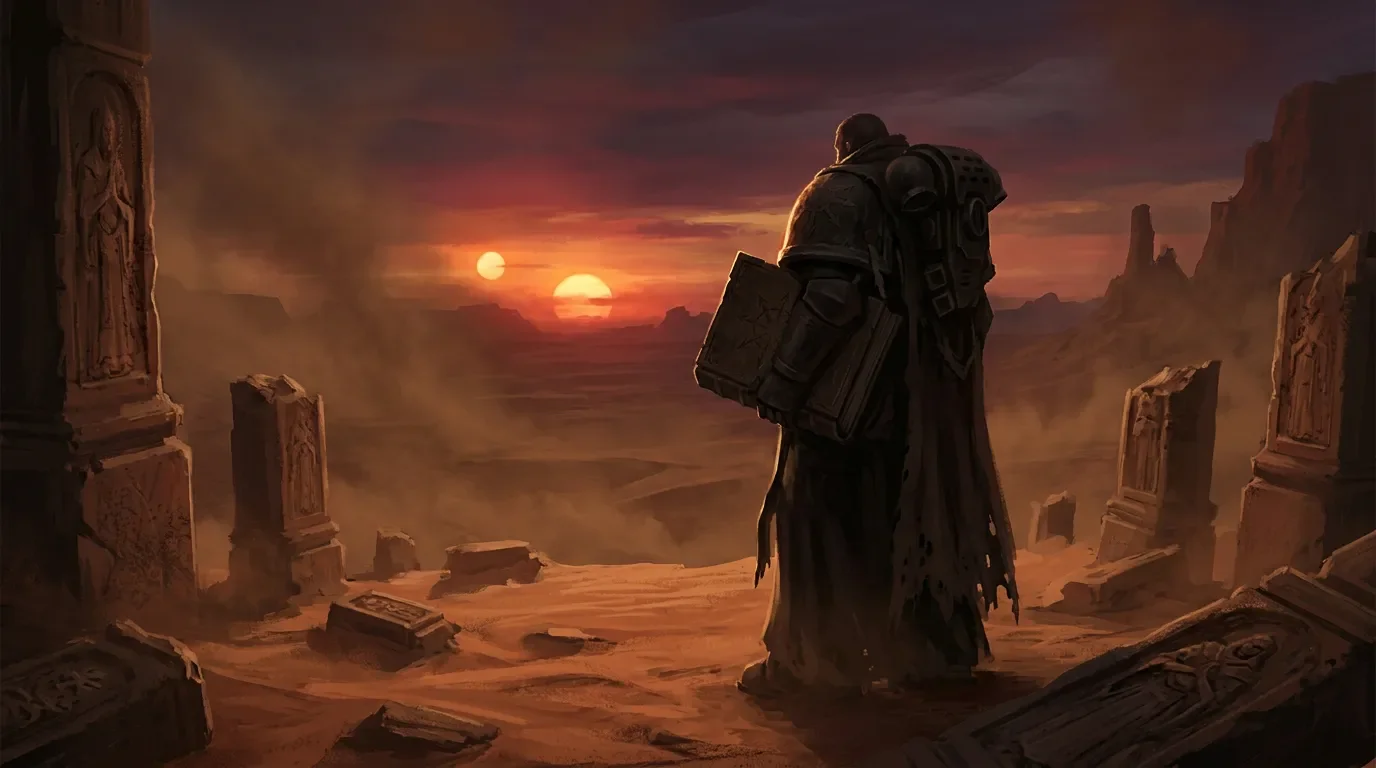
Lorgar's infant pod came down over Colchis hard, shattering on impact the way all the Primarchs' pods did when Chaos scattered them across the galaxy. The desert planet of Colchis was a feudal world of baking stone, ancient theocratic law, and a religion called the Covenant — a polytheistic faith that, unknown to its adherents, pointed dimly at the Chaos Gods. A nomadic outcast tribe called The Declined found the wreckage and the infant inside it. Their chieftain, Fan Morgal, named the child Lorgar — "rain-caller" in the dialect of the plains — because the boy arrived during a rare storm. 1
Seventeen days later, with the infant already grown to the size of a young child, a man named Kor Phaeron found them. 1 Kor Phaeron was an exiled priest of the Covenant, hard-eyed and calculating, and he immediately grasped what he was looking at: something extraordinary, something he could use. He convinced the child to become his disciple. Then he killed Fan Morgal and everyone in the tribe to erase the evidence of how he'd found the boy.
This was Lorgar's first teacher. It is worth holding that fact. The man who would shape the future architect of the Horus Heresy was a murderer who used a child as a vehicle for his own ambition.
Kor Phaeron's lessons were brutal. He beat Lorgar. He manipulated him emotionally. He dismissed the boy's earliest theological insights and tried to steer the child's evolving faith toward his own ends. Yet Lorgar worshipped him anyway — or rather, Lorgar worshipped what Kor Phaeron taught him to worship. The Covenant gave Lorgar a framework for the questions already burning inside him. He read every text he could find. He noticed patterns in the Covenant's theology that the priests had apparently never seen — hints of a singular divine unity behind the polytheistic surface, a binding force he called The One. 1
Kor Phaeron dismissed the idea. Then he started using it.
The schism wars and the miracle at Gahevarla
Lorgar grew faster than any child of Colchis had a right to. By adolescence he had surpassed his master in charisma, learning, and the raw psychic intensity that the Primarchs carried in their blood. He became a preacher of stunning power — crowds gathered wherever he spoke, and his message spread across the trade routes and tribal networks of Colchis like fire in dry grass. 2 He freed slaves. He challenged the established hierarchies of the Covenant. He named himself Bearer of the Word after saving Kor Phaeron's life during a crew mutiny.
The Covenant's leadership moved against him, as established powers always do when someone new commands the room. They declared Lorgar a heretic. When the templars they sent to arrest him were killed by his followers, the declaration became a war.
The Schism Wars consumed Colchis for six years. 1 Lorgar's Brotherhood of Lorgar — ex-slaves, converted tribespeople, lower priests — fought the entrenched Old Faith across every city and caravan route on the planet. One by one the cities fell. The ancient capital of Vharadesh opened its gates after a sermon in front of its walls; the lower priests brought out the corpses of the Covenant Ecclesiarch and Hierarchs as gifts.
The last holdout was Gahevarla, protected by a Dark Age of Technology storm generator — a machine that conjured a permanent maelstrom around its walls, impenetrable to conventional assault. Lorgar walked out alone to meet the storm. What happened next is recorded as a miracle in the texts his followers later compiled: he approached the maelstrom and parted it, opening a clear path for his army to march through. 1
Whether it was telekinesis, latent psychic power, sheer will, or something more, the image of a golden-haired Primarch standing before a supernatural storm and bending it to his faith became the founding myth of a religion. Lorgar had won. He was lord of Colchis.
He was also still asking the same question — what am I supposed to worship? — because Colchis had given him the practice of devotion but not its object.
Lorgar during the Great Crusade, bearing the gilded armour of the XVII Legion 1
The Emperor descends
Less than a year after the final victory, the answer arrived from orbit. 1
A landing craft came down near the temple. Two Tactical Squads of Thousand Sons Space Marines in blue ceramic armour stepped out, flanking a cyclopean giant in blue robes — Magnus the Red, Primarch of the XV Legion. Behind them came the one Lorgar had been seeing in visions his entire life: a figure in gleaming bronze, radiating something Lorgar could only describe as divinity. The Emperor of Mankind.
Lorgar recognised him instantly. He had been seeing this man in dreams since childhood.
He knelt.
The entire world converted. The Covenant was reorganised around the worship of the Emperor as divine saviour. Celebrations lasted months. 1 The Emperor tolerated the ceremony impatiently — he wanted to return to the Great Crusade, the military campaign to reunite all of humanity under a single secular Imperium. When the celebrations finally ended, Lorgar was given command of the Seventeenth Space Marine Legion, then called the Imperial Heralds. Lorgar renamed them the Word Bearers.
The name is a clue. Not Sword Bearers. Not Shield Bearers. The Word.
The slowest legion in the Crusade
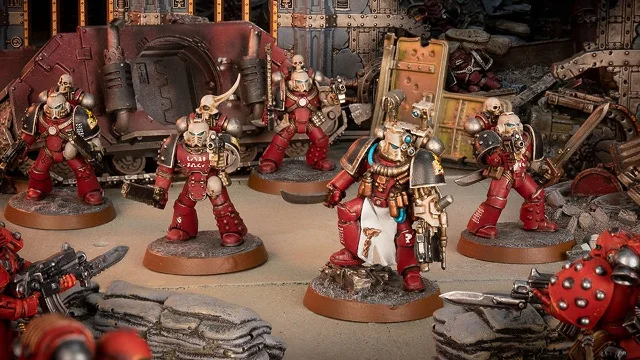
The Word Bearers fought across the galaxy, but they fought differently from every other legion. Where Guilliman's Ultramarines were industrial in their efficiency, and Leman Russ's Space Wolves were savage and swift, the Word Bearers stopped. They stopped to burn what they deemed blasphemous. They stopped to raise temples and cathedral-cities on worlds they'd conquered. They stopped to preach. 2
Lorgar's chaplains produced grand theological treatises. The greatest of their conquered worlds were rebuilt as monuments of devotion to the Emperor as a living god. At some point during this campaign, Lorgar wrote a book called the Lectitio Divinitatus — a text arguing, in philosophical and theological terms, for the divinity of the Emperor. 1 The book circulated in secret, its authorship concealed. It would later become the founding text of the Imperial Cult — the state religion of the post-Heresy Imperium that the Emperor himself explicitly forbade.
But in the short term, the Word Bearers' devotion created a problem: they were slow. Other legions completed the work of conquest in days; the Word Bearers took months. The Emperor noticed. He sent word. He sent it again. The XVII Legion kept stopping to pray.
The thing about the Emperor's doctrine — the Imperial Truth — was that it declared religion to be a lie. There were no gods. The Emperor was not divine. The universe was material and rational and humanity would conquer it by force of science and will, not faith. This was the founding ideology of the Great Crusade. Lorgar, by building temples and writing theology, was directly contradicting everything the Emperor publicly stood for.
The Emperor decided to make the point clearly.
The humiliation of Monarchia
Monarchia was Lorgar's masterpiece. 2 A city on a world the Word Bearers had conquered, rebuilt from its foundations as a monument to the Emperor's divinity — every building a theological statement, every plaza a place of worship, every citizen a convert. The Word Bearers called it the Perfect City. They were proud of it in the way that genuinely devout people are proud of the most sincere expression of their faith.
The Emperor sent Roboute Guilliman and the Ultramarines to destroy it.
Not defeat an enemy in it. Not reprimand its builders. Destroy it. Level it. Burn it to the foundation stones and leave nothing standing.
While the Ultramarines completed that work, the Emperor came personally to Lorgar. He forced the entire Word Bearers Legion — every warrior, every officer, Lorgar included — to kneel in the ashes of Monarchia. In silence. Before the man they had been worshipping. 1
The Emperor said nothing during the kneeling. He had already said everything he needed to say by sending Guilliman.
Lorgar didn't speak for a month afterward. He wore only a hairshirt. He refused to speak to anyone except Erebus — his First Chaplain — and Kor Phaeron, who had come with him into the Imperium as a senior member of the Legion. 1
Here is what those two men said to Lorgar in that month: the Emperor is not the answer. He is not a god. He cannot be worshipped because he refuses it. But there are forces in the universe that do want to be worshipped — that demand it, that reward it, that will give the kind of devotion you want to give somewhere worthy to go.
Kor Phaeron and Erebus had not waited for the Emperor to fail Lorgar. They had already, secretly, continued practicing the old Covenant faith. They had already found their way to the Chaos Gods.
The Urizen chooses a new pilgrimage
Lorgar heard them. He couldn't dismiss them. He needed to know.
He did what he always did when faced with a theological question that exceeded his sources: he sought out a brother. He went to Magnus the Red — the sorcerer, the scholar, the only other Primarch whose mind worked like his — and asked him directly about the nature of the universe. Was there anything out there? Was there meaning? Magnus, careful and guarded, wouldn't give him what he needed. 1
So Lorgar decided to find it himself.
He sent Kor Phaeron and Erebus to convert the Legion — quietly, carefully, one warrior at a time. Then he took a small fleet, the 47th Expedition, and set out on a pilgrimage. No official sanction. No declared destination. Just a Primarch and his retinue, following a psychic pull toward answers.
The pull led him to Cadia.
Lorgar, as he appeared during the Horus Heresy — the gilded preacher transformed by what he found on Cadia and beyond 1
Into the eye
Cadia stands at the narrowest point of the Eye of Terror, the great wound in space where the Warp bleeds into reality. It is the closest inhabited world to that wound. Lorgar heard something calling from the direction of the Eye — a voice, or perhaps something too large to be a voice, something structural, like the sound of a truth that had always been audible to him if he'd known how to listen.
On Cadia, a guide came to him: Ingethel the Ascended, a daemon in a human-shaped body, a creature made of the Warp's promise. Ingethel told Lorgar that the four Chaos Gods were the Primordial Truth of the universe — the actual divine powers that underpinned all reality, that the Eldar had once known and then denied until the denial destroyed them. Ingethel told him that humanity faced the same choice: embrace the Powers, or repeat the Eldar's extinction. 1
Then Ingethel took Lorgar into the Eye of Terror itself.
What followed is among the most significant journeys in the canon of the Horus Heresy. Inside the Eye, Lorgar fought. He defeated an Eldar Avatar on the surface of a shattered Crone World — a world that had once been Eldar and now sat in the Warp's full grip. He fought and defeated An'ggrath the Unbound, a Bloodthirster of Khorne — one of the greatest of Khorne's daemon servants — and this was understood by all four Chaos Gods as a sign: this was their chosen. 1
Then Kairos Fateweaver spoke to him — the two-headed Oracle of Tzeentch, a being whose heads see the past and the future. Fateweaver laid out a choice for Lorgar in unusual terms: on one path, Lorgar could kill Roboute Guilliman — personal vengeance for the humiliation of Monarchia — but this would doom Horus in the rebellion to come. On the other, Lorgar would swallow his pride, work behind the scenes, and serve the greater victory of the Ruinous Powers, but carry the bitterness of Monarchia forever. 1
Fateweaver made clear this was genuinely unusual — that both his heads spoke the truth about this particular choice. He was not deceiving Lorgar. The decision was real.
Before he decided, Lorgar made one more demand. He wanted to see what would happen if the forces of Chaos lost the war against the Emperor.
Whatever the vision showed him changed him absolutely. 1 The lore doesn't specify what he saw — only that it was the last thing that needed to happen for his conversion to become total and irreversible.
He chose the second path. Personal vengeance for later, maybe. The greater cause first.
He emerged from the Eye of Terror no longer a man worshipping his own father. He was the Archpriest of the Primordial Truth — the first Primarch to fall to Chaos, deliberately and completely, with eyes open, for reasons he had spent a lifetime arriving at.
What Lorgar actually decided
It is tempting to read Lorgar as simply a villain, a petulant child who betrayed the Imperium because his favourite city got knocked down. That reading is too clean.
Lorgar's theological crisis predates Monarchia. He had been asking the same question since childhood: what is worth devoting a life to? The Emperor's answer — nothing, there are no gods, devote yourself to humanity's rational empire — never satisfied him. Lorgar had a Primarch's intelligence and a mystic's hunger, and the Imperial Truth felt like a lie to him from the moment he heard it. His visions of the Emperor hadn't felt like a dream of a warlord. They felt like a prophecy of a god.
Then the Emperor showed up and specifically refused divinity. And then had his city burned for the crime of worshipping him.
What Kor Phaeron and Erebus offered Lorgar wasn't manipulation into abandoning his principles. It was a path that aligned with what Lorgar had always believed: that the universe had genuine divine forces in it, that those forces wanted worship, and that serving them was the highest possible calling. From inside Lorgar's framework, Chaos wasn't a corruption. It was the truth he'd always been groping toward — finally, horribly, terrifyingly confirmed.
That is what makes Lorgar dangerous in a way that, say, Horus or Magnus are not. They fell to Chaos through grief, through pride, through manipulation, through accident. Lorgar walked in with his eyes open, looked at everything, and chose.
Next: Part II — Lorgar moves from convert to architect. The Word Bearers begin remaking the galaxy in secret. Erebus goes to Davin. The Battle of Calth. The Shadow Crusade. The Ruinstorm. And Lorgar's attempt to replace Horus as Warmaster of Chaos.
围绕这条内容继续补充观点或上下文。