Three switch cases for June 17, 2026: $1,178, $7,000+, and the one that was right not to happen

Three switch cases for June 17, 2026: $1,178, $7,000+, and the one that was right not to happen

Three publicly disclosed switch cases from the June 10–17, 2026 window: a married family relocating NC→OR switches Nationwide to Progressive, cutting auto premiums by ~$1,178/year (UMPD reduction flagged); a high-net-worth household moves USAA+PURE to Berkeley One on a home+auto+umbrella bundle, saving ~$7,000–$8,000/year after a decade of loyalty-penalized renewals; and a 19-year-old NC driver who was correct not to leave Progressive for National General. Set against a rate climate of 13 weeks without a major carrier filing, plus New York's 10% reform, Illinois DOI oversight legislation, USAA's $500M Florida dividend, and Michigan's price-optimization bill. Includes the four-step pre-flight checklist, life-stage quoting benchmarks, the retention gambit, and four anti-patterns.

Auto Insurance Switch Savings
2026/6/18 · 2:30
1 订阅 · 5 内容
The filing drought is now 13 weeks old. None of the six major carriers — Geico, Progressive, State Farm, Allstate, Liberty Mutual, or USAA — submitted a new rate action in the past 30 days. 1 That doesn't mean the market is standing still. New York just passed its biggest auto insurance reform in decades. Illinois handed its Department of Insurance new power to reject rate hikes. And USAA has been writing $500 million in checks to Florida members since June 15. 2
For shoppers, a quiet filing calendar is the right moment to move. Carriers competing for new-customer applications — rather than processing emergency rate adjustments — have more flexibility in how they underwrite. That's the market this week.

Rate climate: what actually changed this month

No new filings from the big six, but structural movement underneath the surface.
New York's reform package landed in the state's $268.5 billion 2026–2027 budget on May 28. The Citizens Budget Commission estimates it will cut New York premiums by roughly 10%. 3 Core changes: a clearer legal threshold for "serious injury" (fewer nuisance suits), criminal liability extended to staged-accident organizers, and a ban on using occupation, housing status, education level, or ZIP code as a primary pricing factor. The average New York driver pays $1,896/year — 32% above the national average. 3 The reform doesn't show up in quotes overnight, but it removes the structural costs that made that gap persistent.
Illinois passed HB 4273 and SB 714 on May 29, giving the state Department of Insurance power to override increases deemed "excessive, inadequate, or unfairly discriminatory." 4 Auto increases above 10% require 30 days' notice; both laws take effect July 1, 2027. State Farm — which cut Illinois auto rates 15% cumulatively over the past year 5 — opposed the legislation and warned it will ultimately raise rates. The 40-state reduction trend runs opposite to that argument.
USAA's $500M Florida dividend started distributing June 15 to approximately 830,000 members who held a Florida USAA auto policy between 2023 and 2025 — an average of $760 per qualifying policyholder, with more than a quarter receiving $1,000 or more. 2 Combined with Florida rate cuts filed earlier in 2026, USAA has returned more than $750 million to Florida auto members since December 2025.
Michigan introduced a bill on June 10 targeting price optimization — raising premiums based on a policyholder's estimated willingness to pay rather than actual risk. 6 It hasn't advanced beyond introduction, but the direction is clear: legislators are starting to treat loyalty penalties as a policy problem, not just a consumer inconvenience.
Benchmark premiums, for context: Insurify's June 11 update shows the national full-coverage average at $2,236/year ($186/month). 7 Carrier-by-carrier breakdown for full coverage, national average:
正在加载统计卡片…
These are national averages across all driver profiles. Your state, vehicle, and credit tier will move each number significantly — a 19-year-old in New York and a 55-year-old in Iowa are both "national average" inputs, but their quotes sit at opposite ends of the distribution.

Case 1: Nationwide → Progressive, NC → OR move, ~$1,178/year saved

What's verified: u/verystablegenius3746 posted to r/Insurance on June 12. A married family with two vehicles — one EV purchased 2.5 years prior, one additional vehicle — was relocating from North Carolina to Oregon. They had 10 years of continuous Nationwide coverage with no recent claims. A broker in their new Oregon town quoted Progressive: 8
Nationwide (NC, old)Progressive (OR, new)
EV — 6-month premium~$720$461
Second vehicle — 6-month premium~$530$350
Renters insurance (bundled)Not included~$88
Total 6-month~$1,400 (auto only)$899 (auto + renters)
Annual savings on auto~$1,178
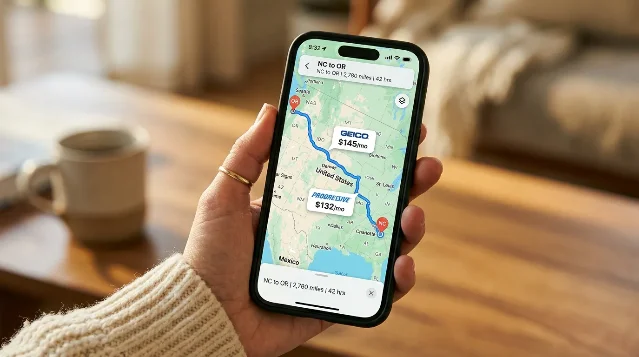
Phone in hand showing a map route from North Carolina to Oregon with Progressive and Geico insurance price tags visible along the route
Auto insurance rates vary by state down to the ZIP code — the same household's premiums can nearly halve on a cross-country move. AI-generated illustration.
The broker confirmed the main coverage parameters aligned — property damage liability at $100,000 on both sides — but flagged two differences. 8 UMPD (uninsured/underinsured motorist property damage) drops from $100,000 with Nationwide to $50,000 with Progressive — Progressive's Oregon ceiling. And Nationwide's $5,000 MedPay gets replaced by Oregon's mandatory PIP: $15,000 in medical coverage plus $3,000/month in work-loss benefits. The PIP is more protective on the medical side; the UMPD reduction is a real trade-off.
The OP: "Part of me is stoked that my insurance costs are getting cut almost in half. But another part of me wonders what the catch is." 8 Top commenter u/InternetDad: "There is no 'catch'. Risks are rated differently, all the way down to zip code, and states mandate different coverage." 8 Oregon's lower traffic density and different tort environment produce genuinely different actuarial math.
What's missing: Vehicle make, model, and year; driver ages; credit tier. The switch was in the planning stage at post time — the family had not yet bound Progressive.
One material caution: u/adjusterjack: "Progressive is notorious for quoting low and increasing the premium when the policy is issued." 8 Before binding, ask the broker: "Has Progressive pulled the MVR, CLUE report, and credit file? Is this the confirmed rate?" A 30% post-underwriting adjustment would still leave this family saving over $700/year — but the question is worth asking.
The UMPD gap: Nationwide's $100,000 UMPD offers more protection when an uninsured driver causes a high-value property damage loss. Oregon's $50,000 cap is a real reduction. Whether it's worth $1,178/year in savings depends on the family's asset situation and parking exposure — but that's a decision to make deliberately, not discover at claim time.

Case 2: USAA + PURE → Berkeley One, bundle switch, ~$7,000–$8,000/year saved

What's verified: u/spur0701, commenting in a June 17 r/Insurance thread, described switching from a decade-long relationship with USAA (auto) and PURE (home) after both carriers raised premiums roughly 20% despite zero claims. The family moved to Berkeley One for a combined home, auto, and umbrella liability package, saving approximately $7,000–$8,000 per year. 9
"I had USAA and PURE, same situation with them for 10 years, premiums go up 20% even though I had no claims, I shopped around and ended up at Berkeley One. They covered everything — home, auto, umbrella liability — saved somewhere around 7 or 8K a year." 9
What's missing: This is a comment-level disclosure, not a full post. No individual premium amounts. The auto-only savings are not isolated — the $7,000–$8,000 figure covers home, auto, and umbrella combined. Driver profile (age, state, vehicles, credit tier) and specific coverage limits not disclosed.
Why it's worth including: Berkeley One (a subsidiary of W.R. Berkley Corporation) targets the high-net-worth market — similar to PURE — with full replacement value and no per-item sub-limits. A household paying for USAA auto plus PURE home can often find Berkeley One, Chubb, or Vault at meaningfully lower combined cost. The loyalty premium in bundled high-net-worth insurance compounds year over year, in larger dollar amounts than the standard market.
u/spur0701's framing is the right one: "I think it pays to shop every 3 to 5 years or so. Just because you shop doesn't mean you have to move." 9 A competitive quote as leverage before it's a commitment.
The thread context: u/shingdao had been with Erie for 16 years on a home + auto bundle. This year — home up 30%, auto up 45%, zero claims. u/Impressive-Peak-6596: "There is no reward for being loyal. And as soon as you have an event, they'll raise your rates more, regardless how long you've gone without a claim." 9 u/InternetDad: "Loyalty means nothing anymore." 9 These describe how captive-carrier pricing algorithms actually work — not optimized to reward tenure, optimized to extract the maximum premium from customers unlikely to shop.

Case 3: Progressive, 19M, NC — the switch that was correct not to make

Not every case ends with a lower bill. u/m4ssacr, a 19-year-old male UNC student in North Carolina driving a 2014 Dodge Charger, posted on June 14. He was paying $200/month ($2,400/year) with Progressive on full coverage, $1,000 deductible on collision and comprehensive. He had found "some good quotes" from National General and Direct but had heard "less than stellar things" about those carriers. He was asking whether to move. 10
The r/Insurance community's answer was uniform: stay put.
u/PepperTop9517: "19 with a fast car, I think you're gonna be hard pressed to do better with the coverages you want." 10 u/devonwillis21: "Progressive is usually the cheapest for this profile... 200 for full coverage is really good at 19." 10 u/Dramatic-Ad9089: "There are no secret tips to cheaper insurance. And that really isn't too bad of a rate for your age." 10
Why this case belongs here: National General and Direct Auto specialize in high-risk drivers non-renewed or declined by standard carriers. They can undercut standard carriers on initial price — often through thinner coverage terms, more restrictive claims conditions, or underwriting tiers that spike after the first policy period. Without the actual quote amounts and declarations-page details, this is an unresolvable coverage equivalence question. The community's answer stands: use the Progressive rate as a floor, ask an independent agent to shop the profile across Erie, Travelers, Nationwide, and Auto-Owners, and don't move for a lower sticker price from a non-standard carrier without a side-by-side comparison on every coverage line.
The no-switch is the right call. Cases where the only path to a lower premium runs through National General, Direct Auto, Bristol West, or Dairyland deserve extra scrutiny. A lower price with weaker claims handling, a lower AM Best financial strength rating, or coverage definitions that narrow what actually gets paid in a real accident isn't savings. It's a bet that nothing goes wrong.

The four-step pre-flight checklist

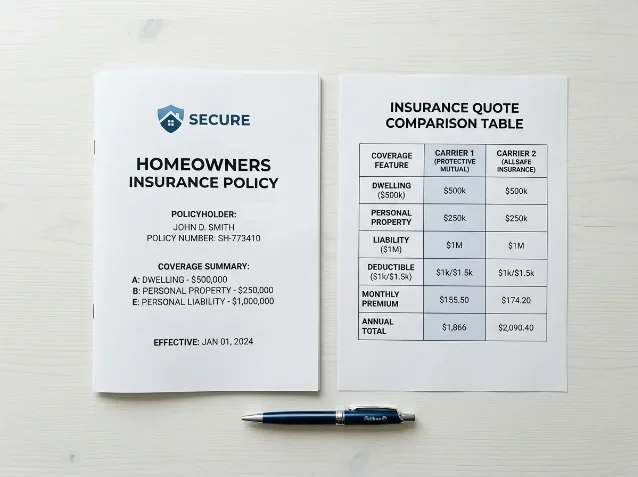
Insurance policy document beside a printed coverage comparison table showing two carriers side by side, pen on white desk, professional photography
Lock down your current coverage spec — limits, deductibles, endorsements — before requesting a single quote. Comparing carriers on different specs produces a meaningless number. AI-generated illustration.
Run all four steps before requesting any quote.
Step 1 — Pull your credit score. Credit-based insurance scoring operates in 46 states (California, Hawaii, Massachusetts, and Michigan restrict or ban it). Insurify's June 2026 data shows a 46% premium gap between excellent-credit and poor-credit drivers on identical vehicles and coverage. 7 If your credit tier has improved since your last switch, carriers that weight credit most heavily — Geico and Travelers consistently lead that list — may now price you better than two years ago. Pull your score first, not after you've started comparing quotes with stale assumptions.
Step 2 — Lock your current coverage spec. Pull the declarations page and write down every field: bodily injury per person and per accident, property damage liability, UM/UIM limits, comprehensive and collision deductibles, and endorsements. The NC→OR case shows why: UMPD dropped from $100,000 to $50,000 and MedPay was replaced by PIP. Both differences were identified and named before binding — that's the process. A quote that cuts UM/UIM from 100/300 to 25/50 is not a comparable quote. It's less insurance.
Step 3 — Confirm continuous coverage documentation. A gap of 30 or more days raises your risk tier at most carriers. Have your current policy's effective dates and a proof-of-prior-insurance letter ready before binding anything new. Bind the new policy first, then cancel the old — never reverse the order.
Step 4 — Quote the full household, not just one vehicle. Multi-car discounts typically run 10–25%; home + auto bundles add another 5–15%. Moving a single vehicle out of a three-car household can simultaneously remove the multi-vehicle discount from the policies you left behind — producing a net premium increase despite the switch. Quote the entire household at any new carrier before moving anyone. ValuePenguin editor Roslyn Ayers: "Every year when my policies are up for renewal, I get both separate and bundled quotes for car and home insurance to see which is a better deal. I'm actually saving money by not bundling right now." 11 The bundle assumption is worth testing, not taking for granted.

Quote-shopping path by life stage

Benchmark data from Insurify (updated June 11, 2026) and ValuePenguin (June 2026). 7 11
25-year-old single driver. National average full coverage: $196/month. Geico and Travelers each lead on price in roughly 12 states. Progressive's Snapshot telematics program cuts rates 10–20% for clean-record younger drivers. If Auto-Owners (available in 26 states) operates in your state, it averages $87/month for this profile nationally. 7 Before shopping any non-standard carrier for a cheaper number, run the profile through an independent agent first — a standard-market quote from Travelers or Geico at $160/month beats a National General quote at $140/month with a $2,000 deductible and narrower claims language.
30s family, two vehicles. ValuePenguin shows American Family at $159/month nationally for full coverage — lowest in their June 2026 data set. Travelers at $173/month, State Farm at $192/month. 11 Quote all vehicles and all drivers together at any new carrier before assuming household savings. Adding young drivers to the household changes the math significantly — get those quotes separately before consolidating.
50s household, two cars. National average: $122/month. 7 If you haven't shopped in three years, State Farm's 40-state rate reductions make a fresh State Farm quote worth running even if you hadn't considered them before. 5 USAA-eligible drivers in this bracket average $1,584/year nationally — the lowest of any major carrier for eligible members.
65+ retiree, low mileage. National average at 65: $115/month. Ask each carrier explicitly about low-mileage pricing. Drivers under 7,500 miles per year can qualify for reductions of 15–30%, but the standard online form defaults to 12,000–15,000 miles. If you're driving 5,000 miles annually and quoting at the default, you're comparing the wrong number.

The retention-department gambit

Before completing any switch, call your current carrier's retention department — not the main customer service line — and give them the best competing quote you've pulled. Name the carrier, the exact coverage spec, and the annual premium. Ask whether they can match it or apply discounts not currently on your policy.
Carriers cannot file a custom rate on the spot — rates are filed with state regulators. What retention departments can do: apply discounts you haven't yet received, a loyalty tier not triggered automatically, a multi-policy adjustment, or a telematics enrollment credit. These work best at renewal.
One option that often goes unused: some r/Insurance contributors have saved by calling their current carrier and requesting a fresh policy application on the same vehicles with the same coverage — canceling the existing policy and re-applying as a new customer. Long-tenure underwriting data can inflate a rate even within the same carrier; a new application resets that baseline. Not every carrier permits it, and some will flag the overlap. Ask the retention desk directly before taking your business elsewhere.
If retention can't get within 10% of your best external quote, set the new policy start date equal to the old policy end date, cancel in writing, and get written confirmation back. A turned-off autopay is not a cancelled policy.

Switches you should not make

Lowering liability limits to hit a lower number. If a quote looks 25% cheaper but bodily injury liability has dropped from 100/300/100 to 25/50/25, that quote is not cheaper insurance — it's less insurance. One r/Insurance commenter's illustration: "Imagine you hit a Maserati and it's your fault. You just wrecked a $200,000 car. Your minimum insurance pays the small number you chose, and they come after you for $180,000. Plus $100,000+ in medical bills." 12 If saving money requires cutting liability, raise the deductible on collision and comprehensive instead. That's the correct lever.
Switching during an open claim. The new carrier didn't underwrite the incident. Changing policies while a claim is active doesn't transfer the claim — it creates two carrier relationships on the same event without resolving either. Wait for final settlement. No exceptions.
Dropping UM/UIM coverage. Roughly one in eight U.S. drivers carries no auto insurance. 13 In New Jersey, uninsured drivers grew from 3% in 2019 to over 14% by 2023 as premiums became unaffordable. 13 That's an extreme case, but the trend tracks across any high-cost state. Keep UM/UIM limits at minimum equal to your bodily injury limits.
Transferring vehicle titles to dodge a premium. A thread this week surfaced a family considering transferring accident-heavy household vehicles to a family member with a clean record to escape doubled rates. r/Insurance was unequivocal: this is insurance fraud. u/WhenTheDevilCome: "Insurance isn't just some game of 'how do I trick the company into charging less.' That's just insurance fraud." 14 If an accident occurs, the carrier pulls AutoPlus, sees the ownership history, and denies the claim. Legitimate alternatives: wait for incidents to age off the record, enroll in a defensive driving course to reduce the surcharge, or maintain separate policies so the clean-record driver's premiums don't absorb the risky driver's history.

Cover image: AI-generated illustration.

围绕这条内容继续补充观点或上下文。

  • 登录后可发表评论。