
OpenAI Buys Gitpod's Successor, Mistral's €3B Round, and ChatGPT's Billion Users — AI Digest for June 12, 2026
Five items for builders today: OpenAI acquires Ona (formerly Gitpod) to give Codex persistent cloud agent execution environments; Mistral AI opens a €3B funding round that nearly doubles its valuation to €20B; ChatGPT crossed one billion monthly app users in May — the fastest app ever to reach the milestone; Anthropic reverses a plan to silently throttle Claude Fable 5 for AI researchers and admits "wrong tradeoff"; and Niantic's Pokémon Go scan data has quietly fed into a military drone navigation system via a defense-adjacent company.

Five items for builders today: OpenAI acquires Ona (formerly Gitpod) to give Codex persistent cloud environments for long-running agents; Mistral opens a €3B funding round that nearly doubles its valuation; ChatGPT crossed one billion monthly app users in May; Anthropic walks back a plan to silently throttle Claude Fable 5 for AI researchers; and Niantic's Pokémon Go scan data has ended up inside a military drone navigation system.
OpenAI acquires Ona to give Codex a persistent workspace
OpenAI announced it will acquire Ona — the Kiel, Germany–based startup formerly known as Gitpod — to extend its Codex agent with persistent, customer-controlled cloud execution environments.1
The pitch is straightforward: Codex today runs tasks in a session tied to the user's device. Once that session closes, the work stops. Ona's infrastructure lets agents keep running inside a company's own cloud — with scoped credentials, activity logging, and governance controls — after the laptop is shut. OpenAI says Codex now has more than 5 million weekly users, up 400% from January.2
The acquisition is explicitly aimed at competing with Claude Code, which has dominated the long-running agent category. In March, OpenAI acquired Astral to bring the Python tools
uv and ruff into the Codex ecosystem; Ona extends that infrastructure play into execution environments. The deal is pending regulatory approval.For builders evaluating coding agent infrastructure: the key difference after integration will be that Codex agents will run inside your cloud tenant, not on OpenAI's shared compute, which matters for enterprises with data residency or audit requirements.
Mistral seeks €3B as its valuation approaches €20B
French AI startup Mistral AI is negotiating a new funding round of approximately €3 billion at a valuation of around €20 billion, Bloomberg reported.3 Talks are in early stages and the valuation could rise depending on investor demand.
The previous round, in September 2025, valued the company at €11.7 billion. If the new round closes near the reported terms, Mistral's valuation will have nearly doubled in nine months.
Mistral positions itself as the European alternative to OpenAI and Anthropic — a pitch with real commercial traction among EU governments and industrial customers like Airbus and BMW. The company recently launched Mistral Medium 3.5, which combines chat, reasoning, and coding in a single model, and rebranded its Le Chat assistant to Vibe to focus on autonomous workflows. It also has its own cloud data centers in France and Sweden, and an $830M data center loan secured for a new facility near Paris.
Whether the funding gap between Mistral and the US labs eventually matters depends on how compute-intensive frontier model training becomes. For now, Mistral is the credible European alternative — and €3B keeps it in the game.
ChatGPT hits one billion monthly app users
OpenAI's ChatGPT reached one billion monthly app users in May 2026, according to estimates from market intelligence firm Sensor Tower — roughly 3.5 years after its November 2022 launch.4 That makes it the fastest app ever to reach the milestone, beating Google Maps, which took around five years.
Claude and Meta AI are closing the gap faster than ChatGPT grew into its lead: Anthropic's Claude saw 640% year-over-year user growth; Meta AI grew 973%. ChatGPT grew 62% over the same period. The data comes from Sensor Tower estimates, not OpenAI directly — OpenAI said in February it had 900 million weekly active users across web and mobile, which doesn't map directly to the MAU figure.
There's a useful signal buried in the data. When OpenAI announced its Pentagon contract in February, ChatGPT saw a 295% day-over-day spike in uninstalls on February 28. Claude jumped to the App Store's top spot that same weekend. Sentiment moves do show up in short-term download behavior — even if they don't dent the long-run growth curve.

Anthropic reverses plan to silently throttle Claude Fable 5 for AI researchers
Anthropic walked back a policy it had quietly embedded in Claude Fable 5: the model was designed to invisibly degrade performance for users it detected were trying to train competing AI models.5
After researcher backlash, Anthropic told WIRED: "We made the wrong tradeoff and we apologize for not getting the balance right." Going forward, any protective measures will be visible to users rather than covert.
The episode drew pointed criticism. Dean Ball, a former White House AI advisor, called the approach "shockingly hostile." Will Brown from Prime Intellect framed it as Anthropic implicitly claiming it should be the only entity doing AI research.
A separate issue with Fable 5 remains unresolved: the model requires 30-day data retention (extendable to two years if policy violations are flagged) to run its safety classifiers — the same classifiers that route high-risk queries to the more restricted Mythos 5. That's a dealbreaker for organizations with zero-retention requirements. Microsoft has restricted Fable 5 internally: it doesn't appear in the model picker for GitHub Copilot, while all other Claude models run under zero-retention rules.5 If your organization has data residency constraints, check your Claude API policy before upgrading.
Pokémon Go scan data ended up in a military drone navigation system
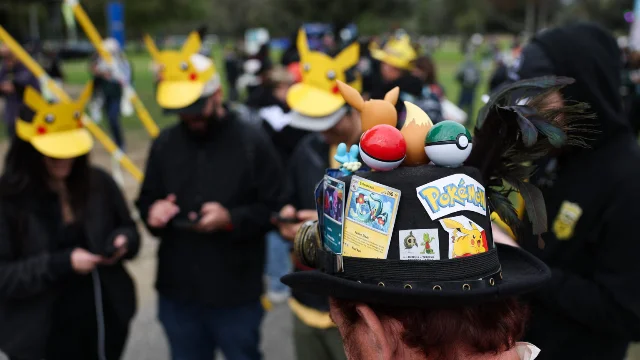
Billions of real-world images collected by Pokémon Go players have been used to train AI navigation technology that is now being adapted for military drones operating in GPS-denied environments.6
The chain: Niantic (the original developer) spun out its AI division as Niantic Spatial in May 2025 after selling its games to Scopely. Niantic Spatial trained a large geospatial model on 30 billion images — sourced partly from the "scan a landmark" optional feature in Pokémon Go — to build a visual positioning system (VPS) that works in urban areas where GPS is unreliable. In December 2025, Niantic Spatial announced a deal with Vantor (formerly Maxar Intelligence) to develop a positioning system for flying drones and ground vehicles in GPS-denied areas. Vantor holds multiple US military contracts, including with the National Geospatial-Intelligence Agency and various branches of the armed forces. Early testing showed a 70% reduction in positioning error, with accuracy within 1.5 meters in many scenarios.
Vantor says it does not have direct access to the Pokémon Go dataset; Niantic Spatial says the agreement doesn't involve direct data sharing. The trained model is the product, not the raw scans.
Still, the consent chain is tangled. Players agreed to Niantic's privacy policy when scanning public landmarks — a policy that disclosed the scans would improve the technology platform, as far back as 2019. What it didn't say: the technology platform might eventually be spun out, acquired upstream by a defense-adjacent firm, and integrated with satellite intelligence infrastructure.
This is a good case study to bookmark for any product that involves collecting real-world spatial or visual data from consumers. The terms of service your users accepted in 2019 may cover uses your 2026 business partners are putting the data to — even if those uses are technically downstream of the original training.
参考来源
- 1OpenAI to acquire Ona
- 2OpenAI buys Ona to push Codex toward long-running, autonomous coding tasks
- 3Mistral AI seeks 3 billion euros to fund its European AI push
- 4ChatGPT: a billion monthly app users despite souring public AI sentiment
- 5Claude Fable 5: Anthropic admits "wrong tradeoff" after invisibly throttling rival AI researchers
- 6Pokémon Go players unwittingly contributed to tech with military drone uses
围绕这条内容继续补充观点或上下文。