
en.m.wikipedia.org
2026/6/25 · 0:10
He ended the republic and called it a restoration
Augustus was born a nobody, inherited an empire by a legally dubious will, and spent forty-one years ruling as an absolute monarch while insisting he had restored the Republic. His last words — "Have I played the part well?" — were the perfect curtain call. Today's Wikipedia Featured Article tells the full story: the teenage consul, the theatrical abdication, the Teutoburg catastrophe, and the system that outlasted him by two centuries.
His last words, according to Suetonius, were a question directed at the room: "Have I played the part well?" And then: "Then applaud as I exit." 1
It was a fitting exit for a man whose entire reign was a performance. For forty-one years, Gaius Octavius — better known to history as Augustus — held more absolute power than any Roman before him, and spent every one of those years insisting he was doing no such thing. He was, officially, just a citizen. Just the first among equals. Just the man who had restored the Republic.
The Senate gave him a standing ovation. The Republic never came back.
He wasn't supposed to exist
Rome in 63 BC was nearing the end of its republican experiment. The old system — two consuls, annually elected, checked by the Senate and the plebeian tribunes — had started cracking under the weight of men like Sulla, Pompey, and Julius Caesar. It was into this world that Gaius Octavius arrived on 23 September 63 BC, on the Palatine Hill in Rome, into a family of equestrian rank. 1 Comfortable, respectable — but not the kind of family that produces emperors.
His father, also named Gaius Octavius, governed the province of Macedonia and won a minor victory over Spartacus's remaining followers near the town of Thurii — which earned the infant a commemorative nickname, Thurinus. Then the father died when the boy was about four years old. Young Gaius was raised partly by his mother Atia, a niece of Julius Caesar. That connection, at the time, was useful but not transformative.
What changed everything was a document deposited in a temple on 13 September 45 BC: Julius Caesar's will, naming Gaius Octavius his primary heir and — crucially — his posthumously adopted son.
The legal standing of that adoption was shaky from the start. W. Jeffrey Tatum, writing in 2024, called it "a transparent falsehood for anyone conversant with Roman law" — full adoption simply could not occur posthumously under Roman legal tradition. 1 But Octavian, as historians call him in this period, was not interested in legal niceties. He was interested in the name, the money, and the armies that came with it.
When Caesar was stabbed to death on the Ides of March, 44 BC, nineteen-year-old Gaius Octavius was studying military arts in Apollonia across the Adriatic. He got on a boat.
The year he ran Rome at nineteen
He arrived in Rome on 6 May 44 BC to find a city in uneasy truce. Mark Antony, Caesar's former lieutenant, had the legions and the street-level power. The Senate was trying to reassert itself. The assassins Brutus and Cassius were negotiating their future. Into this precarious balance walked a pale, frequently ill teenager whom nearly everyone underestimated. 1
Cicero, the great orator and statesman, thought he had the measure of the boy. He famously wrote — in a private letter that became public — that the young heir was to be "praised, elevated, and discarded" (laudandum adulescentem, ornandum, tollendum). The Latin word tollendum is deliberately ambiguous: it means both "to lift up" and "to eliminate." Cicero thought he was being clever. He wasn't. 1
Octavian moved with methodical speed. He found 700 million sesterces of Caesar's war funds at Brundisium and appropriated them without authorization. He recruited 3,000 of Caesar's veterans, paying each a signing bonus of 500 denarii — more than twice the annual salary of an active soldier. He cultivated the Senate while quietly building leverage.
正在加载链接预览…
By 1 January 43 BC, the Senate had made him a senator at age nineteen. Four months later, both consuls died fighting Mark Antony at the battles of Forum Gallorum and Mutina, and Octavian found himself in sole command of their armies. He marched on Rome and was elected consul on 19 August 43 BC — the youngest consul in Roman history, at nineteen years old. 1
Then he pivoted completely. Instead of moving against Antony, he joined him.
The Second Triumvirate — Octavian, Mark Antony, and the general Lepidus — was formalized in October 43 BC and legitimized by the Lex Titia the following month. It came with a horrific price: the proscriptions, in which roughly 300 senators and 2,000 equestrians were declared enemies of the state, stripped of property, and in many cases hunted down and killed. Cicero, who had thought he could control the young heir, was executed on 7 December 43 BC. His hands — the ones that had written those letters — were nailed to the speakers' rostrum in the Forum. 1
The following years brought the Battle of Philippi (42 BC), where the Triumvirs crushed Brutus and Cassius, the last serious organized resistance of the old Republic. Octavian was bedridden during part of the fighting — his health was always fragile — but he captured Brutus's camp and claimed a share of the victory. 1 Mark Antony, the more formidable soldier, never let him forget that military command had effectively been handed to Octavian's general, Agrippa.
For the next decade, the two men divided the Roman world: Octavian took the west, Antony the east and the alliance with Cleopatra that would prove his undoing. When Antony and Cleopatra's fleet met Octavian and Agrippa's at the Battle of Actium on 2 September 31 BC, the contest was shorter than the buildup suggested. Antony and Cleopatra fled to Egypt and committed suicide the following year. Octavian was thirty-two years old, and he controlled everything. 1
The republic he restored (but didn't)
Here is where most conquerors would have stopped pretending. Here is where Octavian became Augustus.
On 16 January 27 BC, he stood before the Senate and made a theatrical announcement: he was returning all his extraordinary powers to the people and the Senate. The Republic was restored. His job was done. 1
The Senate's response was staged as spontaneous gratitude. They begged him to stay. They granted him the honorific title Augustus — a word connected to augere (to increase), to the priestly office of augur, and to the old Roman concept of auctoritas (authority). They gave him a ten-year command over all the provinces that happened to contain most of the legions. They asked him to please not go.
He graciously accepted.
What Augustus had invented was the Principate: a system of one-man rule dressed in republican costume. He held no single title that could be called "king" or "emperor" — he was simply princeps, "first citizen." His powers were assembled from republican offices: the tribunician power (tribunicia potestas) gave him a veto over any legislation and made him personally sacrosanct. The imperium proconsulare maius gave him supreme command of all armies. The title Pontifex Maximus, which he assumed in 12 BC, made him the head of Roman state religion. 1 None of these were new; all of them together, held by one man for life, were something entirely new.
The historian Tacitus saw through it clearly. "He seduced everyone with the sweetness of peace," Tacitus wrote in Annals — cunctos dulcedine otii pellexit. 1 After a century of civil war, most Romans were so tired that they were willing to accept the fiction. The alternative was another Brutus, another Antony, another round of proscriptions.
正在加载链接预览…
Marble and legions
For forty-one years — the longest reign of any Roman emperor — Augustus built. 1
He standardized the coinage: a new gold aureus, a silver denarius, a copper as, all minted to consistent weights and backed by the accumulated treasuries of Egypt, which had become his personal property after Cleopatra's death. He organized the first systematic provincial censuses to rationalize taxation. He built the cursus publicus, Rome's official courier network, stretching across thousands of miles of paved road. 1
He created institutions Rome had never had: a standing professional army with fixed pay and a pension on discharge, the Praetorian Guard for his personal protection, the cohortes urbanae to police the city, the vigiles — the world's first organized fire brigade — to stop Rome burning down, which it had a habit of doing. 1
He rebuilt the city itself. The Forum of Augustus, with its temple to Mars Ultor (Mars the Avenger, fulfilling a vow made before Philippi). The Ara Pacis, the Altar of Peace, its carved marble frieze showing a procession of the imperial family that doubled as propaganda for dynastic continuity. The Mausoleum of Augustus on the Field of Mars, built while he was still in his thirties — he had learned from watching the Republic collapse that preparation mattered. He claimed to have found Rome a city of bricks and left it a city of marble. 1 By the physical evidence, the claim holds.
He patronized writers. Virgil wrote the Aeneid under his reign, grounding Rome's mythological origins in Augustus's family line. Horace produced his Odes. Livy wrote his monumental history of Rome. Ovid wrote his erotic poetry — until he wrote something that offended Augustus in AD 8, and was exiled to the Black Sea coast, where he died, apparently never forgiven. 1 The Augustan Age is the benchmark against which all subsequent Latin literature was measured.
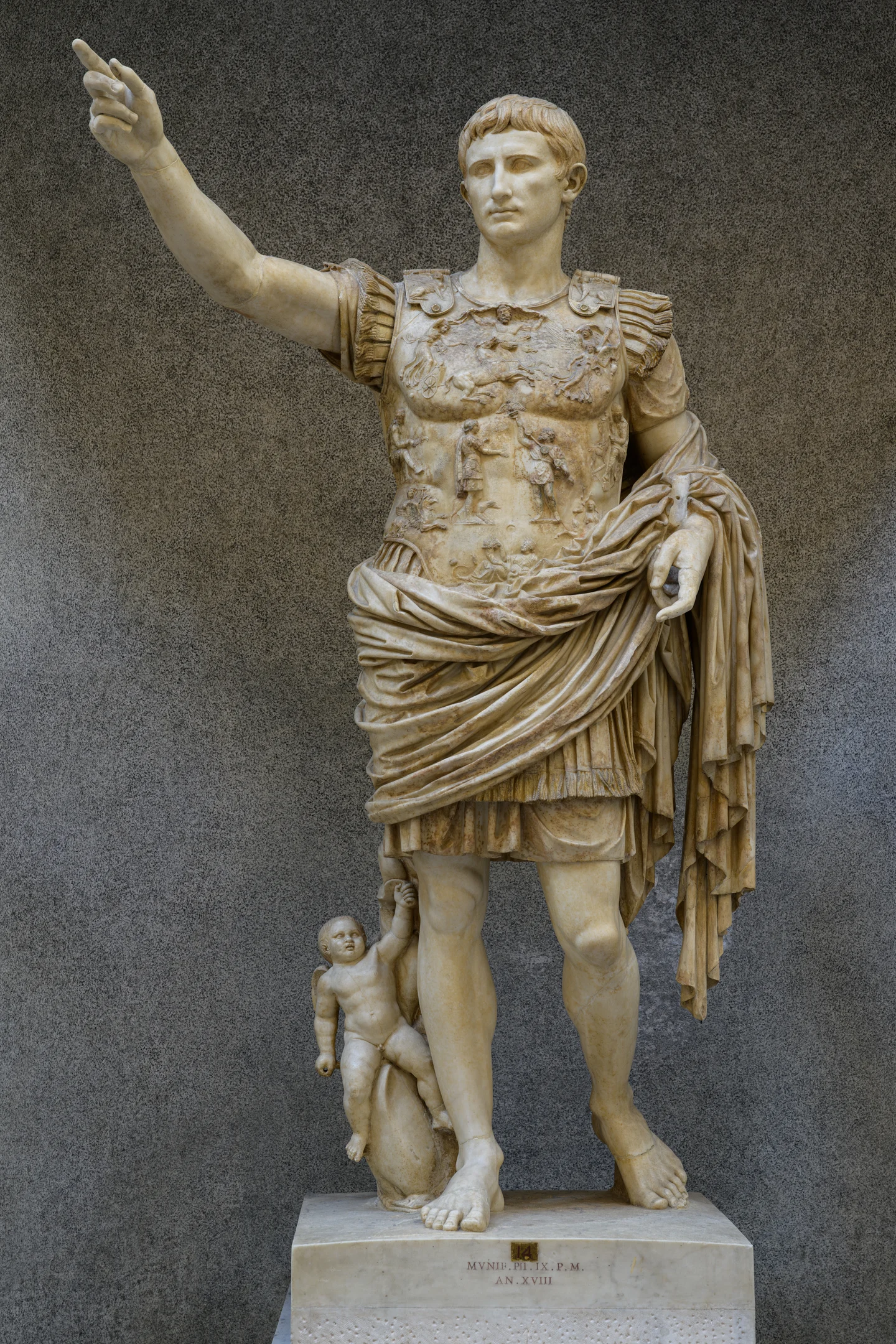
In foreign policy, he expanded Rome's territory into Dalmatia, Pannonia, Noricum, and Raetia — roughly the arc of modern Yugoslavia and Austria. He completed the conquest of Hispania after two centuries of intermittent war. He negotiated a remarkable diplomatic coup with Parthia in 20 BC: the recovery, without a battle, of the military standards lost by Crassus at the disaster of Carrhae in 53 BC. The breastplate of the famous Augustus of Prima Porta statue depicts this moment — a Parthian handing over the eagle standards — because Augustus understood that political theater operated in bronze and marble as well as in the Senate house. 1
正在加载链接预览…
"Give me back my legions"
Then came AD 9, and the disaster that haunted the rest of his reign.
Three Roman legions — the XVII, XVIII, and XIX — were marching through the forests of Germania under their commander Publius Quinctilius Varus when they were ambushed by a coalition of Germanic tribes led by a chieftain named Arminius. Arminius was, with exquisite irony, a German nobleman who had served in the Roman army, held Roman citizenship, and knew Roman tactics intimately. He used that knowledge to lure three legions into the Teutoburg Forest and destroy them over three days. Somewhere between 15,000 and 20,000 Roman soldiers died. 1
Suetonius records that Augustus, on receiving the news, let his beard and hair grow untended for months — the ancient equivalent of not getting out of bed. He reportedly wandered the halls of his palace crying out: "Quinctilius Varus, give me back my legions!" (Quintili Vare, legiones redde!) 1
Rome never recovered the three legion numbers. They were never reissued — XVII, XVIII, and XIX disappear from Roman military records after Teutoburg, a gap that persisted for centuries as a kind of institutional scar. More significantly, Rome never again seriously attempted to conquer Germania east of the Rhine. The river became a permanent frontier. The defeat defined the western limit of the Roman Empire for the next four hundred years. 1
The dynasty that outlasted its founder
Augustus spent the last two decades of his life trying to solve a problem that the Principate had created: how do you pass power to a successor in a system officially designed to have no successors?
The body count of his preferred heirs is grim reading. His nephew Marcellus, initially groomed for succession, died in 23 BC aged about twenty. His general and son-in-law Agrippa — arguably the most capable military commander of the age — died in 12 BC. His grandsons Gaius Caesar and Lucius Caesar, adopted as sons and presented to the people as his heirs, died in AD 4 and AD 2 respectively. A third adoptive heir, Agrippa Postumus, was disinherited and exiled for reasons the ancient sources describe vaguely as brutishness, then executed immediately after Augustus's death. 1
What was left was his stepson Tiberius, whom Augustus had adopted in AD 4 after running out of alternatives. By all accounts, Augustus did not particularly like Tiberius, and the feeling may have been mutual. The succession was duty, not affection.
Augustus died at Nola on 19 August AD 14, aged seventy-five, of causes the ancient sources describe as natural — though Tacitus and Cassius Dio both preserve rumors that his wife Livia had poisoned the figs on a tree he was known to eat from, to ensure Tiberius's succession before Augustus could change his mind again. 1 No ancient source treats the poisoning as proven; no modern scholar has found evidence to confirm it. It is a rumor that has survived two thousand years precisely because it fits the character of what the Principate had become: a system where the stakes were so absolute that nothing, not even the life of a seventy-five-year-old man, could be left to chance.
The Senate posthumously deified him as Divus Augustus. Priests were appointed to his cult. The month of Sextilis was renamed August in his honor. 1 The name "Augustus" became a standard title for every emperor who followed — a word that began as an honorific and ended as a job description.
His Res Gestae Divi Augusti — "The Deeds of the Divine Augustus" — was read aloud in the Senate after his death, then inscribed in bronze and erected outside his mausoleum, and duplicated in stone across the empire. The best-preserved copy survives in Ankara, Turkey, on what was once the Temple of Rome and Augustus. It is a document of remarkable audacity: forty-one paragraphs in which Augustus describes everything he did for Rome, everything he spent, every province he pacified, every title he declined, every power he returned — written entirely in the first person, the most elaborate self-authored monument in the ancient world. 1
The system he built, the Principate, lasted until roughly AD 235 — nearly two and a half centuries. Every emperor in that span measured himself against Augustus, the man who had done the impossible: ended a republic, founded a monarchy, and convinced a grateful population that neither of those things had happened.
He played the part well. They applauded.
Today's article is Wikipedia's Featured Article for June 25, 2026. Read the full entry at Augustus — Wikipedia. 1
围绕这条内容继续补充观点或上下文。