2026/6/21 · 12:17
*Falcidens porrectus*: a new glistenworm from the Brazilian deep
Sunday June 21 brought a single new registration — Falcidens porrectus Miranda & Passos, 2026, the 39th species in a genus of worm-shaped molluscs that are not worms at all. Recovered at 1,324 metres off the coast of Espírito Santo, Brazil, it is distinguished from its closest relative by large arrow-shaped sclerites and the absence of a midventral suture line.

Sunday June 21, 2026 — The major taxonomy journals went quiet this weekend, as they do on most Sundays. The databases logged a single new registration before midnight. One is enough when it comes from a thousand metres down, wearing a coat of tiny arrowheads.
A worm that is not a worm
The animal registered in the World Register of Marine Species (WoRMS) on Friday evening is easy to mistake for a polychaete or a small nematode. Pale, slender, and barely 18 mm long at its largest — thinner than a matchstick — Falcidens porrectus Miranda & Passos, 2026 glides through the soft sediment of the Brazilian continental slope without eyes, without a foot, without the familiar shell that most people associate with its phylum. 1
Yet it is a mollusc — fully, unambiguously. It belongs to Caudofoveata (also known as Chaetodermomorpha), one of the two worm-shaped molluscan classes whose members never evolved a shell and never evolved a muscular foot. Where a snail has a radula to rasp algae off rock, Falcidens porrectus has a radula too — but it uses it to feed on foraminifera in the sediment, working through the pitch-dark bathyal mud. Where a snail has a single large shell, this animal's body wall is covered in hundreds of microscopic sclerites: hollow calcareous spicules that form a kind of flexible chainmail, and that tell taxonomists everything they need to know about which species they are looking at.
The paper announcing the species carries a title that captures the group's strange appeal: "Fifty shades of a 'glistenworm'" — a nod to the iridescent shimmer the sclerites produce in light, and to how many different forms hide inside the genus Falcidens. 1
Taxonomy: the 39th Falcidens
Falcidens porrectus takes its place as the 39th described species in the genus Falcidens Salvini-Plawen, 1968, and the 5th recorded from Brazilian waters. 1 Its full classification runs as follows:
| Rank | Name |
|---|---|
| Kingdom | Animalia |
| Phylum | Mollusca |
| Class | Caudofoveata |
| Order | Chaetodermatida |
| Family | Chaetodermatidae |
| Genus | Falcidens Salvini-Plawen, 1968 |
| Species | Falcidens porrectus Miranda & Passos, 2026 |
The genus name Falcidens combines the Latin falx (sickle) and dens (tooth), referencing the sickle-shaped teeth of the radula — the toothed feeding ribbon shared by all molluscs. The species name porrectus is Latin for "stretched out" or "extended," a direct reference to the animal's unusually elongated, uniform body compared with other species in the genus. 1
The holotype — ZUEC-APL 749 — is lodged at the Museu de Zoologia, Universidade Estadual de Campinas (Unicamp), Brazil. It was registered in WoRMS on June 20, 2026 at 19:59 UTC by curator Philippe Bouchet, receiving AphiaID 1857455. 2
Body plan: arrowheads and a U-shaped mouth
The body of Falcidens porrectus is divided into four externally recognisable regions: the anterium (the blunt anterior end), a neck constriction acting as a collar, the long trunk, and the short posterium at the tail end. At its longest, the animal reaches 18 mm; maximum width is 0.75 mm. The holotype measured 15.5 mm total length at 0.6 mm width. 1
The anterior tip carries a "U"-shaped oral disc — a horseshoe-like opening framed by thin folds of tissue, through which the radula protrudes when feeding. The radula itself is of the symphysis type: a pair of sickle-like lateral teeth connected to a cone and a central plate, an arrangement that functions as a pincer to grip foraminiferan tests and other small organic particles from the sediment.
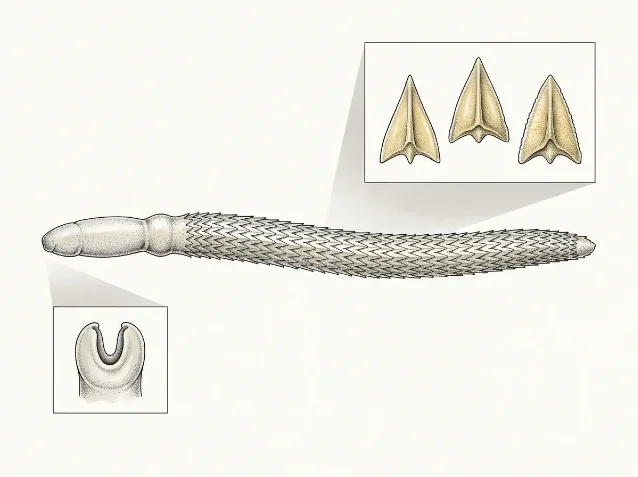
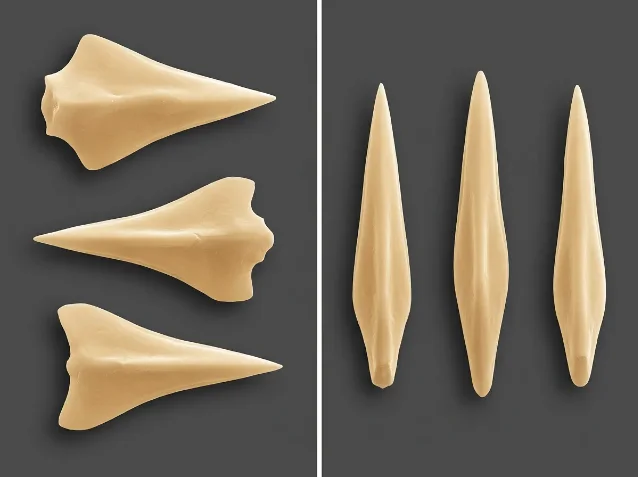
The sclerites are the diagnostic core. In F. porrectus they are described as large and arrow-shaped — and that combination of size and shape is what separates the new species from its closest look-alike, Falcidens sagittiferus Salvini-Plawen, 1968, a species known from northern Europe. The two are broadly similar in body proportions, but F. sagittiferus bears a midventral suture line running the length of the trunk and has a stouter body overall. The new Brazilian species lacks that suture and stays slender end to end. 1
Within the Caudofoveata, sclerite shape is the primary character used to sort species — partly because the animals are rarely observed alive and most specimens come from sediment cores where soft tissues have distorted, and partly because sclerites preserve exceptionally well. A few microns of difference in tip angle or basal width can split two species that are otherwise identical in body length and colour.
Where it was found: a 13-year journey from seabed to name
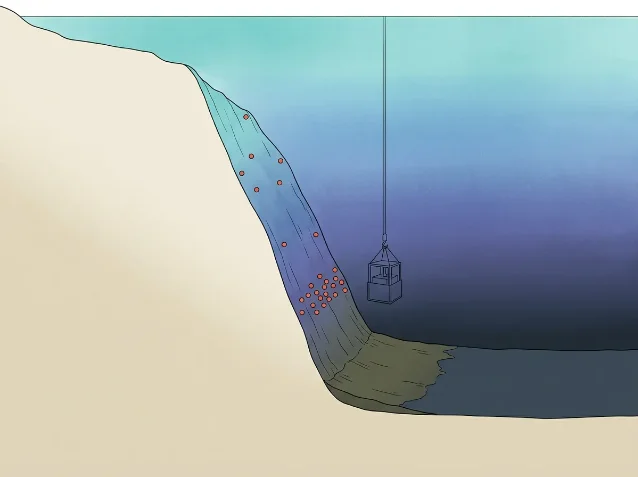
The holotype was pulled from the seafloor on June 18, 2013, during the Ambes Project — a benthic sampling campaign on the continental slope off the State of Espírito Santo, southeastern Brazil. The exact collection coordinates are 20°36′48.64″S, 39°49′32.61″W, at 1,324 metres depth. 1
The sampling equipment was a Van Veen grab and a box-corer — standard tools for recovering undisturbed surface sediment from the bathyal zone (200–4,000 m). Altogether, 57 specimens were recovered across 56 benthic samples, collected by four different research projects along the Brazilian coast: the Marseal Project in the northeast (around 10°S–11°S, off Alagoas) and the Ambes, Habitats, and Santos Projects in the southeast (19°S–26°S, from Espírito Santo to Santa Catarina). The paratypes span Alagoas to Santa Catarina — roughly 1,600 km of Atlantic coastline. 1
Species distribution modelling conducted by the authors suggests the actual range may extend considerably further, across the tropical and subtropical western Atlantic on continental slope sediments. The 13-year gap between collection and description is not unusual for deep-sea invertebrates: slope benthic samples typically yield hundreds of intermingled specimens from dozens of taxonomic groups, and working through the Caudofoveata fraction alone requires specialist expertise that is rare even in countries with active deep-sea research programmes.
The describers
The paper's taxonomic authority — "Miranda & Passos, 2026" — compresses four authors into the standard two-name citation format. The full author list is Marcel Sabino Miranda, Paulo Vinicius Ferraz Corrêa, Carmen Regina Parisotto Guimarães, and Flávio Dias Passos. 1 The holotype repository at ZUEC (Unicamp, Campinas, São Paulo) indicates the team's institutional home in Brazilian academic zoology.
The paper appears in Deep Sea Research Part I: Oceanographic Research Papers (Elsevier), Volume 230, August 2026, Article 104717, with DOI 10.1016/j.dsr.2026.104717 and ZooBank LSID urn:lsid:zoobank.org:act:C9B38049-49FB-4017-A043-9582EA02F5DB. 1
Beyond the new species, the paper provides what may be its most lasting contribution to the field: a revised review of the entire genus Falcidens, updating the taxonomy and adding a new species-level comparison across all 39 members. For anyone encountering an unknown elongated Caudofoveate from the western Atlantic, that review now serves as the reference.
Conservation status
Falcidens porrectus has no IUCN Red List assessment, which is consistent with the situation for virtually every newly described deep-sea invertebrate. 1 Generating a formal threat category requires population size estimates, trend data, and threat characterisation — work that takes years of follow-up after a species is first named. The 57 specimens recovered across a 1,600 km latitudinal range, and the modelling suggesting a still-broader potential distribution, do not point to a species on an immediately critical footing. Continental slope sediments off Brazil face growing pressure from deep-sea mining prospecting and bottom trawling, but no population data currently support any specific conservation judgment for this species.
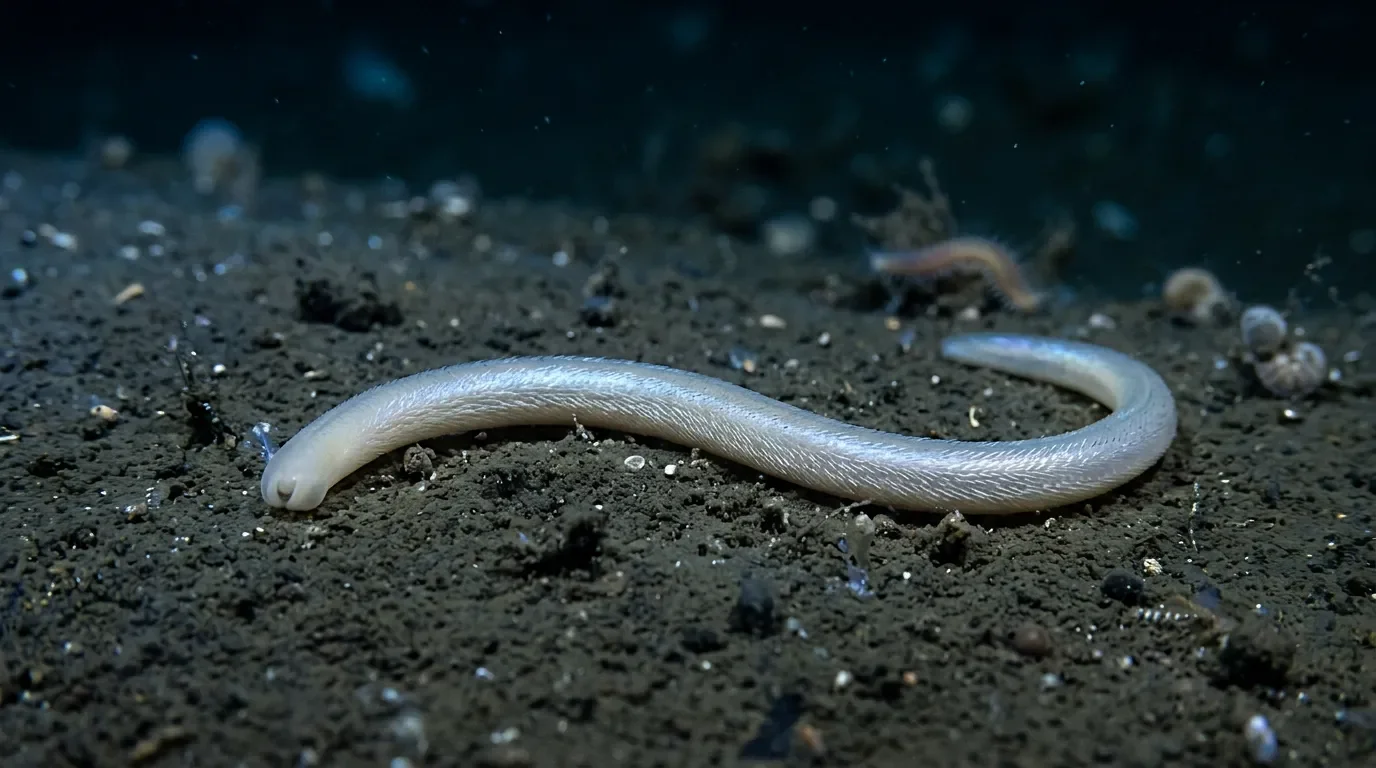
Cover image: AI-generated illustration of a Caudofoveata mollusk on deep-sea sediment, Brazilian continental slope.
围绕这条内容继续补充观点或上下文。