When your plan structure is the problem: dental and vision cost moves for June 2026
No major plan changes from Delta Dental, MetLife, VSP, or EyeMed this week, but seven community stories and four new topic baselines produced a data-rich issue: dental options for the self-employed (Marketplace trap, savings plan math), dental school clinic pricing verified at 50–72% savings vs. private practice, the Medicare Part B dental gap and how Medicare Advantage caps ($1,000–$3,000) change the picture, a three-step contact lens cost stacking strategy that cuts annual spend 40–60%, and the finalized NYDFS $2.25M consent order against Delta Dental.

No major plan changes landed this week from Delta Dental, MetLife, VSP, or EyeMed. What surfaced instead was a cluster of community stories and new data that all point to the same underlying problem: most people don't know which structure they're in, and the structure determines everything about what they'll actually pay.
Seven reader-reported stories from r/HealthInsurance, r/medicare, r/Frugal, and r/glasses ran this week. Alongside those, research turned up verified pricing data on four topics the channel hasn't covered yet: dental options for the self-employed, dental school clinic savings, the Medicare dental gap, and contact lens cost stacking. This issue covers all four in depth.
This week in the community
EyeMed billed for "astigmatism" and "premium fit" until a member asked for codes. A member on r/HealthInsurance was told before her exam she'd only owe a copay. After declining to buy glasses on the spot, the clinic suddenly cited astigmatism and a premium fit charge — roughly $300. She pushed for billing codes. The explanation changed three times. The clinic dropped all extra charges and charged only the copay. "The fact they backed down and removed everything when you pushed for codes tells you all you need to know," wrote u/Appropriate-Neat1202. 1 The pattern is common: astigmatism contact lens fitting fees are real, but they apply to contact lens fittings — not to an exam where you decline to purchase lenses.
Medicaid root canal: the coverage ceiling hit hard. A Medicaid member on r/HealthInsurance needed a molar root canal but couldn't afford the $1,000 crown. The front desk said the procedure likely wouldn't be covered even after switching from Healthy Blue to UnitedHealthcare under Medicaid. Community members flagged a critical point: Medicaid users cannot pay out of pocket for Medicaid-non-covered services without risking coverage loss and a potential fraud investigation. 2 The practical options were limited to waiting, seeking a second opinion, or extraction — which Medicaid does cover.
Aetna's missing tooth clause blocked implant coverage. A member on r/HealthInsurance learned that Aetna's missing tooth clause made her ineligible for implant coverage because the tooth had been extracted before the policy took effect. Community members pointed her toward dental school clinics and HRSA-funded health centers as the lowest-cost paths. u/Jujulabee shared real numbers from personal experience: roughly $4,000 per tooth — $2,000 for the implant body and $2,000 for the crown — with a 3–6 month gap between the two surgeries. 3
The frugal dental playbook. An r/Frugal thread on dentist new-patient specials drew 83 upvotes and 66 comments — the sub's most active dental thread this week. Readers pooled tactics: a Groupon for cleaning, X-rays, and exam for $31.50; dental school savings described as "thousands less"; and dental tourism in Puerto Vallarta at 1/4 to 1/3 of US prices. "You don't owe your dentist office any loyalty," wrote u/Express_Pop810. 4
Vision insurance: seniors say skip it, buy direct. A 44-comment r/medicare thread on whether vision insurance is worth it reached a clear community consensus: it often isn't. Multiple users independently called it a discount plan, not insurance. u/mgibson9999 reported paying more when enrolled in vision insurance than after dropping it and switching to Costco — eye exam under $100, full glasses under $200. 5 u/Revolutionary_Low581 gave the cleaner framing: "Like dental 'insurance', if the discounts are enough to cover your premiums or more then it may be worth it." 5
AR coating: $250 at the office, $51 online. An r/glasses member skipped anti-reflective coating to save money, then found she could barely see in the exam room with her new glasses. u/rsilvers129's response: "AR coating is mandatory. As for $250, that is just buying from the wrong place. Today I paid $51 for RX with AR coating and frames and shipping." 6 Zenni and online retailers like EyeBuyDirect typically include AR as a $10–$20 add-on, not a $250 line item.
UHC dental discounts shrink every year. An r/medicare discussion about AARP/UHC Plan G surfaced an underreported feature of UHC dental wellness extras: the discounts decrease annually — roughly 2% per year from age 67 to 73, then about 3% per year afterward, reaching zero around age 85–86. u/Revolutionary_Low581 also noted AARP/UHC plans are showing 18–20% premium increases this year. 7
Dental coverage if you're self-employed

The self-employed face a structural disadvantage: no employer contribution, no group pricing, and a Marketplace rule that catches many people off guard.
The Marketplace trap: HealthCare.gov allows you to buy a standalone dental plan only if you're also buying a health plan on the Marketplace at the same time — you cannot buy Marketplace dental independently. 8 Adult dental is not an essential health benefit under the ACA, so health plans have no obligation to include it for anyone 19 or older. And standalone plans can impose waiting periods — you pay premiums for months before coverage kicks in. If you already know you need a crown or root canal, a plan with a 12-month major-services waiting period is nearly useless for that specific need.
The three structures available to self-employed buyers:
| Structure | Monthly cost | Annual max | Waiting period | Network |
|---|---|---|---|---|
| PPO dental insurance | $40–$70+ | $1,000–$2,000 | 6–12 months (major) | Large; OON allowed |
| HMO/DHMO dental insurance | $20–$35 | None (copay-based) | Minimal | Restricted; OON = $0 |
| Dental savings/discount plan | $13–$20 | None | None | 140,000+ dentists 9 |
The dental savings plan option (DentalPlans.com, Careington, and others) is not insurance — you pay an annual membership fee and get pre-negotiated rates at participating dentists, typically 20–60% off. No deductible, no annual maximum, no waiting period, and pre-existing conditions are covered. Careington starts at $12.95 per month plus a one-time $20 processing fee. 10 DentalPlans.com, the largest marketplace, lists 25+ plans accepted by over 70% of US dental practices. 9
A savings plan makes sense if you need work soon, your preferred dentist participates, and your expected spend is mostly major procedures — crowns, implants, root canals — where a 50% discount beats a $1,500 annual insurance maximum. A PPO makes sense if your needs are mixed over a longer horizon and you want a network structure to negotiate against providers.
One more thing self-employed buyers often miss: dental insurance premiums may be tax-deductible under the self-employed health insurance deduction (IRS Form 7206), depending on your net self-employment income. 11 A savings plan membership fee typically doesn't qualify the same way — worth confirming with a tax professional before choosing between the two.
Dental school clinics: verified savings of 50–70%
Dental school clinics are probably the most underused cost-reduction option available to any uninsured or underinsured adult in the US. The savings are large enough to change the math on major procedures entirely.
How they work: Treatment is performed by dental students under continuous faculty supervision — a licensed dentist reviews and approves each step throughout the visit. The savings come from institutional funding and students needing patient hours. The trade-off is time: appointments typically run 2–3 hours, compared to 45–90 minutes for the same procedure in private practice. Treatment plans often span several months, and more than one student may be involved. 12
What you actually pay: University of Louisville School of Dentistry publishes a direct comparison between its student clinic fees and the 50th-percentile private practice rate for the same ZIP code: 13
| Procedure | Student clinic | Private practice (50th percentile) | Savings |
|---|---|---|---|
| One-surface filling (D2391) | $98 | $240 | 59% |
| Root canal — bicuspid (D3320) | $345 | $1,130 | 69% |
| Crown — porcelain/metal (D2752) | $530 | $1,396 | 62% |
| Complete upper + lower dentures | $1,275 | $4,600 | 72% |
| Removable partial denture | $757 | $2,370 | 68% |
Tufts University School of Dental Medicine in Boston charges 25–50% less than area specialists for student clinic appointments. Full-mouth X-rays: $115. Comprehensive oral exam: $76. 14
Most dental school clinics are open to the general public with no income requirement. Many accept private dental insurance and Medicaid — which can reduce your out-of-pocket further on top of already-discounted rates. The intake process: screening appointment → treatment plan review → cost discussion → patient assignment. Not everyone is accepted; your needs must align with what students are currently practicing.
How to find one: There are 76 schools accredited by CODA (the Commission on Dental Accreditation, the ADA's accrediting body) for the 2025–26 academic year, with at least one in most states. 12 To verify accreditation, use the CODA "Find a Program" directory at coda.ada.org/find-a-program, then call the school directly for current fees, scheduling, and insurance acceptance. Screening fees are sometimes non-refundable.
If no dental school is accessible, HRSA (the Health Resources and Services Administration) funds community health centers that served 6.4 million dental patients in 2023 across 15,000+ sites — use findahealthcenter.hrsa.gov to locate the nearest one. 12 As of 2025, 38 states plus DC offer Medicaid adult dental benefits with at least a $1,000 annual maximum.
Medicare dental: what Part B actually covers (and what Medicare Advantage adds)
This is where the community consensus from r/medicare connects to hard data.
Part B covers almost nothing. Medicare Part B explicitly does not cover routine dental care — no cleanings, fillings, extractions, dentures, or implants. In Medicare's own language: "In most cases, Medicare doesn't cover dental services like routine cleanings, fillings, tooth extractions (removals), or items like dentures and implants." 15 Part B only covers dental when it's directly required for a covered medical procedure — an oral exam before a heart valve replacement, tooth extraction before chemotherapy, or treatment tied to head and neck cancer. Those exceptions are real but narrow.
For Part A hospital stays involving dental, the 2026 deductible is $1,736 per benefit period, then $0/day for days 1–60. 15
Medicare Advantage changes the equation — but read the caps. 98% of Medicare Advantage (MA) enrollees are in plans that include dental benefits in 2026, according to KFF. 16 But what "dental benefits" actually covers varies widely:
- Preventive-only plans: cover cleanings, exams, and X-rays at 100%
- Comprehensive plans: also include basic services (fillings at 50–70%) and sometimes major services (crowns, bridges, dentures), but often cap or exclude major coverage
- Annual maximums: KFF documents most MA dental plans cap annual benefits at $1,000–$3,000 16 — specific examples from SummaCare's 2026 lineup: $3,000 (Topaz HMO), $2,500 (Garnet HMO), and $2,000 across four other plans; UnitedHealthcare's comprehensive benefit for 2026 carries a $1,500 annual maximum
55% of eligible Medicare beneficiaries — 35 million of 64 million — are now enrolled in MA plans, up from 19% in 2007. 17 That shift means MA dental is, in practice, the dental benefit for the majority of seniors. But 75% of individual MA enrollees pay $0 supplemental premium beyond the $202.90/month Part B premium — the dental benefit is partly funded by the $2,664 per-enrollee rebate the federal government pays MA plans above standard Medicare costs. 16
The takeaway: if you're on MA, find your plan's exact annual dental maximum before scheduling major work. A $1,000 cap doesn't stretch far against a $1,396 crown. If your planned procedures exceed the cap, dental school clinics and dental savings plans — described above — can cover the gap.
For seniors on traditional Medicare with no MA plan, the options are the same as for any uninsured adult: dental savings plans, dental school clinics, HRSA health centers, or adding a separate standalone dental policy.
Contact lens cost stacking: how to cut your annual bill by 40–60%
Contact lens wearers can layer three separate discounts — vision plan allowance, manufacturer rebate, and FSA/HSA — without doing anything unusual. Most people use one layer, leaving significant money on the table.
Step 1 — Apply vision plan contact lens allowance first. VSP's standard plan includes a $150 contact lens allowance. 18 EyeMed and most employer-sponsored plans offer $120–$200/year. This is used at your eye doctor's office or at the time of purchase.
Step 2 — Submit a manufacturer mail-in rebate. All four major lens manufacturers run rebate programs through the end of 2026: 19
- ACUVUE (Johnson & Johnson): up to $250 for new wearers (8 boxes of 90-count), up to $100/year for current wearers — valid Jan 1–Dec 31, 2026
- Alcon (DAILIES TOTAL1, PRECISION1, TOTAL30): new and current wearer rewards starting April 1, 2026
- CooperVision (MyDay, Biofinity, clariti): new and current wearer rewards, Jan 1–Dec 31, 2026
- Bausch + Lomb (Biotrue ONEday, INFUSE, ULTRA): rewards program, Jan 1–Dec 31, 2026
Most rebates require purchasing at least 4 boxes, with the highest rebate tier for an annual supply (8 boxes). Some retailers apply rebates at checkout; others require a mail-in or online submission with proof of purchase.
Step 3 — Pay the remaining balance with pre-tax FSA/HSA dollars. An FSA (Flexible Spending Account) and HSA (Health Savings Account) both let you pay qualified medical expenses with pre-tax income, effectively giving you a discount equal to your tax rate. Contact lenses are fully FSA- and HSA-eligible, as are contact lens solution and accessories. 20
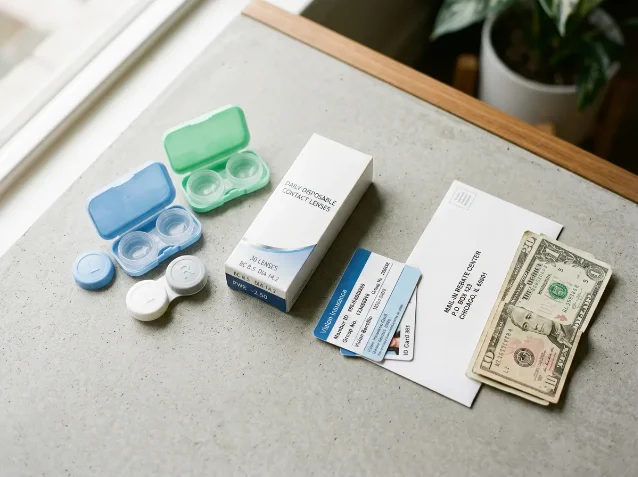
The stacking math:
| Item | Amount |
|---|---|
| Annual cost for daily disposables (pre-discount, premium brands) | ~$600–$1,000 |
| Minus vision plan contact lens allowance | –$150 |
| Minus manufacturer rebate (current wearer) | –$100 |
| Remaining out-of-pocket | ~$350–$750 |
| Pay with pre-tax FSA/HSA (24% effective tax rate example) | saves ~$84–$180 in taxes |
| Effective total cost range | ~$270–$570 |
Where to buy to maximize the combination: CNET's 2026 ranking of online contact lens retailers names ContactsDirect as the best option for applying vision insurance directly at checkout (no reimbursement forms), and Eyeconic as the best for VSP and MetLife members (owned by VSP, automatic benefit verification). 21 Lens.com typically comes out cheapest after factoring in rebates but is out-of-network for most plans, meaning you'll need a reimbursement form. Costco Optical consistently offers the lowest per-box price for major brands including Acuvue, Air Optix, and Biofinity, but requires a membership. 21
One practical note: if you're switching brands to qualify for a new-wearer rebate, confirm the new brand works for your prescription before buying an annual supply. Astigmatism and multifocal lenses have a shorter list of available SKUs, and the highest-rebate brands may not cover your script.
Regulatory note: NYDFS fined Delta Dental $2.25M over a 2023 data breach
On April 30, 2026, the New York Department of Financial Services finalized a $2.25 million consent order against Delta Dental Insurance Company and Delta Dental of New York. 22 The violations involved New York's cybersecurity regulation (23 NYCRR Part 500): Delta Dental lacked a written data retention policy, had no written incident response plan, and failed to notify NYDFS within 72 hours of discovering the breach.
The underlying incident: in May 2023, the CL0P ransomware group exploited a zero-day vulnerability in MOVEit Transfer software, exfiltrating approximately 60,000 files containing member names, Social Security numbers, driver's license numbers, passport numbers, financial account information, and patient health records. Delta Dental discovered suspicious activity on June 1, 2023, confirmed the breach on July 6, but didn't notify NYDFS until December 15, 2023 — nearly six months after discovery. The consent order prohibits Delta Dental from seeking tax deductions or insurance reimbursements for the fine amount. 22
If you were a Delta Dental member in 2023, check whether you received a breach notification letter and whether your state attorney general's office has related filings.
Brief: Delta Dental expands women's health coverage
Delta Dental of California announced on June 2, 2026, an expanded partnership with Midi Health, a telehealth platform focused on menopause and pregnancy. 23 The collaboration links Delta Dental's Next Stage™ Women's Health benefit with Midi Health's virtual menopause care, giving eligible members enhanced dental benefits alongside remote specialist access. Delta Dental's own research found 83% of women over 40 are unaware that menopause affects oral health. This applies to Delta Dental of California members enrolled in plans that include the Next Stage benefit — check your summary of benefits to confirm eligibility.
Community story details sourced from r/HealthInsurance, r/medicare, r/Frugal, and r/glasses posts from June 1–8, 2026. Individual experiences reflect specific plan terms and may not generalize. Verify plan details, waiting periods, and network participation directly with your insurer before scheduling procedures.
AI-generated cover image.
参考来源
- 1r/HealthInsurance: Eye exam extra charges
- 2r/HealthInsurance: Getting a root canal but aren't covered
- 3r/HealthInsurance: Best way to pay for a dental implant without insurance?
- 4r/Frugal: Dentist new patient specials for cleanings
- 5r/medicare: Vision insurance for seniors on Medicare
- 6r/glasses: Glasses without anti-glare a horrible choice
- 7r/medicare: AARP/UHC Plan G wellness cheaper than standard Plan G?
- 8HealthCare.gov: Dental coverage in the Health Insurance Marketplace
- 9DentalPlans.com
- 10Careington: Official site
- 11DentalCoverageGuide.com: Best dental insurance for self-employed 2026
- 12NewMouth: Top dental schools for low-cost dental work
- 13UofL Dental Care: Practice types and price comparison
- 14Tufts University School of Dental Medicine: Price comparison guide
- 15Medicare.gov: Dental service coverage
- 16KFF: Medicare Advantage in 2026 — premiums, out-of-pocket limits, supplemental benefits
- 17KFF: Medicare Advantage in 2026 — enrollment update and key trends
- 18VSP: Vision plan benefits and savings
- 19MyEyeDr.: Contact lens rebates
- 20Lens.com eyeSTYLE: Contact lens rebates — what are they and how do they work
- 21CNET: Best places to buy contact lenses online 2026
- 22WilmerHale: NYDFS enforcement action against Delta Dental
- 23Delta Dental of California: Expands partnership with Midi Health
围绕这条内容继续补充观点或上下文。