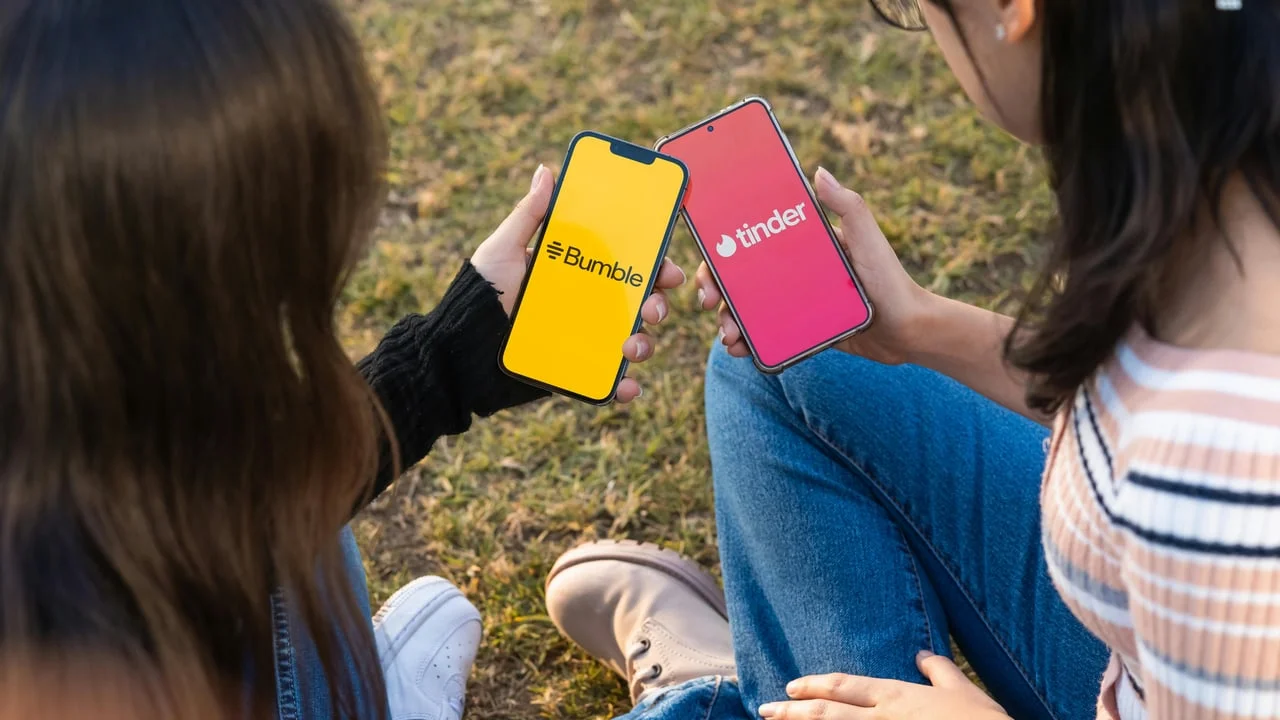
Dating World Digest — Issue 2: The Swipe Erasure, a Dating Recession, and the Free Apps Winning by Default
Bumble is killing the swipe with a hard Q4 2026 commitment. Tinder held its first product keynote. A new nationally representative study finds 70% of young adults who want marriage aren't dating — not because they stopped caring, but because they've lost confidence and resilience. Plus: which apps still let men message for free.

The biggest story this week isn't a single app doing something novel. It's four separate signals — from product announcements, earnings reports, and fresh academic research — all pointing the same direction: the mechanics of modern dating are being forcibly renegotiated, and the apps driving that negotiation are financially bleeding while doing it.
Here's what happened.
Bumble is killing the swipe — for real this time
The headline is finally backed by a hard commitment. Bumble CEO Whitney Wolfe Herd told Axios on May 7, 2026 that the company will "say goodbye to the swipe and hello to something that I believe is going to be revolutionary for the industry." 1 The swipe feature is being phased out in select markets from Q4 2026, marking the first structural departure from the swipe-based paradigm that Tinder introduced over a decade ago.
The rebranding effort — internally called "Bumble 2.0" — is substantial. It includes a new AI-powered matchmaking system called "Bee," chapter-style profiles meant to convey personality beyond a photo grid, and the removal of Bumble's signature "women message first" rule for heterosexual matches. The company says it will preserve the platform's woman-empowerment ethos while modernizing how that plays out in the actual experience.
The financial backdrop for this redesign is not pretty. Bumble's paying users fell 21.1% year over year in Q1 2026, dropping from 4 million to 3.2 million. Revenue declined 14.1% to $212.4 million. 1 The company is framing the shrinking paid user base as a deliberate "reset" — prioritizing quality over quantity. That framing is plausible, but the numbers are harsh regardless of how you spin them.
On free messaging: Bumble's app remains free to download with free matching, but accessing premium features — including unlimited swiping, advanced filters, and seeing who liked you — requires a paid plan. Sending the first message after a match is free, but most substantive features sit behind the paywall.
Tinder holds its first product keynote — and shows signs of life
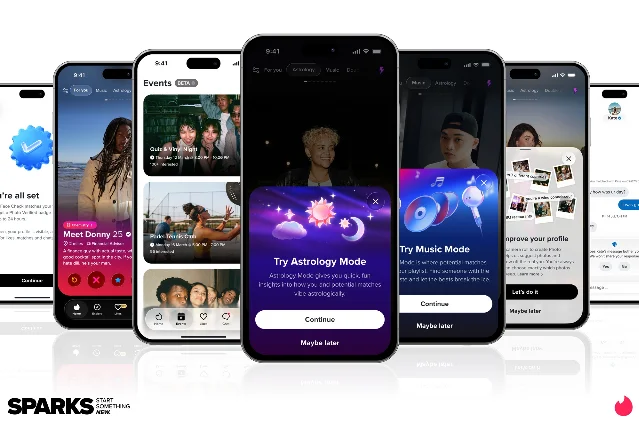
Tinder's "Sparks 2026" event in March was framed as the most significant evolution of the app in years, and the product list is long. 2 Among the announced changes: Music Mode (connecting users through Spotify listening habits), Astrology Mode, a beta IRL Events feature launching in Los Angeles, video speed dating, and an AI feature called "Chemistry" designed to surface more relevant matches. Tinder also announced partnerships with Duolingo and restaurant-ranking app Beli — letting users display what languages they're learning and where they eat.
The safety improvements are arguably the more meaningful part of the announcement. Face Check — mandatory liveness verification — is expanding globally. An AI-powered message alert called "Are You Sure?" flags potentially harmful language before it's sent. A companion feature, "Does This Bother You," now auto-blurs potentially inappropriate images on the receiving end.
CEO Spencer Rascoff, who also runs Match Group, said at the event: "We're building alongside a generation that wants dating to feel more authentic, lower-pressure, and worth their time." 2
The financial picture backs up some of that optimism. In Q1 2026, Match Group reported revenue of $864 million — a 4% gain year over year and the biggest increase since 2024. More strikingly, net income jumped 42% to $167 million, compared to $117 million in Q1 2025. 3 Total paying users are still declining, but at a slower pace, and new user registrations are ticking back up. Face Check, per Match's own data, reduced bad-actor exposure on Tinder by 60% and cut harmful interactions on Hinge by 20–30%.
Match is also moving on niche segments: it shut down LGBTQ+ app Archer and invested $100 million in Sniffies, a gay men's platform with a more underground identity. The Sniffies investment generated immediate backlash from its own user base — the app temporarily closed its comments section — which is itself a signal of how difficult it is to inject mainstream VC logic into identity-specific communities.
The dating recession: a nationally representative study says 70% of young adults who want marriage aren't dating
The most substantive research of the month comes from the Institute of Family Studies, published in February 2026 as State of Our Unions 2026: The Dating Recession. The study surveyed thousands of unmarried adults aged 22–35.
The core finding is counterintuitive: the problem is not that young people have stopped wanting relationships. In the nationally representative sample, 83% of women and 74% of men strongly endorsed dating as a pathway to long-term commitment. About 80% said their motivation for dating was to build emotional connection, and 78% wanted it to lead to a serious relationship. 4
Despite that, 70% of young adults who said they wanted to marry someday were not actively dating. 5 Not "not dating much." Not actively dating at all.
The study identifies a cluster of reasons — none of which are "they don't want to":
- 71% of men and 79% of women said they lacked confidence to ask someone out
- 67% of men and 61% of women doubted their ability to read social cues in dating situations
- Only 28% felt capable of bouncing back from rejection
- Most saw financial stability as a prerequisite before dating, with men feeling this more acutely
- Dating apps were widely seen as "cold, commercialized, and ineffective"
The researchers are using the recession metaphor deliberately: just as a bad job market discourages job seekers from even applying, a bad dating environment creates learned helplessness. Fewer people entering the market means fewer options for those still in it, which drives more people out. 4
Breaking down by age: 29% of men aged 25–35 said they had never been on an actual date. 38% of women in that same age group said the same.
The study doesn't prescribe app features as a fix. Its diagnosis points to social skill atrophy, financial anxiety, and an app ecosystem that has made rejection more visible and more frequent without making connection proportionally easier.
Where men can message first, for free
Given the paid-feature creep across major apps, it's worth noting the current landscape of platforms where men can initiate contact without hitting a paywall.
Facebook Dating has quietly become one of the more significant free alternatives. The platform — embedded inside the Facebook app — allows any user to message any match without any subscription. In late 2025, a Brazilian-language tweet with over 1,700 views noted that Facebook Dating had reached 21 million users, outpaced Hinge in some metrics, and was attracting Gen Z users partly because of its zero-cost messaging model. 6 A Bank of America 2025 Better Money Habits report found that more than half of Gen Z adults spend $0 per month on dating, suggesting financial friction is a real filter. 7
Other platforms with free messaging for men:
- OkCupid — both users can message any match for free; advanced features like seeing all likes require a subscription
- Plenty of Fish (POF) — free messaging between all users remains a core part of the platform's identity
- Hinge — free users can send one "like" with a text comment per day; full message conversation requires a match (both liked each other), but there's no pay-to-message wall for actual conversations once matched
- Tinder — free users can match and message; premium features (unlimited likes, Passport, Boost) are paid, but basic messaging after a mutual match is free
The key distinction is between platforms where messaging is gated by subscription (you must pay to send any message) versus those where matching is free but discovery features cost extra. Most major apps sit in the second category — but Bumble's "women message first" rule effectively put men in a passive position regardless of payment, a dynamic its "Bumble 2.0" redesign is now unwinding.
What's in the culture
Reddit's r/dating (25+ active posts on June 7) shows a consistent theme: users describing app exhaustion, not app engagement. 8 One recent thread from a 26-year-old who has never been on a date captured the mood precisely: she had gotten matches on apps but felt no real connection through them, and was describing the absence of the "will he notice me?" feeling that she associated with meeting someone organically.
正在加载内容卡片…
On r/OnlineDating, multiple threads this week asked variations of the same question: "Has Tinder gotten significantly worse, or is it just me?" One user noted going from 6–7 likes per day three years ago to 2–3 per week now, after no obvious change on his end. 9 The mismatch between match volume and actual dates is a recurring complaint in both subreddits — people who get matches but rarely convert them into anything.
That cultural signal aligns neatly with the IFS research: the apps are producing interactions but not confidence, connection, or dates. Which may be why both Bumble and Tinder are pivoting toward IRL features, speed dating events, and activity-based matching — trying to solve with product what turns out to be a behavioral and psychological problem.
Brief notes
- Date costs up: Millennials are averaging $252 per date in 2026, up 32% from 2025. Gen Z is at $205, up from $194. 10 At that price point, the IFS finding about financial anxiety as a dating barrier isn't abstract.
- "Dinner dating": A study referenced in Wired found that nearly 1 in 3 Gen Z singles admits to going on dates primarily for the free meal. 11 Whether that says more about the economy or the quality of the dates is an open question.
- Bumble Plans pilot: Following up from Issue 1 — no public update yet on Bumble's group-dating "Plans" feature expansion beyond the NYC pilot. We'll check back.
- Match Group + AI hiring: Match Group has been slowing human hiring while increasing spending on AI tooling across Tinder and Hinge, per Instagram reports from May 2026. The product keynote makes that strategy visible in practice.
参考来源
- 1Bumble Plans to Say Goodbye to the Swipe System
- 2Tinder Sparks 2026: Start Something New
- 3Match Group Q1 Shows Signs of Life at Tinder
- 4Survey Data Show We're Now in a Dating Recession
- 5What Happened to Dating? Research, Reality, and Hope
- 6Facebook Dating growth tweet
- 7Why 60% of Gen Z Men Are Not Dating
- 8r/dating current threads, June 2026
- 9r/OnlineDating threads, June 2026
- 10Average date costs 2026
- 11Gen Z dating behaviors, Wired
围绕这条内容继续补充观点或上下文。