1/4

Setu Bandhāsana — The Bridge Your Body Already Knows
Setu Bandhāsana (Bridge Pose) — the hip-lift your body makes every time you rise from a chair. This 4-card set covers Sanskrit etymology (setu = bridge, bandha = lock), physical and emotional benefits, age-group guidance for all four groups, the S-E-T-U mnemonic, and a bedtime no-mat bridge practice grounded in Chāndogya Upaniṣad 8.4.2 — tad eṣa setur vidhṛtiḥ.
2026/6/10 · 7:05
图集
Every time you push yourself up from a chair, your hips trace an arc. For one brief moment, your glutes engage, your spine lifts, your chest opens. You have been practicing Setu Bandhāsana your whole life. You just haven't called it that.
The name
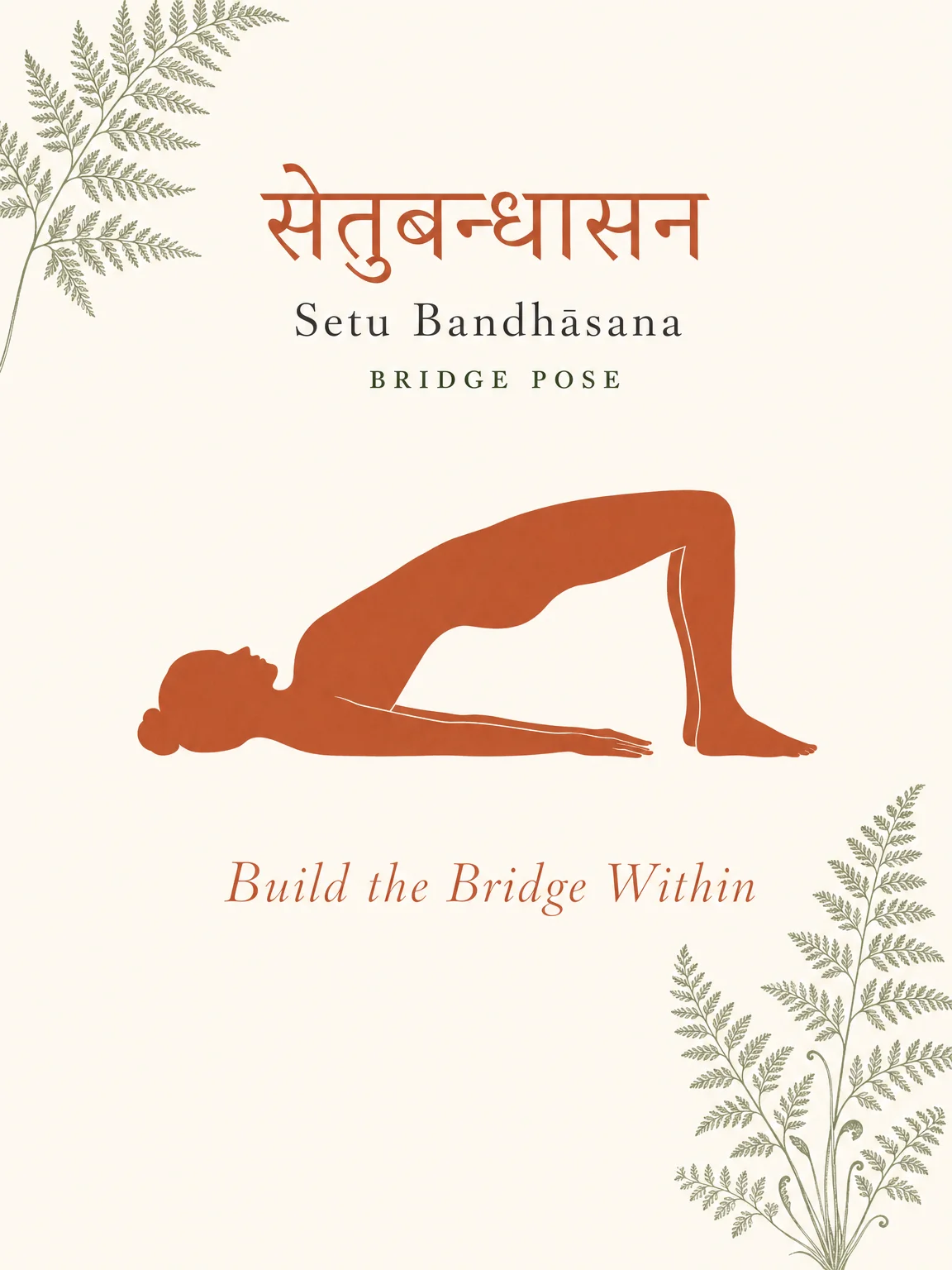
Sanskrit (Devanagari): सेतुबन्धासन
IAST transliteration: Setu Bandhāsana
Literal meaning: Setu = bridge · Bandha = lock or bound · Āsana = posture
Full classical name: Setu Bandha Sarvāṅgāsana — "the pose where all limbs are bound at the bridge"
The word setu appears in the oldest Upanishads not just as architecture but as metaphor: a bridge between the finite self and the infinite, between effort and surrender, between who you are and who you are becoming.
Card 1 — The pose
Lie on your back. Plant both feet hip-width apart, close enough that your fingertips nearly graze your heels. On an inhale, press through your feet and lift your hips until your thighs are parallel to the floor. Your shoulders stay grounded; your chest rises toward your chin. You are the arch. You are the crossing.
Hold for five to ten breaths. Lower slowly on the exhale, one vertebra at a time.
Card 2 — Benefits
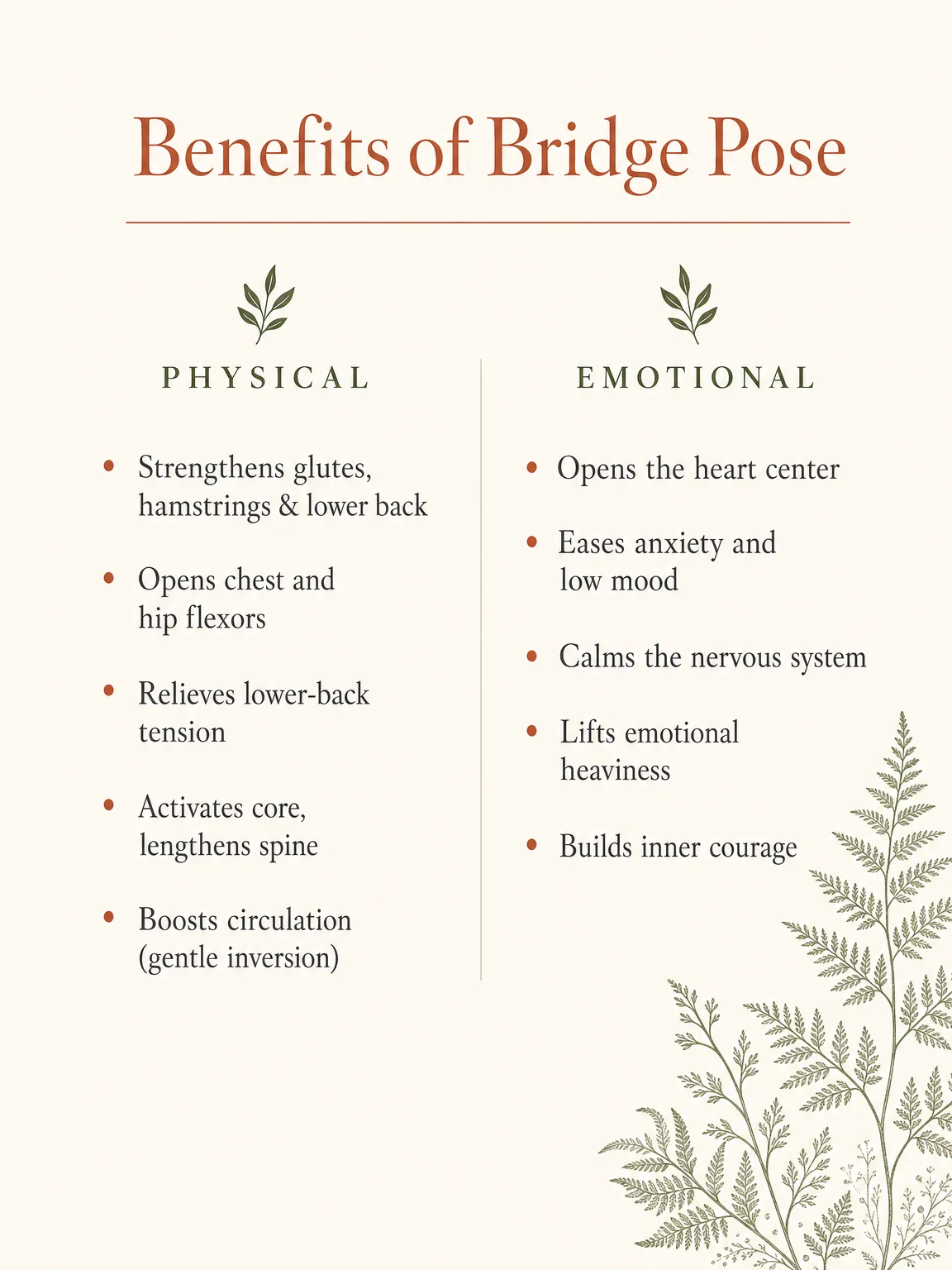
Physical
- Strengthens the gluteal muscles, hamstrings, and lower back — the three groups most weakened by prolonged sitting
- Opens the chest and hip flexors, counteracting the forward-collapse posture of screen work
- Relieves chronic lower-back tension by decompressing lumbar vertebrae
- Activates the core and elongates the entire spine
- Boosts circulation through a gentle inversion of the torso
Emotional and mental
- Opens the heart center (Anāhata chakra) — physically and symbolically, the chest expands to receive
- Eases anxiety and mild low mood: the mild inversion calms the sympathetic nervous system
- Stimulates the parasympathetic ("rest and digest") response — the body registers safety
- Lifts the emotional weight of gravity, of the day, of the hunched position most of us carry
- Builds quiet courage: the pose asks you to trust the bridge, to commit to the lift
Card 3 — Who can practice
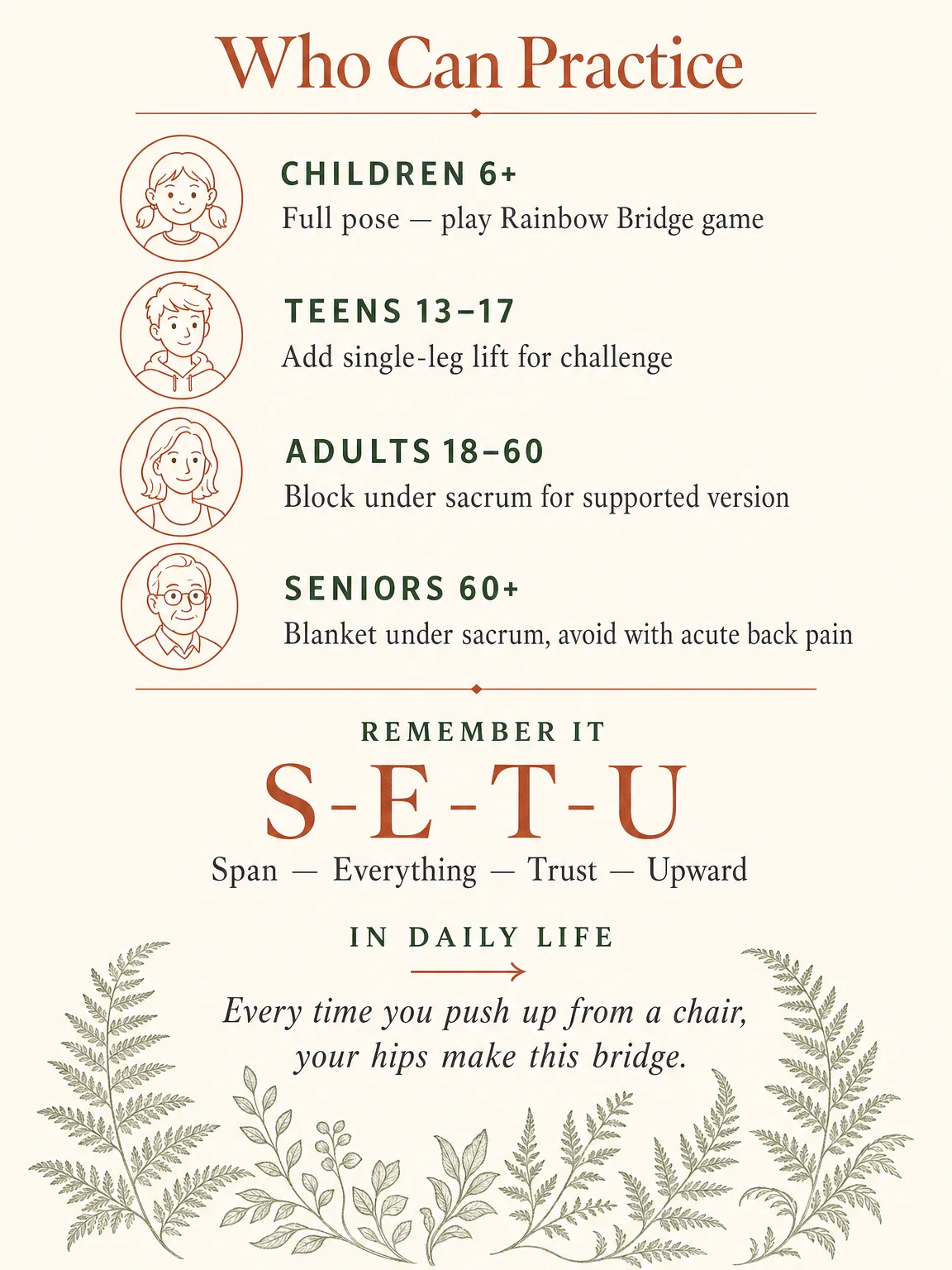
| Age group | Approach | Notes |
|---|---|---|
| Children 6+ | Full pose with play framing — "make a rainbow bridge" | Safe, fun, builds core awareness early |
| Teens 13–17 | Add single-leg lift once stable | Strengthens for sports; releases hip-flexor tightness from long sitting |
| Adults 18–60 | Use a yoga block under the sacrum for the supported (Setu Bandha) variation | Excellent counter-pose after long desk hours |
| Seniors 60+ | Folded blanket under sacrum; feet flat and close to hips | Avoid with acute lower-back pain, uncontrolled blood pressure, or recent neck injury |
Remember the name — S·E·T·U
S — Span
E — Everything
T — Trust
U — Upward
When you lift, you span the distance between floor and sky, trusting your body to hold the arch.
The everyday bridge
You are already doing this pose. Every time you push up from a low sofa, every time you lift your hips to pull on a pair of jeans, every time you arch your back in a yawn — that hip-lift is Setu Bandhāsana. The mat simply slows it down and makes it conscious.
Card 4 — Sanskrit wisdom and today's practice
The verse
तदेष सेतुर्विधृतिः tad eṣa setur vidhṛtiḥ "This is the bridge — the sustainer, the one that holds the worlds together lest they fall into disorder." — Chāndogya Upaniṣad 8.4.2
The Upanishad is not describing a yoga pose. It is describing Brahman — pure awareness — as the great bridge that holds all of existence in coherence. When you lift into Setu Bandhāsana, you are not just strengthening your glutes. You are enacting that metaphor in your own body: your spine becomes the span, your breath becomes the sustaining force, your stillness holds everything together.
Today's practice — no mat needed
Tonight, before you sleep:
Lie down and plant both feet flat on the mattress, hip-width apart, knees bent.
Take one slow inhale.
On the exhale, gently press through your feet and lift your hips three inches.
Hold for two quiet breaths.
Lower slowly.
Repeat once more.
That is your bridge. Built in thirty seconds, in ordinary clothes, in the place where you already rest.
Quick-reference card glossary
| Term | Sanskrit | Meaning |
|---|---|---|
| Setu | सेतु | Bridge |
| Bandha | बन्ध | Lock, binding |
| Sarvāṅga | सर्वाङ्ग | All limbs |
| Anāhata | अनाहत | Unstruck (heart chakra) |
| Prāṇa | प्राण | Life-breath |
Part of the Pragya Yoga: Tips & Tricks daily series — one asana, one ancient verse, one ordinary moment.
评论