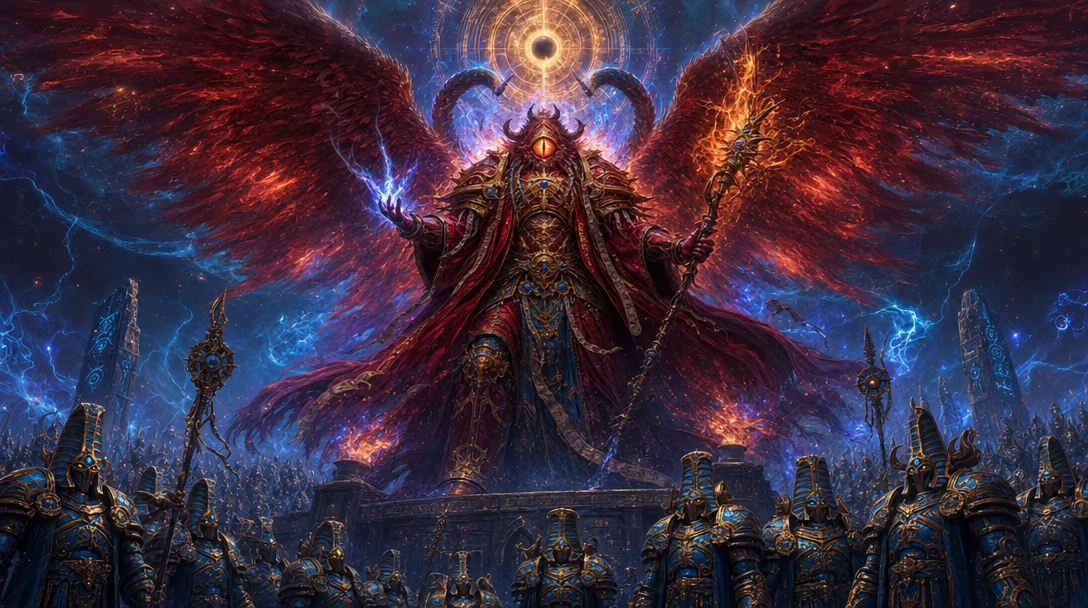
Magnus the Red, Part II: The Rubric and the Reckoning
Part II of the Magnus arc — from the catastrophic Rubric of Ahriman that turned the Thousand Sons into hollow Rubricae, Magnus's fury and Ahriman's exile, through the Battle of the Fang in M32 where Magnus destroyed the Space Wolves' chance at a lasting dynasty, to the Siege of the Fenris System in late M41 — a millennial revenge plot that ended with the Planet of Sorcerers relocated to hang above the ruins of Prospero.

Where Part I ended with a city on fire and a Legion hurled into the Warp, Part II begins with the survivors taking stock of what they had become — and discovering the answer was worse than anyone had imagined.
Into the Eye
The mortal form of Magnus the Red died on the plains of Prospero, torn apart in psychic combat with Leman Russ of the Space Wolves. What arrived in the Eye of Terror was not a corpse but something stranger: a being of pure, materialised Warp energy, his soul shattered into fragments yet still animate, still furious, still brilliant. 1
The Eye of Terror is the largest stable Warp rift in the galaxy, a wound torn open during the ancient Eldar Fall where the material universe and the immaterium overlap. For the ten thousand warriors of the Thousand Sons who followed their Primarch into exile, it was now home. Magnus settled on a world that would eventually be called Sortiarius — the Planet of Sorcerers — a daemon world of labyrinthine spires, shifting corridors, and libraries stuffed with forbidden knowledge accumulating over centuries. 2
But there was a problem that no amount of architectural grandeur could conceal. The Flesh Change — the genetic instability that had plagued the Thousand Sons since before the Great Crusade, the creeping mutation that unravelled a warrior's body from the inside — had not stopped. Magnus had spent decades finding workarounds. Tzeentch, the Chaos God of Change and Fate who had claimed both Magnus and his Legion during the Heresy, had no interest in halting mutation; change was his nature. With the Legion's patron offering nothing and Magnus himself too fractured to hold back the tide, the Flesh Change resumed its slow consumption of the Thousand Sons.
Ahzek Ahriman watched it happen. Of all the senior officers who had survived Prospero, Ahriman was arguably the most capable sorcerer — the author of the forbidden Book of Magnus study notes, the first captain of the First Fellowship, and a man who had spent his entire adult life trying to protect his brothers from exactly this fate. He had defied Magnus's order to stand down and let the Space Wolves burn Prospero, fighting to the last to save what could be saved. Now he watched warriors he had known for decades dissolve into monstrous forms, their humanity stripped away in slow, hideous increments. 3
He decided to do something about it. Magnus would not.
The Rubric
Working in secrecy that bordered on sacrilege, Ahriman assembled the most powerful surviving sorcerers of the Legion — his cabal, sometimes called the Council of Ahriman — and set to work on a ritual he believed could permanently halt the Flesh Change. The spell was derived from the oldest forbidden lore of the Thousand Sons, distilled through Ahriman's own formidable psychic knowledge, and anchored to the fundamental principle that mutation required impurity of soul. He would burn out the impurity. He would stop the rot. 3
The Rubric of Ahriman was cast across Sortiarius.
Blue-white psychic lightning erupted across the entire planet. Every warrior of the Thousand Sons was struck simultaneously. The energy was so violent, so overwhelming, that even the daemons of the Warp retreated from its radius. Ahriman's cabal channelled everything they had into the working. 4
Magnus felt it through the Warp. He descended onto Sortiarius and shattered the ritual before it could complete its full cycle.
It was already too late.
The Rubric had worked — but not as Ahriman intended. The warriors of the Thousand Sons with genuine psyker potential had their abilities dramatically amplified; in some cases their power doubled or trebled overnight. The approximately one hundred sorcerers who fell into this category survived the rite intact, more powerful than they had ever been. 4
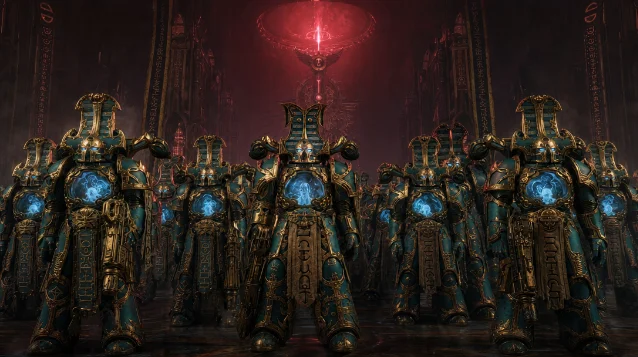
The rest — the vast majority of the Legion, those whose psyker talent was minimal or absent — had their bodies turned to dust. Their souls, however, did not disperse. The Rubric had fused psychic energy into their armour itself, trapping each spirit inside the ceramite shell. The suits of power armour now stood upright, walked on command, fought when directed, and stopped when they were told. Inside each one was a soul that could not leave, could not grow, could not change — permanently preserved against the Flesh Change at the cost of everything that had made it human.
These were the Rubricae. The Rubric Marines. They are the iconic symbol of the Thousand Sons to this day: hollow warriors in teal and gold, their eye-lenses glowing with witchfire, moving silently and with terrible efficiency under the direction of their sorcerer masters. 4
Ahriman believed this was victory. Magnus did not.
Magnus's rage and the exile of Ahriman
The Primarch's fury at what Ahriman had done was total. The Rubric had solved the Flesh Change in the most grotesque way imaginable — by killing the majority of the Legion's physical forms. Magnus had lost his eye purchasing a bargain with a daemon to save his warriors from mutation. He had shattered the Emperor's Webway project, betrayed his father, and burned his homeworld to ashes, and now the chief beneficiary of all that sacrifice had taken the remnants of the Thousand Sons and stripped them of their bodies.
Magnus tried to kill Ahriman. In the confrontation that followed, the Primarch — even in his fractured, partially-destroyed state — was far beyond Ahriman in raw power. Ahriman and his cabal were moments from death. 3
Then Tzeentch intervened. The God of Change appeared, in whatever manner a Chaos God communicates its will, and stayed Magnus's hand. What the Changer of Ways saw in Ahriman's fate — whether it was some vast amusement, some manipulation within manipulation — is unknowable, but the result was clear: Magnus was told not to kill his most powerful sorcerer. He obeyed. 3
Ahriman was exiled instead. He and his council were cast out of Sortiarius, banned from the Planet of Sorcerers, condemned to wander the Eye of Terror and the wider galaxy in search of understanding — Tzeentch's own private joke, perhaps, since true understanding of the Changer of Ways is by definition impossible. The exile meant Ahriman would spend thousands of years pursuing knowledge he could never fully possess, gathering lost artefacts, building warbands, delving into forbidden libraries, seeking some way to reverse what he had done to the Legion he loved.
Magnus, newly purged of his first captain and most of his surviving mobile warriors, turned outward. The Legion that remained to him was efficient, implacable, and entirely silent. He began planning operations that only sorcerers could execute.
The Battle of the Fang, M32
Nearly a millennium passed. The Thousand Sons, operating from Sortiarius, had not forgotten Prospero. Magnus had not forgotten the face of Leman Russ standing over his mortal body as the Wolf King delivered the killing blow on the orders of the Emperor himself. The Space Wolves had executed the order. The Wolves would pay.
In the early 32nd Millennium, Magnus identified a vulnerability in his enemy. The then-Great Wolf of the Space Wolves, Harek Ironhelm, had become dangerously obsessed with hunting Magnus down personally. The Primarch decided to use that obsession as a weapon. 5
The Thousand Sons launched a series of raids on worlds neighbouring Fenris, drawing the Space Wolves into a chase. The Wolf Priests were pushing toward a breakthrough that Magnus had been monitoring: Thar Hraldir, a Rune Priest of considerable talent, was close to solving the defect in the Canis Helix — the genetic flaw that prevented the Space Wolves from founding successor Chapters. If Hraldir succeeded, the Space Wolves could reproduce as other Legions did, seeding multiple successor Chapters across the galaxy, their geneseed spreading beyond Fenris. That future, to Magnus, was unacceptable.
He baited Ironhelm with psychic visions, taunting him across the Warp until the Great Wolf took the bait entirely. Ironhelm stripped Fenris of nearly all its defenders and led the Chapter's full strength to the world of Gangava, where the Thousand Sons had staged a false target. The Fang — the fortress-monastery carved into the highest mountain on Fenris — was left with a skeleton garrison: the Twelfth Great Company, eleven Dreadnoughts, and a handful of Rune Priests. 5
Magnus struck immediately.
The Thousand Sons' fleet translated directly into Fenris's orbital space using Warp abilities no conventional fleet commander could replicate. Magnus's first action was a precise psychic strike that killed every Wolf Priest on the planet before a single ground force had landed. With the Fang's spiritual defenders dead, his sorcerers began dismantling the fortress's anti-psychic wards at range. Two Planets-of-Sorcerers-class bombardment ships, each carrying oversized plasma cannon arrays, took up position and began sustained fire. The void shields held — but the artillery suppressed every surface-to-orbit weapon the Fang possessed, and within four days the Thousand Sons' ground forces had encircled the fortress.
The siege lasted weeks. Vaer Greyloc, the First Claw of the Twelfth Great Company, oversaw the defence with cold precision. He woke every Dreadnought in the mountain, including the legendary Bjorn the Fell-Handed, the oldest living Space Marine in the Imperium, who had fought at the Siege of Terra itself. The defenders held the two critical chokepoints inside the fortress — the reactor vault known as the Borean Seal, and the upper command level — against forces twenty times their number. 5
But the Thousand Sons' objective was not to take the fortress. It was to reach one room.
Magnus materialised in physical form using a sorcerer, Herume Aphael, as a vessel — the Daemon Primarch descending into real-space in a temporary body. He cut through the defenders on a direct path to Hraldir's genetic research laboratory. Every warrior who tried to stop him died. Vaer Greyloc and Bjorn the Fell-Handed intercepted him and fought with everything they had, but Magnus struck them both down. He reached the laboratory, destroyed every specimen, killed Thar Hraldir, and shattered every document, every result, every decades-long accumulation of research that might have given the Space Wolves the ability to build a legacy beyond Fenris. 5
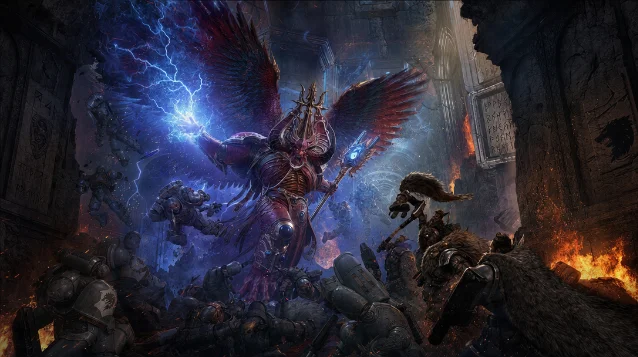
The single scout ship Nauro had broken through the orbital blockade earlier in the siege and reached Gangava. Ironhelm's relief force arrived as Magnus was completing his work. The Great Wolf himself inserted via drop pod to the top of the Fang and attacked the Daemon Primarch directly. They fell from the peak together, a three-way collapse into the mountain's lower levels. Magnus, physically spent, killed Harek Ironhelm. Then he withdrew.
The Thousand Sons abandoned their two million Spireguard troops on Fenris without extraction. The returning Space Wolves spent forty days hunting them down to the last man. When the accounting was done, the Twelfth Great Company had twenty-two survivors from three hundred warriors. Vaer Greyloc was dead. Bjorn the Fell-Handed was grievously damaged. The Great Wolf was dead. The genetic research that could have given the Space Wolves a lasting dynasty was permanently destroyed.
The Thousand Sons had lost nearly their entire ground force. Magnus considered it worth it. 5
The shards of Magnus
Throughout the long millennia between the Battle of the Fang and the 41st Millennium, Magnus existed in a way that most Daemon Primarchs do not: broken. His psychic assault on the Emperor's Webway had catastrophically damaged not just the project but Magnus himself. His soul had shattered on impact with the barriers the Emperor had constructed, and the pieces — each carrying some aspect of his personality, his memories, his knowledge — scattered across the Warp. 1
These Shards of Magnus became a recurring threat across the galaxy for thousands of years. Each Shard was an immensely powerful psychic entity carrying a fragment of the Primarch's character — sometimes his curiosity, sometimes his pride, sometimes his rage, sometimes his grief. The Inquisition catalogued encounters with them across multiple millennia, never quite understanding what they were encountering. The Shards periodically attempted to recombine, drawn together by whatever remained of Magnus's sense of self.
Ahriman's second attempt at the Rubric — thousands of years after his exile, driven by the same obsessive need to undo what he had done — inadvertently provided Magnus with exactly the mechanism he needed. When Ahriman worked the rite again, drawing on vast quantities of psychic energy, Magnus hijacked the process. He used the power of the ritual to call in his scattered Shards, pulling the fragments of himself back together. The reconstitution was not perfect — the Shards that represented Magnus's noblest qualities, his compassion and his genuine love for humanity, were among the last to return, and some appear to have been lost entirely. What reassembled was a more unified Magnus, but one in whom the generous and hopeful aspects of his character had been further eroded. 1
He gained power at a cost he had not chosen to pay, which is entirely in keeping with his story.
The Siege of the Fenris System, late M41
For nine thousand years, Magnus had been planning. When the opportunity arrived — when he saw exactly the configuration of events, the vulnerabilities, the positions of Space Wolves forces across the galaxy — he moved.
In the closing years of the 41st Millennium, reports began filtering in from Space Wolves patrols of something that the Chapter had not encountered in living memory: Wulfen. The legendary, cursed warriors of the Lost 13th Great Company, warriors who had been cast into the Eye of Terror chasing Magnus himself after the Heresy and who had never returned, were reappearing across the galaxy. The Chapter dispatched eleven of its thirteen Great Companies to recover these lost brothers. Fenris was left largely unguarded. 6
The Wulfen's return had been engineered. Their reappearance was a signal, the first act in a ritual Magnus had constructed over centuries. The entire Wulfen phenomenon — or at least its timing — was manipulation, designed to scatter the Space Wolves before Magnus struck.
The Thousand Sons came to the Fenris System in force. Rather than attacking the Fang directly as he had in M32, Magnus's plan was more sophisticated this time. Silver Towers — Tzeentchian warp-constructs of immense power — descended across Fenris, penetrating the planet's defences by circumventing conventional aerial approach vectors. On the third day of the invasion, sorcerers at each Silver Tower conducted a ritual lasting exactly nine hours, nine minutes, and nine seconds. Space Wolf prisoners served as the sacrificial components. The separate rituals merged and amplified each other across the planet's ley lines. 6
Magnus descended into physical reality on the Aesheim Plains. His arrival tore open a Warp rift and swept daemon allies into real-space behind him. He crossed the plains destroying everything the Space Wolves could put in his path. Egil Iron Wolf, attempting to intercept him with the Spear of Russ, was disintegrated. Logan Grimnar caught the spear mid-air and pressed the attack, landing a blow with the Axe Morkai that wounded Magnus physically — one of the first times in millennia that the Daemon Primarch had bled in battle. 6
Grey Knights arrived. Purifiers under Brother-Captain Stern completed a banishment rite that hurled Magnus back into the Warp, and the daemon host was pulled with him. The space around Fenris was cleared. The Imperial forces declared the system saved.
But Magnus had achieved everything he came for.
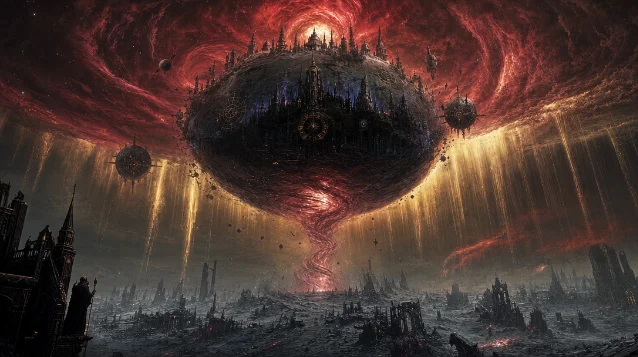
The planet Midgardia, which Logan Grimnar had been forced to exterminatus — to prevent its total daemonic corruption from spreading — had served as the power source for a planetary-scale ritual that had nothing to do with defeating the Space Wolves in battle. Its sacrifice had provided enough psychic energy to move Sortiarius, the Planet of Sorcerers, from its position deep in the Eye of Terror to physical reality above the ruins of Prospero. 6
Prospero — the world Magnus had studied as a boy, where he had built his Legion, where he had watched Leman Russ execute his father's orders and burn everything to cinders — now had the Planet of Sorcerers hanging in its sky. A continent-sized Warp rift opened between them. Magnus had not just attacked the Space Wolves. He had transplanted his home, positioned it at the edge of the material galaxy, and opened a permanent gateway through which the forces of Tzeentch could pour endlessly into real-space.
The civilian population of the Fenris System was destroyed in its entirety by the conflict. The Grey Knights' Grand Master Voldus was killed in the fighting. The Space Wolves lost Egil Iron Wolf and suffered catastrophic casualties. A full-scale Inquisitorial response was triggered, and the Silent Sisters were deployed across Fenris to purge witnesses. The entire star system was permanently altered. 6
Logan Grimnar had 'won' the battle. Magnus had won the war.
The architecture of long revenge
Across the ten millennia between the Burning of Prospero and the fall of the Fenris System, Magnus the Red demonstrates something unusual among Chaos Champions: patience operating at civilisational timescales. The 41st Millennium version of Magnus is not acting in the moment but executing a plan that began in M32 at the earliest, perhaps earlier. The corruption of the Space Wolves' gene-seed at the Battle of the Fang — which planted the seeds of the Wulfen phenomenon — only paid dividends nine thousand years later when those cursed warriors reappeared at exactly the right moment. 5
The Wulfen situation was noted by some within the Chapter as a gift from Russ himself, a sign of divine favour. Magnus had made it look like a miracle.
Whether Tzeentch planned all of this — whether the God of Fate watches the Long War as a chess match played across millennia, with Magnus as both player and piece — is a question the Warhammer 40K universe intentionally leaves open. Magnus believes himself a player. The Imperium's Inquisitors believe he is a weapon in a god's hands. They may both be right.
What is clear is that by the end of M41, Magnus stood on Prospero — or rather, hovered above it on a world he had personally relocated — with the most important strategic asset in the galaxy: a stable pathway from the Eye of Terror to the material universe, anchored to the ruins of the world he had loved above all others. He had endured the Rubric, the shattering of his soul, the isolation of millennia, the exile of his first captain, and the political machinery of Tzeentch, and he had arrived at a position his father the Emperor had once told him was impossible.
Part III follows Magnus into the 42nd Millennium — the Terran campaign, the wars of M42, and the question of what a Daemon Primarch who has already won his long revenge chooses to do with the victory.
Previously in this arc: Magnus the Red, Part I: The Crimson King — Origins on Prospero, the Thousand Sons' Flesh Change, the daemonic bargain with Choronzon, the Council of Nikaea, Magnus's Folly, and the Burning of Prospero.
围绕这条内容继续补充观点或上下文。