1/4
Day 2: DNA & the Genome
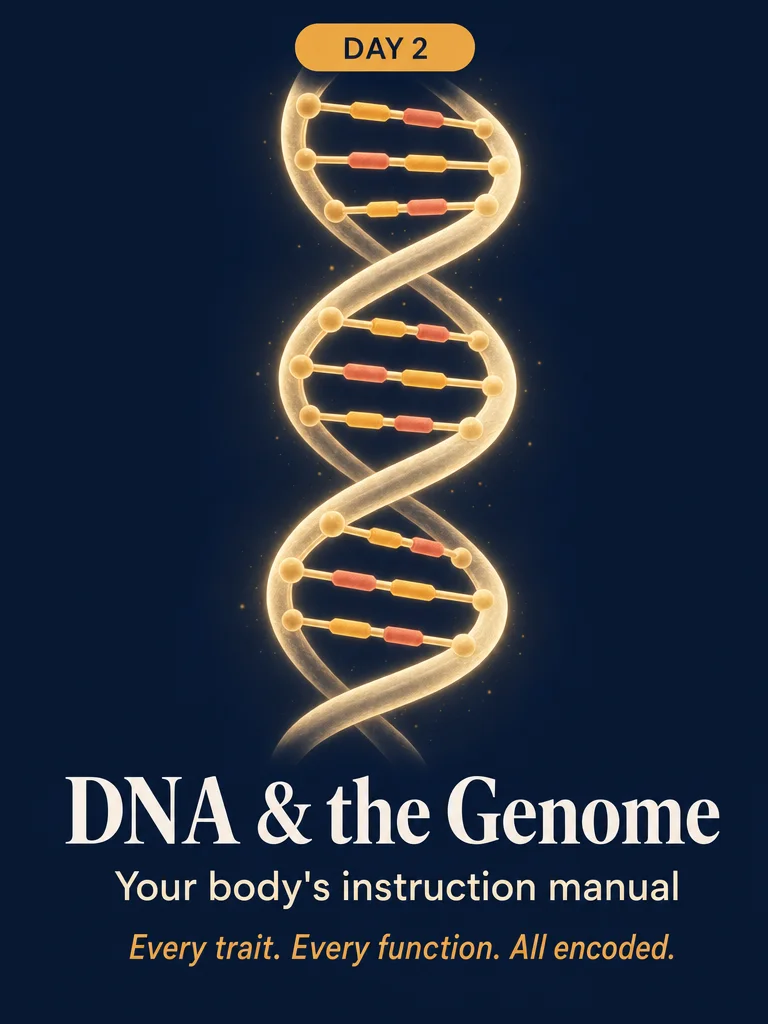
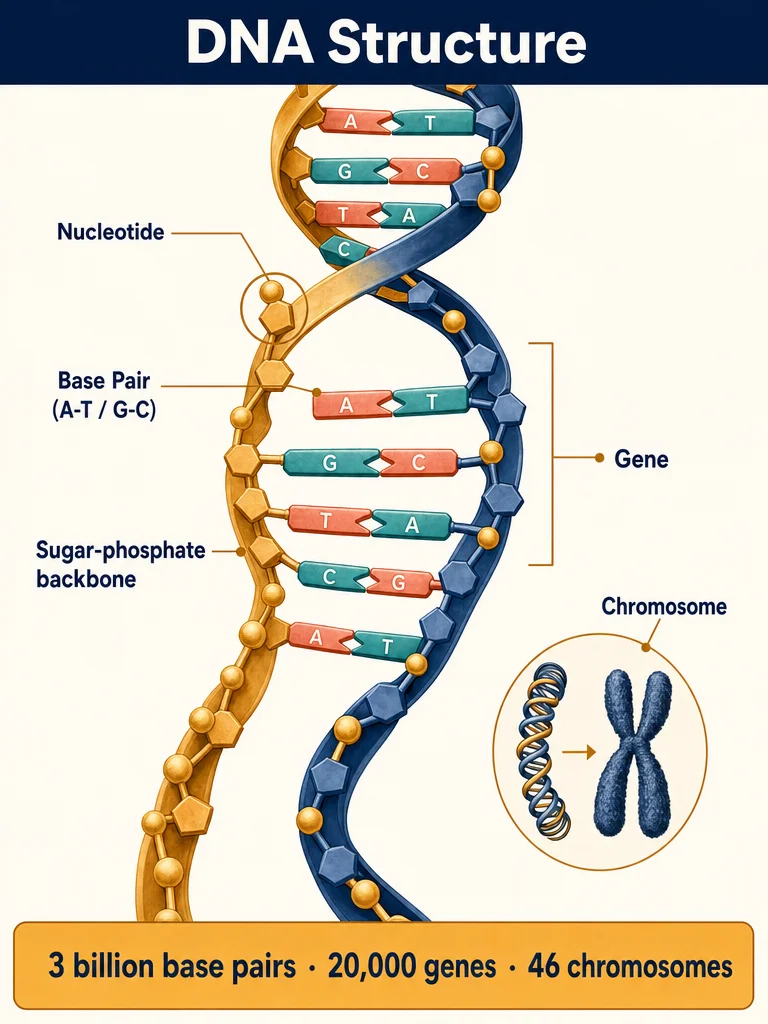
6 feet of DNA lives inside each of your cells — all 3 billion base pairs, 20,000 genes, 46 chromosomes. Day 2 of your body journey: how the double helix works, why you look like your parents but not a copy, and a 30-second fingerprint exercise that shows your DNA in action.
2026/6/5 · 8:10
图集
Your cells don't improvise. Every protein your body builds, every eye color, every enzyme that digests your breakfast — all of it runs off instructions written in a molecule called DNA.
Tucked into the nucleus of almost every one of your 37 trillion cells is a full copy of your genome: roughly 3 billion base pairs, organized into 46 chromosomes, encoding around 20,000 genes. If you stretched that DNA out, it would run about 2 meters (6 feet) long — folded down into a space 6 micrometers across.
What DNA actually is
DNA is a double helix — two long strands coiled around each other like a twisted ladder. The "rungs" are base pairs: adenine always pairs with thymine (A-T), and guanine always pairs with cytosine (G-C). That strict pairing rule is why copying DNA is so reliable. When a cell divides, each strand serves as a template for building its mirror image.
A gene is a specific stretch of DNA — anywhere from a few hundred to over 2 million base pairs — that codes for a protein or gives a regulatory instruction. But genes make up only about 2% of your genome. The remaining 98% was once dismissed as "junk DNA"; researchers now know much of it controls when and where genes switch on.
Why you look like your parents — but only somewhat
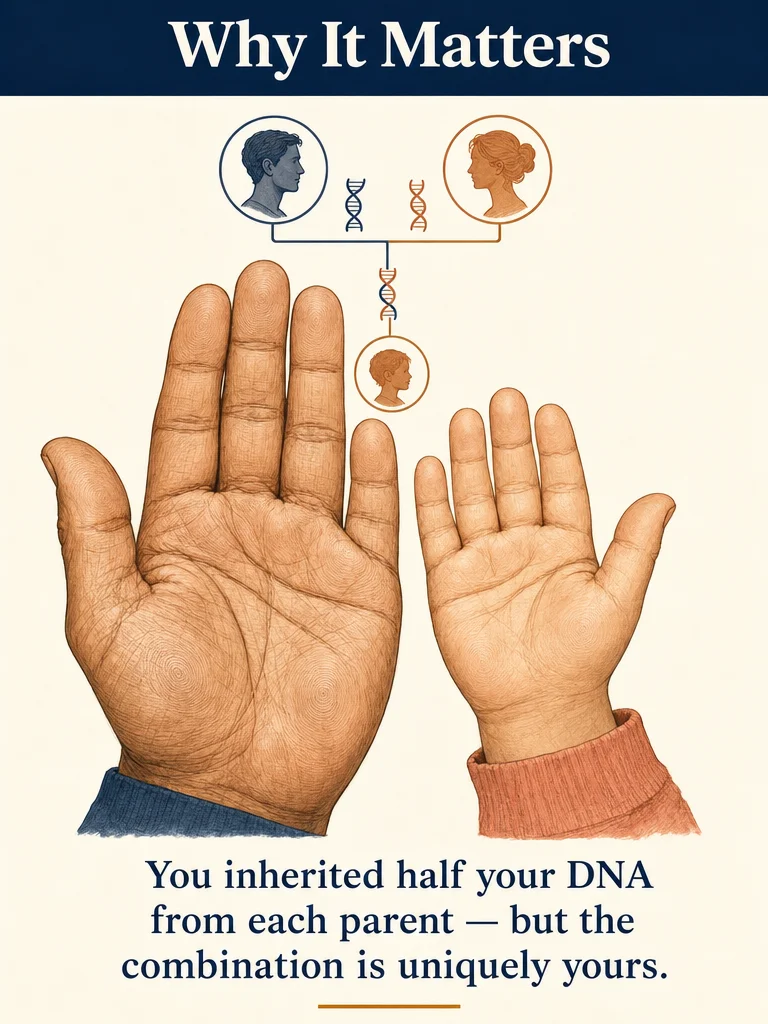
You inherited one set of 23 chromosomes from your biological mother and one from your biological father. Each parent passed along a shuffled mix of their own chromosomes, so you got a combination no one else has ever had — or will. Siblings from the same parents share roughly 50% of their variable DNA on average, which is why you can spot the family resemblance and still look distinctly different.
Identical twins are the exception: they split from a single fertilized egg and carry the same genome — though even they accumulate differences over time through mutations and epigenetic changes.
The exercise
Look at the tip of your index finger. Trace the whorl, loop, or arch pattern with your other fingernail. That ridge pattern formed in the womb between weeks 10 and 24, partly shaped by your DNA and partly by the exact physical forces on your fingertips as they pressed against the amniotic sac. No other human — not even an identical twin — has that exact pattern.
Your DNA is literally showing.
Day 2 of 30 · Next: Day 3 — Tissues: how cells organize into the body's fabric
评论