
AI Sector Daily Digest — June 1, 2026
Today's five: NVIDIA opens Cosmos 3 and unveils RTX Spark at GTC Taipei; MiniMax ships M3 claiming a SWE-Bench Pro lead; DeepSeek is in talks for a $10B raise at $45B — China's largest-ever first-time startup fundraise; GitHub Copilot switches to token-based billing; and ByteDance weighs $70B in AI infrastructure spending.

Today's five: NVIDIA floods GTC Taipei with hardware and opens Cosmos 3 for physical AI; MiniMax releases M3, claiming a coding benchmark win over GPT-5.5 and Gemini; DeepSeek is in talks for the largest first-time fundraise in Chinese tech history; GitHub Copilot moves to token-based billing as of this morning; and ByteDance is weighing $70 billion in AI infrastructure spending.
1. NVIDIA opens Cosmos 3 — its first physical AI omnimodel — and announces RTX Spark PC chip
NVIDIA used GTC Taipei to release Cosmos 3, an open-weights foundation model for physical AI built on a mixture-of-transformers architecture. The model handles text, images, video, ambient sound, and action trajectories in a single system, and NVIDIA says it cuts physical AI training cycles from months to days. 1 Two sizes are available now — Cosmos 3 Super and Cosmos 3 Nano — on Hugging Face and NVIDIA's build platform; Cosmos 3 Edge for real-time inference is listed as coming soon.
NVIDIA also launched the Cosmos Coalition, pulling in Agile Robots, Black Forest Labs, Runway, and Skild AI as founding partners to develop next-generation world models in the open. The same keynote featured RTX Spark, a new consumer PC chip built with Microsoft. Jensen Huang called it "the biggest reinvention of the PC in 40 years," with RTX Spark-powered laptops landing in autumn at a price yet to be disclosed. 2

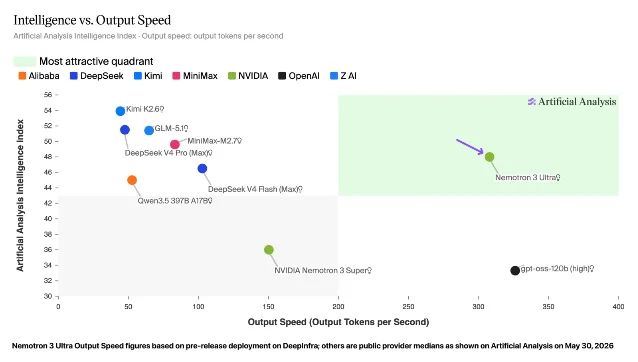
Separately, NVIDIA announced Nemotron 3 Ultra, the latest in its open-weights reasoning family. On the Artificial Analysis Intelligence Index it scores 48 — the highest among US open-weights models, above Gemma 4 31B (39) and Nemotron 3 Super (36) — and a DeepInfra preview deployment clocked output speeds above 300 tokens per second. The model weighs 550 billion total parameters (550B active at 90% sparsity) and is expected to go live on Hugging Face on June 4. 3
2. MiniMax ships M3, claiming SWE-Bench Pro lead over OpenAI and Google
Shanghai-based MiniMax released M3 on June 1, the company's first major model since it filed for a dual listing on Hong Kong and Shanghai's Star Market. The company says M3 processes up to 1 million tokens — five times the M2.7 ceiling — and has cut computational requirements to roughly one-twentieth of the prior architecture, bringing inference costs down. 4
On the SWE-Bench Pro coding benchmark, MiniMax says M3 beats OpenAI's GPT-5.5 and Google's Gemini 3.1 Pro, though the company has not yet released full weights or training code. The model's API is live with a seven-day promotional discount of 50% for up to 512,000 tokens. M3 is also the core of Mavis, MiniMax's multi-agent system that runs parallel agents on a single device. MiniMax posted $79 million in revenue for 2025 (up 159% year-on-year) and $150 million annualized recurring revenue as of February 2026.
3. DeepSeek in talks to raise $10B at a $45B valuation — China's largest first-time startup fundraise on record
DeepSeek is in advanced talks to close a $10 billion funding round at a $45 billion post-money valuation, according to people familiar with the matter, making it the largest first-time fundraise by a Chinese tech startup in history. 5 That compares to the $10 billion valuation DeepSeek was targeting as recently as April 2026.
The round is being led by China's National Large Fund (state-backed semiconductor investment fund), with CATL, JD.com, and NetEase among the strategic participants. A close is expected as early as June 2026. Founder Liang Wenfeng has consistently said the company is not optimizing for near-term profit, focusing instead on open-source research toward AGI.
4. GitHub Copilot switches to token-based billing today
As of June 1, GitHub Copilot has moved from flat-rate premium-request billing to an AI-credit model across all plans. Base subscription prices are unchanged — Pro at $10/month, Pro+ at $39, Business at $19/user, Enterprise at $39/user — but usage of higher-capability models now draws from a credit pool rather than a fixed request budget. 6
Some developers are already reporting credit depletion faster than expected under the new system. The change arrives the day before Microsoft Build 2026 opens, where additional Copilot and MAI model announcements are expected. Separately, OpenAI has set a GPT-4.5 retirement date of June 27.
5. ByteDance weighs $70B AI infrastructure spend, Bloomberg reports
ByteDance is considering a sharp increase in capital expenditure for 2026, with the potential outlay reaching $70 billion to expand data centers in China and overseas, Bloomberg reported, citing people familiar with the matter. 7 The figure would represent a significant step-up from prior years and is tied to ByteDance's Doubao AI platform, which is the company's primary consumer AI product in China.
The report follows separate news that ByteDance has turned to Qualcomm for AI ASIC supply as its compute needs outpace what it can procure through standard channels. If confirmed, a $70B capex program would put ByteDance ahead of most hyperscalers in absolute AI infrastructure spend.
正在加载内容卡片…
围绕这条内容继续补充观点或上下文。