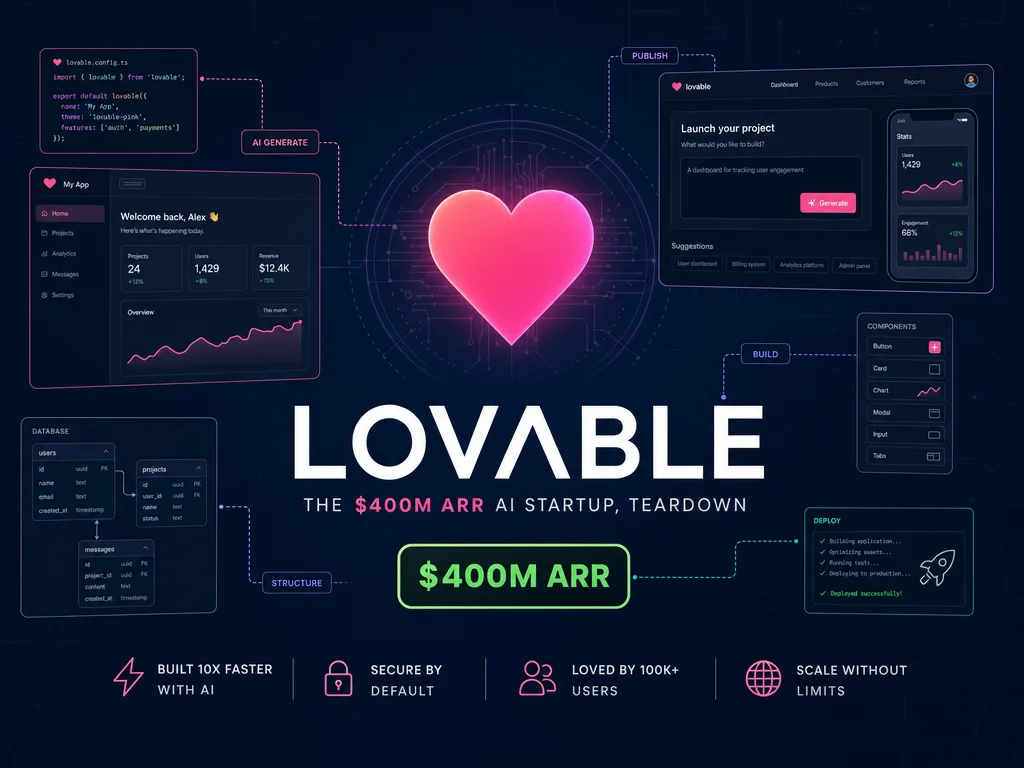
Lovable's growth playbook: $400M ARR in 14 months without a sales team
How Lovable went from a failed open-source experiment to $400M ARR in 14 months — using a non-technical ICP flip, viral shareable outputs, a credit model that scales with LLM usage, and enterprise governance as the retention layer.

Lovable went from a renamed open-source side project to $400M ARR in roughly 14 months, with 146 employees and no traditional outbound sales motion in its early phases. How a Stockholm team did it — and which specific mechanisms drove each dollar of that growth — is the subject of this teardown.
Acquisition: three launches, one that actually worked
Before Lovable was Lovable, it was GPT Engineer — an open-source experiment by Anton Osika that hit 50,000 GitHub stars in 2023 and briefly became the fastest-growing repository on GitHub. The viral moment was real, but the product wasn't 1. Two early attempts at productization stalled: users saw GPT Engineer as a toy, retention collapsed on complex tasks, and per-user compute costs on power users bled money.
The third launch, in November 2024 under the new Lovable brand, hit differently. It finished #1 on Product Hunt and #1 on Hacker News simultaneously and reached $10M ARR in two months with 15 people 2. Three things changed:
1. ICP flip. The team stopped targeting developers and repositioned around non-technical builders — product managers with backlogs, founders who couldn't hire engineers, operators stuck in spreadsheets. The rebrand to "Lovable" encoded this: the name describes how software should feel, not who should build it 3.
2. Founder brand as distribution. Anton Osika had spent years posting raw numbers, failed experiments, and half-formed ideas publicly. When the third launch dropped, people trusted the person before they trusted the product. The 50K GitHub stars transferred as a credibility halo rather than as actual users 4.
3. Product as its own ad. Short video demos of non-technical users building real, working apps in under a minute spread on X and TikTok without paid amplification. Every app someone shipped and shared was an organic proof point. Co-marketing with Supabase, Replicate, and Resend extended that into adjacent developer-adjacent audiences.
The ICP expansion from indie hackers to enterprises came later and through a different lever. By late 2025, Lovable's CEO declared at Web Summit that more than half of Fortune 500 companies were using Lovable to "supercharge creativity" — mostly for rapid prototyping and internal tooling 5. The enterprise sales motion arrived as a consequence of organic adoption by individual employees, not as a standalone top-down channel.
One promotional signal shows how distribution thinking runs through the company's DNA: on International Women's Day 2026, Lovable made the entire platform free for 24 hours, in partnership with Anthropic. Over 500,000 projects were built or updated that single day, versus a typical daily average of around 200,000 5. Free days generate projects; projects generate shares; shares generate subscribers.
Retention: the work lives in Lovable
Lovable's retention mechanics split into two categories depending on user type.
Consumer/prosumer lock-in: project gravity. Every app a user builds on Lovable is hosted on Lovable's infrastructure, connected to Supabase for its database and authentication, and maintained through Lovable's interface. Moving an app off the platform means rebuilding the hosting layer, re-integrating your database, and losing the conversational interface that makes iteration fast. The code is portable — Lovable deliberately exports clean React, TypeScript, and Tailwind that syncs to GitHub — but the workflow is not. The friction isn't technical lock-in, it's operational continuity: a user who's iterated through 40 messages on a project has built a conversational history that doesn't transfer 6.
By December 2025, Lovable reported 25 million+ total projects created in its first year and 100,000 new projects per day 7. A user who has 5 to 10 live projects on the platform doesn't churn — the cost of reconstituting those elsewhere exceeds the monthly subscription cost by a wide margin.
Enterprise lock-in: workflow integration. For larger teams, Lovable's retention mechanism is deeper. The platform integrates with Okta, Azure AD, and Google via SAML/OIDC for SSO. Admin dashboards give IT visibility into every project, user, and code change. Security scanning runs automatically on generated code, dependency trees, database configurations, and RLS policies. Lovable holds ISO 27001:2022 and SOC 2 Type II certifications. When a 2,000-person product and engineering organization (Deutsche Telekom's scale) is running prototyping workflows on the platform, the switching cost isn't one user's credit balance — it's retraining staff, re-establishing governance, and rebuilding an audit trail 6.
The enterprise case studies are specific. A leading ERP platform reduced a four-week, 20-person project to a four-day, four-person sprint, with 75% of their frontend now generated through Lovable. Zendesk compressed the time from idea to working prototype from six weeks to three hours 7. When a company's product management workflow is measured in hours instead of weeks, the tool that enabled that shift doesn't get replaced lightly.
正在加载内容卡片…
The Agent upgrade as a retention mechanism. In July 2025, Lovable launched Lovable Agent as the default experience — a mode where the AI interprets requests, explores the codebase, finds missing pieces, makes changes, fixes errors, and wraps up with a summary, without the user hand-holding each step. The company reported a 91% reduction in errors for complex multi-step tasks 8. The effect on retention is structural: users who got stuck on complex apps and churned pre-Agent now successfully ship them. The ceiling on what non-technical users can build moved up, and so did the ceiling on monthly credit spend.
Monetization: credits as both revenue lever and upsell mechanism
Lovable runs a usage-based credit model layered on top of subscription tiers — a structure that separates Lovable from straight per-seat SaaS pricing and creates several distinct monetization advantages.
The tier structure:
| Plan | Entry price | Credits/month | Notable features |
|---|---|---|---|
| Free | $0 | 5 daily (max 30/month) | Basic access, public projects |
| Pro | $25/month | 100 | Custom domains, code mode, no badge |
| Pro 200 | $50/month | 200 | Same features, higher volume |
| Pro (max) | $2,250/month | 10,000 | High-volume prosumers |
| Business | $50/month | 100 | SSO, restricted projects, opt-out of training |
| Business (max) | $4,300/month | 10,000 | Enterprise-grade governance |
Business plans cost roughly 2× Pro at the same credit tier, with the premium going entirely to governance features: SSO, per-user credit limits, data training opt-out, and restricted project visibility. For a mid-size company, the delta between a $200/month Pro plan and a $400/month Business plan is cheap compliance insurance.
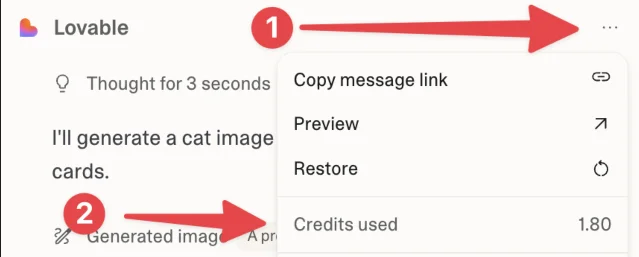
The credit model's expansion mechanics. Credits are consumed per message based on complexity — from 0.50 credits (change a button color) to 2.00+ credits (build a landing page with images). Pro users can buy one-time credit top-ups at $15 per 50 credits; Business users pay $30 per 50. Users who outgrow their tier have a frictionless upgrade path within the same dashboard, with no sales call required. The practical effect: a user who starts building a more ambitious app mid-cycle can add credits in real time without disruption 9.
The implicit expansion motion. Lovable's most structurally interesting monetization pattern is how individual users and teams expand without a formal sales cycle. An engineer or PM discovers Lovable personally, hits the Pro tier, shares built apps internally, and the team adopts Business for its governance controls. The company's Series B investors explicitly highlighted that both enterprises and individual founders use Lovable — two buyer profiles with largely non-overlapping purchasing rationales, served by the same product with a pricing structure that captures both 7.
The revenue velocity. Lovable hit $100M ARR in July 2025 (8 months from its first $1M), $200M in November 2025, $300M in January 2026, and $400M in February 2026 5. At $400M ARR and 146 employees, the revenue-per-employee ratio sits at roughly $2.74M — above Gartner's 2030 prediction for next-generation unicorns of $2M ARR per employee 5.
The Series B round was $330M at a $6.6B valuation, led by CapitalG and Menlo Ventures, with NVentures (NVIDIA), Salesforce Ventures, Databricks Ventures, Atlassian Ventures, and HubSpot Ventures participating alongside Khosla, DST Global, and EQT Growth 7. The strategic investor list reads as a who's-who of enterprise software infrastructure — companies that either sell into Lovable's target buyer or have distribution advantages if Lovable's platform succeeds.

Transferable patterns
The ICP flip is worth examining carefully. Most developer tools start with developers and try to move upmarket. Lovable's third launch succeeded precisely because the team stopped targeting a saturated ICP (developers who could already code) and went after the latent majority who couldn't. This required a rebrand, a full product rearchitect (backend moved from Python to Go, new AI self-debugging layer), and leadership conviction that non-technical users were a bigger market than the open-source community they'd spent years cultivating.
Product virality needs a shareable artifact, not just a good product. Lovable's demos went viral because every output — a working app with a live URL — was a shareable artifact, not a screenshot or a demo video. Users were sharing things that potential users could click, use, and clone. The unit of viral spread was a working product, which carries far more credibility than a demo. Any AI tool aiming for organic acquisition should design for shareable outputs from day one.
Usage-based pricing aligned costs with value delivery in a way per-seat pricing couldn't. A user who builds a simple prototype in five messages pays very little. A user building a complex full-stack app pays more — and gets more done. The credit model means Lovable's unit economics scale with actual LLM usage rather than with headcount, which is how a 146-person team reaches $400M ARR without a large support infrastructure.
Governance features as the enterprise moat. Lovable's enterprise retention isn't about proprietary model quality or data advantage — it's about SSO, SCIM, per-user credit limits, audit logs, and ISO/SOC 2 certification. Non-technical users inside Fortune 500 companies bring Lovable in through the side door, but they stay because IT can govern it. The same logic applies to any bottom-up SaaS targeting enterprise: the individual user is the acquisition channel, but governance is the retention layer.
参考来源
- 1Lovable: two failed launches and what we got wrong about PLG
- 2How Lovable grew to $17M ARR in 3 months
- 3Rebranding: GPT Engineer to Lovable
- 4Lovable's Growth Playbook: 0 to $400M ARR in 14 Months
- 5Lovable says it added $100M in revenue last month alone
- 6What CTOs ask before adopting AI development tools
- 7Lovable raises $330M to power the age of the builder
- 8$100M ARR & Lovable Agent
- 9Plans and credits — Lovable Documentation
围绕这条内容继续补充观点或上下文。