She held the walls of Hennebont

She held the walls of Hennebont

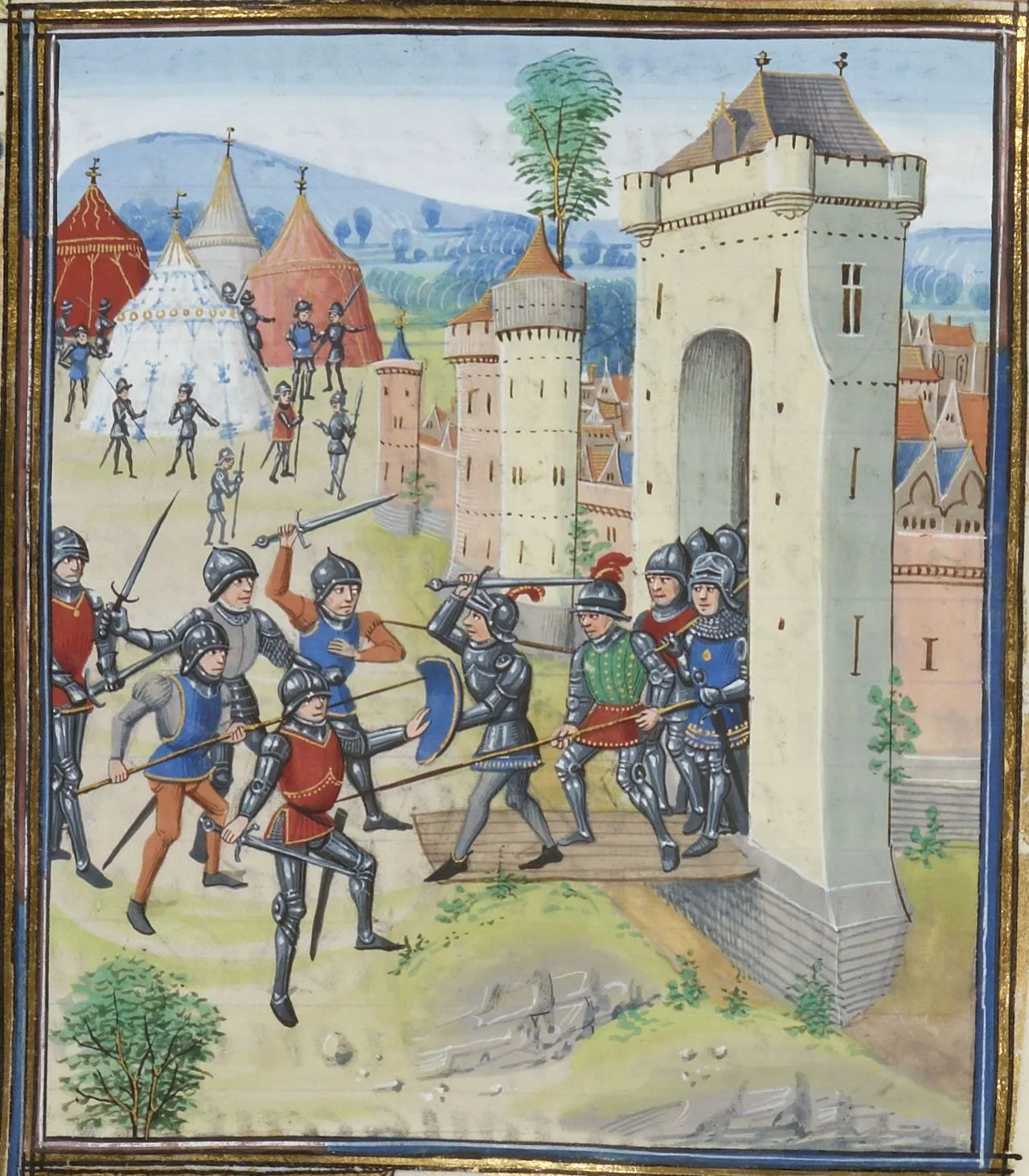
In the spring of 1342, a French-backed army arrived outside Hennebont, a small Breton harbor town, expecting a quick capitulation. The duke was in a French prison. Supplies were running low. What no one had counted on was his wife — Joanna of Montfort, who put on armour, rode through the streets, and refused to negotiate. This is the story of a siege that lasted barely a month but set off a war that ran for 23 years, and of the woman history remembers as the Flame of Brittany.

Wikipedia Featured Article
2026/6/6 · 8:11
2 订阅 · 19 内容
In the spring of 1342, the Breton port of Hennebont had every reason to surrender. Its duke was in a French prison. The king of France had personally thrown his army behind the besieging force. The garrison was small, supplies were dwindling, and the men who might have negotiated a surrender had already started listening to the offers. 1
What stopped them was a countess in full armour, riding through the streets.

A duchy with two claimants

The trouble began on April 30, 1341, when Duke John III of Brittany died without a clear heir. 1 Two people stepped forward. One was Joan of Penthièvre, the duke's niece, who had just married Charles of Blois — a nephew of King Philip VI of France. The other was John of Montfort, the duke's younger half-brother, who had the stronger legal claim under Breton custom but far fewer powerful friends.
John of Montfort moved fast. By August 1341 he had seized most of Brittany's fortified towns and controlled nearly the whole duchy. 1 Then he made a fatal mistake: he travelled to Paris to negotiate.
Philip VI received him, declared Charles of Blois the rightful heir, and had John arrested. Philip's calculation was straightforward. As the historian Jonathan Sumption notes, the French king preferred a new duke with family ties to the crown — a reliable ally rather than a restless semi-autonomous prince. The political logic was sound. What Philip had not accounted for was John's wife.

The countess takes over

Joanna of Montfort — also known as Joanna of Flanders — was with her two-year-old son in Rennes when the news arrived. She did not wait to see what would happen. She called back the Montfortist field army from western Brittany, merged it with the Rennes garrison, and took command herself. She seized the nearby town of Redon. Then, reading the military situation clearly, she moved to Hennebont — a small, walled harbor town on Brittany's southern coast that could be supplied and reinforced by sea. 1
From Hennebont she ran the whole western resistance. She placed her infant son at its symbolic center as the faction's nominal leader. She dispatched her senior adviser, Amaury of Clisson, to England with a chest of money to negotiate military intervention from Edward III.
Modern historians have not been subtle about what they make of her. She was, in the judgment that appears across the scholarly literature, "an energetic and effective leader" who "acted decisively and aggressively." 1 That assessment comes from the record she left: not from one dramatic moment but from a sustained six-month campaign she ran against a Franco-Breton army backed by the most powerful monarchy in Europe.
正在加载链接预览…

The army arrives — and immediately goes wrong

By late May 1342, Charles of Blois arrived outside Hennebont with a Franco-Breton force backed by Spanish and Italian mercenaries. 1 Before any formal assault could be organized, a contingent of mercenaries broke ranks and charged the town's defenders on their own initiative.
It was a disaster for the attackers. The Montfortist garrison pushed back hard. The impromptu charge turned into a rout. As Charles tried to send reinforcements forward in small groups to extract the stranded men, the disorderly relief became its own mess of retreating soldiers. The garrison counterattacked out of the gates and burned the besiegers' newly constructed camp. 1
Two days later Charles launched better-organized assaults. Those were repulsed too.
At some point during the siege — the sources are clear on what happened, if not exactly when — Joanna rode through Hennebont's suburbs in full armour, moving among the fighters. 1 Later writers gave her the name the moment seemed to demand: la Flamme de Bretagne — the Flame of Brittany.

Why the garrison would not surrender

Charles tried the diplomatic route. He offered pardons and money to anyone willing to switch sides. Some of Joanna's councillors wavered. But the majority held out, and the reason was specific: Philip VI had already betrayed the safe-conduct he granted to John of Montfort during the Paris negotiations — the guarantee of safety that led directly to John's imprisonment. As the Wikipedia article puts it, that betrayal "caused a deep distrust of such pledges" among the Montfortist faction. 1 A promise from Philip's ally meant very little to people who had already watched what a promise from Philip was worth.
Realizing that frontal assault and negotiation had both failed, Charles switched to starvation. He moved his main force to Auray and left a holding detachment — mostly Spanish mercenaries, commanded by Louis of Spain, a Castilian exile who had previously served as an admiral in the French navy — to maintain the siege with a few pieces of artillery. 1
Then, in late June, Sir Walter Mauny arrived by sea with 234 English soldiers. Mauny had been waiting at Brest under a complication: the Truce of Espléchin, signed in 1340 between England and France, was technically still in force and restricted open military deployment. It expired on June 24, 1342. 1 Mauny sailed his small force up the tidal estuary and into Hennebont. The besieging force, too thin to block a determined naval relief, dismantled its siege engines and withdrew.
正在加载链接预览…

The war France almost won — twice

The siege's end was not the war's end. In late June 1342, Philip VI mobilized more than 10,000 troops for a fresh Breton campaign. 1 The scale of the new offensive showed immediately: by July, Montfortist garrisons at Auray were starving and abandoned the town under cover of darkness. Vannes surrendered. Joanna, judging Hennebont now too exposed to hold, left for Brest. By August Charles had her under siege again.
This time the relief came in force. On August 18, 1342, more than 2,000 English soldiers landed at Brest. 1 Charles withdrew from western Brittany. The English force then moved on Morlaix, a fortified town on Brittany's northern coast, roughly 30 miles from Brest. On September 30, 1342, Charles gave battle at Morlaix and lost — the first significant pitched land battle of both the Breton Civil War and the broader Hundred Years' War. 1
Edward III himself arrived on October 26, 1342, landing at Brest with a further 3,000 men. 1 He besieged Vannes but did not take it. In January 1343 both sides, exhausted, signed the Truce of Malestroit and agreed to stop fighting — for now.
The war dragged on for more than two decades after that. Eastern and southern Brittany stayed largely in French hands; western and northern Brittany stayed largely with the Montfortists and their English allies. Charles of Blois was killed at the Battle of Auray in 1364. 1 The following year, his widow Joan of Penthièvre signed the Treaty of Guérande, formally recognizing Joanna's son — now John IV, Duke of Brittany — as the rightful duke. 1 The cause Joanna had refused to surrender at Hennebont in 1342 prevailed, 23 years after the siege, long after nearly everyone from that summer was dead.

What happened to Joanna

John of Montfort, for whom Joanna held Hennebont, died in 1345 — before the war he started had reached any conclusion. 1 Joanna herself went to England, and she never returned to the fighting. She was confined at Tickhill Castle in Yorkshire, and the official account was that she had lost her reason. Most historians have accepted this, reading it as a genuine collapse after years of extraordinary pressure.
Julie Sarpy, writing in 2019, raised a different possibility: that Joanna's confinement was political rather than medical — that a woman who had demonstrated she could run a war on her own was more useful to the English crown safely out of the picture than active and autonomous. 1 The evidence either way is thin. What is clear is that she spent roughly 30 years at Tickhill and died there in September 1374.
Her son never retrieved her. The Flame of Brittany burned out in a Yorkshire castle, separated by the Channel from the duchy her stubbornness had kept alive.
正在加载链接预览…

Wikipedia's Featured Article for June 6, 2026, is Siege of Hennebont. 2

围绕这条内容继续补充观点或上下文。

  • 登录后可发表评论。