
June 7 in Business History: When Architecture Beats Product
Four decisions landed on June 7 across 64 years. Berry Gordy turned an $800 family loan into a vertically integrated hit factory — then sold it for $61 million the year before it fetched $330 million. Sony launched Betamax, the technically superior format that lost to VHS's open-licensing strategy. Google paid $2.6 billion for Looker as Thomas Kurian's opening move in the cloud wars. Oracle closed its $28.3 billion Cerner acquisition — and spent four years watching market share drain to Epic.

Four events across 64 years landed on June 7. One was a music label built on an $800 family loan. One was a consumer electronics format widely considered technically superior. One was the largest acquisition in Oracle's history. One was the opening move in a cloud-market battle that cost $2.6 billion and took seven years to judge. In each case, the technical or financial terms of the deal were less decisive than the structural choices made around it — who controlled the ecosystem, how talent was treated after the check cleared, and whether the acquirer understood the market they were buying into.
1959: Berry Gordy turns $800 into a hit factory
The founding date of Tamla Records — the original label that became Motown — appears in different sources as either June 7, 1958 or January 12, 1959. 1 2 The Detroit Historical Society and Motown Museum cite January 12, 1959 as the operational start; some historical calendars list June 7, 1958. The exact date is less important than the founding math: Berry Gordy Jr., a 29-year-old former Lincoln-Mercury assembly-line worker and songwriter, borrowed $800 from his family's Ber-Berry Co-op savings fund at 6% interest with a one-year repayment term. 3
Gordy had already tried a jazz record store (it failed) and worked as an independent producer leasing recordings to End Records and United Artists. The fundamental economics bothered him: the royalties from writing Jackie Wilson hits like "Reet Petite" were small, because he didn't own the masters. Smokey Robinson told him the obvious: start your own label. 1
What Gordy built from that $800 was not just a record company. He applied Ford's assembly-line logic to music production: 3 dedicated songwriting teams (Holland-Dozier-Holland, Smokey Robinson, Norman Whitfield), a studio house band called the Funk Brothers, weekly "Quality Control" meetings every Friday where producers played new recordings and the group voted on what to release, and an Artist Personal Development Department that trained raw talent in etiquette, choreography, and vocal delivery. An unknown could walk in and come out a polished performer. 4

In mid-1959, Gordy bought a two-family flat at 2648 West Grand Boulevard for around $25,000, nailed up a sign reading "Hitsville U.S.A.," lived on the second floor, and recorded on the ground floor. 4 Within seven years, the operation expanded to occupy seven additional neighboring houses, employed over 450 people, and posted gross revenue of $20 million in 1966. 1 From 1961 to 1971, Motown produced 110 Top 10 hits on the Billboard charts. 4
The vertical integration was the real asset. Gordy owned the recording studio (Hitsville), the publishing rights through Jobete Music (established June 1959, named after his three eldest children), artist management through ITMI, and later film and television production through Motown Productions. 1 Value was captured at every stage rather than leaking out to distributors and publishers.
The cracks appeared when that tight control collided with artists demanding autonomy. Holland-Dozier-Holland — the songwriting trio responsible for 10 of the Supremes' 12 number-one singles — left Motown in 1967 over a royalty dispute and sued. 1 Gordy announced the company's full relocation to Los Angeles on June 14, 1972, primarily to enter film and television. John McClain, an A&M Records executive, later said of the move: "Something happened when [Motown] left Detroit and came to [Los Angeles]. They quit being innovators and started following trends." 1
Gordy sold Motown to MCA Inc. and Boston Ventures for $61 million on June 28, 1988, retaining the Jobete publishing arm. 5 Five years later, PolyGram acquired Motown from MCA and Boston Ventures for over $330 million — more than five times what Gordy had sold it for. 1 Gordy's estimated net worth as of 2024 is approximately $400 million. 6
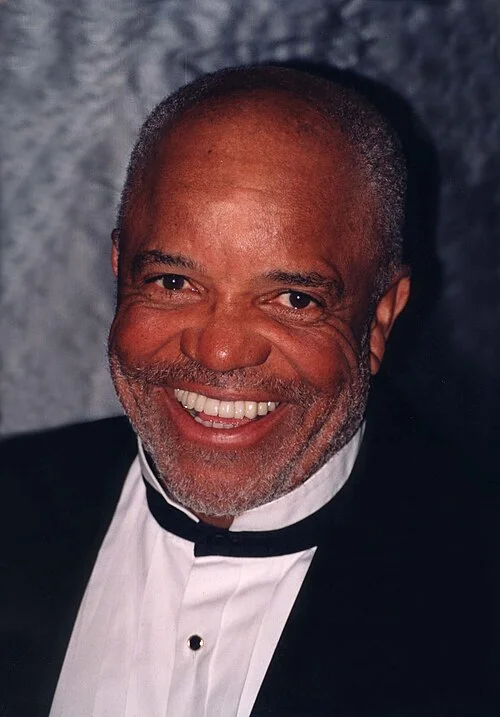
Mirror: The Motown story contains two distinct lessons that pull in opposite directions. The first is that vertical integration — controlling recording, publishing, management, and development — created compounding margins and competitive barriers that a label with only one of those functions could never build on $800. The second is that the same tight control that built the company eventually drove away the creative talent responsible for its output. The practical question for today's founders and operators: at what stage does the integration model start extracting more from your best contributors than it returns? Holland-Dozier-Holland's departure marked that inflection point. It came after the first wave of scale but before the company could internalize what had made the scale possible.
1975: Sony launches Betamax — technically superior, strategically outmaneuvered
Sony released the world's first consumer home video cassette recorder to the Japanese market on May 10, 1975, with June 7, 1975 widely recorded as the broader Betamax launch date. 7 8 The first product for American consumers was the LV-1901, an integrated unit combining a 19-inch Sony Trinitron color television with a Betamax VCR in a teakwood cabinet, priced at $2,495 — roughly $12,000 in 2025 dollars. 9
Betamax's technical specifications were genuinely better than what JVC would later ship in VHS: 250 lines of horizontal resolution versus VHS's 240, superior audio fidelity, and a more compact cassette. 7 The problem was recording time. The initial Betamax tape (L-500, running at βI speed) recorded 60 minutes — not enough to capture a feature film or a football game. Recording The Godfather required nine tapes. 9 JVC's VHS, launched in Japan in September 1976 and at the Chicago Consumer Electronics Show on June 4, 1977, recorded two hours from day one. 10
Sony's attempted fix compounded the problem. The 1977 βII half-speed mode doubled recording time to two hours — but reduced resolution from 250 lines to 240, erasing Betamax's picture-quality advantage over VHS and leaving consumers with no reason to pay more for it. 7
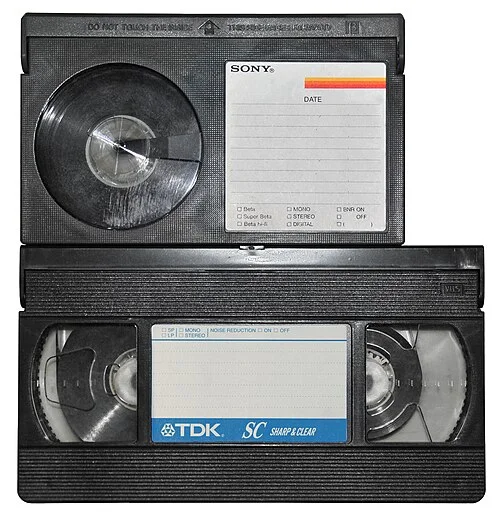
The licensing strategy was the other deciding factor. JVC opened VHS to Sharp, RCA, Magnavox, Zenith, Panasonic, Hitachi, Mitsubishi, and others. By 1984, 40 companies manufactured VHS equipment. Betamax had 12. 7 11 The network effect compounded from there: more manufacturers meant lower prices; lower prices meant more households; more households meant more content distributors stocking VHS; more VHS content meant fewer reasons to buy Betamax.
The market share timeline is unambiguous. Betamax held 58% of the VCR market between 1975 and 1977. 11 By 1978, VHS had overtaken it. By 1980, VHS controlled 60% of North America. By 1987, VHS accounted for more than 90% of the $5.25 billion U.S. VCR market. 12 Sony tacitly admitted defeat in 1988 when it added VHS models to its lineup, with early units manufactured by Hitachi. 7 Sony discontinued Betamax hardware production in August 2002 and stopped shipping Betamax tapes in March 2016, ending 41 years of commercial life. 13
Betamax was not without legacy. The Betacam format, derived from Betamax hardware in 1982, became the broadcast television industry standard for electronic news gathering (ENG) and persisted for decades in professional production. 7 Sony also applied the lesson selectively: when Blu-ray competed with Toshiba's HD-DVD in the mid-2000s, Sony built a broad industry consortium including Panasonic, Philips, Samsung, Dell, and Apple, and won. 14
Mirror: Betamax is the canonical case for why superior product specifications do not determine platform outcomes. Two variables that Betamax controlled — recording duration and licensing openness — mattered more to consumers than picture quality. Recording time was fixable but Sony's fix degraded the one advantage it held. Licensing openness was a strategic choice to protect margins that instead built VHS's scale moat. The Blu-ray correction shows Sony internalized the lesson, but only after losing an entire market. For anyone today deciding how widely to license a platform, open a standard, or share API access: the short-term margin calculation and the long-term ecosystem calculation run in opposite directions, and the ecosystem almost always wins.
2019: Google acquires Looker — the $2.6B bet on data infrastructure
On June 6, 2019 — the announcement was broadly reported through June 7 — Google announced it would acquire Looker Data Sciences for $2.6 billion in cash. 15 16 This was Thomas Kurian's first major move after joining as Google Cloud CEO in November 2018, and — until then — Alphabet's largest deal since the $3.2 billion Nest acquisition in 2014.
Looker was founded in 2012 in Santa Cruz, California by Lloyd Tabb and Ben Porterfield. Its core product was LookML, a proprietary semantic modeling language that let data teams define business metrics (revenue, active customers, churn) consistently at the database layer, so every team's query returned the same answer. 17 At acquisition, Looker had roughly 1,600 enterprise customers, annual recurring revenue above $100 million, 70% year-over-year growth, and had raised $280 million at a $1.6 billion valuation. 16 18
The competitive context was stark: Google Cloud held approximately 7.6% of the global cloud infrastructure market in late 2018, far behind AWS (32%) and Microsoft Azure (13.7%). 19 AWS had QuickSight. Azure had Power BI. Google had nothing comparable in business intelligence. Kurian acknowledged the need directly at a Goldman Sachs conference in February 2019: "You will see us accelerate the growth even faster than we have to date." 19
The acquisition announcement coincided with a week of BI market consolidation. Three days later, on June 10, Salesforce announced it would acquire Tableau for $15.7 billion in an all-stock deal — six times the Looker price, reflecting Tableau's 86,000 customers versus Looker's 1,600. 20 On the day of the Looker announcement, Tableau's stock fell more than 3%. 21
Kurian's stated strategy was multi-cloud: Looker would continue supporting Amazon Redshift, Azure SQL, Snowflake, Oracle, and Teradata alongside BigQuery. "Customers will continue to benefit from Looker's multi-cloud functionality," the acquisition announcement read. 15 The UK Competition and Markets Authority opened a review in December 2019 and cleared the deal in February 2020, finding no likely harm to competition given the number of other BI vendors in the market. 22 The acquisition formally closed on February 13, 2020.
The integration record was mixed. Looker CEO Frank Bien left Google Cloud quietly in February 2022, less than two years after close. 23 Weeks later, Google cut "dozens" of Looker support staff, with affected employees later reporting they had unknowingly trained their replacements. 23 In October 2022, Google unified its entire BI product line under the Looker brand, renaming Google Data Studio as Looker Studio. 24 By April 2026 — three and a half years later — Google reversed course, renaming Looker Studio back to Data Studio, acknowledging that the two products "serve fundamentally different use cases" and that sharing a brand name had created market confusion. 25
Google Cloud itself, however, grew decisively. Annual revenue rose from approximately $8.9 billion at the time of the acquisition announcement to a $20 billion quarterly run rate by Q1 2026. 26 27 Cloud now represents roughly 18% of Alphabet's total revenue. Looker's precise contribution to that trajectory is not broken out separately in Alphabet's financial disclosures.
Mirror: The Looker acquisition shows how the strategic logic of a deal and the execution experience of an acquisition can diverge entirely. The strategic logic held: Google needed enterprise BI credibility and enterprise customer relationships to compete for cloud contracts, and Looker delivered both. Google Cloud's growth from 2019 to 2026 is real. The execution problem — founder departure, support team cuts, a brand consolidation experiment that lasted three years before being reversed — illustrates a pattern common in large-platform acquisitions of smaller, culture-dependent companies: the purchasing entity optimizes for integration velocity while the acquired company's value was embedded in the team and product autonomy being integrated away. The brand reversal from Looker Studio back to Data Studio is a concrete marker of a decision made at scale under time pressure that required undoing at scale later.
2022: Oracle closes its Cerner acquisition — and four years of difficulty begin
Oracle's $28.3 billion all-cash acquisition of Cerner Corporation — Oracle's largest deal in its history — formally reached tender offer threshold on June 7, 2022, with full closing on June 8. 28 29 The deal had been announced December 20, 2021, at $95.00 per Cerner share, with Larry Ellison framing it as the foundation of a national health data platform and voice-enabled electronic health record (EHR) system. 30
Cerner was then the second-largest EHR vendor in the United States, with approximately $5.5 billion in annual revenue and 28,000 employees. Safra Catz, Oracle's CEO, positioned the deal explicitly as a growth engine: "Healthcare is the largest and most important vertical market in the world — $3.8 trillion last year in the United States alone." 30 Oracle financed the acquisition through a $15.7 billion bridge loan, later refinancing with a $7 billion bond offering in November 2022 and a $5.7 billion term loan; Fitch downgraded Oracle's credit rating from BBB+ to BBB as a result. 31
The four years since have not matched the thesis. By May 2023 — within a year of close — Oracle had cut more than 3,000 of Cerner's 28,000 employees, frozen raises and promotions, and sidelined Cerner's CEO David Feinberg into a ceremonial role before he departed in September 2022. 32 Former Cerner executives described morale as "terrible." Oracle sold multiple Cerner office buildings in Kansas City, consolidating staff into a single campus. 32
Oracle Health (the renamed Cerner operation) lost ground to Epic Systems — the dominant U.S. EHR provider, based in Verona, Wisconsin — in every subsequent KLAS Research (a healthcare IT market research firm) market report. Oracle Health's acute-care EHR market share declined from approximately 25% in 2020 to 21.9% in 2025 — a third consecutive year of the largest net customer losses in any vendor. 33 In 2025, Oracle Health lost 56 hospitals and 14,676 beds; all but three went to Epic. 34 Epic's acute-care share rose from 42.3% to 43.7%, gaining 77 hospitals. KLAS analysts noted: "Amid the repeated layoffs, restructures, and focus shifts that have occurred since Cerner was acquired by Oracle, customer satisfaction with the Millennium platform has continued to decline." 33
The VA EHR project — a $10 billion contract awarded to Cerner in 2018 and inherited by Oracle — had by 2026 seen cost estimates expand to a range of $16.1 billion to $50 billion. 35 The VA suspended all new deployments in April 2023 due to patient safety concerns, with a GAO report finding 58% of VA employees believed the new system increased patient safety risk. 35 Rollout at four Michigan sites resumed in April 2026, ending a three-year pause; only 10 of a planned 170 sites are operational. 35
Revenue has been flat. Cerner contributed approximately $5.9 billion to Oracle's FY2023 results, representing roughly 10% of Oracle's total revenue. 36 HFS Research estimated Oracle Health's revenue at approximately $5.3 billion by FY2024 — essentially flat with pre-acquisition levels and with no sign of the growth engine Catz promised. 37 In March 2026, Oracle's global restructuring cut approximately 30,000 employees (18% of its 162,000 workforce), with the Revenue and Health Sciences division — the former Cerner operation — taking approximately 30% reductions, removing an estimated 12,000 Cerner-trained specialists from the market. 38 Five integration executives Oracle had brought in to fix Cerner departed, including the senior VP of Clinical and Healthcare AI and the EVP of Health. HFS Research concluded in January 2025: "Cerner is finished in the US market. There is really no coming back." 37
Mirror: The Oracle/Cerner outcome offers two distinct lessons on deal failure, and it is worth distinguishing them rather than bundling everything under "execution." The first is structural: healthcare IT is a relationship-intensive, heavily regulated market where customer loyalty is built over years of implementation work and clinical staff training. Oracle's post-close cuts removed exactly those relationship-carrying professionals — the Cerner specialists who knew how each hospital's system was configured — in the name of integration efficiency. Customers noticed. Replacing domain expertise with platform consolidation is the classic misjudgment of a technology company acquiring in a market where the product is only 30% of what clients are actually buying. The second lesson is financial: a $28.3 billion deal financed through debt, with an immediate credit downgrade, sets a performance requirement that a maturing EHR market with flat total addressable size cannot realistically deliver. Before closing any large acquisition in a regulated, low-growth vertical, the question is not whether the product can be improved — it can always be improved — but whether the market structure will allow the financial thesis to clear.
Cover image: AI-generated editorial illustration.
参考来源
- 1Wikipedia: Motown
- 2On This Day: June 7
- 3Motown Museum: Berry Gordy
- 4Detroit Historical Society: Motown Records
- 5Los Angeles Times: Berry Gordy Sells Motown Records
- 6Wikipedia: Berry Gordy
- 7Wikipedia: Betamax
- 8EDN: Betamax is born, June 7, 1975
- 9National Science and Media Museum: First Betamax Home Television Recording Technology
- 10WIRED: June 4, 1977: VHS Comes to America
- 11Wikipedia: Videotape format war
- 12The Conversation: The end of Sony's Betamax video tape
- 13BBC News: Sony says goodbye to Betamax tapes
- 14Museum of Failure: Sony Betamax
- 15Google Cloud: Google to Acquire Looker
- 16TechCrunch: Google to acquire analytics startup Looker
- 17Wikipedia: Looker (company)
- 18Forbes: 4 Reasons Google Bought Looker
- 19CNBC: Google buys cloud company Looker
- 20Salesforce: Signs Definitive Agreement to Acquire Tableau
- 21GeekWire: Google acquires Looker
- 22SiliconANGLE: Google's $2.6B Looker acquisition closes
- 23Business Insider: The CEO of Looker quietly left the company
- 24Google Cloud: Introducing the next evolution of Looker
- 25Google Cloud: Data Studio returns
- 26Fortune: Google Cloud is almost one-fifth of Alphabet's business
- 27Constellation Research: Google Cloud revenue growth hits 63% in Q1 to $20 billion
- 28Oracle Corporation: Oracle Completes Acquisition of Cerner
- 29Fierce Healthcare: Oracle closes $28B deal to buy EHR giant Cerner
- 30Oracle Corporation: Oracle Buys Cerner
- 31Bloomberg via Yahoo Finance: Oracle Sells $7 Billion of Debt
- 32Business Insider: Insiders say Oracle is crushing morale at Cerner
- 33Healthcare Dive: Oracle Health's market share declined substantially
- 34Fierce Healthcare: Epic grows EHR footprint
- 35Federal News Network: VA EHR rollout resumes after three-year pause
- 36Becker's Hospital Review: Cerner brings in $1.5B in revenue for Oracle
- 37HFS Research: Oracle must stop kicking the Cerner can down the road
- 38KORE1: Oracle Health Layoffs 2026
围绕这条内容继续补充观点或上下文。