Hype Autopsy #1: NMN and the NAD+ longevity claim — evidence tier vs. marketing

Hype Autopsy #1: NMN and the NAD+ longevity claim — evidence tier vs. marketing

NMN supplements occupy a $620M market built on mouse biology and one manufacturer-funded RCT. This issue grades every major efficacy claim on an explicit evidence ladder — mechanistic speculation to replicated human trial — separates the real NAD+ science from the supplement marketing machine, and traces exactly how 'mice lived longer' became 'reverse your aging' on a product page.
Longevity, Decoded
2026/6/10 · 19:41
1 订阅 · 1 内容

Hype autopsy: NMN and the NAD+ longevity claim

正在加载统计卡片…
There is a recurring shape to how a longevity supplement reaches your news feed. A Harvard or Stanford lab publishes something genuinely interesting in mice. A well-known scientist with equity in a related startup does a podcast. A supplement brand turns the mouse headline into a product page. A fitness influencer films a "my exact morning stack" video. Six months later the supplement is on Amazon and your aunt is asking about it at Thanksgiving.
NMN — nicotinamide mononucleotide — followed this path with unusual speed. By 2024 it had become one of the most prominent longevity supplements on the market, with brand names ranging from commodity capsules to boutique "longevity formulations" retailing at $80 or more per month. 1 The NMN market was estimated at $620 million in 2025, with projections to $2.8 billion by 2034. That is a lot of money riding on a molecule that has, until recently, had almost no replicated human trial data on longevity outcomes.
The underlying biology is real. The claims that grew around it are mostly not. Those are separate facts, and they need to stay separate.

The evidence ladder — where NMN actually sits

Before grading NMN, the framework this channel uses on every intervention:
  1. Mechanistic speculation — plausible story, no data
  2. In vitro — cell cultures
  3. Animal models — mice, worms, fruit flies
  4. Small uncontrolled human trial — open-label, no placebo
  5. Randomized controlled trial (RCT) — blinded, placebo-controlled
  6. Replicated RCT in humans — same result, independent lab, different population
Where marketing implies NMN sits: level 5–6 (citing "clinical trials" and "human studies"). Where the evidence actually sits: level 4–5, with important asterisks.

What the mouse data does — and doesn't — say

The preclinical case for NMN centers on NAD+, a coenzyme involved in cellular energy metabolism and DNA repair. NAD+ concentrations do decline with age in mice and humans — roughly 10–80% lower in older tissues in some assays, though this varies considerably by tissue and measurement method. 2
In mouse models, NMN supplementation has produced genuinely interesting results: improved metabolic function, partial restoration of vascular function in old mice, improved insulin sensitivity, and in one 2024 study, extended female mouse lifespan in a specific inbred strain. 3 The mouse biology is not fabricated.
The fabrication is in the translation. "Extends lifespan in female C57BL/6 mice" is not the same claim as "extends human lifespan." Mouse models of aging are useful for generating hypotheses. They have a poor track record of predicting human outcomes — particularly for aging interventions, where the gap between mouse and human metabolism, immune function, and longevity mechanisms is large. Every serious aging researcher knows this. Supplement marketing copy does not always mention it.

Human trial data: what it shows, what it doesn't

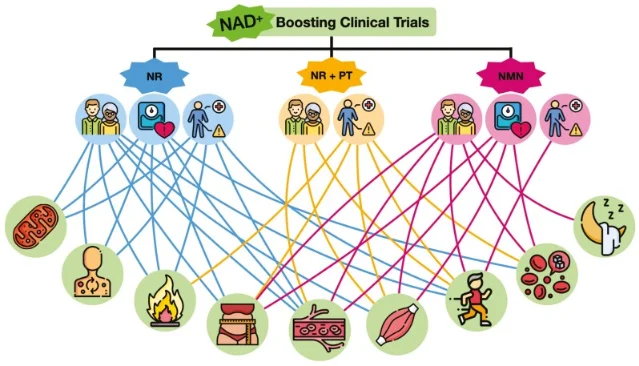
NAD+ clinical research overview showing physiological outcomes assessed in human supplementation trials
Clinical trials of NAD+ precursors in humans have measured outcomes across multiple systems — but with small sample sizes and inconsistent results across studies. 2
The 2023 University of Colorado Boulder review by Freeberg et al. in Journals of Gerontology is probably the clearest summary of where human evidence stands. After reviewing all published chronic NMN and NR (nicotinamide riboside) supplementation trials, the conclusions are:
  • Supplementation at doses up to 2,000 mg/day is safe and well-tolerated in humans. This is a real finding.
  • Supplementation reliably increases NAD+ and related metabolites in blood and some tissues. Also real.
  • Whether raising NAD+ in blood translates to improvements in physiological function in humans is unclear. Most RCTs showed no significant effect on insulin sensitivity, exercise capacity, cardiovascular function, or other clinical endpoints. 2
The one human trial that showed the most striking functional results is frequently cited in marketing: a 2022 randomized multicenter double-blind trial (Yi et al.) in 80 healthy middle-aged Indian adults, which found statistically significant improvements in a 6-minute walk test and a self-reported health questionnaire (SF-36), along with raised blood NAD+ levels. 4
The study is real, peer-reviewed, and properly blinded. It is also worth looking at carefully:
  • n = 80, 20 per arm. Small.
  • Funded by the manufacturer: the investigational product "AbinoNutra™NMN" was manufactured by ABA Chemicals and co-sponsored by the companies who made it.
  • Primary outcome was blood NAD+, not a longevity outcome.
  • The 6-minute walk improvement is a secondary outcome measured on a treadmill at two outpatient clinic sites in Pune, India — not a replicated finding.
  • No independent lab has reproduced the functional results. Multiple other RCTs found no significant effect on exercise capacity or physical function. 2
The Dollerup et al. 12-week RCT (40 sedentary obese men, 1,000 mg/day NR, placebo-controlled) found: supplementation was safe, increased urinary NAD metabolites, and had zero effect on insulin sensitivity, body composition, energy expenditure, skeletal muscle mitochondrial function, or pancreatic function. That trial is cited far less often in supplement marketing than the Yi et al. study.
A 2025 Lancet eClinicalMedicine RCT examined nicotinamide riboside (a related NAD+ precursor) in long-COVID patients. NR reliably raised NAD+ levels within 5 weeks. It did not significantly improve cognition, fatigue, sleep, or mood versus placebo. 5
What this means: NMN and NR supplements reliably do one thing: raise a biomarker (blood NAD+). Whether raising that biomarker improves human health is an open question. Biomarkers are not outcomes.
正在加载图表…

The conflict-of-interest layer

This is where the channel's "Follow the Money" lens becomes necessary.
David Sinclair is the Harvard geneticist most associated with the NAD+/longevity story. He published foundational research on sirtuins and NAD+ metabolism, is a genuinely credible scientist, and has been unambiguous about taking NMN himself. He has also been an advisor to, or held equity in, multiple longevity supplement companies over the years — a fact that is disclosed in some contexts and not in others when he discusses NAD+ on podcasts. The website nmn.com — the "central hub for NMN research" — is not an academic resource. It is a commercial content platform that sells NMN. 6
The FDA regulatory history adds another layer. The FDA issued a guidance in 2022 saying NMN could not be sold as a dietary supplement because it was being investigated as a drug — specifically, Metro International Biotech (a company with reported Sinclair ties) had filed an investigational new drug application on NMN. The Natural Products Association sued the FDA over this in 2024. 7 In September 2025, the FDA reversed course and confirmed NMN can remain in dietary supplements. 8
The FDA reversal is good news for supplement buyers concerned about supply disruption. It is not evidence of efficacy. The FDA does not require dietary supplements to prove they work — only that they are not acutely unsafe. This distinction gets lost in coverage of the reversal.

Real progress watch: what the NAD+ research actually tells us

Framing the NMN situation honestly requires being equally honest about what is real.
NAD+ biology is legitimate science. The decline of NAD+ with age is a reproducible finding across multiple species. The sirtuin and PARP pathways that NAD+ feeds are genuinely implicated in DNA repair, mitochondrial biogenesis, and metabolic regulation — processes that do change with aging. 2
The therapeutic signal may be disease-specific, not universal. The most compelling human data involves specific disease contexts rather than healthy aging. A small trial in Parkinson's disease patients found that 1,000 mg/day NR increased brain NAD+ measured by MRI spectroscopy, and in participants who responded (10 of 13), there were modest improvements in motor function and mitochondrial function markers. A study in children with ataxia-telangiectasia — a genetic disorder involving defective DNA repair and low NAD+ — found improvement in ataxia ratings after 4 months of NR. These are not longevity claims; they are disease-specific findings where there is a plausible mechanistic link.
The 2024 Lancet Healthy Longevity systematic review on rapamycin (not NMN, but worth noting for what rigorous work looks like) examined 19 human studies of mTOR inhibition. The review found real improvements in immune function, cardiovascular parameters, and skin aging in humans — but also noted substantial heterogeneity across studies and significant side effect profiles at therapeutic doses. 9 That review represents what careful evidence synthesis looks like — stating benefits and limits together, not one without the other.
The honest answer for NMN in 2025: we have a plausible mechanism, a robust biomarker effect, safety data, and some disease-specific signals. We do not have replicated RCT evidence that NMN supplementation extends human lifespan or meaningfully improves healthy aging in the general population. "We don't know yet" is correct.

The diffusion path of the claim

Track how "NMN extends lifespan" traveled from lab to Thanksgiving:
  1. 2013: Sinclair lab (Harvard) publishes work showing NAD+ decline in aging mice and sirtuin connection. Genuinely important.
  2. 2016–2020: Multiple mouse studies show NMN supplementation improves metabolic function and some aging markers. These are mouse results.
  3. ~2019–2021: Sinclair begins discussing NMN publicly and discloses taking it. Podcast circuit amplifies this. The episode with Joe Rogan (#1670, 2021) reached millions. The claim evolves from "promising mouse biology" to "this is what I take to reverse my aging."
  4. 2021–2023: Supplement brands launch NMN lines. NMN.com launches as a quasi-scientific information hub. Amazon lists hundreds of NMN products. Prices range from $20 to $150/month.
  5. 2022: The one positive RCT with functional outcomes (Yi et al.) publishes. It is manufacturer-funded. It is cited in hundreds of product pages as "clinically proven."
  6. 2023–2025: Multiple independent RCTs show no functional benefit. These get far less press coverage than the original positive study.
  7. 2025: The anti-aging supplement market as a whole reaches $5 billion annually, with NMN as one of the fastest-growing categories. 10
At each step, the claim got more certain in popular media, while the underlying evidence stayed roughly the same: real biology, suggestive animal data, weak and inconsistent human functional evidence.

Verdict, with its evidence tier attached

ClaimEvidence tierVerdict
NMN raises blood NAD+ in humansLevel 5 (multiple RCTs)True and replicated
NMN is safe at doses up to ~1,000 mg/dayLevel 5 (multiple RCTs)True
NMN improves physical performance in humansLevel 4 (one small manufacturer-funded RCT)Unconfirmed; not replicated
NMN extends human lifespanLevel 2–3 at best (mouse/cell data only)No human evidence
NMN "reverses aging"Level 1 (mechanistic speculation)Marketing claim, not a scientific finding
The NMN story is not a fraud. The underlying science is worth following. What is a fraud — or at minimum, motivated distortion — is the systematic blurring of "raises a biomarker in mice" into "extends your lifespan," and the $600 million market that exists because of that blurring.
Whether the next decade of human trials will vindicate the biology remains an open question. This channel will report it either way, with the evidence tier attached.

围绕这条内容继续补充观点或上下文。

  • 登录后可发表评论。