5 new species named May 24: five South China Sea flatworms — including a brand-new genus — from a single integrative-taxonomy paper
Sunday, May 24, 2026 yielded exactly 5 new species — all marine polyclad flatworms registered in WoRMS at 16:10 UTC in one batch — from a single paper by Liu Heng-Lei and six colleagues: Discocelis foulingum, Neoplanocera sinica, Latocestus rubidus, Neolatocestus salsus (with its new genus Neolatocestus gen. nov.), and Notoplana hamata, all from the South China Sea intertidal zone, spanning four families of the suborder Acotylea.

研究速览
Sunday, May 24, 2026 delivered 5 confirmed new species and 1 new genus, all marine flatworms registered in WoRMS at 16:10 UTC in a single batch. 1 Every one of the five comes from the same paper: Liu Heng-Lei and six colleagues at institutions across China, publishing in Contributions to Zoology 95(2): 149–196, DOI 10.1163/18759866-bja10096. The journal publishers who normally drive weekday counts — Zootaxa, ZooKeys, MycoKeys, Phytotaxa, and the Pensoft family — published nothing new on Sunday, a predictable weekly gap. What the day lacked in breadth it makes up in coherence: five species across four families, one brand-new genus, all from the intertidal fringe of the South China Sea.
What polyclad flatworms actually are
Polycladida (from Greek polys, "many" + klados, "branch") is an order of free-living marine flatworms in the phylum Platyhelminthes (flatworms). They are not the parasitic tapeworms or flukes most people associate with the phylum — polyclads are entirely free-living, typically predatory, and in many cases strikingly colorful. A polyclad can be as small as 2 mm or as large as 15 cm; the body is a flat, leaf-shaped or oval sheet of tissue that glides across surfaces on a carpet of beating cilia, leaving a mucous trail.
The order divides into two suborders: Cotylea, which have a distinctive adhesive sucker on the ventral surface, and Acotylea, which lack it. All five species described by Liu et al. belong to Acotylea, the suborder that dominates intertidal and shallow subtidal habitats worldwide.
What makes polyclads anatomically unusual is their gut. Rather than a simple tube, the intestine branches repeatedly throughout the body — that branching pattern is the basis of the order's name. These branches bring digestion products close to every cell in the flat body without requiring a circulatory system to ferry nutrients around. The same flat geometry means gas exchange happens by diffusion across the entire body surface; polyclads have no gills and no lungs.
Polyclads are simultaneous hermaphrodites — each individual carries both male and female reproductive organs simultaneously. Many species perform hypodermic insemination: sperm are injected directly through the body wall, bypassing the reproductive openings entirely. Some cotylean species brood their eggs; most acotylea release them freely.
Species richness in context: Polycladida currently contains roughly 900 described species spread across approximately 30 families — a number taxonomists widely regard as a major undercount. The phylum Platyhelminthes as a whole numbers around 30,000 described species, but the vast majority are the parasitic tapeworms (Cestoda) and flukes (Trematoda); free-living flatworms, Polycladida included, are far less studied relative to their probable actual diversity. The South China Sea intertidal, widely regarded as one of the most species-rich coastal biomes on Earth, has received only sporadic systematic attention for turbellarian worms.
The four families represented in today's batch — Latocestidae, Notoplanidae, Planoceridae, and Discocelidae — all belong to Acotylea. Latocestidae and Planoceridae fall within the superfamily Stylochoidea; Notoplanidae sits in the superfamily Leptoplanoidea; Discocelidae belongs to its own superfamily, Discoceloidea. They are not a single clade within Acotylea — they represent multiple independent evolutionary lines that share the same general flat-worm body plan but differ in reproductive anatomy, gut architecture, and preferred microhabitat.
The five new species
Discocelis foulingum Liu, 2026
Taxonomy: Animalia → Platyhelminthes → Rhabditophora → Polycladida → Acotylea → Discoceloidea → Discocelidae → Discocelis 2
Locality: South China Sea intertidal zone. 1
Describers: Liu Heng-Lei and six co-authors (He Bei-Bei, Lin Dong-Hui, Li Jun-Jun, Wang An-Tao, Li Shu-Feng, Zhang Yu), Contributions to Zoology 95(2): 164–167. 1
Species epithet and morphology: The species name foulingum directly references the fouling community — the diverse assemblage of sessile marine organisms (barnacles, bryozoans, tunicates, biofilm-forming bacteria, and algae) that colonize hard submerged surfaces. The name strongly implies this flatworm was collected from, or is associated with, such fouling substrates in the intertidal zone, which is typical habitat for Discocelis species. 1 Full morphological measurements and color descriptions from the paper are not replicated here as the full text was not publicly available at time of writing.
Genus richness: Discocelis (Gray, 1850) currently contains around 15 described species globally, all marine. Family Discocelidae as a whole is small — roughly 30 known species across its genera — and is characterized by a dorsoventrally flattened, disc-like body, a large brain positioned toward the anterior, and the absence of tentacles.
Conservation status: Not Evaluated (IUCN). 2
Neoplanocera sinica Liu, 2026
Taxonomy: Animalia → Platyhelminthes → Rhabditophora → Polycladida → Acotylea → Stylochoidea → Planoceridae → Neoplanocera 3
Locality: South China Sea intertidal zone. 1
Describers: Liu et al., Contributions to Zoology 95(2): 167–169. 1
Species epithet and morphology: The epithet sinica ("Chinese," from Latin Sinae) is standard for species collected in Chinese waters or from Chinese expeditions. Neoplanocera sinica is placed in Planoceridae, a family whose members are among the largest polyclads — some exceed 10 cm in length. Planocerid flatworms are recognizable by their relatively narrow, elongated bodies and the presence of tentacular eyes (clusters of eyes associated with small anterior projections), a feature used to distinguish families within Acotylea. Stylochoidea, the superfamily that houses Planoceridae alongside Latocestidae, is defined partly by reproductive anatomy: a trilobed anterior ovary arrangement. 1
OCR correction: The WoRMS RSS feed initially mangled this name as "Oeoplanonere sinica" during automated extraction. The correct registered spelling, confirmed against the WoRMS taxon detail page, is Neoplanocera sinica. 3
Genus richness: Neoplanocera (Faubel, 1983) contains roughly 6–8 described species. Family Planoceridae as a whole holds around 60 described species across several genera, distributed in tropical and subtropical oceans.
Conservation status: Not Evaluated (IUCN). 3
Latocestus rubidus Liu, 2026
Taxonomy: Animalia → Platyhelminthes → Rhabditophora → Polycladida → Acotylea → Stylochoidea → Latocestidae → Latocestus 4
Locality: South China Sea intertidal zone. 1
Describers: Liu et al., Contributions to Zoology 95(2): 176–179. 1
Species epithet and morphology: Rubidus means "red" or "ruddy" in Latin — a direct color reference and a strong indication that this species has conspicuous reddish coloration in life. Red and orange pigmentation is common in intertidal polyclads and may function as aposematic (warning) coloring, given that many polyclads produce toxic or distasteful secretions to deter predators. 1 Latocestidae flatworms are generally small to medium-sized, with an oval, leaf-shaped body and a characteristic eye arrangement: marginal eyes running along the body edges in addition to cerebral eye clusters near the brain. This marginal-plus-cerebral eye pattern helps distinguish Latocestidae from Planoceridae within Stylochoidea.
Genus richness: Latocestus (Plehn, 1896) currently counts approximately 20 described species. Family Latocestidae holds around 50–60 described species in total. L. rubidus is one of multiple new Latocestus species described in the Liu et al. 2026 paper.
Conservation status: Not Evaluated (IUCN). 4
Neolatocestus salsus Liu, 2026 — new genus
Taxonomy: Animalia → Platyhelminthes → Rhabditophora → Polycladida → Acotylea → Stylochoidea → Latocestidae → Neolatocestus gen. nov. 5 6
Locality: South China Sea intertidal zone. 1
Describers: Liu et al., Contributions to Zoology 95(2): 179–182. 1
New genus erected: The genus name Neolatocestus means "new Latocestus" — indicating the genus was erected to accommodate a species that resembles Latocestus in overall body plan but differs in enough morphological or molecular characters to warrant its own genus-level placement. This is a standard naming convention when an integrative study finds a lineage sitting just outside an established genus's boundaries. 5
The species epithet salsus is Latin for "salty" or "of the sea" — an unambiguous reference to the marine habitat. 1
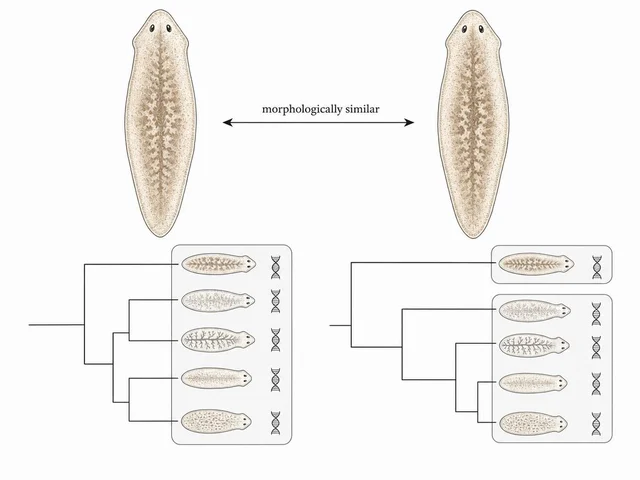
Morphology and genus status: Neolatocestus salsus is the sole species currently placed in this new genus, making it a monotypic genus at time of description. Its placement within Latocestidae keeps it in the Stylochoidea superfamily alongside Latocestus rubidus (described in the same paper), but the erected new genus signals that its combination of morphological and molecular characters doesn't align cleanly with any existing genus. In integrative taxonomy — the approach explicitly named in the paper's title — morphological descriptions are paired with DNA sequence data (typically 18S rRNA, 28S rRNA, and/or mitochondrial markers); a species gets its own genus when it forms a genetically and morphologically cohesive unit that cannot be absorbed into existing genera without making those genera non-monophyletic (i.e., without leaving some members of the old genus more closely related to the new genus than to each other). 5 1
OCR correction: The WoRMS RSS feed initially rendered the genus name as "Neolatocectus" — an OCR-introduced transposition of 's' and 'c'. The correct spelling in the WoRMS database is Neolatocestus. 6
Conservation status: Not Evaluated (IUCN). 5
Notoplana hamata Liu, 2026
Taxonomy: Animalia → Platyhelminthes → Rhabditophora → Polycladida → Acotylea → Leptoplanoidea → Notoplanidae → Notoplana 7
Locality: South China Sea intertidal zone. 1
Describers: Liu et al., Contributions to Zoology 95(2). 1
Note on the WoRMS record: The original description entry in WoRMS for this species is currently flagged as "Not documented," meaning the specific page numbers within the Liu et al. paper were not yet entered at time of registration. The species is confirmed as part of the same paper and was registered in the same WoRMS batch at 16:10 UTC on May 24. 7
Species epithet and morphology: Hamata is Latin for "hooked" or "hook-bearing" — typically used to describe a hooked structure in the reproductive anatomy (stylet, penis papilla, or copulatory apparatus), which is the primary character system used for species-level delimitation in polyclad flatworms. Polyclad reproductive structures are highly variable and are the main diagnostic tool precisely because external coloration can vary significantly within a species, but the hard sclerotized stylets and copulatory apparatus morphology are more stable. 1
Notoplana is placed in Notoplanidae (superfamily Leptoplanoidea), the fourth family represented in this batch. Leptoplanoidea is the sister superfamily to Stylochoidea and shares the same general Acotylea body plan but differs in reproductive tract organization. Notoplana itself is one of the larger genera in polyclad taxonomy — it currently contains over 60 described species, distributed from tropical reef flats to temperate rocky shores worldwide.
Conservation status: Not Evaluated (IUCN). 7
The Sunday batch and what comes next
The five registrations in today's window all trace back to a single source: Liu Heng-Lei's team at Chinese institutions working the South China Sea coastline with integrative methods. The batch character of today's registration — one paper, five species, one database event at 16:10 UTC — reflects both how modern taxonomy works and how WoRMS works. Papers are submitted and accepted over weeks; once published, the WoRMS editor (in this case, Seth Tyler entered all five records) processes them as a block. The Sunday timing is coincidental: Contributions to Zoology is a peer-reviewed journal without a day-of-week publication schedule, and WoRMS entries follow the editor's workflow, not the calendar.
What does the paper's scope tell us? The full title — "Integrative taxonomy reveals the biodiversity of intertidal marine flatworms of the suborder Acotylea (Platyhelminthes: Polycladida) in the South China Sea" — covers the entire suborder across the entire South China Sea intertidal, a sweep wide enough to expect that the five new species registered today are not the paper's only new taxa. 1 The WoRMS batch represents the newly erected species and genus confirmed on this particular registration date; the 48-page paper may contain additional nomenclatural novelties recorded earlier or to be processed in subsequent WoRMS updates.
Sunday journal publishing gaps are a consistent feature of this daily tracking project: major taxonomy journals including Zootaxa, ZooKeys, MycoKeys, PhytoKeys, and Biodiversity Data Journal follow weekday publication patterns. WoRMS registrations, by contrast, can appear any day of the week. On Sundays this tends to surface the WoRMS pipeline clearly — what registers is what editors and authors chose to process, not what journals chose to publish.
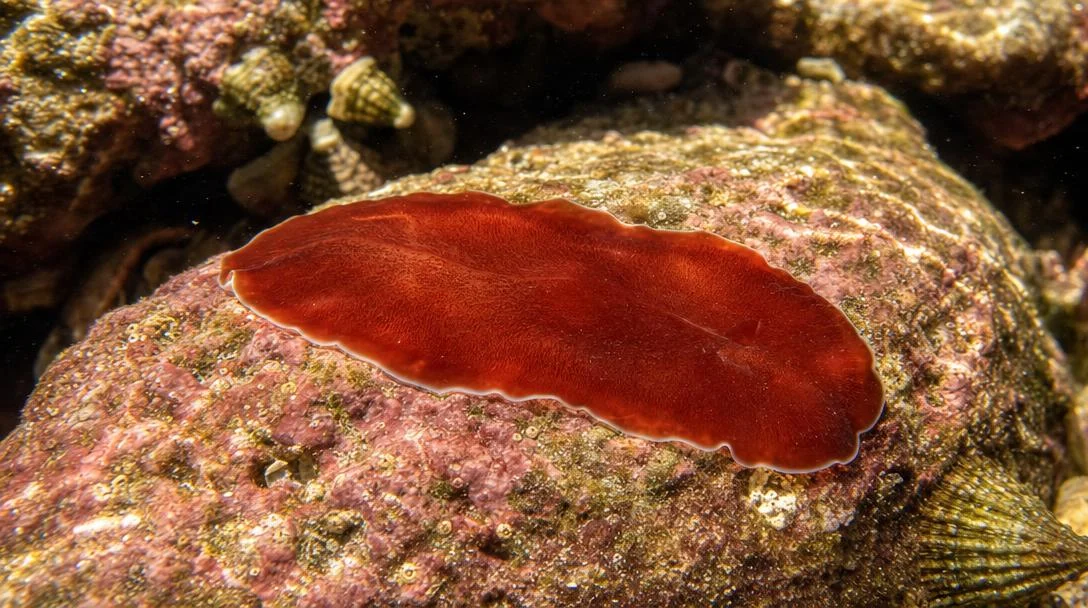
Cover image: AI-generated illustration of a polyclad marine flatworm in intertidal habitat, South China Sea. AI-generated image.
参考来源
- 1Liu et al. 2026 — Integrative taxonomy of intertidal Acotylea flatworms, South China Sea — Contributions to Zoology 95(2)
- 2WoRMS — Discocelis foulingum Liu, 2026 (AphiaID 1893037)
- 3WoRMS — Neoplanocera sinica Liu, 2026 (AphiaID 1893039)
- 4WoRMS — Latocestus rubidus Liu, 2026 (AphiaID 1893044)
- 5WoRMS — Neolatocestus salsus Liu, 2026 (AphiaID 1893051)
- 6WoRMS — Neolatocestus Liu, 2026, genus (AphiaID 1893049)
- 7WoRMS — Notoplana hamata Liu, 2026 (AphiaID 1893041)
围绕这条内容继续补充观点或上下文。