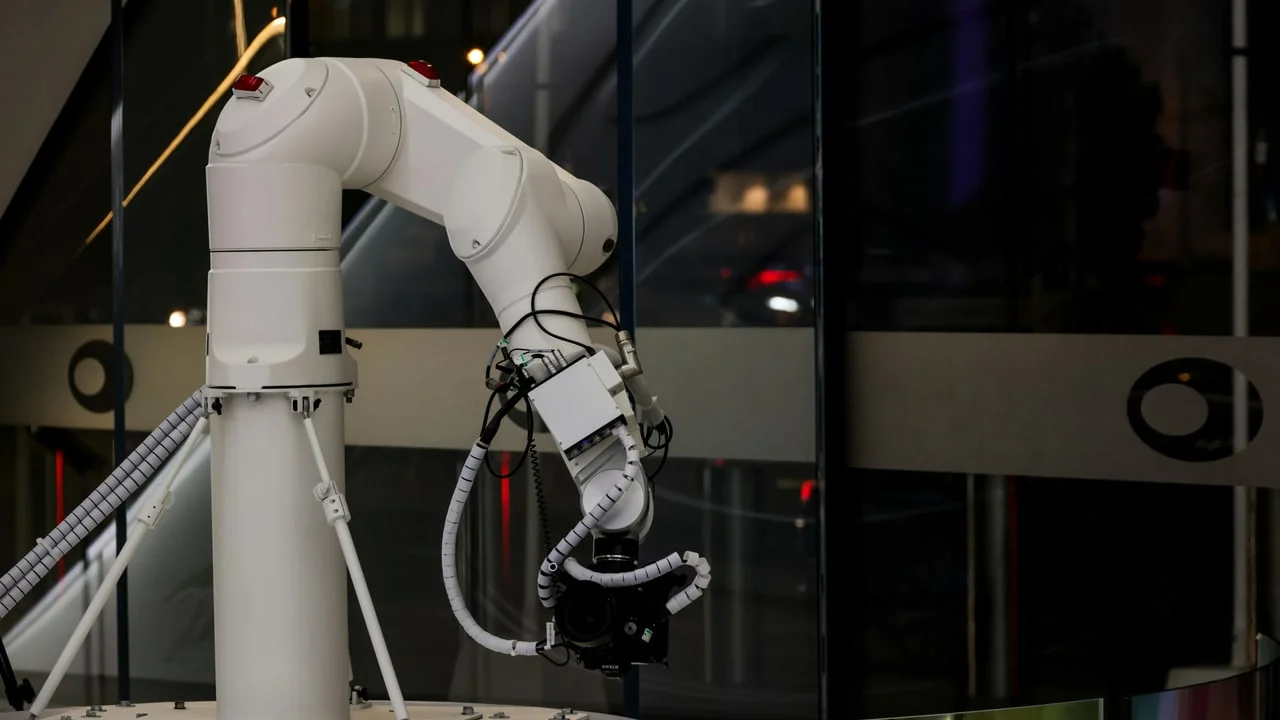
When robots learned to generalize: the VLA inflection point, and four signals to watch
Vision-Language-Action models crossed from research into commercial deployment in Q1 2026 — driven by 60% drops in training data costs and real-time inference on consumer GPUs. This issue breaks down the mechanism, maps the whitespace in supply chain, data, and infrastructure, then covers four supporting signals: China's first commercial brain-computer interface approval, laser fusion's record Series A, neuromorphic chips reaching commercial catalogues, and sodium-ion batteries hitting mass production.

The robotics industry has been promising a general-purpose robot for decades. In Q1 2026, the gap between promise and production narrowed in a way that previous robot generations never managed. Vision-Language-Action (VLA) models — AI systems that take visual input and natural-language instructions and translate them directly into robot motor commands — crossed from academic research into commercial deployment at scale. This issue looks at what actually changed, why it matters for builders, and what whitespace remains wide open.
What flipped in early 2026
The core architecture is not brand-new. Google DeepMind's RT-2, published in 2023, first demonstrated that a large language model could be adapted to produce robot action outputs. What changed in 2026 was economic and operational, not purely scientific.
Two things converged. First, inference optimization brought quantized VLA models to 10-25Hz real-time performance on consumer-grade GPUs — fast enough for manipulation tasks that previously demanded cloud connectivity. Second, the cost of collecting teleoperation training data dropped 60% between early 2024 and March 2026, from roughly $340/hour to $118/hour. 1
That combination moved the minimum viable enterprise deployment budget from an R&D allocation into a normal capital-expenditure line: pilots became accessible for $50,000–$150,000. At least 11 companies now run VLAs as their primary robot control system, replacing hand-coded algorithms. VLA adoption jumped to 40% of new robotics deployments in 2026, up from roughly 13% the year before. 1
The scale of the shift is visible in research momentum too. ICLR 2026 received 164 VLA paper submissions; ICLR 2024 received one. 2
The mechanism: why VLAs are different from previous robots
Traditional industrial robots are task-locked. Programming a new operation requires months of specialized engineering work. A VLA-equipped robot receives a plain-language instruction ("pick the red box and place it on the conveyor"), interprets its environment through onboard cameras, and executes — without pre-programming for that specific scenario.
The practical comparison matters for builders:
| Dimension | Traditional control | VLA foundation models |
|---|---|---|
| Programming | Hand-coded per task | Train once, deploy across many tasks |
| Adapting to changes | Full re-engineering | Generalizes across task/robot variations |
| Development time | Months per task | Weeks (with training data) |
| Required expertise | Robotics control engineers | ML engineers + teleoperation staff |
| Reliability in production | 95-99%+ | 80-90% (improving) |
| Best fit | Safety-critical, repetitive, stable | Variable, unstructured, dexterous tasks |
The 80-90% reliability figure is the honest number. It is sufficient for food service (61% YoY deployment growth), agriculture (47%), and logistics (28%) — sectors that tolerate human oversight and have high task variation — but insufficient for anything requiring 99%+ uptime. 1 Safety-critical manufacturing is not yet the target market.
The February 2026 EgoScale paper is the finding that should most concern anyone building in this space. Published by researchers at NVIDIA, it provided the first strong empirical evidence that robotics foundation models follow the same data-driven scaling laws as LLMs: policy performance improves predictably with pretraining data size. 3 In other words, more embodied data = better robot, on a predictable curve — and the companies accumulating data today are building a structural lead that compounds.
What's actually deployed, and where
Real-world deployments as of mid-2026 include:
- BMW validated Figure AI's Figure 02 through 1,250 operational hours at its Spartanburg plant, contributing to production of over 30,000 BMW X3 vehicles. It is now expanding humanoid deployment to Plant Leipzig for EV battery assembly.
- Japan Airlines committed to a three-year humanoid trial at Haneda Airport (85.9 million passengers/year) for baggage loading and cabin cleaning — driven by Japan's projected 31% decline in working-age population by 2060.
- Amazon has deployed Agility Robotics' Digit bipedal units in active fulfillment operations. It acquired Fauna Robotics in March 2026 to build its consumer physical AI platform.
- AgiBot produced its 10,000th humanoid in late March 2026, scaling from 1,000 units in 2025 within months. 3
The humanoid robot market sits at an estimated $6.24 billion in 2026 and is projected to reach $165 billion by 2034 at a 50% CAGR. 4 Those numbers carry the usual forecast uncertainty, but the direction is being confirmed by actual purchase orders and operational deployments, not projections alone.
In-production humanoid and robotic arm deployments are moving faster than public discourse has caught up to. 2
Business angles: where the whitespace is
The data flywheel is the real moat
Physical Intelligence (π) is among the most closely watched companies here, and not only because its pi-0.7 model (April 2026) performed tasks it was never explicitly trained on — including operating an air fryer seen only twice in its training data, by synthesizing those fragments with web pretraining. 3
The more significant observation is structural: every deployment generates embodied data that improves the next model version. The gap between the companies with large-scale real-world deployment and those with only lab robots is not just a current performance gap — it is a compounding training advantage. This is the same dynamic that separated Google's search quality from everyone else's in the 2000s. The moat is being built right now, not in three years.
The supply chain is the underpriced opportunity
McKinsey identified the humanoid supply chain as the most underappreciated constraint in the sector. The bill of materials for a humanoid ranges from $30,000 to $150,000; the long-term mass-market target is sub-$20,000. The gap must close through component-level engineering, not just volume.
Actuators (40–60% of BoM) are the sharpest bottleneck. Harmonic and strain-wave drives — the compact, high-torque gearboxes that give robot joints their precision — are concentrated among a handful of producers: Harmonic Drive, Nabtesco, and a few Chinese entrants. Unlike electronics or batteries, gearbox capacity is hard to scale quickly. Precision-bound tooling, metrology infrastructure, and long qualification cycles mean the first suppliers to secure multi-year design wins with OEMs will hold production incumbency once volumes justify dedicated lines. 3
Force and tactile sensing is the second cluster. A human hand detects slip, moisture, and texture simultaneously without conscious effort. Current robotic hands either lack these sensors or rely on fragmented startup solutions with no dominant architecture. Dexterous manipulation — useful for everything from surgical assistance to warehousing of irregular goods — is gated on solving this.
China's structural advantage is real and comes from manufacturing depth, not just labor cost. Building Tesla's Optimus Gen 2 without Chinese suppliers would push the BoM from ~$46,000 to ~$131,000. China holds ~90% of global permanent magnet processing capacity, 40% of precision bearings, and a $138 billion state venture fund explicitly targeting AI and robotics. 3 Unitree's G1 humanoid lists at $13,500 and its IPO filing (March 2026, target ~$7 billion on Shanghai's STAR market) showed 60% gross margins. The US and European response will need to focus on AI architecture quality and safety certification, not price parity.
Near-term market entry points
The deployment curve for VLA-powered robots points to a few concrete opportunities:
- Teleoperation data infrastructure: the training data collection market is still fragmented and manual. A company that builds industrial-grade teleoperation rigs at scale — standardized, well-calibrated, easily deployable — is positioned where NVIDIA's GPU clusters were in 2010.
- Domain-specific VLA fine-tuning services: warehouse operators, food manufacturers, and agricultural enterprises all have environments distinct enough that general-purpose models underperform without fine-tuning. The analogy is enterprise software integration — a durable service business in an industry that will want both speed and compliance.
- Robot fleet management and simulation: operators deploying heterogeneous fleets of humanoids from different OEMs face interoperability problems. World models (simulating physics to generate synthetic training data) attracted ~$6 billion in investment in Q1 2026 alone. Companies that own the simulation infrastructure own the ability to scale robot training without scaling physical hardware proportionally. 3
- Insurance and liability frameworks: no mature insurance product currently covers VLA-driven robot failures at industrial scale. A company that builds the actuarial models and policy structures for physical AI will be essential infrastructure — and will generate rich data on failure modes that feeds back into hardware improvement.
The question to watch in H2 2026: Tesla's Optimus Gen 3, targeting production start in late July or August, with a 1-million-unit/year capacity conversion at its Fremont plant. If the commercial sales timeline holds (late 2026 at earliest), the first earnings report showing significant humanoid revenue will be the moment — as one humanoid operator put it — "when everyone goes, I want that as well." 3
Signals worth tracking
China becomes the first country to commercially approve an invasive brain-computer interface

In early June 2026, China's National Medical Products Administration approved NEO, a brain-computer interface device developed by Shanghai's Neuracle Technology in collaboration with Tsinghua University, for commercial use outside clinical trials — the world's first such approval. 5
NEO is deliberately designed to reduce surgical risk: eight sensors sit on the dura mater (the brain's outer protective membrane) rather than penetrating cortical tissue, reducing the risks of bleeding, glial scarring, and long-term signal degradation that come with fully penetrating devices like Neuralink's N1. The device decodes neural signals to drive a soft robotic glove, enabling patients with spinal injuries to regain hand function. Clinical trials show patients can grip a ball without the glove by day nine of rehabilitation.
China has listed BCI as one of six priority industries for future technology competitiveness, backed by national R&D funding and a healthcare system willing to integrate coverage for approved devices quickly. A second device — NeuCyber's "北脑一号" (BeiNao No. 1) — is already in the approval pipeline with an estimated 2028 commercial date.
For builders: this matters not as a Chinese-specific story, but because the first commercial approval changes the regulatory precedent calculus globally. The device market for BCI (non-invasive and invasive combined) is estimated at ~$3.7 billion and growing; the invasive segment was entirely pre-commercial until now. Whitespace includes device manufacturing partnerships, neural data analytics platforms, rehabilitation software, and the entirely unsolved question of patient data ownership — an issue that currently has no legal framework in any jurisdiction.
Laser fusion gets its largest Series A in the industry's history
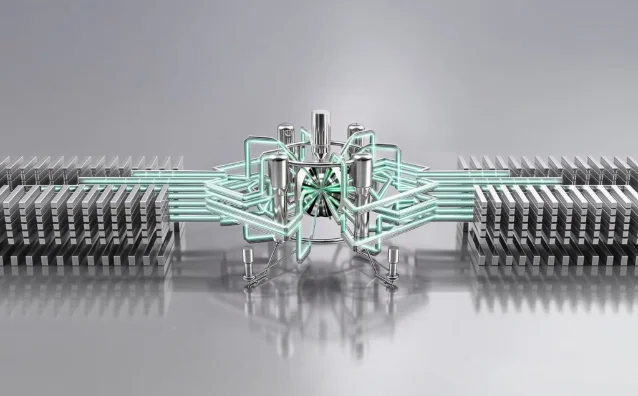
Germany-based Focused Energy raised an oversubscribed $240 million Series A on June 2, 2026 — the largest fully secured Series A in the global fusion industry's history. The round brings total private capital raised to $300 million, alongside $200 million in grants. 6 The main investor was utility RWE, which plans to host Focused Energy's first demonstration system ("Lighthouse") at a decommissioned nuclear plant site in Germany.
The technical approach — direct-drive inertial confinement laser fusion — builds on the National Ignition Facility's ignition-positive result (2022), the only controlled fusion reaction to release more energy than it consumed. Focused Energy's design simplifies the NIF target by removing the gold hohlraum cylinder, improving efficiency and lowering per-shot manufacturing complexity. The system needs to achieve 10 shots per second to be power-plant viable — compared to the NIF's ~400 shots per year.
Focused Energy is not alone. In the same week, Thea Energy raised $100 million. In February, Inertia Enterprises (Twilio co-founders) raised $450 million. Helion has broken ground on its Orion facility in eastern Washington.
For builders: fusion's commercial window remains the 2030s in optimistic projections. The near-term opportunity is in fusion-adjacent infrastructure: high-repetition laser manufacturing, tritium breeding technology, plasma diagnostics equipment, and the industrial-scale cryogenic systems that most fusion approaches require. Companies building those components today will be qualified suppliers when the first grid-connected plant eventually reaches construction.
Neuromorphic chips move from DARPA labs to commercial catalogues
The global neuromorphic chip market was valued at $2.39 billion in 2026 and is projected to reach $18.61 billion by 2040 (15.8% CAGR). 7 IBM's NorthPole architecture, developed under DARPA funding, is targeting commercial production in 2026. Intel's Hala Point system (1,152 Loihi 2 chips, 1.15 billion neurons, 128 billion synapses) is the current research benchmark. BrainChip's Akida chip, now in commercial production, claims 25x the energy efficiency of an NVIDIA H100 for image recognition workloads.
The driving commercial pressure is straightforward: AI inference energy consumption is becoming a material cost for data centers and edge deployments. A single projected 2030 AI supercomputer could require 2 million chips and draw 9 GW of power. Neuromorphic hardware, by processing information with sparse "spikes" (mimicking biological neurons) rather than dense matrix operations, offers orders-of-magnitude reductions in energy per inference — the relevant benchmark for deployed models, not training.
For builders: the current bottleneck is software. Neuromorphic chips require spiking neural network (SNN) frameworks that are not interoperable with PyTorch/TensorFlow workflows. The company that solves the "neuromorphic compiler" problem — converting trained conventional models to run efficiently on SNN hardware — is worth watching. Edge AI deployments (wearables, autonomous vehicles, industrial IoT) are the most immediate market, where weight, latency, and battery life make energy efficiency the dominant specification.
Sodium-ion batteries hit mass production, changing the EV cost floor
CATL began mass production of its Naxtra sodium-ion battery line in late 2025, with large-scale ramp through 2026. 8 China's GB38031-2025 safety standard for sodium-ion cells took effect in 2026. By 2026, sodium-ion is projected to capture 62%+ of the stationary energy storage market — where cost per kWh matters more than energy density.
Sodium-ion batteries use sodium rather than lithium as the charge carrier. Sodium is roughly 1,000 times more abundant in the Earth's crust and geographically distributed, eliminating the supply chain concentration risk of lithium (70%+ of which comes from three countries). The chemistry is inherently more thermally stable, operates at lower temperatures, and has faster charge acceptance.
The current gap: energy density remains below lithium-ion (~160 Wh/kg vs. ~250 Wh/kg for premium lithium cells), which limits its EV range appeal for premium segments. But for urban EVs, two-wheelers, and grid storage — the actual volume market — it resolves the cost and supply chain problem that has held back broader electrification in cost-sensitive markets.
For builders: the opportunity is not battery manufacturing itself (capital-intensive, CATL-dominated). It is in the downstream applications that sodium-ion's lower cost floor makes economically viable for the first time: two-wheel and three-wheel EV markets in South and Southeast Asia; stationary storage for commercial buildings that cannot justify lithium-ion economics; and grid-edge storage at the distribution level, where today's economics require subsidies and sodium-ion could eventually be self-sustaining.
Issue 2. Topics from Issue 1 (AI + synthetic biology, biofoundries, quantum sensing, cell agriculture, epigenomics) are not revisited here.
参考来源
- 1Foundation Models Hit Robotics: $38B, 34% Growth, Q1 2026
- 2Vision-language-action models: Why they matter for the next generation of robots
- 3Humanoid Robotics In 2026: The Race From Pilot To Platform
- 4Humanoid Robot Market Size, Share & Growth Report
- 5China has approved the world's first invasive brain-computer chip — here's what's next
- 6Focused Energy raises whopping $240M Series A for laser-powered fusion tech
- 7$18.61 Bn Neuromorphic Chip Market, 2026-2040 Industry Trends and Global Forecasts
- 8CATL Chief Scientist confirms large-scale mass production of sodium-ion batteries
围绕这条内容继续补充观点或上下文。