Large Hadron Collider: constraints that cascade
How the decision to reuse the 3.8 m LEP tunnel forced the two-in-one dipole design, which forced 1.9 K superfluid helium cooling, which unlocked the field density for 7 TeV beams — and how Run 3 ends on June 29, 2026 to begin a four-year shutdown that will finally install the Nb₃Sn magnets CERN knew it needed in 1994 but could not yet build.

On June 29, 2026, the last proton bunch will complete its final lap of a 26.7 km tunnel beneath the Swiss-French countryside, and the Large Hadron Collider (LHC) will end Run 3. 1 The machine will not return to operation until 2030 — and when it does, it will be a substantially different device. Long Shutdown 3 (LS3) starts in July 2026 and will last roughly four years, transforming the LHC into the High-Luminosity LHC (HL-LHC) with ten times the collision rate. 2
The timing makes this a useful moment to examine the LHC as an engineering object: what problems the designers actually faced, which solutions they chose and why, and what the decisions they made in the 1990s constrain about what can be done in 2030.
The inherited constraint: 26.7 km of borrowed tunnel
The most consequential single fact about the LHC's engineering is that the machine was not given a blank site. The 26.7 km (26,659 m) circular tunnel it occupies was built between 1983 and 1988 for CERN's earlier Large Electron-Positron (LEP) collider, which operated from 1989 until November 2000. When CERN approved the LHC in 1995, the plan was always to install it in the existing tunnel. 3
This saved billions in excavation cost and years of schedule, but it handed every subsequent engineering decision a fixed physical envelope. The tunnel is 3.8 metres in diameter — enough for a single large magnet assembly but not for two separate magnet rings that would be needed to guide two counter-rotating proton beams. The tunnel sits between 50 and 175 metres underground, angled to minimize the depth under the Jura Mountains where a vertical access shaft would be prohibitively expensive. It crosses the France-Switzerland border at four points and connects to the surface through eight access shafts. The decision to build underground rather than at surface level was driven partly by radiation shielding and partly by avoiding the cost of purchasing surface land around Geneva. 3
The tunnel geometry drove the detector cavern construction almost as much as the accelerator itself. ATLAS, the largest of the four LHC detectors, required a cavern measuring 55 × 32 × 35 metres — completely new excavation at Point 1, along the existing tunnel alignment. The B1M reported that "the chamber housing just one of the detectors...required the excavation of more than 250,000 cubic metres of earth." 4
Eight surface buildings house the compressors, refrigeration plants, and control electronics that support the underground ring. The total project cost reached approximately SFr 4.6 billion (about $4.4 billion) for the accelerator alone, against an original 1995 budget of SFr 2.6 billion — a SFr 480 million overrun discovered in a 2001 review that also pushed the planned completion from 2005 to 2007. First beam circulated on September 10, 2008. 3
Two-in-one magnets: engineering the beam steering system
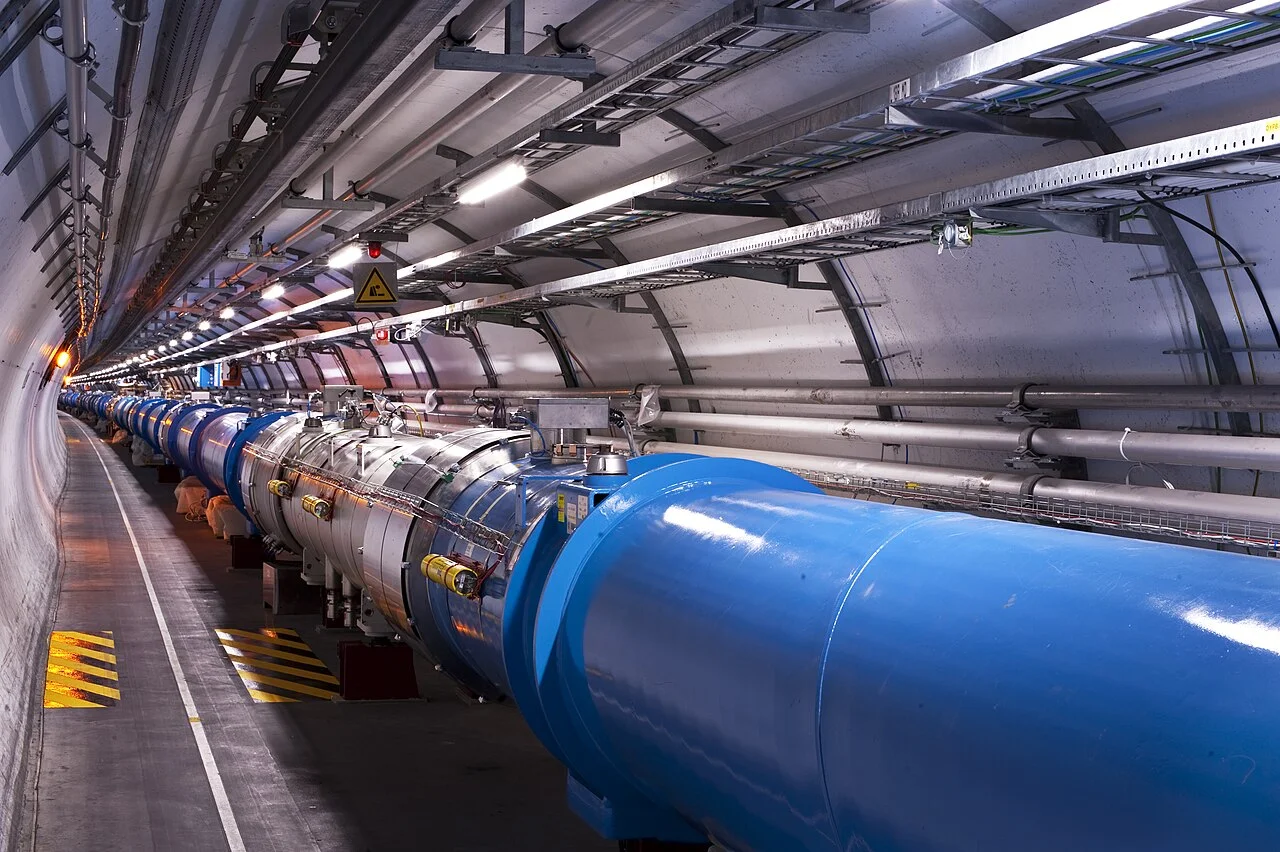
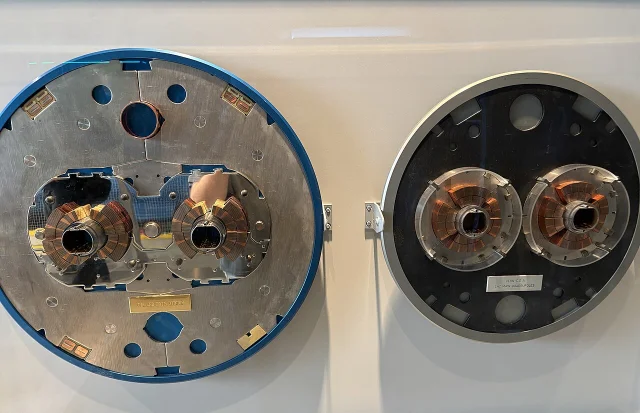
The 3.8 m tunnel diameter forced the single most distinctive engineering feature of the LHC: the "two-in-one" superconducting dipole magnet. In a conventional collider design, each counter-rotating beam would travel through its own magnet ring, each with its own set of dipoles to curve the beam around the ring. The LEP tunnel does not have room for two separate rings. CERN's solution was to put both beams inside one magnet cryostat, with each beam in its own bore but sharing a common iron yoke and a common refrigeration enclosure. 3
The LHC contains 1,232 main dipole magnets, each 15 metres long with a cold mass of 35 tonnes. Each dipole must bend both beams in opposite directions simultaneously, which requires opposite-polarity magnetic fields in the two adjacent bores — a geometry that is mechanically and electromagnetically coupled in ways that a single-beam magnet is not. An additional 392 quadrupole magnets (and roughly 8,000 smaller corrector magnets) bring the total superconducting magnet count to approximately 10,000. Total niobium-titanium (Nb-Ti) superconductor used: 470 tonnes. 3 5
The design dipole field is 8.33 tesla — which at the time was the strongest field achieved in any operational accelerator dipole. Why Nb-Ti and not niobium-tin (Nb₃Sn), which has a substantially higher critical field? Nb₃Sn can, in principle, sustain fields above 20 tesla, but the material is brittle and difficult to manufacture into the fine wire strand geometry that superconducting coils require. In 1994, when the LHC magnet design was finalized, Nb₃Sn fabrication at the scale needed — hundreds of tonnes of conductor — was judged impractical. Nb-Ti wire, by contrast, is ductile and its manufacturing technology was well established. At 1.9 K, Nb-Ti can sustain the 8.33 T field; at the warmer temperature of 4.2 K, it cannot. So the choice of Nb-Ti at 8.33 T directly determined the cooling requirement. 5 3
A practical consequence of using superconducting magnets at their physical limits is magnet training — the process by which a newly installed magnet is repeatedly ramped to progressively higher currents, each time provoking a "quench" (sudden loss of superconductivity) that releases a burst of energy and physically rearranges microscopic defects in the conductor lattice and coil geometry. Each quench allows the magnet to reach a slightly higher current on the next attempt. The LHC dipoles require extensive training runs to reliably reach their design field; without training, internal stress concentrations at manufacturing imperfections cause premature quenches at lower fields. During Run 1 (2010–2012), the machine was deliberately operated at 3.5 TeV per beam — not the 7 TeV design energy — partly to reduce the training burden on magnets whose splice connections had not yet been fully reinforced. 3
Run 2 (2015–2018) reached 6.5 TeV per beam, corresponding to a dipole field of about 7.7 T at 11,000 amperes. Run 3 pushed to 6.8 TeV per beam (13.6 TeV collision energy), with the dipole field running just below the 8.33 T maximum. 3
The total energy stored in the LHC magnet system reaches 10 gigajoules — equivalent to roughly 2,400 kilograms of TNT — with each individual dipole storing about 7 MJ. 3 That energy must be safely extracted whenever the machine is powered down or when a quench occurs.
1.9 K: why colder than deep space
Deep space has an ambient temperature of about 2.7 K. The LHC runs its magnets at 1.9 K — colder by almost a kelvin. The reason is physical, not aspirational.
Helium-4 undergoes a phase transition at 2.17 K called the lambda point. Below this temperature, liquid helium becomes a superfluid: a quantum state in which viscosity drops to effectively zero and thermal conductivity increases by a factor of roughly 1,000 compared to normal liquid helium. That dramatic increase in thermal conductivity is what makes 1.9 K so useful. At the current densities required by the LHC's Nb-Ti coils, the magnets generate heat that must be removed quickly and uniformly. Normal liquid helium (at 4.2 K, the standard boiling point at atmospheric pressure) cannot conduct heat fast enough through the magnet structure without forming local hot spots that would trigger quenches. Superfluid helium can. 3
At lower temperature, the Nb-Ti superconductor itself also has a higher critical current density — it can carry more current before transitioning to the normal (resistive) state. The combination of better cooling and higher critical current is what makes 8.33 T achievable in Nb-Ti wire. The Tevatron at Fermilab used Nb-Ti magnets at 4.2 K and achieved a maximum dipole field of about 4.4 T — the LHC's 1.9 K operation nearly doubles that from the same base conductor material. 5
The scale of the LHC cryogenic system is substantial. 96 tonnes of superfluid helium-4 cool the 10,000-plus superconducting magnets distributed around 26.7 km. Eight refrigeration plants supply 144 kW of cooling capacity at the 4.5 K equivalent level. A dedicated Cryogenic Distribution Line (QRL) — a vacuum-insulated cryogenic pipeline running parallel to the magnets around the entire ring — distributes the helium from the surface plants to the underground magnets. 3
Injection chain and RF acceleration
Protons do not enter the LHC at 6.8 TeV. They start as hydrogen atoms in a bottle at room temperature and are accelerated through a chain of four machines before reaching the LHC. 3 6
Linac4 (the linear accelerator, upgraded from Linac2 in 2020) strips electrons from hydrogen atoms to create H⁻ ions and accelerates them to 160 MeV. The Proton Synchrotron Booster (PSB) then strips the remaining electrons and accelerates the proton bunches to 2 GeV. The Proton Synchrotron (PS) takes the beam to 26 GeV and formats the bunch structure — dividing and timing the pulses that will ultimately become the LHC's beam trains. The Super Proton Synchrotron (SPS, 6.9 km circumference) accelerates to 450 GeV and injects into the LHC through two transfer tunnels. 3
Inside the LHC, 16 superconducting radio-frequency (RF) cavities operating at 400 MHz provide the final acceleration. Each cavity delivers 2 MV of accelerating voltage; the eight cavities per beam provide a net 16 MV per turn. The ramp from 450 GeV injection to 6.8 TeV takes approximately 20 minutes, during which the dipole magnet current must ramp synchronously from 0.54 T to 7.7 T to maintain the correct bending radius for the rising beam energy. 3
At full intensity, each beam contains 2,808 bunches, each bunch holding approximately 1.15 × 10¹¹ protons. The bunches circulate with 25-nanosecond spacing, producing a collision frequency of 40 MHz at the interaction points. The designed peak luminosity — the measure of how many collisions occur per unit area per unit time — is 1 × 10³⁴ cm⁻² s⁻¹. The LHC first reached this value on June 29, 2016, and exceeded twice the design value in 2017. In 2025, ATLAS and CMS each received a record 125 fb⁻¹ (inverse femtobarns, the standard unit of integrated collision count) over a single year, bringing cumulative delivery to 500 fb⁻¹ since operations began. 3 7
Each proton circulates at 0.999999990 times the speed of light, with a relativistic Lorentz factor of about 6,930. 3
The beam dump: stopping 362 MJ safely
A fully loaded LHC beam stores 362 MJ of kinetic energy — comparable to a 120-tonne freight train travelling at 150 km/h. Bringing that beam to a controlled stop is as much an engineering problem as accelerating it in the first place.
The LHC beam dump system at Point 6 of the ring deflects the beam out of the main ring using a set of 15 fast-kicker magnets that must all fire within a single beam revolution (89 microseconds) — a partial dump would misdirect the beam into the vacuum pipe rather than the dump blocks. The dump itself consists of graphite and aluminium composite blocks housed in a 700-tonne iron shielding enclosure; graphite is chosen for its low atomic number (which reduces secondary radiation) and its ability to absorb beam energy spread over a large volume without localized melting. 3
The machine protection system that triggers the dump monitors hundreds of sensor channels continuously and must decide within microseconds whether conditions require an abort. The 2008 quench incident demonstrated exactly what happens when the chain from detection to dump works but a downstream mechanical assumption does not.
The 2008 quench incident: a $40 million lesson in what "correct" can miss
On September 19, 2008 — nine days after the first successful beam circulation — the LHC's beam operations had not yet resumed at full current. Engineers were ramping one of the LHC's sectors to test current when a quench developed in approximately 100 bending magnets in Sectors 3 and 4. 3
The root cause, identified in a detailed analysis by CERN physicist Lucio Rossi published in Superconductor Science and Technology in February 2010, was a faulty electrical splice between two adjacent superconducting magnets. The splice had higher resistance than the specification allowed. At the 8,700-ampere test current, resistive heating in the splice caused the local temperature to rise, and the superconductor transitioned to the normal (resistive) state — a quench.
The quench protection system detected the quench and correctly initiated a power abort, extracting the stored energy from the magnet circuit. So far, the system worked as designed. What it could not prevent was the collateral damage. The resistive heating in the faulty splice created an electric arc that punctured the helium enclosure and the vacuum insulation surrounding it. This allowed approximately 6 tonnes of liquid helium to expand explosively into the surrounding tunnel — the over-pressure was sufficient to break several 10-tonne magnets free from their floor mountings and displace them along the tunnel. 3
The damage assessment: 53 superconducting magnets damaged or destroyed, the beam vacuum lost over a 700-metre tunnel section, and temperatures rising by approximately 100°C in affected regions. Repairs took approximately 14 months and cost approximately $40 million. 3
The incident illustrates a failure mode that is distinct from a pure electrical or superconducting problem. The protection system's logic was correct; the fault was in the mechanical design assumption that a correctly triggered power abort would always result in a controlled energy release. The explosive helium release was not anticipated in the original containment design. After LS1 (2013–2015), all inter-magnet splices were reinforced and the resistance of each was individually measured — approximately 10,000 connections verified — and pressure relief systems were upgraded throughout the cryogenic enclosures.
Detectors: engineering to see the invisible
Even a perfectly steered beam of protons is scientifically useless without instruments capable of recording what happens when two protons collide at 13.6 TeV. The LHC's four main detectors — ATLAS (A Toroidal LHC Apparatus), CMS (Compact Muon Solenoid), ALICE (A Large Ion Collider Experiment), and LHCb (LHC beauty) — are each distinct engineering structures optimized for different physics goals.
ATLAS and CMS are the two general-purpose detectors. Both were designed to detect the full range of particles that might emerge from high-energy collisions, including particles not yet observed. Their independence is deliberate: a claimed discovery at one detector has scientific weight only if the other detector independently confirms it with a different instrument and a different analysis team.
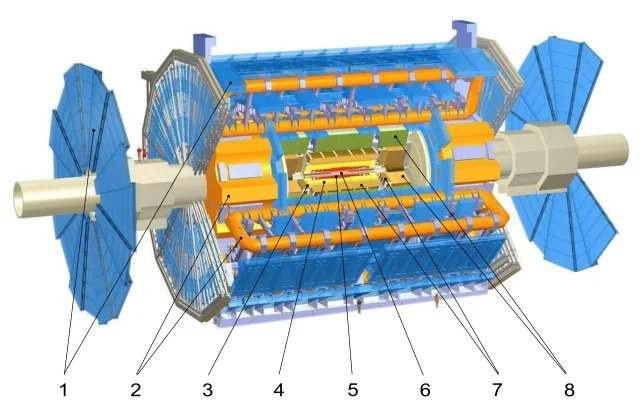
ATLAS is the largest detector by volume: 46 metres long, 25 metres in diameter, and 7,000 tonnes. It uses a "onion-layer" detection architecture: starting from the 55 mm diameter beam pipe, particles pass outward through the Inner Detector (pixel, silicon strip, and transition radiation tracker layers), then an electromagnetic calorimeter (liquid argon with lead absorbers), then a hadronic calorimeter (steel tiles and scintillator), and finally the Muon Spectrometer. The magnet system is a hybrid: a central solenoid generating 2 T for the inner tracker, plus three enormous air-core toroid magnets (the largest superconducting toroids ever built) for the muon spectrometer. The pixel detector alone contains 92 million readout channels — each pixel measuring just 50 × 400 micrometres. Total internal cabling: approximately 3,000 km. The ATLAS collaboration involves 6,003 members from 257 institutions in 42 countries. 8
CMS is physically smaller at 21 metres long and 15 metres in diameter, yet heavier: 14,000 tonnes — more than twice ATLAS by mass. The central design choice was a single, very strong solenoid magnet: a 13-metre-long, 6-metre-diameter superconducting coil generating 4 T at full design (operated at 3.8 T to maximize longevity). The solenoid stores 2.66 GJ — roughly 500 kg of TNT equivalent — with a circuit time constant of approximately 39 hours, the longest of any circuit at CERN. The 12,500-tonne steel return yoke that contains the magnetic flux accounts for the bulk of CMS's mass. 9
CMS's silicon tracker covers 205 m² of silicon sensors — approximately the area of a tennis court — with 9.3 million microstrip channels and 76 million pixel channels, achieving a tracking precision of 10 micrometres. The electromagnetic calorimeter uses 61,200 lead tungstate (PbWO₄) crystals, a material denser than stainless steel yet optically transparent — each crystal scintillates when struck by an energetic electron or photon, and the crystal array measures the particle's energy with exceptional resolution. A curious manufacturing detail: some of the brass used in the hadronic calorimeter endcaps came from recycled Russian artillery shell casings — a practical material sourcing decision that appears in the published technical documentation. 9
The two detectors' construction strategies diverged sharply. ATLAS was assembled in its underground cavern in situ, because the completed detector could not fit down any of the access shafts. CMS was assembled on the surface and then lowered underground in 15 massive sections — the heaviest individual section weighed nearly 2,000 tonnes — using a special crane rented from Belgium. This required the detector to be designed from the outset with structural interfaces that could be separated and rejoined precisely at depth. 9
July 4, 2012: what the engineering found
The LHC was approved, designed, and built primarily to answer one physics question: does the Higgs boson — the particle predicted by Peter Higgs, François Englert, and others in 1964 to explain why fundamental particles have mass — actually exist?
On July 4, 2012, at a seminar at CERN that was simultaneously webcast to the physics community worldwide, both the ATLAS and CMS collaborations independently announced the observation of a new boson with a mass of approximately 125 GeV/c² — 133 times the proton mass — at a statistical significance of 5 sigma (probability of the signal being a random fluctuation: less than one in 3.5 million). 10
Two decay channels made the discovery possible. The diphoton channel (H → γγ, Higgs decays to two photons) required the electromagnetic calorimeter resolution that the CMS crystal array and ATLAS liquid argon system were specifically designed to achieve — photons are measured by energy deposition alone, and the Higgs signal sits on a smooth background that can only be distinguished statistically with very precise energy measurement. The four-lepton channel (H → ZZ* → 4l) required the tracking precision and muon momentum resolution that justified CMS's 4 T solenoid and ATLAS's toroid system. CERN Director-General Rolf-Dieter Heuer said at the seminar: "As a layman, I would say, I think we have it." 10
The Higgs mass was subsequently refined to 125.11 ± 0.11 GeV/c² (ATLAS, 2023). Peter Higgs and François Englert received the 2013 Nobel Prize in Physics. 10
The LHC's physics output extends well beyond the Higgs. By the end of Run 3, experiments at the collider will have discovered more than 80 new hadrons (composite particles made of quarks) — the 80th, a doubly-charmed Ξcc particle (two charm quarks plus a down quark), was announced by LHCb at the Moriond 2026 conference in March with a significance of 7 sigma. 11 In July 2025, ATLAS reported evidence for the extremely rare decay H → μμ (Higgs to two muons) at 3.4 sigma significance — the first indication of the Higgs coupling to a second-generation fermion. 12 LHCb confirmed the first observation of CP violation (matter-antimatter asymmetry, the phenomenon that causes matter to outnumber antimatter in the universe) in baryon decays at 5.2 sigma, published in Nature. 13
HL-LHC: breaking the Nb-Ti ceiling
The engineering decision that defined the LHC — Nb-Ti wire at 1.9 K, constrained by the 3.8 m tunnel — produced 16 years of productive physics. It also set a ceiling. At 8.33 T, the LHC dipoles are operating close to the physical limit of Nb-Ti at 1.9 K. To collect significantly more data, the machine needs higher luminosity, not higher energy; and higher luminosity at the same energy requires stronger focusing magnets near the collision points.
That is the engineering core of the HL-LHC upgrade, which Long Shutdown 3 exists to install.
The new inner triplet focusing quadrupoles — designated MQXF — are wound from niobium-tin (Nb₃Sn) conductor and will produce 11.3 T, up from 8.6 T in the current LHC quadrupoles. Nb₃Sn has a critical field roughly twice that of Nb-Ti and was seriously evaluated during the original LHC design process in the early 1990s. It was rejected then because the manufacturing techniques needed to produce hundreds of tonnes of fine-strand Nb₃Sn wire without introducing the brittle cracking that destroys superconducting performance at conductor bends did not exist at that scale. Three decades of materials R&D at CERN, Brookhaven National Laboratory, Fermilab, and Lawrence Berkeley National Laboratory produced the fabrication process now being used. As Oliver Brüning, CERN's Director for Accelerators and Technology, described the test program: "All the systems have already been tested individually. The goal of the IT String is to validate their integration and their collective performance under operational conditions." 14
The IT String — a 95-metre full-scale test stand at CERN's SM18 surface facility — began cooling to 1.9 K in February 2026, integrating the new Nb₃Sn triplet magnets with the cryogenic, power, protection, and alignment systems before any hardware goes underground. 14 The US Accelerator Upgrade Project (AUP), a collaboration of Fermilab, Brookhaven, and Lawrence Berkeley, had delivered five magnet cryoassemblies as of early 2026, with five more planned for mid-2027.
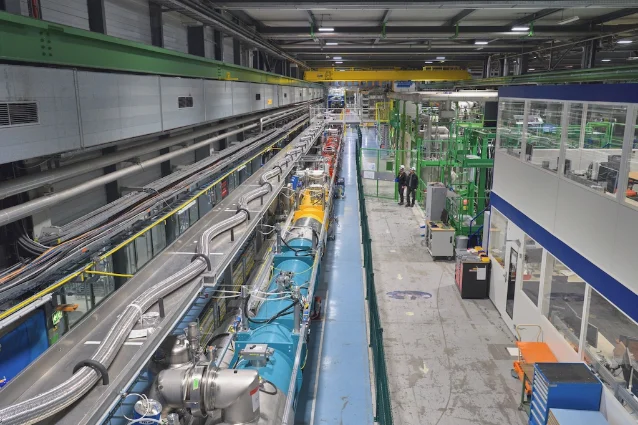
The HL-LHC also introduces crab cavities — 16 superconducting RF structures (8 per experiment at ATLAS and CMS) that tilt the proton bunches just before they collide. In the current LHC, the two beams cross at a small angle; the bunches overlap only partially, leaving luminosity on the table. The crab cavities apply a transverse RF kick that rotates each bunch so its long axis is aligned with the collision direction, maximising the overlap. The technique was successfully demonstrated in prototype tests in CERN's SPS (Super Proton Synchrotron, 6.9 km circumference). 2
The luminosity target after HL-LHC commissioning in 2030 is 5 × 10³⁴ cm⁻² s⁻¹ — five times the original LHC design value and potentially up to 7.5 × 10³⁴ in optimistic scenarios. The number of collision pile-up events per bunch crossing will increase from about 60 to 140, which in turn drove the detector upgrade programs at ATLAS and CMS to handle the higher track density. The HL-LHC is expected to deliver a total of 3,000 fb⁻¹ over its operating lifetime through the early 2040s, compared with roughly 300 fb⁻¹ from all three LHC runs combined. 2
In total, more than 1.2 kilometres of LHC equipment will be removed and replaced during LS3, including new magnets, cryogenic pipelines, collimators, absorbers, and the MgB₂ (magnesium diboride) superconducting power lines that will carry approximately 100,000 amperes from the surface to the tunnel. 2
FCC: the next generation of constraints
The LHC's successor has been formally studied. The Future Circular Collider (FCC) feasibility study was completed on March 31, 2025, and reviewed by the CERN Council at a dedicated session on November 6–7, 2025. The Council confirmed no fundamental technical obstacles. 15
The first phase, FCC-ee (electron-positron collider, a so-called "Higgs factory"), would occupy a new 91–100 km tunnel beneath the Geneva region at depths down to 400 metres — more than three times the LHC's circumference. Operating between 90 and 350 GeV, FCC-ee would produce enormous samples of Z bosons, W bosons, Higgs bosons, and top-quark pairs for precision measurements, including the first measurement of how the Higgs boson couples to itself. A second phase, FCC-hh (proton-proton collider), would use the same tunnel to reach ~100 TeV collision energy — roughly seven times the LHC's design energy. 16
In December 2025, philanthropists including Yuri Milner, Eric Schmidt, John Elkann, and Xavier Niel committed €860 million through the Breakthrough Prize Foundation and the Schmidt Innovation Fund — the first large-scale private donation in CERN's history. 16 A construction decision is expected from CERN member states in 2028.
Mark Thomson, who became CERN Director-General on January 1, 2026 — taking over specifically to oversee both the HL-LHC shutdown and the FCC decision — put the continuity plainly in a December 2025 interview: "We've not got to the point where we have stopped making discoveries and the FCC is the natural progression. Our goal is to understand the universe at its most fundamental level. And this is absolutely not the time to give up." 17
Key specifications
| Parameter | Value | Source |
|---|---|---|
| Tunnel circumference | 26,659 m (26.7 km) | 3 |
| Tunnel internal diameter | 3.8 m | 3 |
| Tunnel depth range | 50–175 m | 3 |
| Main dipole magnets | 1,232 × 15 m, 35 t cold mass each | 3 |
| Total superconducting magnets | ~10,000 | 3 |
| Nb-Ti conductor mass | 470 tonnes | 3 |
| Dipole design field | 8.33 T | 3 |
| Run 3 beam energy | 6.8 TeV/beam (13.6 TeV collision) | 3 |
| Operating temperature | 1.9 K (−271.25 °C) | 3 |
| Superfluid helium mass | 96 tonnes | 3 |
| Cryogenic cooling capacity | 144 kW at 4.5 K equivalent | 3 |
| RF frequency | 400 MHz, 16 cavities, 2 MV each | 3 |
| Bunches per beam | 2,808 × 1.15 × 10¹¹ protons | 3 |
| Bunch spacing | 25 ns (40 MHz collision rate) | 3 |
| Design peak luminosity | 1 × 10³⁴ cm⁻² s⁻¹ | 3 |
| Integrated luminosity to date | ~500 fb⁻¹ (ATLAS + CMS) | 7 |
| ATLAS detector dimensions | 46 m × 25 m diameter, 7,000 t | 8 |
| CMS detector dimensions | 21 m × 15 m diameter, 14,000 t | 9 |
| Total project cost (accelerator) | ~SFr 4.6 billion (~$4.4 billion) | 3 |
| HL-LHC quadrupole field | 11.3 T (Nb₃Sn) | 2 |
| HL-LHC peak luminosity target | 5 × 10³⁴ cm⁻² s⁻¹ (up to 7.5 × 10³⁴) | 2 |
| HL-LHC integrated luminosity target | 3,000 fb⁻¹ (lifetime) | 2 |
| Run 3 end date | June 29, 2026 | 1 |
| HL-LHC first physics | ~2030 (Run 4) | 2 |
Legacy of the engineering decisions
The LHC's engineering legacy operates on two timescales: the techniques it required, and the precedents it set.
On the technique side, the superconducting magnet manufacturing program — 1,232 dipoles produced by three European industrial consortia to specifications tighter than anything previously achieved in high-field magnet production — established that precision superconducting fabrication at this scale was industrially possible. The cryogenic distribution system, connecting eight surface refrigeration plants to 26.7 km of underground magnets through hundreds of individual cryogenic connections, was the largest such installation ever built and served as the template for the HL-LHC's upgraded cryogenic circuits. The quench protection philosophy, refined after 2008, has informed the quench detection and protection architecture for every large superconducting accelerator designed since.
On precedents: the decision in the early 1990s to accept Nb-Ti at 1.9 K rather than wait for Nb₃Sn manufacturing maturity was correct for the LHC's schedule and budget. It also made the HL-LHC upgrade necessary: the Nb-Ti ceiling was always finite. The 30-year gap between the LHC's rejection of Nb₃Sn in practice and its first operational deployment in the HL-LHC inner triplets reflects exactly how long it took to develop the wire fabrication and coil winding techniques that the 1994 designers knew they needed but could not yet produce. The HL-LHC is in that sense the resolution of a constraint that was knowingly deferred.
The FCC, if approved, will restate that problem at the next scale. A 91–100 km tunnel introduces new geological and geotechnical challenges, new cryogenic distribution requirements, and — eventually — a need for dipole fields above what Nb₃Sn can deliver at 1.9 K, pushing toward high-temperature superconductors or other materials that are today roughly where Nb₃Sn was in 1994. The engineering trajectory from LEP to LHC to HL-LHC to FCC is a series of constraint-deferral and constraint-resolution decisions, each one enabled by the previous generation's manufacturing and materials research.
When the last proton circulates on June 29, 2026, it will close a chapter that began with the LEP tunnel boring machines in 1983. The four-year shutdown that follows is not a pause in that story. It is the part of the story where the next constraint gets resolved.
Cover image: LHC tunnel Sector 3–4 showing blue-jacketed superconducting dipole magnets and the cryogenic distribution line. Image from Wikipedia: Large Hadron Collider (CC BY-SA).
参考来源
- 1CERN: Final laps at the LHC
- 2Wikipedia: High Luminosity Large Hadron Collider
- 3Wikipedia: Large Hadron Collider
- 4The B1M: The World's Greatest Science Megaprojects
- 5Wikipedia: Superconducting magnet
- 6Wikipedia: Super Proton Synchrotron
- 7CERN: LHC delivers a record number of particle collisions in 2025
- 8Wikipedia: ATLAS experiment
- 9Wikipedia: Compact Muon Solenoid
- 10Wikipedia: Higgs boson
- 11CERN: LHCb Collaboration discovers new proton-like particle
- 12ATLAS Collaboration / CERN: ATLAS closes in on rare Higgs decays
- 13Nature: Observation of CP symmetry breaking in baryon decays
- 14Fermilab: HiLumi LHC — full-scale tests start
- 15Innovation News Network: CERN Council endorses next step for the Future Circular Collider
- 16Wikipedia: Future Circular Collider
- 17The Guardian: The man taking over the Large Hadron Collider — only to switch it off
围绕这条内容继续补充观点或上下文。