The snail that conquered the world

The snail that conquered the world

A thumbnail-sized freshwater snail with a left-handed shell, a unique spinning defense, and the ability to self-fertilize has colonized every continent but Antarctica.

Wikipedia Featured Article
2026/5/28 · 8:11
2 订阅 · 10 内容
Somewhere in your city's drainage system, storm runoff channels, ornamental ponds, and possibly the aquarium of whoever owns that overgrown community fish tank, there lives a freshwater snail roughly the size and shape of a watermelon seed. Its shell is amber and nearly transparent. It has no door — no hinged plate to seal itself shut when threatened. It can reproduce without a partner. It breathes air. It has a muscle system found in no other animal on Earth that allows it to spin its shell like a top to throw off attackers.
Scientists call it Physella acuta — the acute bladder snail. Researchers Dillon, Wethington, Rhett, and Smith described it in 2002 as "the world's most cosmopolitan freshwater gastropod," 1 meaning it has established itself on every continent except Antarctica. It accomplished this partly by hitching rides inside bales of 18th-century American cotton, later aboard aquarium plant shipments, and always by being far harder to kill than anything around it.
Today it is Wikipedia's Featured Article — a piece the encyclopedia's editorial community has reviewed and certified as among the finest, most complete entries in the entire project. 2 That distinction feels appropriate for an animal whose biography is, by almost any measure, one of the stranger success stories in natural history.

A name with a troubled history

The snail was first formally described in 1805 by Jacques Philippe Raymond Draparnaud, a French naturalist working with specimens collected from the Garonne basin in southern France. 1 He named it Physa acuta — "physa" from the Greek for bellows or bladder, referring to the swollen shape of the shell; "acuta" from the Latin for pointed or sharp, referring to the tapered spire. He assumed, reasonably enough, that the snail he had in front of him was European. It wasn't.
Twelve years later, in 1817, an American naturalist named Thomas Say independently described what he believed was a different species living in Pennsylvania, giving it the name Physa heterostropha. 1 He was describing the same animal. Nobody knew this for a long time, because the snail's shell varies so dramatically — in width, in the proportions of the spire, in the number of whorls — that the same species can produce shells that look genuinely different from different populations, or even from the same population under different conditions. This variability generated a cascade of false "new species" descriptions across the 19th and 20th centuries. The synonymy list for P. acuta runs to dozens of names.
Molecular genetics sorted most of it out by the early 2000s, collapsing those taxonomic ghost species back into a single entity with a North American origin. 1 The snail Draparnaud found in France was almost certainly already an introduced population — meaning the European "original" was actually a North American immigrant even when first described. More recently, in 2021, a phylogenetic study moved the species from the genus Physa to Physella, where it currently sits. 1 Some databases and authors still use Physa acuta or Haitia acuta — the reclassification isn't universally adopted.
The naming chaos, it turns out, was always a sign of the biological chaos underneath: a creature whose defining trait is not conforming to expectations.
正在加载链接预览…

Left-handed, lid-free, and nearly see-through

Most snails coil to the right. Hold the shell with the opening facing you and the spire pointing up, and the opening is on the right side. This is so reliably true across gastropod species that a snail coiling to the left — described as sinistral — is the kind of thing that gets written up in natural history journals when it appears in right-coiling species. Physella acuta is sinistral as a species. Every individual, every population, every specimen ever collected. The opening is always on the left. 1
This matters beyond aesthetics. The coiling direction shapes the mechanics of predation, mating, and muscle attachment. Being the opposite handedness from most of your environment creates just enough asymmetric friction in every interaction to matter.
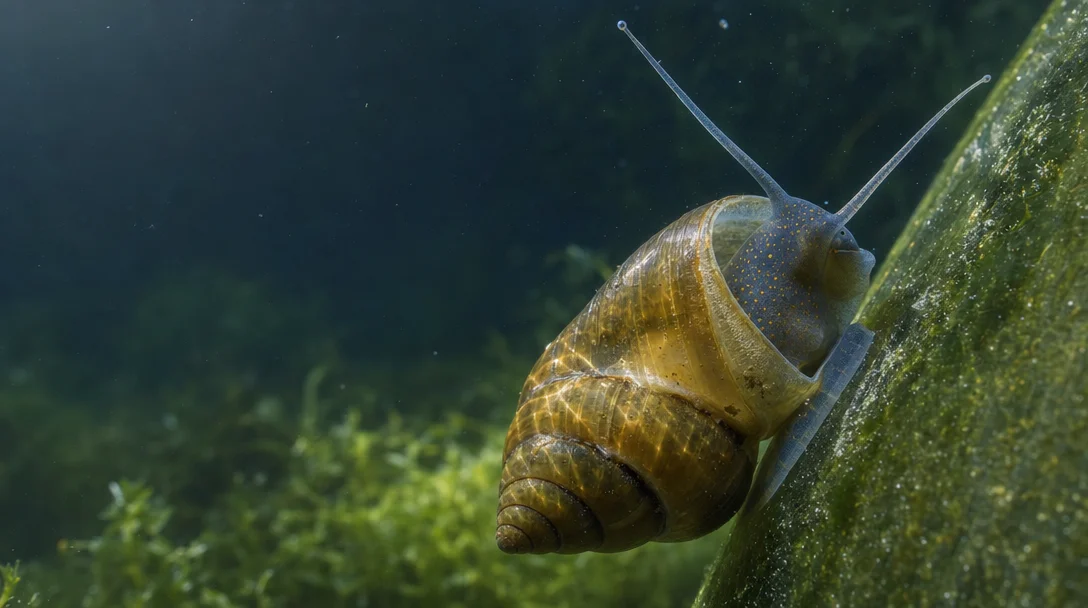
The shell itself, at full adult size, reaches about 16 mm long and 9 mm wide — roughly the dimensions of a large grain of rice. 1 It is smooth, pale amber-brown to yellowish, and built from the thinnest walls of any common freshwater snail: 0.15 to 0.35 mm across. 1 You can hold a dry shell up to a light and see through it. There is no operculum — no trapdoor to close off the shell opening when the animal retreats inside. If something gets in, there is no barrier to stop it.
The soft body that lives inside this minimal architecture is stranger still. The body color ranges from blue to dark gray, and the top surface of the mantle — the fleshy outer layer that secretes the shell — is scattered with tiny gold spots. 1 Along the mantle's edge, finger-like projections called mantle lobes extend outward: 7 to 11 on the right side, 4 to 6 on the left. These lobes function as supplementary gills, absorbing dissolved oxygen directly from the water. They also detect chemical signals from approaching predators, giving the snail an early warning system it could not live without given how little the shell protects it.
The tentacles are cylindrical, very slender, and nearly transparent. At their base, small black dots mark the location of the eyes — but "eyes" is generous. They distinguish light from dark. They cannot form images. 1
The shell's thinness is also adaptable: when predators are present in the environment, the snail builds a thicker shell. When it self-fertilizes (more on that shortly), the offspring tend to produce thinner shells. 1 The shell isn't just a fixed inheritance — it's a tunable parameter.

The spin move

A snail without a door, wearing a nearly transparent shell 0.15 mm thick, living in water full of leeches, crane fly larvae, predatory water bugs, crayfish, and fish, might seem to have lost the armor lottery. Evolution compensated with something more unusual: a dedicated spinning mechanism.
Buried in P. acuta's body is a muscle system found in no other gastropod family. Researchers Naranjo-García and Appleton, who described it in detail in 2009, called it the "physid musculature." 1 It has two parts: a branching main muscle (physid muscle sensu stricto) and a fan-shaped secondary muscle. The two structures work in concert to let the snail rotate its shell rapidly in a clockwise direction, twisting it up to 120° relative to the body. 1
The behavior, called shell-shaking or shell-rocking, is not random thrashing. It is a targeted response to slow-moving contact predators — leeches attempting to attach, fly larvae trying to rasp at the soft tissue, anything that needs a moment of sustained contact to do damage. The violent rotation dislodges the attacker mechanically. Combined with "bouncing" — a behavior in which the snail simultaneously shell-shakes and uses its foot to push off a surface, throwing itself free — the snail can escape attacks that would be fatal without these adaptations. 1
There are limits. Against fast-moving predators — water scorpions, giant water bugs from the family Belostomatidae, which stab with a rostrum rather than grappling — the spinning does nothing useful. The attack is over before the muscle system can respond. The snail's full defensive repertoire also includes climbing out of the water entirely, burrowing into sediment, and simply clamping down hard on a surface. 1 Different threats call for different responses.
Naranjo-García and Appleton noted that this spinning capacity may itself be part of why the species invades so successfully. 1 A snail that can survive in predator-heavy environments that thin out competitors has an obvious advantage when moving into new territory with unfamiliar threats.
正在加载链接预览…

Cotton ships, canals, and aquarium bags

Physella acuta is native to North America. This is established beyond reasonable doubt by reproductive isolation experiments and molecular genetic analysis. 1 But when Draparnaud described it in 1805, it was already living in the Garonne basin — which means the transatlantic crossing had already happened before the species was formally named.
The most plausible explanation, put forward by researcher Anderson in 2003, is the 18th-century cotton trade. 1 Cotton bales from Mississippi River ports, saturated with river water and packed for transatlantic shipment to France, would have carried whatever small aquatic organisms happened to be living in that water. Bordeaux was a major destination. The snails — survivors of a weeks-long voyage inside wet packing material — established themselves in French waterways and spread east from there. This remains a hypothesis rather than confirmed history; bird-assisted natural dispersal across the Atlantic is also theoretically possible, and the exact mechanism may never be provable. But the timing and geography fit.
What came after is better documented. P. acuta's spread across Europe proceeded along the continent's rapidly expanding 19th-century canal network, with waterfowl providing additional dispersal as they moved between wetlands. 1 In the 20th century, the global aquarium trade took over as the dominant vector: the snails attach themselves to aquatic plants sold for home tanks, and when those plants are shipped internationally — sometimes with no snails visible — egg masses travel with them.
The consequences for local ecosystems have been documented across multiple continents. In Mozambique, P. acuta replaced the native snail Bulinus forskalii as the dominant freshwater gastropod in under 50 years. 1 In Australia it displaced Glyptophysa gibbosa; in Italy it squeezed out Physa fontinalis; in India it outcompeted Racesina luteola and Filopaludina bengalensis. 1 The competitive advantages are straightforward: higher reproductive output, faster egg development, and a greater tolerance for degraded, oxygen-poor water than any of its native competitors.
There is also an immunological advantage. In its native North American range, P. acuta carries a normal load of parasites and pathogens. In newly invaded regions, those parasites haven't followed it — the snail arrives, as the ecological literature calls it, "enemy-released." 1 It competes without the drag of infection. Local species, meanwhile, are meeting a competitor from outside their evolutionary history and have no particular defense against its biology. The combination is decisive.

The biology of relentlessness

Physella acuta is a simultaneous hermaphrodite. Every individual carries both male and female reproductive organs, both fully functional at the same time. 1 This is not unusual among gastropods — many snail species share it — but what distinguishes P. acuta is the degree to which it has made self-fertilization a viable and deployed reproductive strategy rather than an emergency fallback.
Between 10 and 30% of fertilizations are self-fertilizations under ordinary conditions. 1 That fraction rises significantly when mates are scarce — exactly the situation a freshly arrived colonizer faces in a new habitat. A single individual, swept along in an aquarium shipment, arriving in a pond with no other members of its species, can found a reproducing population without any help. This matters enormously in the mathematics of invasion. Most animal species need at least two individuals to establish a population in a new location. P. acuta needs one.
Once established and surrounded by mates, it is prolific. A sexually mature adult produces 50 to 100 eggs per week, deposited in transparent gel capsules attached to rocks, compacted soil, or occasionally the shells of other snails. 1 The eggs hatch in 15 to 20 days. Individuals reach sexual maturity through cross-fertilization in about 5 to 7 weeks; self-fertilizing individuals take roughly 14 weeks. Under laboratory conditions, the snail lives 22 to 30 weeks on average — though one recorded individual survived 88 weeks. 1
The snail feeds by scraping biofilms of green algae, diatoms, and decomposing plant matter from surfaces using a toothed tongue-like organ called a radula. 1 As a pulmonate — a lung-bearing gastropod — it can surface to breathe air directly, which is why it tolerates stagnant, polluted, and oxygen-depleted water that suffocates gill-breathing competitors. Sewage channels, eutrophic ponds choked with algal blooms, irrigation ditches: these are not marginal habitats for P. acuta. They are something close to ideal.
One further advantage: climate warming appears to favor the invader over many native competitors. Research published in 2017 found that rising water temperatures drive asymmetric competition in the snail's favor. 1 As waterways warm, the competitive balance shifts further away from native species and toward P. acuta. The invasion is, in this sense, not a historical event that has run its course — it is an ongoing process.
正在加载链接预览…

Pest, cleaner, and lab animal

If you have ever bought aquarium plants from a pet store and then noticed small snails appearing in your tank a few weeks later, there is a reasonable chance you imported Physella acuta as a passenger. The species is one of the most frequently reported "nuisance snails" in the freshwater fishkeeping hobby worldwide, surfacing in forums and care guides under names like bladder snail, sewage snail, and tadpole snail. 1
The typical origin story involves a single individual — or a clutch of eggs glued to the underside of a leaf — arriving unnoticed. Left unmanaged, a population builds quickly. The usual driver is overfeeding: excess fish food that settles to the bottom provides an essentially unlimited food supply for snails that scrape detritus for a living. Manage the food, and the snail population regulates itself. Ignore it, and the tank surface fills with tiny amber shells.
What many aquarists discover eventually is that a controlled population of P. acuta does useful work. The snails graze algae off glass and decorations, consume uneaten food before it decays and fouls the water, and generally reduce the maintenance burden of keeping a planted tank. 1 A dedicated predatory snail — Anentome helena, a carnivorous freshwater snail sold specifically for snail control — will hunt them down if numbers climb too high. The snail that is a pest is also, at the right density, part of the ecosystem it inhabits.
At the research level, P. acuta has become one of the standard model organisms in ecotoxicology — the study of how pollutants affect living things. 1 Its qualifications are almost exactly what a laboratory scientist would design if given a blank sheet: short generation time, year-round reproduction, ease of culture in standardized conditions, extreme sensitivity to waterborne chemicals, and the ability to produce genetically identical offspring through self-fertilization for controlled experiments. When researchers want to test how a new agricultural pesticide behaves in freshwater ecosystems, P. acuta is often the organism they use first.
Its relationship with human health is, so far, minimal. A 2024 study by Moreira and colleagues, conducted in public parks in Rio de Janeiro, detected trematode parasites of the genus Echinostoma in P. acuta specimens — a flatworm capable of causing intestinal infections in humans who consume contaminated water or undercooked food. 1 This was the first recorded association between P. acuta and a human-pathogenic parasite. It is one data point from one city in 2024. It does not make the snail a public health emergency, but it makes it worth watching in urban waterways where wild-harvested shellfish or water contact are common.
The IUCN lists Physella acuta as Least Concern. 1 From the snail's perspective, this seems like an understatement.

There is no venom in Physella acuta's toolbox, no unusual size, no weapon anyone would call impressive. What it has is a convergence of reproductive tricks, anatomical quirks, physiological tolerances, and behavioral adaptations, each unremarkable alone, each reinforcing the others. A left-handed shell in a right-handed world. A spinning muscle no other snail evolved. The willingness to father its own children. Lungs that work in sewage.
It was described twice, by two naturalists on different continents who didn't know they were looking at the same thing. It was assigned a genus, then reassigned to another. Scientists still argue about where the genus boundary falls. But the snail itself has never been confused about what it is — a survivor, a colonizer, and very likely something living in the drainage ditch nearest to wherever you are reading this.
Cover image: AI-generated illustration

围绕这条内容继续补充观点或上下文。

  • 登录后可发表评论。