39 new species named May 29: *Kank australis* — a Patagonian dinosaur from the age of extinction — plus a cobalt mushroom from Borneo and three new snail genera from Vietnam
The 24-hour window May 28–29, 2026 yielded 39 new species and 6 new genera across Zootaxa 5821(2), Phytotaxa 759(3), ZooKeys 1280, PhytoKeys 275, EJT 1062, and WoRMS. Headline: *Kank australis*, the first named unenlagiid dinosaur genus from southern Patagonia. Supporting highlights include *Calocybe kinabaluensis* (deep indigo-blue mushroom, first *Calocybe* from Sabah), three new Vietnamese land snail genera, *Hypoxylon kaiyangense* isolated from phosphogypsum waste, and 17 arthropods from Zootaxa 5821(2).

The 24-hour window from May 28 (22:00 UTC) through May 29, 2026 delivered 39 new species and 6 new genera across five journals and the World Register of Marine Species. The output spread across three research units: Zootaxa 5821(2) — 17 arthropod species and 1 new genus; Phytotaxa 759(3) — 8 species of fungi, lichens, and plants; and an open-access cluster spanning ZooKeys, PhytoKeys, and the European Journal of Taxonomy — 14 more species across dinosaurs, snails, planthoppers, hoverflies, and Chinese wild gingers. Five marine invertebrates (2 chitons, 3 sponges) entered WoRMS on the window's opening day.
Headline: Kank australis — a new theropod genus from end-Cretaceous Patagonia
Taxonomy: Animalia → Chordata → Reptilia → Dinosauria → Theropoda → Paraves → Unenlagiidae → Kank gen. nov.
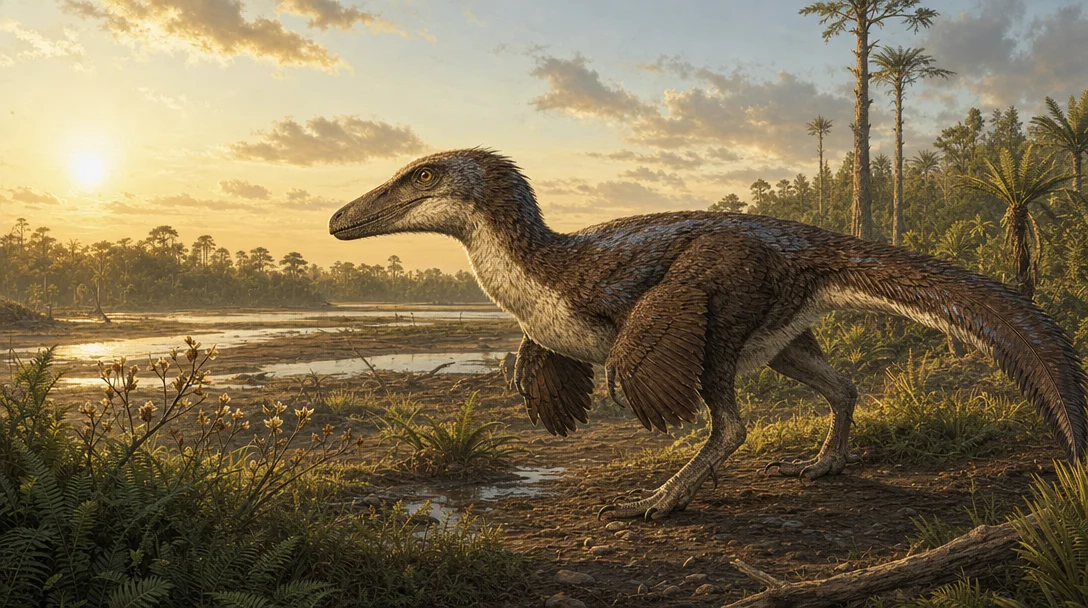
Motta, Rolando, Rozadilla, Agnolín, and nine co-authors from Argentina, Japan, and Italy describe Kank australis Motta et al., 2026 gen. et sp. nov. from the Chorrillo Formation (Maastrichtian, ~66–72 Ma), La Anita farm, El Calafate, Santa Cruz Province, Argentina — one of the southernmost dinosaur-bearing deposits in Patagonia. 1
The holotype (MPM-PV-23106-A) is a single cervicodorasal vertebra found within a roughly 5 m² excavation area called the "Monotreme site." Referred material includes teeth, three pedal phalanges, and a claw from a second locality called "Puma Cave." The body weight is estimated at around 27 kg — comparable to a large dog — placing it among the mid-sized members of Unenlagiidae (the bird-like dromaeosaurid family that includes Buitreraptor, Neuquenraptor, and Rahonavis). 1
Two autapomorphies (unique anatomical features) diagnose the new genus: the cervicodorasal vertebra bears three pneumatic foramina on its ventral surface, and it has a distinct epapophyseal fossa (a pit above the neural spine). Among shared features, the reduced distal condyle on pedal phalanx II — the digit that bore the famous "killing claw" in dromaeosaurids — parallels a morphology seen in troodontids, suggesting convergent functional evolution between the two lineages. 1
The genus name Kank is drawn from Aonikenk mythology — the indigenous people of Patagonia — and refers to an elder figure who created the Choiols, the Aonikenk name for the Southern Cross constellation. The species epithet australis means "from the south." Kank australis is the first named unenlagiid from southern Patagonia; previous records from the Chorrillo Formation were fragmentary and indeterminate. The formation's fauna also includes sauropods, ankylosaurs, iguanodontians, alvarezsaurids, crocodyliformes, and monotremes, all deposited in a meandering-river and swamp environment under a warm, seasonally wet climate. 1
Conservation status: Fossil taxon; not applicable.
Arthropods (22 species, 1 new genus)
Australian brush-footed spiders: a new genus and three species (Zootaxa 5821(2))
Taxonomy (all): Animalia → Arthropoda → Arachnida → Araneae → Mygalomorphae → Barychelidae
Robert J. Raven (Queensland Museum) revises the Australian genus Idiommata in Zootaxa 5821(2): 151–175, splitting off a new genus and describing three new species. 2
- Zidiommata Raven, 2026 gen. nov. — established for four species from eastern Australia that share a defining character absent from Idiommata sensu stricto: intercheliceral pegs (small spine-like projections between the chelicerae). The type species is the previously known Idiommata fusca L. Koch, 1874 (now Z. fusca comb. nov.); Z. iridescens (comb. nov.) is also transferred.
- Zidiommata simonmaraisi Raven, 2026 sp. nov. — eastern Australia; named for Simon Marais.
- Zidiommata steveirwini Raven, 2026 sp. nov. — eastern Australia; named for Steve Irwin, Australia's late "Crocodile Hunter."
- Synothele xintillans Raven, 2026 sp. nov. — South Australia; re-identified from the female paralectotype of Idiommata scintillans, now placed in the long-established genus Synothele Simon, 1908.
Synothele currently contains approximately 20 species distributed across Australia; Zidiommata joins the genus-level taxonomy of Australia's diverse but under-studied brush-footed mygalomorphs. 2
Conservation status: Not assessed (IUCN; all species).
Four new Afrotropical lichen moths, Archithosia (Zootaxa 5821(2))
Taxonomy: Animalia → Arthropoda → Insecta → Lepidoptera → Erebidae → Arctiinae → Lithosiini → Archithosia
Durante, Potenza, and Pellegrino (Museo di Storia naturale del Salento, Italy) describe four new species of Archithosia Birket-Smith — a genus of roughly 20 lichen moths distributed across sub-Saharan Africa — in Zootaxa 5821(2): 176–196. 3 The four new species, named for their type localities, are:
- Archithosia ghanensis Durante & Potenza, 2026 — Ghana
- Archithosia gabonensis Durante & Potenza, 2026 — Gabon
- Archithosia tchibozo Durante & Pellegrino, 2026 — sub-Saharan Africa (specific country not available from abstract)
- Archithosia ugandensis Durante & Pellegrino, 2026 — Uganda
The paper identifies two species groups within the Afrotropical Archithosia using morphological analysis and provides an identification key. A fifth potential new species, close to A. costimacula (Mabille, 1878), was left unnamed due to insufficient material. 3
Conservation status: Not assessed (IUCN; all species).
Two new Himalayan two-pronged bristletails, Diplura (Zootaxa 5821(2))
Taxonomy: Animalia → Arthropoda → Entognatha → Diplura (two species in separate families)
Kar, Mandal, Mazumdar, and colleagues from the Zoological Survey of India (Kolkata) describe two new Diplura species from India in Zootaxa 5821(2): 197–218, supported by COI barcoding and phylogenetic analysis. 4
- Lepidocampa devprayagensis Kar et al., 2026 sp. nov. (Campodeidae) — from Garhwal Himalaya, Uttarakhand, collected in the western Himalayan forest zone.
- Parajapyx sendrai Kar et al., 2026 sp. nov. (Parajapygidae) — from West Bengal. This is only the second Parajapyx species recorded from India, the first having been described 113 years earlier. 4
Diplura (two-pronged bristletails) are soil-dwelling hexapods with no eyes and reduced pigmentation; most species are smaller than a centimeter and are found in leaf litter, soil, and rotting wood. Parajapyx is a predatory genus of about 60 species worldwide.
Conservation status: Not assessed (IUCN; both species).
Paragomphus matroka — a new hooktail dragonfly from Madagascar (Zootaxa 5821(2))
Taxonomy: Animalia → Arthropoda → Insecta → Odonata → Anisoptera → Gomphidae → Paragomphus
Bedjanič, Bernard, Daraż, and Yu describe Paragomphus matroka Bedjanič et al., 2026 from three localities in the eastern Madagascar humid forests, spanning a distance of 1,033 km, in Zootaxa 5821(2): 219–235. 5 The type locality is Iaboakoho, Réserve de Ressources Naturelles de la Forêt Naturelle de Tsitongambarika, Taolagnaro District (24.57840°S, 47.14493°E).
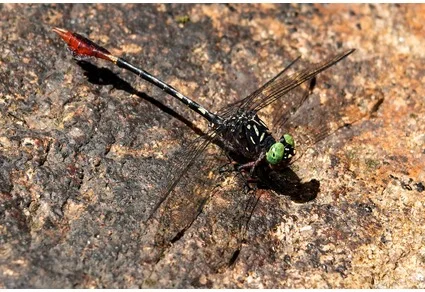
P. matroka is distinguished from its two closest relatives (P. fritillarius and P. sofiae) by darker overall coloration, reduced pale markings on the thorax, and differences in the secondary genitalia. Only three specimens are known, from three widely separated sites — all within the Malagasy humid forest ecoregion. The authors note that the species' limited known range and Madagascar's ongoing forest loss make it potentially eligible for Endangered status under IUCN criteria, though a formal assessment has not been conducted.
Bedjanič et al. write: "The discovery of a new species underlines the need for additional intensive odonatological studies in Madagascar. Improving knowledge of species distributions, taxonomy, phenology and ecological requirements is crucial, especially in the context of threat assessments and conservation of endemic odonate fauna." 5
Conservation status: Not assessed (IUCN); potentially Endangered by distribution criteria.
Further arthropod species (Zootaxa 5821(2))
Six additional species from the same Zootaxa issue round out the arthropod haul:
- Braunilla dasilvae Simões & Waichert, 2026 sp. nov. (Hymenoptera: Pompilidae) — spider wasp from Bahia, Brazil; described by Museu de Zoologia USP and Universidade de Brasília. 6
- Conostigmus concavulus Zhao & Wang, 2026 sp. nov. (Hymenoptera: Megaspilidae) — parasitic wasp from China; from Anhui Normal University and CAS. 7
- Dendrocerus haizhuensis Zhao & Wang, 2026 sp. nov. (Hymenoptera: Megaspilidae) — second parasitic wasp from the same study, China. 7
- Strotarchus adrianae Orozco-Gil et al., 2026 spec. nov. (Araneae: Cheiracanthiidae) — sac spider from Jalisco, Mexico; based on both sexes; from Universidad de Guadalajara and CIBNOR. 8
- Stygioides hecate Japaridze et al., 2026 sp. nov. (Lepidoptera: Cossidae) — carpenter moth from Sultan Dağları Mountains, Konya Province, Turkey; the discovery brings Stygioides to 10 species globally, 3 of them from Turkey; from Agricultural University of Georgia and Finnish Museum of Natural History. 9
- Oligoneura koreana Bae & Suh, 2026 sp. nov. (Diptera: Acroceridae) — small-headed fly from South Korea; from Kyungpook National University. 10
- Simonia lawbah Dutta et al., 2026 sp. nov. (Araneae: Theridiosomatidae) — ray spider from Meghalaya, India; first record of the genus Simonia (previously known only from China and Vietnam) from India; described by the Zoological Survey of India. 11
Conservation status: Not assessed (IUCN; all species).
Two hoverfly species from the Gangetic Plains (European Journal of Taxonomy 1062)
Taxonomy: Animalia → Arthropoda → Insecta → Diptera → Syrphidae → Eristalinae → Eristalinus
Roy, Kar, Naskar, Sengupta, and Banerjee from the Zoological Survey of India (Kolkata) describe two new Eristalinus Rondani, 1845 hoverfly species from West Bengal, India in the open-access European Journal of Taxonomy 1062: 1–33 (CC BY 4.0). 12
- Eristalinus sapphirinus Roy et al., 2026 sp. nov. — distinguished by a striking blue-black body and a strong narrowing of the frons toward the vertex in males; the wing also bears a supplementary vein on vein R4+5.
- Eristalinus brunettii Roy et al., 2026 sp. nov. — initially treated as a color variant of E. polychromata (Brunetti, 1923); confirmed as a distinct species through COI barcoding plus neighbor-joining, maximum likelihood, and Bayesian phylogenetic analyses, supported by both ASAP and ABGD species-delimitation algorithms.
The paper also provides the first description of male genitalia for E. polychromata and an updated key to Indian Eristalinus. 12
Conservation status: Not assessed (IUCN; both species).
Two new planthoppers and a new genus from southwest China (ZooKeys 1280)
Taxonomy: Animalia → Arthropoda → Insecta → Hemiptera → Fulgoromorpha → Derbidae → Breddiniolinae → Cedusini → Dusaceus gen. nov.
Sui, Li, Chen, and Yang (Guizhou University Institute of Entomology) establish Dusaceus Sui, Li & Chen, 2026 gen. nov. in ZooKeys 1280: 349–364 — the fourth genus of tribe Cedusini recorded from China (after Hauptenia, Muiredusa, and Produsa). 13 The genus is defined by a distinctive male genitalia feature: a long, slender process extending from the near-base of the ventral margin of the paramere, projecting well past the midpoint of the ventral margin — not seen in any other Cedusini genus. Two new species are described:
- Dusaceus lvchunensis Sui et al., 2026 sp. nov. (type species) — Lvchun County, Yunnan Province; body length (including forewings) 5.6–6.0 mm; paramere process bifurcated at its apex.
- Dusaceus suiyangensis Sui et al., 2026 sp. nov. — Suiyang County, Guizhou Province; forewing length 4.96 mm; paramere process pointed, not bifurcated.
The authors note that species-level differentiation in Cedusini relies almost entirely on male genitalia, as external morphology varies little among genera. Type specimens are deposited at the Guizhou University Insect Collection (GUGC). 13
Conservation status: Not assessed (IUCN; both species).
Fungi, lichens, and plants (8 new species)
Calocybe kinabaluensis — a cobalt-blue mushroom from Borneo (Phytotaxa 759(3))
Taxonomy: Fungi → Basidiomycota → Agaricomycetes → Agaricales → Lyophyllaceae → Calocybe
Sathiya Seelan, Vizzini, and Shahbaz (Universiti Malaysia Sabah, University of Torino, and University College Sabah Foundation) describe Calocybe kinabaluensis Sathiya Seelan et al., 2026 from the Kinabalu UNESCO Global Geopark, Sabah, northern Borneo, in Phytotaxa 759(3): 227–244. 14 This is the first Calocybe species described from Sabah and highlights the geopark as a significant area for fungal diversity exploration.
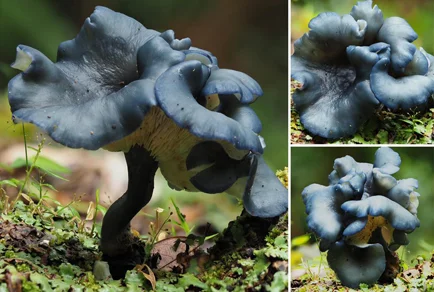
The cap ranges from deep blue to indigo, with an irregularly lobed and wavy margin. The gills are whitish to pale cream and adnate to decurrent. Phylogenetic analysis of ITS and LSU sequences places it as a distinct lineage from its closest relatives C. cyanella and C. longisterigma. The species' vivid coloration — unusual among agarics — and its restricted range within a protected geopark will likely make it a flagship for fungal conservation awareness in Borneo.
Conservation status: Not assessed (IUCN).
Hypoxylon kaiyangense — a fungus from phosphogypsum waste (Phytotaxa 759(3))
Taxonomy: Fungi → Ascomycota → Sordariomycetes → Xylariales → Hypoxylaceae → Hypoxylon
Liu, Li, Jeewon, and nine colleagues from Yunnan Agricultural University, Kunming Institute of Botany (CAS), and partner institutions describe Hypoxylon kaiyangense H.Y. Liu et al., 2026 from the rhizosphere soil of Patrinia scabiosaefolia at a phosphogypsum disposal site in Kaiyang County, Guizhou Province, China, in Phytotaxa 759(3): 201–221. 15 This is the first Hypoxylon species formally described from an industrial phosphogypsum habitat — a calcium sulfate byproduct of phosphoric acid production that accumulates at fertilizer plants across southern China.
Molecular phylogeny of four loci (ITS, LSU, tub2, rpb2) places the new species in Hypoxylon Clade 6, with H. ticinense as its closest relative; nucleotide differences across all four loci confirm it as a distinct species. Its conidiogenous cells are rough-walled with a virgariella-like branching pattern, contrasting with the smooth, pale olivaceous cells of H. ticinense. The holotype is specimen GT4-032. The authors suggest that Hypoxylon fungi from such industrial habitats may hold potential for ecological restoration and bioremediation of phosphogypsum-contaminated land, though no functional testing has yet been conducted. 15
Conservation status: Not assessed (IUCN).
Three lichens from the Qinghai-Tibetan Plateau — and a genus new to China (Phytotaxa 759(3))
Taxonomy: Fungi → Ascomycota → Lecanorales → Ramalinaceae → Thalloidima
Gan and Wang (Kunming Institute of Botany CAS, University of Oslo) describe three new lichen species in Phytotaxa 759(3): 245–260 and simultaneously report the genus Thalloidima as new to China, bringing the global species count for the genus to 21. 16 All three were collected from the Qinghai-Tibetan Plateau and characterized using morphology, chemical spot tests (TLC), and nrDNA ITS phylogenetics:
- Thalloidima lobulatum Yu X. Gan & Xin Y. Wang, 2026 sp. nov.
- Thalloidima qinghaiense Yu X. Gan & Xin Y. Wang, 2026 sp. nov. — epithet from Qinghai Province, where it was collected.
- Thalloidima triseptatum Yu X. Gan & Xin Y. Wang, 2026 sp. nov. — epithet referring to three-septate ascospores, the key diagnostic character.
The paper also adds two previously known species (T. sedifolium and T. squamatum) to the Chinese lichen flora for the first time, and publishes a comprehensive taxonomic key to all 21 Thalloidima species worldwide. 16
Conservation status: Not assessed (IUCN; all species).
Thelenella tropica — a new pyrenocarpal lichen from India (Phytotaxa 759(3))
Taxonomy: Fungi → Ascomycota → Ostropales → Thelenellaceae → Thelenella
Singh, Upreti, and Nayaka from the CSIR–National Botanical Research Institute (Lucknow) describe Thelenella tropica S.P. Singh et al., 2026 from bark in Suhelwa Wildlife Sanctuary, Uttar Pradesh, India, in Phytotaxa 759(3): 222–226. 17 The pyrenocarpal (flask-shaped fruiting body) lichen has muriform, oblong-ellipsoid ascospores (52–65 × 18–23 μm) that are iodine-negative — a key diagnostic reaction. The paper also provides an updated world key to corticolous (bark-dwelling) Thelenella species.
Conservation status: Not assessed (IUCN).
Curcuma phongvui — a wild ginger from Tay Ninh Province, Vietnam (Phytotaxa 759(3))
Taxonomy: Plantae → Zingiberales → Zingiberaceae → Zingiberoideae → Curcuma subgenus Hitcheniopsis
Pham, Bui, and Chen (HUTECH University Ho Chi Minh City, University of Medicine and Pharmacy HCMC, Vietnam Academy of Science and Technology, South China Botanical Garden CAS) describe Curcuma phongvui T.T.D. Pham et al., 2026 from Tay Ninh Province, southern Vietnam, in Phytotaxa 759(3): 287–294. 18
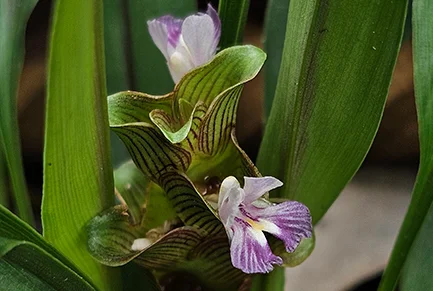
Most closely related to C. prasina (Thailand), C. phongvui is distinguished by branched creeping rhizomes; a green lamina with a deep reddish-purple midrib; green fertile bracts with reddish-purple striations and slightly reflexed tips; spatulate lateral staminodes; and a white labellum with violet stripes and two dark violet lines at the center (pubescent at the base). Vietnam hosts an exceptionally high diversity of Curcuma (the genus containing culinary turmeric), with ~120–150 species recognized globally. The paper includes a preliminary IUCN conservation assessment; the specific category was not publicly available from the abstract.
Conservation status: Under assessment.
Crotalaria phulei — a new rattlepod from central India (Phytotaxa 759(3))
Taxonomy: Plantae → Fabales → Fabaceae → Papilionoideae → Crotalaria section Crotalaria
Chaudhary, Gadpayale, and Somkuwar from Maharashtra colleges describe Crotalaria phulei Chaudhary et al., 2026 from Khairi Butibori–Umred Forest, Nagpur District, Maharashtra, in Phytotaxa 759(3): 295–300. 19 The new species is allied to C. juncea and C. shrirangiana but separable by a unique combination of stipule shape, bract and bracteole characters, calyx morphology, standard petal form, and mottled creamy-olive seeds. India is one of the global diversity centers for Crotalaria (rattlepods), a genus of roughly 700 species worldwide used in folk medicine, green manure, and fiber production. 19
Conservation status: Not assessed (IUCN).
Two new Ophiorrhiza from southern China karst and Guangxi (PhytoKeys 275)
Taxonomy (both): Plantae → Gentianales → Rubiaceae → Ophiorrhiza
Two new species of Ophiorrhiza — a large tropical genus of about 250 species in the coffee family (Rubiaceae) — appeared in PhytoKeys 275 on May 29. 20 21
- Ophiorrhiza xishuiensis Sheng H. Tang, Jia W. Yang & X.Z. He, 2026 sp. nov. — from the Danxia landform of Xishui National Nature Reserve, Guizhou (also distributed in Sichuan and Chongqing); previously misidentified as O. japonica, O. umbricola, or O. chinensis. A perennial herb, 10–20 cm tall, with markedly unequal leaf pairs and white or pale purplish-red tubular-funnel-shaped corollas 9–16 mm long; assessed as Data Deficient (IUCN DD). 20
- Ophiorrhiza bibracteata You Nong & G.Y. Wei, 2026 sp. nov. — from Jinzhongshan Nature Reserve, Longling County, Guangxi (1,715 m elevation); distinguished by two prominent persistent ovate bracts (8–11 × 6–8 mm) that enclose the flower buds — the character behind the epithet bibracteata; assessed as Data Deficient (IUCN DD). 21
Conservation status: Data Deficient (IUCN; both species).
Molluscs: three new genera and two new snail species from Vietnam (ZooKeys 1280)
Taxonomy (all): Animalia → Mollusca → Gastropoda → Stylommatophora → Camaenidae
Páll-Gergely, Gojšina, and Dedov describe three new genera and two new snail species in a single paper on Camaenidae land snails from northern Vietnam in ZooKeys 1280: 365–392. 22 The three new genera are all established on the basis of distinctive reproductive anatomy — a reminder that shell morphology alone often fails to delineate natural groups in Camaenidae.
- Fansipanica Páll-Gergely & Dedov, 2026 gen. nov. — type species: Fansipanica milae Páll-Gergely & Dedov, 2026 sp. nov., from Fansipan summit area, Lào Cai Province (~3,040 m elevation — Vietnam's highest peak, 3,143 m). Shell small (11.9–12.8 mm diameter), spherical, dark brown to pale reddish-brown, thin, hairy-surfaced. The key anatomical distinction: the penis bears a thin penial sheath covering its proximal third — a structure apparently unique within the entire family Camaenidae — and the epiphallus and vas deferens are almost equal in diameter, also unusual in the family. The species is named for Mila Taseva, wife of co-author Dedov. 22
- Vinatachea porcellana Páll-Gergely, 2026 sp. nov. — from Pu Huong Nature Reserve, Nghệ An Province (28 m elevation). Shell large (31.3 mm diameter), thick-walled, high-gloss (the epithet porcellana means "porcelain"), with a complex color pattern of ochre, white, and dark brown bands. Reproductive anatomy is again unusual: a pear-shaped penis with no penial sheath or whip-like flagellum; the epiphallus tapers gradually toward the fertilization pouch duct — the reverse of the usual Camaenidae condition. Provisionally placed in Vinatachea based on shell similarity to the type species; the placement needs confirmation from dissection of Vinatachea type material. 22
- Ducanhia Páll-Gergely, 2026 gen. nov. — established for Helix balansai Morlet, 1886 (not a new species, but a reclassification). Shell large, thin, bright yellow, nearly flat, hairy-surfaced. The genus is defined by an extremely short copulatory duct — unreported in any previously known Southeast Asian Camaenidae — and a sphincter-like zone on the penial sheath. Named for Duc Anh Nguyen, a myriapod specialist and friend of the first author. 22
Conservation status: Not assessed (IUCN; both new species).
Marine invertebrates: 2 chitons and 3 calcareous sponges (WoRMS, May 28)
Five marine invertebrates were registered in the World Register of Marine Species on May 28 — within the collection window — with their primary papers published earlier in May.
Chitons (Polyplacophora): Sirenko and Schwabe (Zoological Institute RAS; Bavarian State Collection of Zoology) simultaneously established the new family Stenosemusidae and described two new species of Stenosemus in Zootaxa 5814(3): 301–338 (DOI: 10.11646/zootaxa.5814.3.1) — a comprehensive revision of the genus in the southern hemisphere: 23 24
- Stenosemus minisulcus Sirenko & Schwabe, 2026 (AphiaID 1893757)
- Stenosemus neozelandicus Sirenko & Schwabe, 2026 (AphiaID 1893758) — name pointing to New Zealand
The revision identifies 17 Stenosemus species from the southern hemisphere overall and suggests the genus has Gondwanan origins. Full morphological details are behind the Zootaxa paywall. 23
Calcareous sponges (Calcarea: Clathrinida): Lopes, Voigt, Wörheide, Pérez, and Klautau described three new hypercalcified calcareous sponges in a phylogenomic study published in the Zoological Journal of the Linnean Society (DOI: 10.1093/zoolinnean/zlag066): 25 26 27
- Murrayona laevis Lopes et al., 2026 (Murrayonidae; AphiaID 1893753)
- Murrayona spinifera Lopes et al., 2026 (Murrayonidae; AphiaID 1893754)
- Lelapiella annularis Lopes et al., 2026 (Lelapiellidae; AphiaID 1893759)
The study's broader finding is that Murrayona and Lelapiella, while each monophyletic, are not closely related — which supports the long-proposed abandonment of the former order Murrayonida as an unnatural grouping. Full location and morphological data are restricted to the OUP paywall. 25
Conservation status: Not assessed (IUCN; all five species).
Cover image: Kank australis gen. et sp. nov. in a Late Cretaceous Patagonian floodplain — AI-generated illustration based on the taxonomic and morphological description in Motta et al. 2026 (Journal of Vertebrate Paleontology, DOI: 10.1080/02724634.2026.2656456). AI-generated illustration.
参考来源
- 1Motta et al. 2026 — Journal of Vertebrate Paleontology
- 2Raven 2026 — Zootaxa 5821(2):151–175
- 3Durante et al. 2026 — Zootaxa 5821(2):176–196
- 4Kar et al. 2026 — Zootaxa 5821(2):197–218
- 5Bedjanič et al. 2026 — Zootaxa 5821(2):219–235
- 6Simões & Waichert 2026 — Zootaxa 5821(2):236–250
- 7Zhao & Wang 2026 — Zootaxa 5821(2):251–262
- 8Orozco-Gil et al. 2026 — Zootaxa 5821(2):263–273
- 9Japaridze et al. 2026 — Zootaxa 5821(2):274–280
- 10Bae & Suh 2026 — Zootaxa 5821(2):281–290
- 11Dutta et al. 2026 — Zootaxa 5821(2):291–300
- 12Roy et al. 2026 — European Journal of Taxonomy 1062:1–33
- 13Sui et al. 2026 — ZooKeys 1280:349–364
- 14Sathiya Seelan et al. 2026 — Phytotaxa 759(3):227–244
- 15Liu et al. 2026 — Phytotaxa 759(3):201–221
- 16Gan & Wang 2026 — Phytotaxa 759(3):245–260
- 17Singh et al. 2026 — Phytotaxa 759(3):222–226
- 18Pham et al. 2026 — Phytotaxa 759(3):287–294
- 19Chaudhary et al. 2026 — Phytotaxa 759(3):295–300
- 20He et al. 2026 — PhytoKeys 275:163–176
- 21Nong et al. 2026 — PhytoKeys 275:151–161
- 22Páll-Gergely et al. 2026 — ZooKeys 1280:365–392
- 23WoRMS — Stenosemus minisulcus, AphiaID 1893757
- 24WoRMS — Stenosemus neozelandicus, AphiaID 1893758
- 25WoRMS — Murrayona laevis, AphiaID 1893753
- 26WoRMS — Murrayona spinifera, AphiaID 1893754
- 27WoRMS — Lelapiella annularis, AphiaID 1893759
围绕这条内容继续补充观点或上下文。