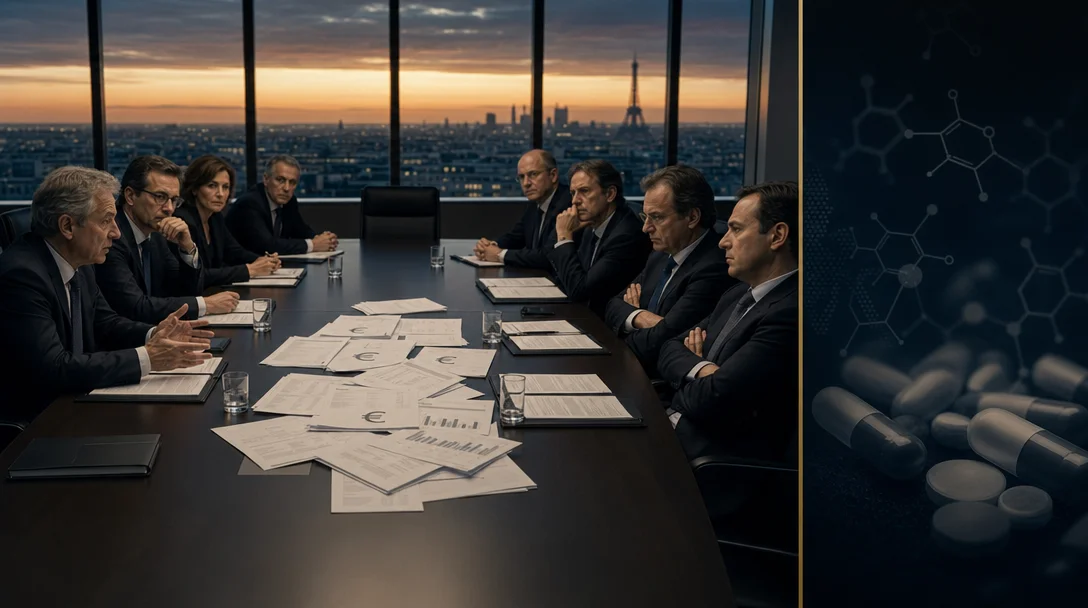

How France turned a hostile takeover into a national champion

How France turned a hostile takeover into a national champion

On January 26, 2004, Sanofi-Synthélabo CEO Jean-François Dehecq launched the first hostile takeover in pharmaceutical history — a €48.5 billion bid for Aventis, a company twice his size. What followed was 90 days of poison pills, a Swiss white knight, two French finance ministers, and a government-orchestrated deal at €55.3 billion that created the world's third-largest pharma company.

On Monday morning, January 26, 2004, Jean-François Dehecq walked into Aventis headquarters bearing an offer the company had not asked for and did not want. Dehecq, who had run Sanofi-Synthélabo since its founding — and before that had spent three decades building its predecessor Sanofi from a subsidiary of the French state oil company Elf Aquitaine — was launching the first hostile takeover in the history of the pharmaceutical industry. 1
The target was roughly twice Sanofi's size. Aventis, formed in 1999 from the merger of France's Rhône-Poulenc and Germany's Hoechst AG, reported annual sales of €16.8 billion and employed about 75,000 people. 2 Sanofi's sales were roughly €8.1 billion. The combined entity would have €25 billion in annual sales and more than 100,000 employees — a scale that Dehecq argued was necessary to survive in a pharmaceutical industry where the top ten companies already controlled 48% of global sales, up from 20% in 1985. 3
The deal Dehecq announced that morning was valued at €48.5 billion ($61 billion) — 81% in Sanofi stock, 19% cash, at €60.43 per Aventis share. 1 Aventis CEO Igor Landau's response was immediate and contemptuous. "We don't need Sanofi," he said, "but they need Aventis."
Ninety days later, Landau had accepted a deal at €55.3 billion and was headed for the exit with a reported $30 million severance package. 4 What happened between January 26 and April 25 — a hostile bid, a poison pill, a Swiss white knight, an intervention by two French finance ministers, and a regulatory ruling that stripped Aventis of its main defensive weapon — is one of the most compressed and politically charged merger negotiations in European business history.
正在加载链接预览…

The parties, the stakes, and what each side actually wanted

Sanofi-SynthélaboAventisNovartis (white knight)French government
Stated objectiveCreate a French pharma leader of global scaleProtect shareholder value; reject undervalued bidExplore merger with Aventis on equal termsSupport a competitive European pharma champion
Hidden preferenceComplete the deal before Plavix patent litigation resolved and before the Total/L'Oréal shareholder pact expired in December 2004Use Novartis as leverage to force Sanofi to raise its price by up to 50%Receive the same French government backing given to Sanofi — knowing this was politically impossibleKeep the deal French; block Swiss ownership of strategic pharma and vaccine assets
BATNAOrganic growth with structural scale disadvantage; face potential acquisition itself after the shareholder pact expiredRemain independent on a weaker standalone trajectory; possible hostile close at the initial low priceWalk away — which is ultimately what happenedAccept a foreign acquisition of a company the government had publicly called strategically vital
Key leverageHigher Sanofi stock valuation; €12 billion credit line from BNP Paribas and Merrill Lynch; Chirac government ties; Total and L'Oréal board support 1Plavix patent risk as a public liability against Sanofi; Novartis as a credible rival bidder; German works council and union opposition; Aventis's vaccine portfolio as a national security asset 5€66.1/share indicative terms (0.9 Novartis share + €35 cash), beating Sanofi's initial offer 5Direct access to both CEOs; ability to delay AMF regulatory decisions; Élysée-Dehecq personal relationship
Key asymmetryDehecq had been considering this acquisition for years and timed it to exploit Sanofi's peak relative valuationAventis's dispersed shareholder base (largest single holder was Kuwait Petroleum Corp at 13.5%) meant no natural blocking coalition 3Novartis was credible as a buyer but politically toxic as a Swiss company acquiring a French assetThe government's legal neutrality was structurally compromised by Dehecq's close personal ties to President Chirac

Why Dehecq moved when he did

The timing was not accidental. Dehecq faced three converging pressures that made January 2004 the optimal window — and made waiting dangerous.
The Plavix clock. Sanofi's most valuable drug, the blood-thinner clopidogrel (sold as Plavix), was generating roughly €1.33 billion in annual sales. 3 Generic manufacturers in Canada and India had filed patent challenges. If Plavix lost its US patent protection — a risk that Aventis would prominently weaponize during the bid war — Sanofi's stock price would fall sharply, making an all-stock offer to Aventis far more expensive. Dehecq needed to use Sanofi's elevated valuation before the patent outcome was known.
The shareholder pact expiry. Total (which had absorbed Elf Aquitaine) held 24.4% of Sanofi; L'Oréal held 19.5%. 3 Both had a shareholder agreement that was due to expire in December 2004. Once it lapsed, Sanofi itself would become a potential acquisition target. Dehecq, in other words, had a narrow window in which he was a potential buyer before he became a potential target.
The industry consolidation logic. Dehecq later told researchers at the University of St. Gallen: "I had a very strong feeling that if we didn't do this deal now then one of our international competitors would have bought either Aventis or Sanofi." 3 That was not a rationalization after the fact. The global pharmaceutical industry in 2004 had undergone a decade of megamergers — Pfizer-Warner-Lambert (2000), Glaxo-SmithKline (2000), Sanofi-Synthélabo itself (1999) — that had compressed a field of dozens into a handful of giants. The average cost of developing a single drug had reached roughly $802 million, with a development cycle exceeding ten years and a high failure rate. 3 Scale was not a luxury; it was a prerequisite for surviving the capital demands of the research pipeline.
At the same time, Dehecq was careful to secure his base before launching. Total and L'Oréal both agreed before the announcement. Sanofi's board approved the deal unanimously on Sunday, January 25. BNP Paribas and Merrill Lynch had committed a €12 billion credit facility. The French government, through Finance Minister Francis Mer, signaled support within 48 hours. 6

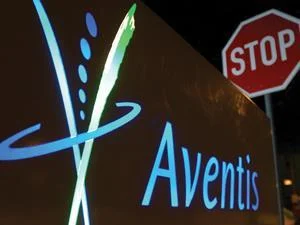
Aventis corporate signage photographed at night alongside a red STOP sign — an image that circulated widely during the hostile bid as a visual shorthand for management's resistance
Aventis's "Stop Sanofi" campaign ran in financial press throughout February 2004. 7
Igor Landau's response was more than rhetorical. Aventis deployed a layered defense across four dimensions simultaneously.
The Plavix poison pill. Aventis proposed issuing warrants to its shareholders tied to Plavix's future revenues. If Sanofi completed the acquisition and Plavix subsequently lost its patent case, Aventis shareholders would receive protection against that value destruction — the exact risk that Dehecq was most reluctant to have priced into the deal. Dehecq threatened to sue, calling the measure a "systematic denigration" of Sanofi's assets. 8 The pill was designed not as a permanent block but as a cost-raising mechanism: if Sanofi wanted the deal, it would have to either increase its price enough to absorb the Plavix risk premium, or accept the warrants as part of the structure.
The board entrenchment. In mid-February 2004, Aventis's supervisory board extended all seven management board members' contracts by three years, through 2007. 9 DZ Bank analyst Peter Spengler called it a textbook defense — the supervisory board was signaling that it would continue resisting and fully supported the incumbent management. The contracts also ensured that if the merger ultimately succeeded, Landau and his colleagues would collect substantial severance.
The legal campaign. Aventis filed suit against Sanofi in both the United States and France, and challenged the Autorité des Marchés Financiers (AMF) — France's securities regulator — over its decision to declare the bid admissible. 10 Aventis ran full-page newspaper advertisements under the headline "Say no to Sanofi's offer," stating: "Sanofi is trying to buy Aventis on the cheap. And they are trying to do it with shares that contain significant downside risk." 5
The Novartis gambit. The most consequential defensive move was inviting Novartis, the Swiss pharmaceutical giant run by CEO Daniel Vasella, to serve as a white knight. Aventis had held exploratory merger talks with Novartis in late 2003 before Sanofi's bid arrived. On March 12, 2004, Novartis publicly confirmed it was analyzing a combination with Aventis — prompted by AMF rules that required disclosure once a potential alternative bid was under consideration. 5 London analysts estimated Novartis was considering terms of roughly 0.9 Novartis shares plus €35 in cash per Aventis share — implying a value of approximately €66.1 per share, well above Sanofi's opening offer. Vasella told French newspaper Le Figaro that Sanofi's price was simply too low.
Landau's public posture throughout February and March was unbending. On February 5, 2004, presenting Aventis's 2003 annual results in London, he told analysts: "In terms of value, [the bid] is ridiculous." 5 He demanded a price increase of up to 50%. Dehecq's response was to threaten litigation, not to move on price. The AMF had declared the bid admissible in early February, calling the offer structure one that "preserves the principle of shareholder equality." 10 Dehecq told reporters: "There is currently absolutely no reason to improve the offer." 10

The French government's hand: from support to orchestration

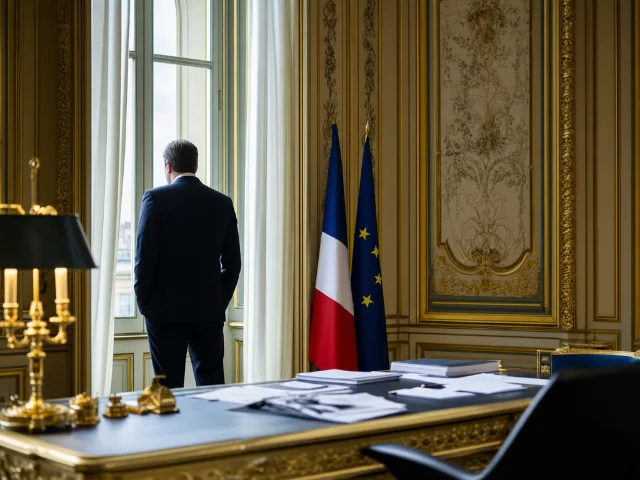
A French government ministry corridor — the kind of formal setting where Finance Minister Nicolas Sarkozy arranged the first direct talks between Dehecq and Landau on April 23, 2004
AI-generated editorial illustration depicting the ministerial setting of the April 23 intervention.
The French government's role in this deal is worth examining with precision, because the official version and the functional reality diverged markedly.
The official version: France was a neutral facilitator that supported a free market outcome between two private companies. Industry Minister Patrick Devedjian told LCI television: "When you watch a football match, you can support one side or the other, but you're not the referee." 11
The functional reality was considerably more directive. Finance Minister Francis Mer publicly endorsed the merger within 48 hours of the January 26 announcement, arguing that France and Europe needed it to compete against American pharmaceutical giants. 6 Prime Minister Jean-Pierre Raffarin went further, framing the deal as a matter of French strategic interest that would "maintain decision-making centers and jobs in France and Europe." 11 In early March, an aide to President Jacques Chirac told Novartis's French operations that a Novartis-Aventis combination was "undesirable." 4 One French government official was blunt about the nationalist calculus: "We are not going to let the Swiss put their hands on something it has taken us years to build." 4
Dehecq, for his part, had a long-standing personal and political relationship with President Chirac — a connection that made the government's stated neutrality structurally implausible. The Thunderbird/ASU case study (TB0105) places Dehecq at his desk on April 22 explicitly reviewing the implications of that political backing. 12
The decisive government intervention came in the deal's final 72 hours. On April 22, 2004, the AMF struck down the key component of Aventis's poison pill defense — the Plavix warrants. On the same day, Novartis publicly announced it was beginning formal merger talks with Aventis, throwing down a direct challenge. 13 The next morning, April 23, newly appointed Finance Minister Nicolas Sarkozy — Mer had been replaced in a cabinet reshuffle — placed separate calls to both Dehecq and Landau and summoned them to the Finance Ministry for their first direct conversation in three months. One French official described the approach afterward: "Our role was to get you around a table. We told the French parties — find a friendly solution among yourselves. We didn't offer any proposal and we didn't make any threats." 13 But a second official confirmed that Sarkozy applied "great pressure" on Dehecq to raise his price. 11
The Novartis threat — real but politically neutralized — had served its purpose: it gave Aventis one last lever to pull, and it gave Sarkozy a reason to intervene.

The final deal: €55.3 billion and a negotiated governance structure

By Sunday, April 25, 2004, the two sides had reached agreement. Sanofi raised its offer to 5 Sanofi shares plus €120 cash for every 1 Aventis share — equivalent to €66.63 per share, or a total deal value of €55.3 billion (approximately $65–65.5 billion). 14 A full-cash alternative was available at €68.93 per share. The final price represented a 14% increase over Sanofi's January opening bid.
Novartis announced its withdrawal the same day. Its statement made no effort to disguise the reason: "Following Aventis' decision to engage in discussions with Sanofi, at the strong intervention of the French government, Novartis decided not to proceed." 11 Novartis noted it had never made a formal offer and that the decision was final.
The governance structure of the new entity — named Sanofi-Aventis — was designed to give Aventis enough dignity in defeat to recommend acceptance to its own shareholders. The 17-member board was split evenly: Sanofi designated 8 directors, Aventis's supervisory board designated 8 directors (including a German representative as vice-chairman), plus Dehecq himself as chairman and CEO. 11 Four board committees — audit, compensation, scientific, and strategy — were structured with equal representation from both sides. All outstanding litigation between the two companies was withdrawn.
Aventis's Supervisory Board Chairman Jürgen Dormann, the former Hoechst CEO who had originally merged Hoechst with Rhône-Poulenc, had argued throughout that "a combination aimed solely at size or synergies is difficult to arrange and implement." 3 The governance structure reflected that concern — at least formally. Landau departed with an estimated $30 million severance package. 4 Dehecq retired as chief executive in 2007, ending a 34-year run at the helm of a company he had helped create from scratch.

Regulatory clearance: EU in eleven areas, FTC in three

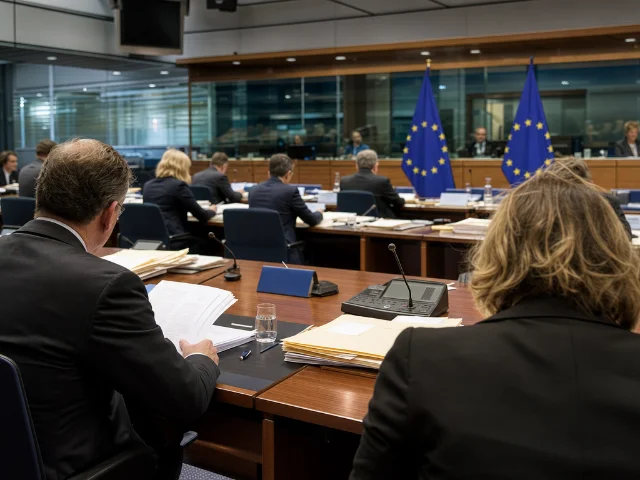
European Commission review proceeding — the Commission cleared COMP/M.3354 in Phase I on April 26, 2004, the day after Aventis's board recommended the deal
AI-generated editorial illustration of a European regulatory hearing.
The regulatory approvals followed the announcement on parallel tracks. The European Commission cleared the deal on April 26, 2004 — the day after the boards agreed — under case COMP/M.3354. 15 The Commission, under Commissioner Stavros Dimas, identified serious competitive doubts in 11 therapeutic areas across EU member states, reviewing 55 overlapping ATC-3 product categories where combined market share exceeded 15%.
The headline EU divestitures: Sanofi committed to sell all development, manufacturing, and commercialization rights to Fraxiparine® and Arixtra® (anticoagulants) on a worldwide basis, including the Notre-Dame de Bondeville manufacturing site in Seine-Maritime, France. 15 It also committed to divest all Campto® (irinotecan, a colorectal cancer treatment) rights under the Yakult Honsha license across all licensed territories.
The FTC cleared the $64 billion transaction on July 28, 2004 (case 041-0031), with a consent order focused on three US-specific overlaps: 16
  • Arixtra® → GlaxoSmithKline: The factor Xa inhibitor anticoagulant market. Sanofi had been in dialogue with the FTC since December 2003 and had pre-committed the Arixtra divestiture to GSK before the deal was announced. 17
  • Camptosar® clinical data → Pfizer: The colorectal cancer drug market, where Sanofi's Eloxatin® and Pfizer's Camptosar® together held over 80% of the US cytotoxic colorectal cancer market with approximately $1 billion in combined annual sales. 18
  • Estorra® → Sepracor: The insomnia drug overlap between Sanofi's Ambien® and Aventis's Estorra® (eszopiclone).
The EU and FTC remedies were complementary. Both required the Arixtra/Fraxiparine and Campto/Camptosar divestitures, but the EU went further on scope (addressing eight additional country-level overlaps in markets ranging from vitamin B12 in France to muscle relaxants in Portugal), while the FTC addressed the distinct Ambien/Estorra insomnia overlap not covered by EU review. 15 18
The merger became legally effective on December 31, 2004. By that point, Sanofi-Aventis held 97.98% of Aventis's share capital. 19 The combined company became the world's third-largest pharmaceutical company, behind Pfizer and GlaxoSmithKline. 7

Did it work?

The integration outperformed the financial targets set at announcement. Sanofi-Aventis's 2004 pro-forma adjusted net sales reached €25.4 billion (+10.0% comparable), adjusted net income reached €5.25 billion (+17.9%), and adjusted earnings per share came in at €3.89 (+18.2%). 20 Cost synergies realized in 2004 were €220 million — 38% above the €160 million promised at the time of the offer. Operating margin rose 2.2 percentage points to 32.1%. The company committed to €960 million in cumulative synergies by end of 2005 and €1.6 billion by end of 2006.
The strategic logic proved out more slowly, via an asset that was not even the headline rationale at the time of the deal. Lantus (insulin glargine), a long-acting insulin developed in Aventis's pipeline, crossed the €1.2 billion revenue threshold in 2006 and reached €3.9 billion by 2011 — making it one of the best-selling drugs in the world. 20 21 At its 2010s peak, Lantus generated approximately $7 billion annually. In 2011, Sanofi applied the deal-structuring lessons of the Aventis acquisition to an even more contentious takeover: the $20.1 billion acquisition of Genzyme, the US rare-disease biotech, which Sanofi ultimately closed by attaching contingent value rights (CVRs) worth up to $14 per share tied to Genzyme's Lemtrada pipeline milestone — a mechanism that bridged the gap between what Sanofi was willing to pay upfront and what Genzyme's shareholders believed the drug was worth. 22
On the other hand, the liabilities Sanofi accepted in the deal were real. Post-merger net debt reached €14.2 billion, making Sanofi-Aventis one of the most leveraged pharmaceutical companies of its size. 20 Total, L'Oréal, and Kuwait Petroleum Corp together held roughly 30% of the combined company's equity — a concentrated ownership structure with uncertain long-term intentions. Plavix's patent exposure remained a live risk: Apotex, a Canadian generics manufacturer, eventually did challenge the US patent successfully enough to compel years of litigation, though Apotex ultimately lost and paid approximately $442 million in damages plus $108 million in interest. 7
Claude Barfield of the American Enterprise Institute, writing shortly after the deal closed, offered the harshest assessment of the long-term picture: "Given the new company's relatively weak drug pipeline and its inefficient sales structure, future market forces may once again defeat the heirs of Richelieu and Mazarin." 4 The verdict on the pipeline proved wrong — Lantus alone vindicated the acquisition. The verdict on structural efficiency was more nuanced: Sanofi eventually became a solid mid-tier pharmaceutical company, but never the European Pfizer that Dehecq had imagined.

Frameworks you can use

Attack as defense: when being smaller is the reason to move first

The core logic of Dehecq's gambit is captured in the UniSG case's title. 3 In a consolidating industry where the top players are continually expanding through acquisition, a mid-tier firm faces an asymmetric choice: either consolidate others while your own valuation supports it, or wait to be consolidated on someone else's terms. Sanofi's €8.1 billion in sales made it too small to be permanently independent in a world where Pfizer had just spent $90 billion on Warner-Lambert and Pharmacia. But Sanofi had unusually high profit margins, two strong drugs (Plavix and Ambien/Myslee), and a window before its own shareholder protections expired.
Application: In any high-consolidation industry (financial services, healthcare, media, logistics), mid-tier players should map their own window: how long does my current valuation support an acquisition of a larger target? When does that window close — due to patent cliff, shareholder pact expiry, competitive entry, or technology disruption? Striking before the window closes is not aggression; it is the correct read of the strategic clock.

White knight negotiation: the rival bid you never intend to accept

Aventis's Novartis strategy was not, at its core, an attempt to find a better owner. It was a negotiating technique. The threat of a higher Novartis bid (at the €66.1 indicative level versus Sanofi's opening €60.43) gave Aventis an external reference point to demand a price increase — without Aventis ever having to actually prefer Novartis as an acquirer. Novartis CEO Vasella understood his own role clearly, publicly examining combinations with "Sanofi or Aventis" rather than making a unilateral commitment to either. 3 The UniSG teaching note frames this precisely: the white knight's mere presence changes the equilibrium, regardless of whether a competing offer is ever formalized.
Application: For any target of an unsolicited bid, the question is not "do I prefer this alternative acquirer?" but "does this alternative acquirer's existence change what the hostile bidder will pay?" The credibility threshold for a white knight is lower than it appears: the rival bidder needs to be plausible and financially capable, not certain. The poison pill and legal challenges buy time for the white knight option to develop — their value is measured in weeks, not permanent blockage.

The poison pill as a bargaining chip, not a shield

Aventis's Plavix warrant structure is a case study in what a well-designed poison pill actually does. It was not designed to prevent the acquisition. It was designed to raise Sanofi's effective cost — by forcing Sanofi to either absorb the Plavix downside risk into its deal math or pay more upfront to compensate Aventis shareholders for accepting that risk. The Thunderbird case study (TB0105) frames the mechanism explicitly as a concession-extraction device: raise the cost high enough that the acquirer is forced to negotiate rather than proceed at the original price. 12
The AMF's April 22 ruling that struck down the pill did not end Aventis's negotiating position — it ended its stalling position, which is not the same thing. Landau still had Novartis. The pill had already served its purpose by anchoring the public debate around Sanofi's Plavix exposure and keeping the deal in limbo for three months while the white knight option developed.
Application: Poison pills work best when they are paired with a credible alternative exit (a white knight, a leveraged buyout, a spin-off) that gives the board a reason beyond obstruction to keep fighting. A pill alone, without a positive alternative narrative, typically fails the "best interests of shareholders" test that boards must satisfy. The Plavix warrants were credible precisely because Plavix's patent exposure was a documented, third-party-verified risk — not a management invention.

National champion politics: when government changes the BATNA table

The Sanofi-Aventis case is the most fully documented modern example of a government redefining the BATNAs in an M&A negotiation by selectively applying political support. The French government's position was structurally simple: it would support a French solution (Sanofi) and would not support a foreign one (Novartis). This was not a formal regulatory block — France had no legal mechanism to block a private-company acquisition in a competitive market. Instead, the government used its influence through informal channels: discouraging the Novartis option through Élysée intermediaries, deploying the "national security" framing around Aventis's vaccine portfolio to signal that a Swiss acquirer would face political friction, and ultimately using the Finance Ministry as a convening authority to end three months of public hostility in a single weekend meeting.
Syed Tariq Anwar's analysis in the Journal of Business & Industrial Marketing places this within a broader French industrial policy tradition: the "national champion" logic treats certain industries as too strategically important for purely market-driven outcomes. 23 James Mittra's academic work adds a darker reading: the synergy rhetoric deployed in pharmaceutical mergers often functions as political cover for decisions that are fundamentally driven by industrial policy rather than commercial logic. 24
Application: In any cross-border deal involving a target in a politically sensitive sector — pharmaceuticals, energy, defense, telecommunications, critical technology — the buyer's BATNA analysis must include a realistic assessment of the target government's preferred outcome and its willingness to mobilize informal pressure to achieve it. A rival bidder's nominal financial advantage can be neutralized entirely by a government that controls access to the regulatory environment, media narrative, and key stakeholder relationships. The question to ask before entering such a negotiation is not just "can I outbid the competition?" but "does the target government want me to win?"

What to remember

  • A hostile bid can be a defensive move. Dehecq launched the offer not out of strength but out of a narrow window: Sanofi's elevated valuation and a shareholder-pact expiry in December 2004 gave him roughly twelve months to be a buyer before he became a target. In consolidating industries, the first-mover advantage in acquisition timing can be the strategic variable that matters most.
  • The white knight's value is probabilistic, not certain. Novartis never made a formal offer. It did not need to. The existence of an indicative €66.1-per-share alternative was sufficient to shift Sanofi's final offer from €60.43 to €66.63. Aventis extracted a 14% price increase from a credible-but-uncommitted rival. The white knight's leverage decays the longer the hostile bid runs — which is why Aventis deployed it alongside legal challenges and the poison pill rather than waiting for Novartis to make the first move.
  • Poison pills are time machines, not vetoes. The Plavix warrants bought Aventis approximately three months — enough time for Novartis to develop its position and for the political environment to shift. When the AMF struck them down on April 22, the pill had already served its purpose. The correct measure of a pill's success is not whether it blocked the deal but whether it changed the deal's terms.
  • When a government declares a deal a matter of "national interest," the BATNA table changes for everyone at the table. France's informal pressure on Novartis — communicated through Élysée aides, not formal regulatory action — was enough to make the Swiss option non-viable. Any cross-border negotiator operating in a sector with industrial-policy significance should map the target government's preferred outcome before calculating whether a higher bid will win.

参考来源

  1. 1NBC News / FT: Sanofi launches hostile bid for Aventis
  2. 2Eurofound: Employees concerned over Sanofi Synthélabo takeover bid for Aventis
  3. 3UniSG IFB-HSG: The Acquisition of Aventis by Sanofi — Attack as Defense
  4. 4AEI: National Champions
  5. 5The Guardian: Novartis may play white knight for Aventis
  6. 6NYT: Talking loudly but carrying a small stick in Paris
  7. 7Chemistry World: Flashback: 2004 — big, big pharma
  8. 8The Guardian: Tone down your rhetoric, Sanofi tells Aventis
  9. 9manager magazin: Aventis — Alle Vorstandsverträge verlängert
  10. 10Les Echos: L'AMF donne son feu vert à l'OPA de Sanofi-Synthélabo
  11. 11NBC News / AP: Aventis accepts sweetened Sanofi bid
  12. 12Thunderbird/ASU: Sanofi-Synthelabo and Aventis — The Birth of a National Champion (A)
  13. 13NYT: France helped broker the Aventis-Sanofi deal
  14. 14MarketWatch: Aventis says 'oui' to Sanofi offer
  15. 15European Commission: Case COMP/M.3354 — Sanofi-Synthélabo/Aventis Decision
  16. 16FTC: Resolving anticompetitive concerns — FTC clears Sanofi-Synthelabo's acquisition of Aventis
  17. 17Cision / Sanofi-Aventis Norge AS: Sanofi-Synthélabo's Offer for Aventis — FTC Second Request
  18. 18Federal Register: Analysis of Proposed Consent Order — Sanofi-Aventis (Vol. 69, No. 152, Aug 9, 2004)
  19. 19SEC EDGAR: Post-Effective Amendment No. 2 to Form F-4 — Sanofi-Aventis (Oct 15, 2004)
  20. 20Sanofi News: Sanofi-Aventis 2004 Results (March 1, 2005)
  21. 21Sanofi News: 2011 Results — benefit from Genzyme acquisition (Feb 8, 2012)
  22. 22Sanofi News: Sanofi-Aventis to acquire Genzyme (Feb 16, 2011)
  23. 23Emerald/JBIM: Creating a national champion or a global pharmaceutical company (Anwar, 2008)
  24. 24Taylor & Francis: Socio-Political Economy of Pharmaceutical Mergers (Mittra, 2006)

围绕这条内容继续补充观点或上下文。

  • 登录后可发表评论。