1/4
Pragya Yoga: Tips & Tricks
Pragya Verma
Adho Mukha Śvānāsana — The Dog That Knows Everything
Adho Mukha Śvānāsana (Downward-Facing Dog) — the full-body reset your spine has been asking for. This 4-card set covers Sanskrit etymology, physical & emotional benefits, age-group guidance for all four groups, a mnemonic trick to lock in the Sanskrit name, and a no-mat desk practice grounded in a Bhagavad Gītā 6.17 quote.
2026/6/4 · 7:07
图集
Every morning, before your dog has had breakfast or thought a single thought, it stretches. Front paws forward, hips high, spine a long diagonal line, heels pressing toward the floor. It does not need a yoga teacher. It does not need a mat. It just does the thing its body is asking for.
Adho Mukha Śvānāsana — Downward-Facing Dog — is one of yoga's most recognised shapes, and also one of its most misunderstood. People treat it as a transition or a resting pose. It is neither. Done fully, it is a whole-body reset: an inversion, a stretch, a strength move, and a breath practice compressed into a single held position.
The name
अधो मुख श्वानासन
Adho Mukha Śvānāsana
Sanskrit roots:
- Adho (अधो) — downward
- Mukha (मुख) — face, mouth
- Śvāna (श्वान) — dog
- Āsana (आसन) — seat, pose
Together: the pose of a downward-facing dog. The name is also a movement instruction. Your face goes down. Your spine follows its own direction. Your feet and hands share the weight.
Card 1 — Cover
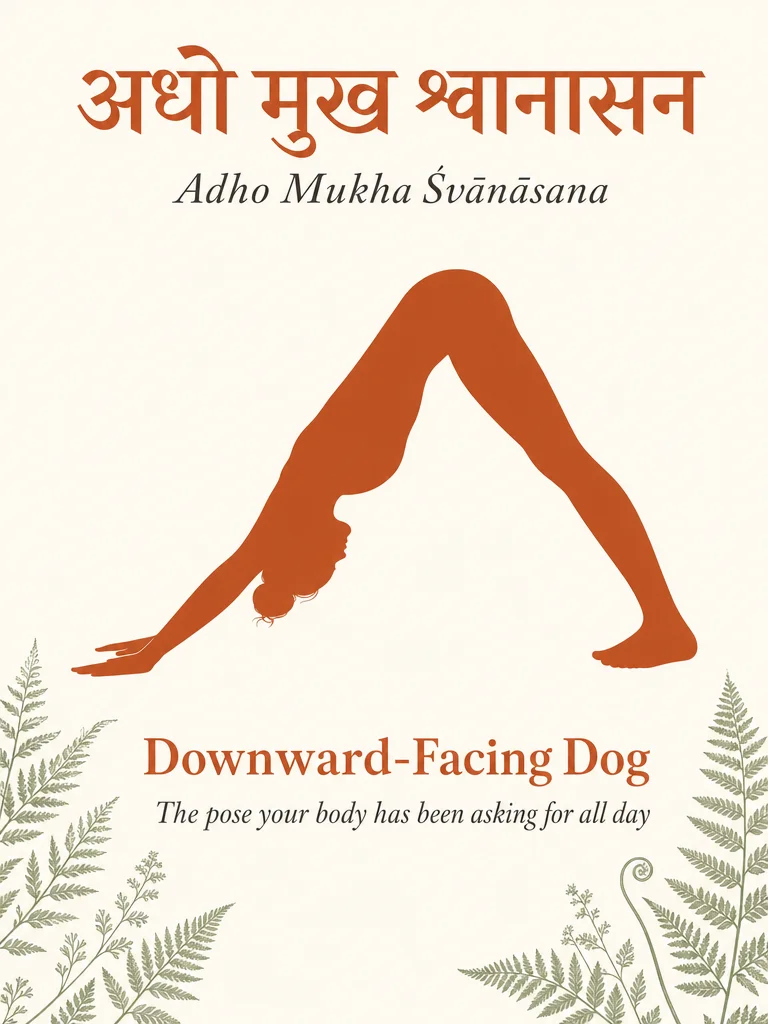
Sanskrit name in Devanagari, the inverted-V silhouette, and a single line: The pose your body has been asking for all day.
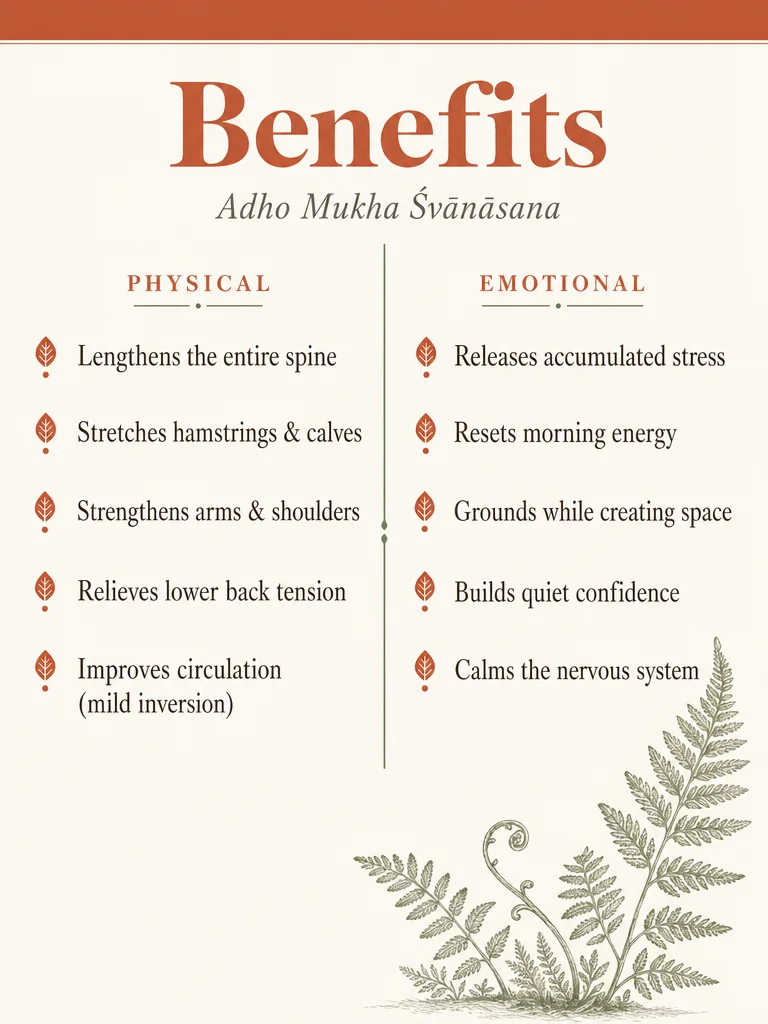
Card 2 — Benefits
Physical
- Lengthens the entire spine, creating space between vertebrae compressed by sitting
- Stretches hamstrings and calves — the two muscle groups most shortened by chairs
- Strengthens arms, shoulders, and upper back
- Relieves lower back tension by decompressing the lumbar region
- Mild inversion improves blood flow to the head and upper body
Emotional and mental
- Releases accumulated stress held in the upper back and neck
- Resets morning (or mid-afternoon) energy without caffeine
- Grounding: weight in both hands and feet simultaneously creates a rare moment of whole-body presence
- Builds quiet, unshowy confidence — the pose asks nothing of you except to stay
- Calms the nervous system through controlled breathing in a stable position
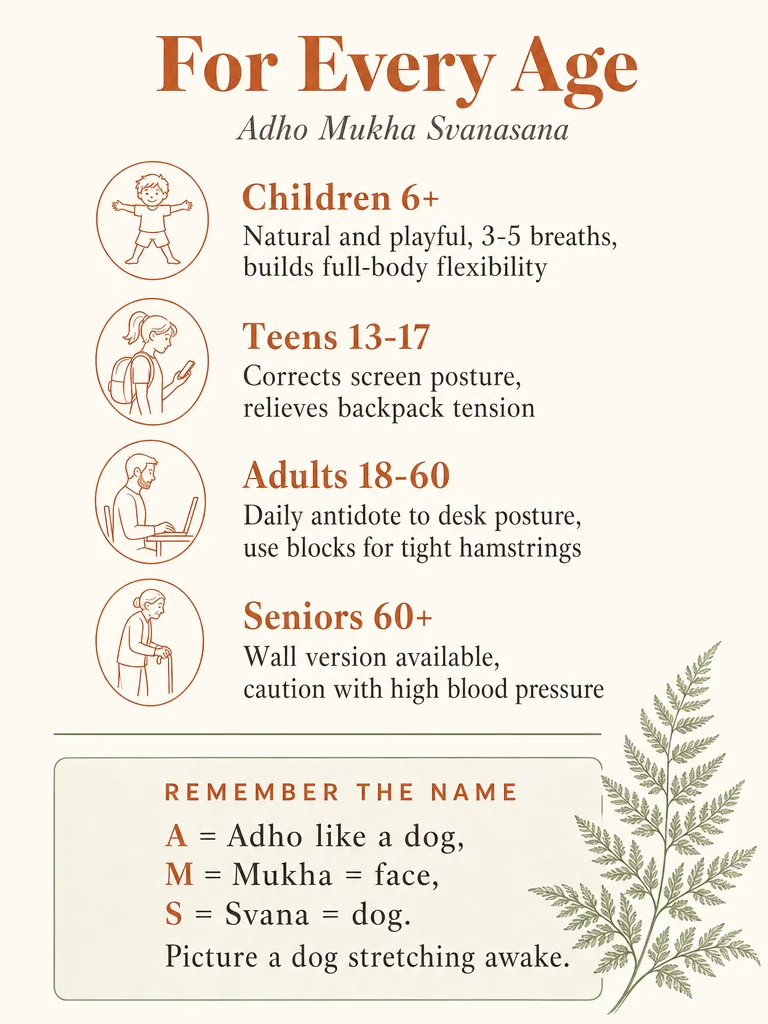
Card 3 — Age-group guidance + mnemonic
Children 6+
Natural and playful. Children often find this pose easy and fun. Encourage 3–5 slow breaths. Good for developing full-body flexibility and coordination. No contraindications for healthy children.
Teens 13–17
Excellent for correcting forward head posture from phone and laptop use. Relieves the tension a heavy school bag puts through the trapezius and neck. Useful as a warm-up before any sport.
Adults 18–60
The daily antidote to desk posture. If hamstrings are very tight, use yoga blocks under the hands to bring the floor closer. Avoid or modify if wrists are injured — try making fists or coming onto the forearms instead.
Seniors 60+
The wall version works just as well: stand facing a wall, place both palms flat at hip height, walk feet back until the body makes an L-shape. Full spine length, none of the wrist load. Caution if you have glaucoma or uncontrolled blood pressure — a head-below-heart position raises pressure momentarily.
Mnemonic to remember the name
A dog → Adho (the A sounds like "a dog")
mukha → face → the dog's face points down
śvāna → dog (śvāna is Sanskrit's word for dog — same ancient root as the English word "hound")
Whenever you forget the name, picture a dog yawning its way out of sleep, front legs stretched, nose to the floor.
Real-world connection
When you get up from a long car journey and instinctively put your hands on the car bonnet, lean forward, and stretch your lower back — you are doing a standing version of this pose. The movement is already in your body. The Sanskrit name is just a label for something you already do.
Card 4 — Sanskrit quote (Bhagavad Gītā) + today's practice
युक्ताहारविहारस्य युक्तचेष्टस्य कर्मसु । युक्तस्वप्नावबोधस्य योगो भवति दुःखहा ॥Yuktāhāra-vihārasya yukta-ceṣṭasya karmasu Yukta-svapnāvabodhasya yogo bhavati duḥkhahā— Bhagavad Gītā 6.17
Meaning: For the person who is balanced in eating, movement, work, sleep and waking, yoga destroys all sorrow.
Kṛṣṇa is not talking about a 90-minute class. He is describing someone whose whole day has a quality of yoking — holding together rather than pulling apart. Adho Mukha Śvānāsana fits inside this vision: a 30-second moment of balance inserted into the middle of an ordinary day.
Today's take-home practice
No mat. No studio. No special clothes.
When you next stand up from your desk or sofa, put both hands flat on the seat edge, walk your feet back until your hips are the highest point, and hold — spine long, tailbone lifting, heels reaching toward the floor — for three full, slow breaths.
That is the pose. That is yoga. That is the Bhagavad Gītā in a 30-second window between one thing and the next.
Adho Mukha Śvānāsana is the fourth post in the Pragya Yoga daily series. Previous posts covered Tāḍāsana (Mountain Pose), Vṛkṣāsana (Tree Pose), and Bālāsana (Child's Pose).
评论